Microchip’s New Touch Controllers Put the Surface to the Test
On October 8, 2026, Microchip announced two turnkey capacitive-touch controllers, the MTCH3380P and MTCH3240P, built for buttons, sliders and wheels in display-free interfaces. The company says both use 12 analog-to-digital converters in parallel and can handle larger sensor counts without the acquisition-time penalties it associates with conventional controllers. That may make a flush, illuminated control panel easier to engineer. It does not make touch the right answer for every control.
For teams designing appliances, outdoor equipment and other consumer products, the more useful question is not whether a controller can read through a cover. It is which jobs deserve a smooth surface—and what the product must do when touch is uncertain.
A chip announcement can change the design brief
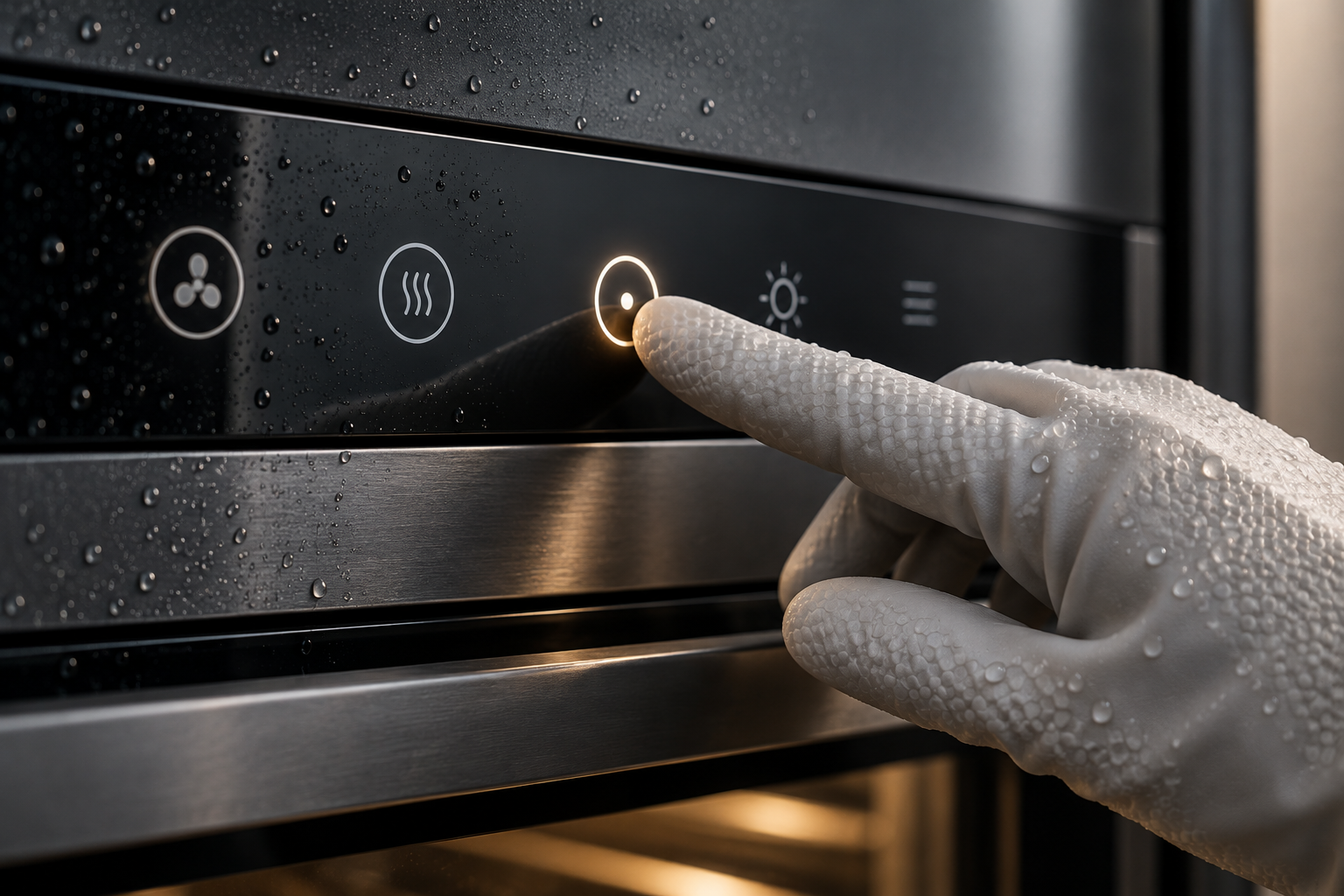
Illustrative design study of gloved use and moisture; not a test of the announced controller.
Microchip lists the MTCH3380P for up to 38 self-capacitance or 64 mutual-capacitance sensors. The MTCH3240P supports up to 24 or 32, respectively. The company also says the parts can detect touch through thick cover materials and when users wear gloves, and can operate up to 105°C. The devices are available at stated starting prices of $1.06 and $0.80 each in 10,000-unit quantities.
Those are supplier specifications and claims, not independent test results for a finished product. Microchip describes support for customer-driven IEC/UL 60730 Class B functional-safety certification; that is not the same as saying a particular appliance or controller is certified. The announcement concerns components and evaluation resources, not a consumer product already shipping with these controls.
The engineering opportunity is clear. A larger sensor array can support more illuminated targets, a continuous slider, or a wheel without putting a display behind every interaction. On a product with a glass or decorated polymer fascia, designers may be able to keep the visible surface visually quiet while still presenting distinct controls when powered.
But “fewer mechanical parts” is only one line in a product cost model. A touch panel still needs sensing electrodes, a cover stack, lighting, firmware, power, calibration, and a method to communicate state. The total result depends on industrial design, electrical integration, manufacturing tolerance, software, validation and service life—not the controller’s unit price alone.
The cover is part of the interface
Microchip’s glove and cover-material claims point to the right prototype question: evaluate the sensing stack as a product assembly. A production cover’s thickness, coating, printed decoration, adhesive, sensor geometry and nearby metal all affect what the user touches and what the electronics must interpret. Moisture, cleaning residue, temperature, electrical noise and grounding can further complicate the interaction.
Those factors should be tested in the actual enclosure, not just on a bare evaluation board. A useful design review can compare multiple cover thicknesses and finishes, wet and dry surfaces, gloved and bare fingers, a range of finger sizes, and likely lighting conditions. It should also examine false activations near seams and edges, and whether the user can tell that an input registered.
A controller’s ability to sense through a material does not establish that the control is legible through it. If icons disappear when unlit, illumination must show what can be operated and where. If a touch changes a setting, the product needs a clear response—an indicator, sound, display, or other feedback—so people do not repeat the action or assume the control failed.
Keep tactile controls where touch adds friction
A smooth panel can be easy to wipe down and can avoid openings around buttons. It can also remove the raised edge, detent and physical travel that help a person locate and operate a control without looking. That trade matters most when a task is repeated, performed with a wet hand, or must be adjusted while attention is elsewhere.
A rotary knob can encode direction and amount through movement. A mechanical button can provide a distinct press. A capacitive wheel may offer a seamless surface and can be lit or reassigned, but it needs a stronger visual and electronic feedback loop. The choice is not a style referendum. It should follow the action’s frequency, risk, context and required precision.
For a high-consequence action, a team may choose a dedicated physical control, a guarded touch region, or a confirmation step. For a low-risk setting adjustment, a touch slider may be appropriate if users can see both the current value and the effect of a change. The interface should make the consequence of an input clear before the user commits.
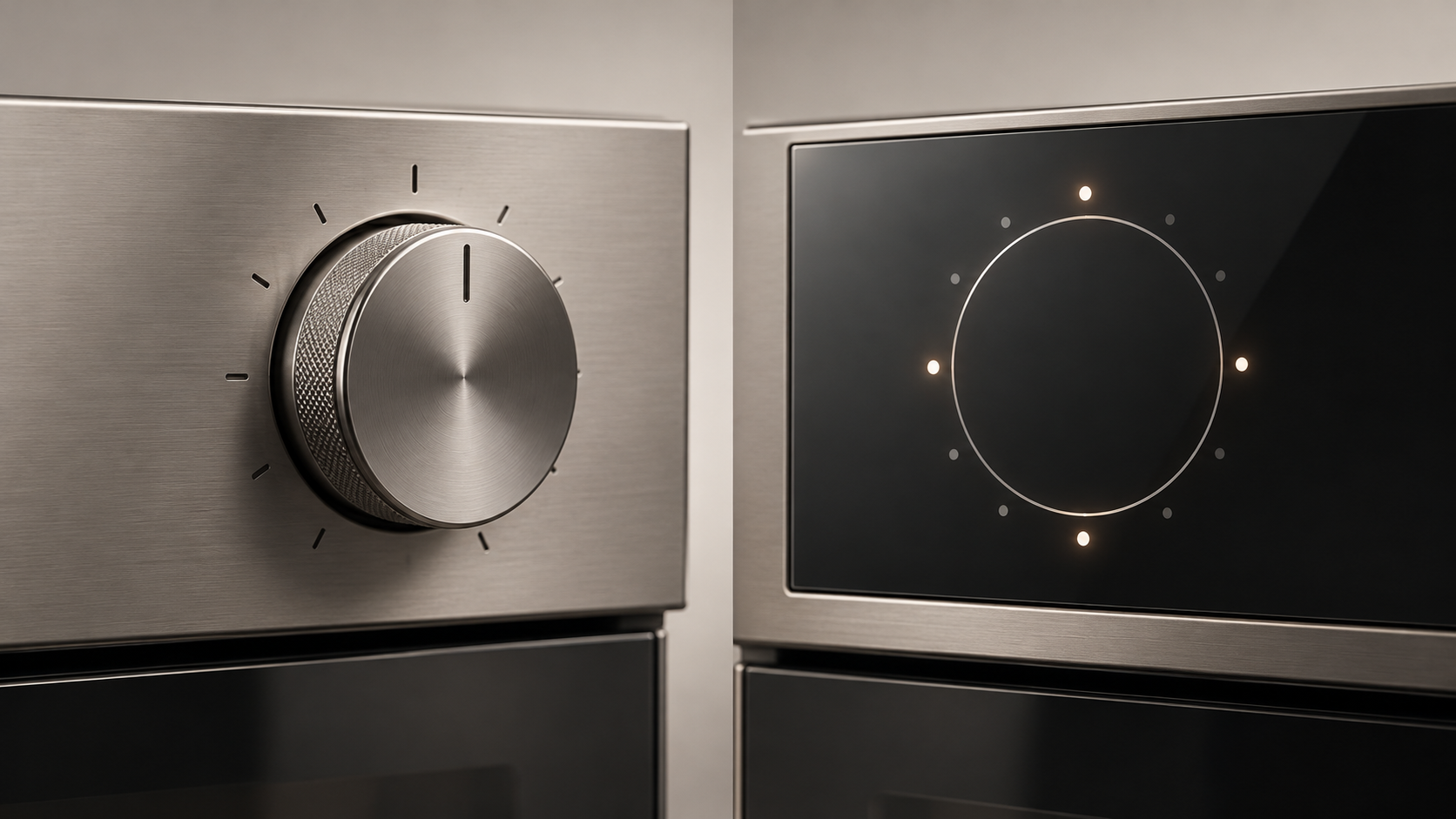
Conceptual illustration comparing a tactile rotary control with an illuminated capacitive touch wheel.
Validate the assembled interaction, not the component promise
Before committing a touch-only fascia, prototype the intended controls in the final geometry and cover stack. Test cleaning, moisture, gloves, temperature and electrical noise representative of the environment. Ask users to find controls without coaching, operate them while looking away when appropriate, and recover from missed or accidental inputs. Confirm that illumination and feedback remain visible at realistic viewing angles and ambient light.
Then compare the touch version with a physical alternative on service access, sealing, assembly, repair and long-term wear. A flush surface may simplify cleaning, while a replaceable switch can be easier to diagnose or service. Those are product-specific tradeoffs, so the design team should measure them in its own use case instead of assuming either approach is universally simpler.
Microchip’s new controllers broaden the options for display-free controls. The design decision still belongs to the product team: make the surface seamless only where the user can reliably understand and trust it. If you are weighing touch against tactile controls in a product concept, Jackson Hedden’s product design and prototyping work can help bring that tradeoff into an early, testable model. Discuss a product challenge.