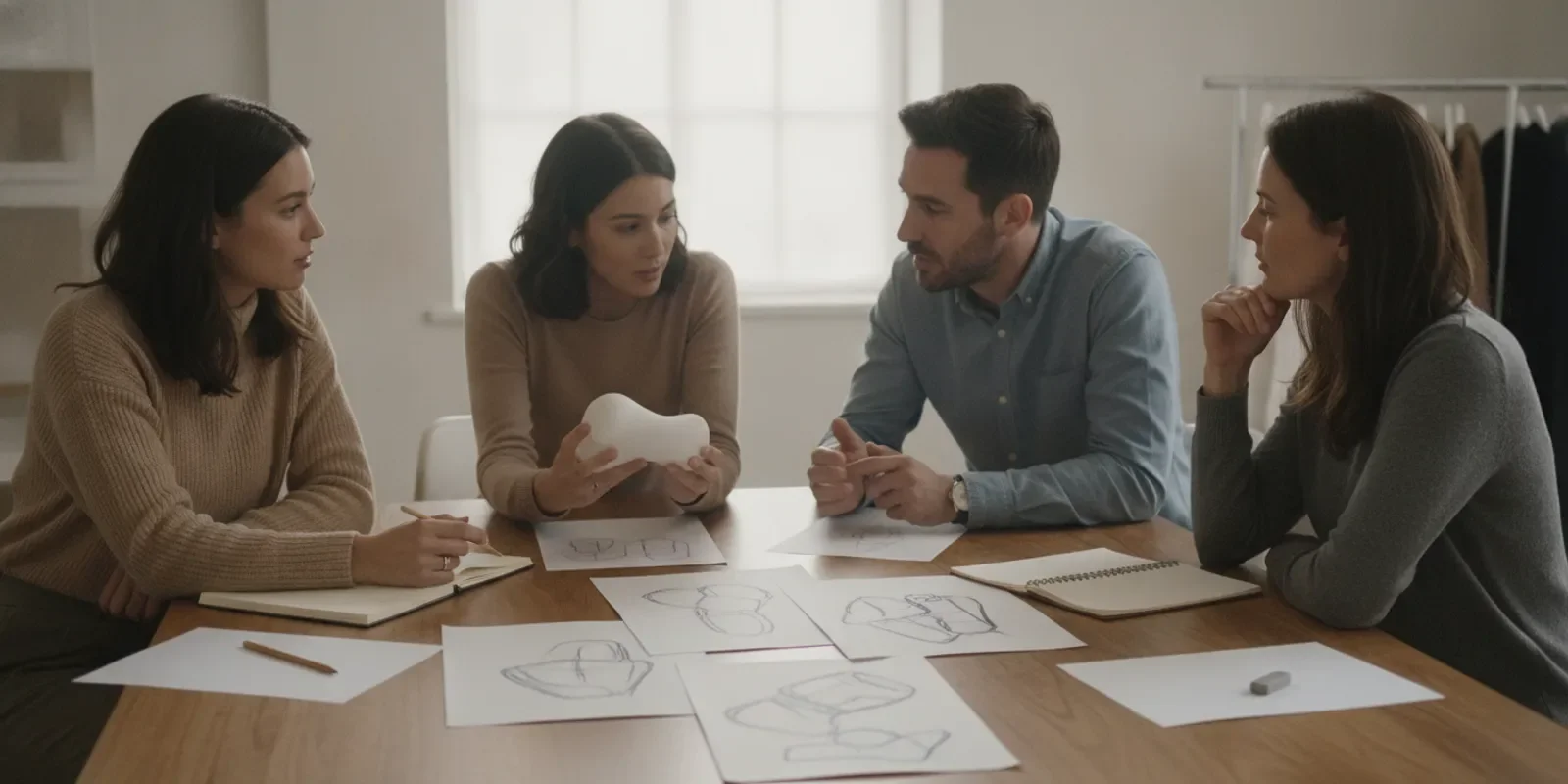
Product design research methods help a team learn whether a physical product concept merits further work before committing to a prototype. Concept testing is not a vote on which sketch looks best. It is a structured way to examine assumptions: who needs the product, what problem it addresses, how people understand it, and what may prevent it from fitting real use. The goal is to choose a sensible next step with evidence, not to prove an idea is already right.
Talk through your product concept
What should concept testing answer before a prototype?
A concept test gives an early read on meaning, relevance, and unresolved risk. It can show whether people recognize the intended use, whether the benefit matters to them, and what questions they raise before touching a product. It cannot confirm that a design will hold up in use, fit its components, meet applicable requirements, or be economical to make. Those questions need later technical evaluation and physical testing.
Write down the decision before choosing a method. âShould we develop a compact countertop device for people with limited storage?â is more actionable than âDo people like our idea?â The first names a user, context, and direction. It also leaves room for findings to challenge the premise.
Concept testing is most useful when a team has several plausible directions, a costly assumption about user behavior, or an idea that is still easy to change. It is less useful when participants are asked to choose between poorly explained alternatives or when a small exploratory study is expected to forecast sales with certainty.
Keep the test question narrow enough to guide the next decision. A team can ask whether a benefit is understood, whether a use situation is relevant, or which of two form directions better fits a particular context. Trying to answer all three, plus likely price, durability, and market size, in one early conversation usually produces broad impressions instead of usable evidence.
How should a team define the test?
Start with a short test brief. It prevents a session from drifting toward general feedback or leading questions. Include the decision, intended audience, assumptions, evidence sought, and the limits of what the test can establish.
Decision: What choice will the findings inform? Examples include selecting a use case, refining a direction, or identifying what needs to be learned before prototyping.
Audience: Whose experience matters? Describe relevant behavior and circumstances rather than relying only on age or job title.
Assumptions: What must be true for the concept to work? Include need, use context, value, form, and practical constraints.
Evidence: What observation would increase or reduce confidence in each assumption? Define useful signals before sessions begin.
Limits: What will this test not establish? State that an early concept review is not proof of demand, safety, technical feasibility, or production readiness.
Imagine a team considering a reusable travel container. Its assumptions might be that people want to carry it daily, can open and clean it easily, and understand how it differs from items they already own. A useful test explores those beliefs rather than asking whether the container is âinnovative.â The brief might say: âWe need to learn whether frequent travelers see a use for this container, understand the opening sequence, and identify a reason to choose it over their current option.â
Keep the concept description consistent across participants. If one person sees a polished rendering and another hears a quick verbal pitch, their reactions are not directly comparable. Record the exact materials, wording, and order shown. If someone asks a question that requires extra explanation, note the clarification; the need for that explanation may itself reveal a communication problem.
Before fieldwork, agree on what the team will do with different possible outcomes. For example, if people understand the use but do not see a meaningful benefit, will the team revisit the intended audience, revise the proposition, or stop? Naming those paths in advance reduces the temptation to reinterpret an inconvenient result after the fact.
Which concepts and materials should be shown?
Show enough information for people to understand the proposition, but do not over-finish a concept so attractive visuals hide unanswered questions. A concept card can include a simple image, a plain-language description, the intended user, and the situation in which the product is used. Do not present speculative features as settled facts.
When comparing options, vary a meaningful choice rather than changing everything at once. For example, compare two ways of carrying a device while keeping its intended user and core benefit constant. If use case, price expectation, features, and appearance all change together, it becomes difficult to tell what drove a response.
Early directions: Rough sketches or simple diagrams can prompt discussion about the problem and possible approaches. Make clear that the direction is exploratory.
Form and interaction: Use a more tangible representation when size, grip, reach, sequence, or spatial fit affects understanding. Explain what the model can and cannot do.
Product in context: Show the likely setting, including relevant accessories or steps, so feedback does not depend on an isolated object.
Stanford Graduate School of Business describes research in which internet-based prototypes predicted consumer choice nearly as accurately as physical ones. That finding supports digital representations for some early choice questions; it does not mean a screen can answer every question about a physical object. Choose the representation to match the uncertainty. Use hands-on models when touch, scale, movement, or physical fit is central. Read the Stanford research on virtual prototypes.
Teams can explore ways to represent and refine a physical idea through prototyping services, while keeping the model appropriate to the question rather than making it more elaborate than necessary. A model intended to prompt discussion about shape does not need to demonstrate a working mechanism. A model meant to reveal how a person grasps or opens the product must make those interactions possible to observe.
Who should participate, and how many sessions are useful?
Recruit people whose experience connects to the intended use. They may be current users, people who recently encountered the problem, or people working in a relevant environment. The right participants depend on the decision. Colleagues can help uncover confusing language, but they are not a substitute for people who face the real problem.
For exploratory concept work, a small set of well-chosen conversations can expose recurring misunderstandings and useful new questions. Do not treat a handful of interviews as a statistically representative survey. If the decision requires an estimate of prevalence or preference across a market, design a separate quantitative study with suitable sampling and analysis.
Recruit across relevant differences in behavior and context. If a product may be used both at home and at work, or by people with different levels of familiarity, include those experiences when they matter. Keep a record of who participated and who was not represented. That limitation belongs in the decision record.
Set inclusion criteria before inviting people. For a kitchen product, a relevant criterion might be that a participant regularly performs the task the product is meant to support. For a workplace device, the team may need people who use the equipment in the actual setting, not just people who have seen similar products. Make the criteria specific enough that another team member could apply them consistently.
Be transparent about the studyâs purpose and avoid implying that a concept is already available or guaranteed to work. Ask neutral questions, give participants time to respond, and listen for their own language. A moderator should not defend the concept when someone is confused.
How can teams ask questions without leading participants?
Begin with current behavior before showing the concept. Ask what participants do today, what is difficult, and what alternatives they use. This establishes context and helps distinguish a real need from a reaction to a persuasive pitch.
After introducing the concept, use open questions and concrete prompts:
âWhat do you think this is for?â
âWhen, if ever, would you use something like this?â
âWhat would you expect to happen next?â
âWhat seems unclear or inconvenient?â
âWhat do you use now instead?â
âWhat would make you hesitate to try it?â
Ask people to explain their reasoning, not just give a rating. If someone says a concept seems useful, ask what situation they have in mind. If they say it is confusing, ask what they expected to see. These follow-ups connect reactions to design implications.
Avoid prompts such as âWouldnât this save you time?â or âHow much do you love this design?â They signal the desired response. Do not ask people to predict what they would buy as the only measure of interest. Stated intentions can be useful context, but they are not the same as observed behavior or a purchase commitment.
Silence is useful. Give a participant time to look at the material before explaining it. If the moderator fills every pause with a description of how the product works, the team may miss that the concept does not communicate on its own. When a participant misunderstands something, ask what led to that interpretation before correcting it.
What should the team observe and record?
Capture evidence in a consistent format. Separate what participants said or did from the teamâs interpretation. âParticipant turned the model over twice and asked where the battery goesâ is an observation. âPeople need a clearer power explanationâ is an interpretation to compare with other sessions.
Comprehension: Can participants explain the productâs purpose in their own words?
Relevance: Does the concept connect to a problem or task they actually encounter?
Use context: Where and when do they imagine using it, and what else is happening?
Interaction: What actions do they expect, and where do they hesitate?
Concerns: What worries them about comfort, maintenance, storage, durability, privacy, or another context-specific issue?
Alternatives: What do they use today, and why might they keep using it?
Uncertainty: Which findings recur, and which are isolated or ambiguous?
Use an evidence log with a row or note for each assumption. Record supporting and contradictory observations, participant context, and confidence. A disagreement is not noise to hide. It may signal that the product serves different situations or that the concept is not clear enough to evaluate.
For example, suppose several people understand a deviceâs purpose but cannot explain how it is powered. The team should not conclude that the whole idea is unwanted. It can mark the purpose assumption as supported, the power explanation as unresolved, and plan a focused follow-up with revised concept material. That separation prevents one confusing detail from obscuring stronger or weaker evidence elsewhere.
Use short, direct notes while the session is fresh. Preserve exact phrases where they reveal how people describe the problem or benefit. Avoid turning a single memorable comment into a general finding. A useful summary distinguishes a repeated pattern, an important outlier, and an open question the method could not resolve.
How should teams compare concepts fairly?
Choose comparison criteria before reviewing reactions. Criteria might include problem relevance, clarity, ease of use, fit with intended context, and unresolved feasibility questions. A serious safety or usability concern may outweigh a modest preference for appearance, so do not assume each criterion deserves equal weight.
When participants see several concepts, rotate the order when practical. The first option can set expectations, while later options can benefit from comparison. Give each direction the same explanation and time. If participants discuss concepts together, record individual reactions before group discussion so one voice does not shape everyone elseâs view.
A comparison is not simply a tally of favorite concepts. Consider why a direction was preferred, whether that reason matters to the productâs purpose, and what trade-offs it introduces. A concept that attracts attention but is misunderstood may need revision rather than selection. A less immediately appealing direction may address a more important need.
Review each direction separately before comparing them:
Strength: What need or use situation does this direction address clearly?
Friction: What is hard to understand, access, carry, clean, or maintain?
Trade-off: What benefit appears to come at the cost of another requirement?
Open question: What cannot be answered from the current concept material?
This prevents an attractive feature from dominating the discussion before the team has checked the basics. For decisions that connect user research to broader product choices, teams can review product design services to see how research, design choices, and practical development considerations may connect across a project.
Imagine two concepts for a portable light. Participants favor the smaller option, but several cannot see how it would stand upright on an uneven surface. The larger option is less convenient to carry but is immediately understood. Instead of treating the preference count as a verdict, record portability and stable placement as separate criteria. The next step could test whether a revised base resolves the smaller conceptâs main concern.
How should findings change the next build?
Translate each important finding into a decision or a testable question. If people consistently misunderstand the benefit, revise the explanation or concept and test comprehension again. If the idea is relevant but interaction is uncertain, create a model that makes that interaction observable. If a key assumption remains unsupported, investigate it before committing to a detailed build.
Use four possible outcomes:
Proceed: Evidence supports the core proposition well enough to explore the next set of risks.
Revise: The need appears relevant, but the concept, interaction, or communication needs another iteration.
Investigate: Important evidence is missing or contradictory; conduct focused research before choosing a direction.
Pause: The central problem or intended use is not supported strongly enough to justify further investment now.>
These are project decisions, not claims that a product will succeed or fail in the market. Pair a positive concept signal with the next unanswered question. That might involve evaluating dimensions, testing a sequence of use, exploring material choices, or checking production constraints. The next model should answer that question, not merely look more finished.
As a practical example, a team may find that participants recognize a need for a compact kitchen tool, but cannot tell how its parts separate for cleaning. A sensible decision is not necessarily âgoâ or âstop.â The team can proceed to an interaction-focused model, observe how people interpret the separation steps, and keep cleaning access as a named risk until that evidence exists.
For another example, imagine a personal-care product concept tested with people who currently use a different method. Participants may understand the proposed benefit but question whether the product will fit in a small bathroom. The team should record that this test measured concept relevance, not actual storage fit. A simple scale model or measurement exercise can address the physical question more directly.
As a team moves from a preferred direction toward production considerations, a review of relevant product work can provide context about the range of physical-product challenges and outcomes. Keep examples as inspiration, not proof that a new concept will have the same result.
What belongs in a concept test decision record?
Keep the record concise enough for a team to use, but complete enough that someone who missed the sessions can understand the decision. Capture:
Project name, date, facilitator, and the decision under review.
Concept versions shown, including images, descriptions, and presentation order.
Research question, assumptions, participant profile, and recruitment limits.
Method, session format, and any important changes made during the study.
Key observations, separated from interpretations and recommendations.
Evidence for and against each assumption, including unresolved differences.
Known limitations, unanswered questions, and confidence in the findings.
Decisionâproceed, revise, investigate, or pauseâwith a brief rationale.
Next action, owner, and the evidence needed before the next decision.
For example, a record might state: âProceed to a simple interaction model. Participants understood the intended use and described situations where the problem occurs, but opening the proposed container was unclear. This study did not assess durability or willingness to pay. Next, model the opening action and observe use with participants who have limited hand strength.â The statement is specific, bounded, and tied to a next test.
Make the record useful for people who were not in the room. Label evidence and interpretation separately, preserve dissenting observations, and avoid turning a tentative pattern into a universal claim. If the team changes the concept after sessions, save the version tested and document what changed. Otherwise, later decisions may be attached to evidence from a different proposition.
Write the decision summary in plain language. A useful record states what the team learned, what it did not learn, why the decision follows from that evidence, and who owns the next action. Avoid vague conclusions such as âusers responded well.â Name the response: Did participants understand the purpose? Did they describe a real situation? Did they identify a concern that changes the next step?
Which mistakes weaken concept testing?
Testing an attractive rendering instead of the underlying idea: Visual polish can draw attention away from unclear use or unmet needs.
Asking for approval: âDo you like it?â invites politeness and gives little direction for change.
Changing too many things at once: The team cannot tell which change drove a response.
Recruiting only convenient participants: Findings may reflect the teamâs network rather than the intended audience.
Calling a small qualitative study proof of market demand: Exploratory conversations identify themes and questions; they do not estimate a whole market by themselves.
Ignoring negative or mixed findings: Contradictory responses may expose distinct contexts or an unclear proposition.
Building before naming the uncertainty: More detail does not automatically create more useful evidence.
Failing to record limitations: A decision becomes hard to interpret when its evidence and boundaries are forgotten.
Concept testing works best as part of a learning sequence. Early research clarifies the problem and proposition; later models test physical interactions and constraints. A team can invest in more detail as the questions become more concrete. Where the team needs to explore a physical representation, rapid prototyping options can help frame the next model around the evidence needed.
How can a team plan a focused concept test?
A short plan makes the work easier to repeat and compare. Start with one primary question, then arrange the session so each part produces evidence relevant to that question.
Write the decision in one sentence. Name the choice at hand, such as whether to explore one use case or revise the concept before a model is made.
Choose the riskiest assumptions. Avoid trying to test every possible product attribute in one conversation. Select assumptions that could change the next action.
Prepare neutral materials. Use consistent language and enough visual detail to explain the concept, without implying that untested features are final.
Recruit for experience. Identify the behavior or context that qualifies someone. Note gaps in who you could reach.
Run a short practice session. Check whether instructions are clear and whether questions lead participants toward a preferred answer. Adjust the guide before the main sessions.
Review evidence before recommendations. Summarize what people did and said first. Then identify patterns, contradictions, and implications for the next step.
Close with an owner and action. Assign who will resolve the next uncertainty and what evidence will count as useful.
Suppose the question is whether a compact travel product is understandable when presented without a spoken explanation. Show the same concept card to each participant, first ask what they think it is, then ask how and where they might use it. If people repeatedly need a moderatorâs explanation, the finding points toward a communication or concept-clarity issue. It does not, by itself, establish whether the product would be purchased.
Keep the test narrow enough to interpret. If discussion uncovers a new issueâsuch as cleaning, storage, or compatibilityârecord it as a follow-up rather than changing the session for each participant. A consistent method helps the team tell whether a pattern recurs.
How do concept testing and prototype testing differ?
Concept testing examines the proposition and its meaning: whether people recognize the problem, understand the proposed benefit, and see a plausible place for the product in their lives. A prototype test examines a representationâs physical or functional qualities, such as fit, reach, sequence, or operation. The boundary depends on what the model can actually demonstrate.
A sketch may be enough to explore whether a product category makes sense. A rough physical model may be needed to learn whether a handle is reachable or whether an object fits in a bag. A working model may be necessary for questions about an operating sequence. Do not treat feedback on one representation as evidence about qualities it cannot show.
This distinction also prevents premature certainty. A concept may be compelling but physically awkward; a model may be easy to handle while the underlying need remains weak. Tie each test to a decision and interpret it within its limits. Teams can explore the next stage through rapid prototyping when a physical question requires a physical representation.
Book a product design conversation
Frequently Asked Questions
Is concept testing the same as prototype testing?
No. Concept testing looks at whether people understand and find relevance in an early proposition. Prototype testing investigates questions about a physical representation, such as fit, interaction, or function. The right boundary depends on what the model can demonstrate.
Can a digital concept test replace a physical model?
Sometimes, if the question concerns comprehension or broad preference and the digital materials communicate the idea clearly. A physical model is more appropriate when scale, grip, movement, spatial fit, or tactile qualities affect the answer.
Should a team choose the most popular concept?
Not automatically. Popularity is one signal. Compare it with the productâs purpose, the reasons behind reactions, the clarity of the concept, and important risks that remain unresolved.
How many participants do we need?
There is no universal number for every decision. Exploratory research can use a small, carefully selected group to identify themes, but it should not be presented as a representative estimate of market preference. The sampling plan should match the decision and the claims the team intends to make.
When should the team stop concept testing?
Stop when the team has enough evidence to make the next bounded decision, not when every uncertainty has disappeared. Record what remains unknown and design the next research or model around those questions.
A clear concept test does not guarantee a successful product; it helps a team understand what it knows, what it still needs to learn, and what kind of next step is justified.
