On November 23, 2026, Lausanne robotics hardware startup coprod announced a $6 million pre-seed round to bring a family of plug-together robot modules to market and to build a hardware prototyping facility in Lausanne (coprod).
Key takeaways
- Integration is often the slowest part of hardware development. coprod's pitch targets "integration hell," the months or years spent making sensors, motor controllers, power and batteries from different vendors work together.
- Standard interfaces trade flexibility for speed. One bus, one clock and one software interface can shorten early iteration, but they also set limits a product team has to design within.
- Fast prototype loops depend on owning the workshop. coprod says its planned in-house facility will cut development cycles from two weeks to 24 hours.
- Module platforms help most before the design is frozen. For production hardware, cost, enclosure, certification and supply decisions still have to be made product by product.
What coprod announced
According to coprod's announcement and coverage by EU-Startups (November 23, 2026) and European Startup Insider (November 24, 2026), the reported facts are:
- Funding: a $6M (about EUR 5.45M) pre-seed round led by Founderful and PROTOTYPE, with General Catalyst, Pace Ventures, Kima Ventures and others participating, plus angels including Hugging Face founder Thomas Wolf.
- Product: "co:products," a family of compatible modules for sensing (co:sense), motion (co:act/co:motion), power (co:power) and batteries (co:battery), tied together by the co:system platform. The modules share a single real-time EtherCAT network (an industrial Ethernet protocol built for deterministic, low-latency control) and one C++ and Python programming interface.
- Status: the components already run in several Swiss robots, including a student-built humanoid from the ETH Robotics Club. coprod says it is validating prototypes with integrators and labs before market launch early next year; European Startup Insider reports an IMU (inertial measurement unit, the sensor that tracks orientation and motion) is the first part open for pre-order.
- Claims: coprod says custom task-specific robot hardware normally takes two to three years and dozens of specialist engineers, and that on its stack a small team can do it in a few months at $5,000 to $25,000 per design iteration. These are the company's own estimates.
- Facility and production: funds go to a Lausanne workshop with CNC lathes, mills, lasers and electronics assembly and test equipment, which coprod says will cut its development cycles from two weeks to 24 hours and support datasheets and digital-twin models for each component. It plans the full component line qualified, certified and packaged by the end of 2027, with volume production in Shenzhen and Texas.
We have not tested coprod hardware. Everything below the next heading is Jackson Hedden analysis, not a description of coprod's internal engineering.
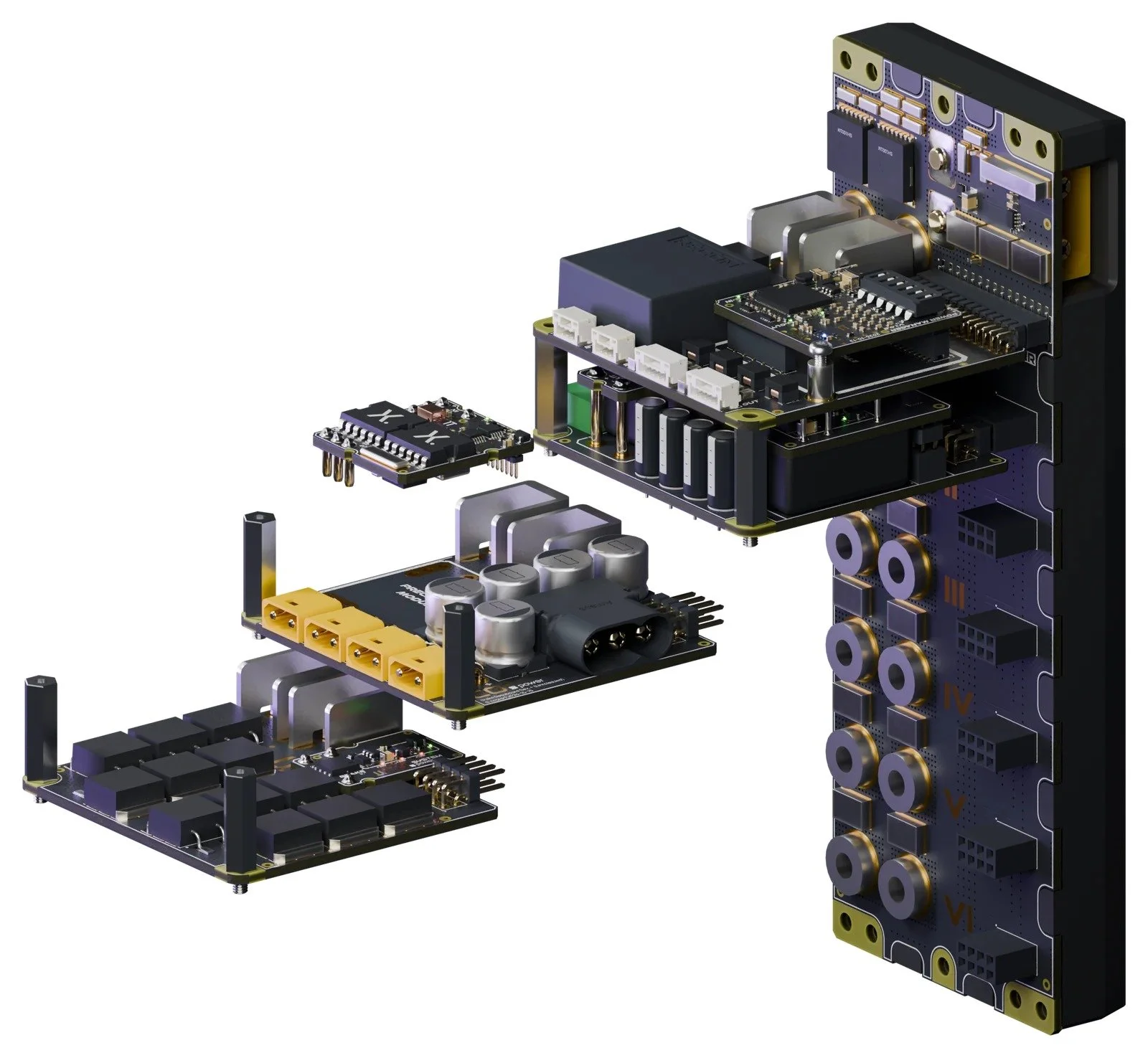
coprod’s co:power modular power stack, shown exploded. Image: coprod
Why integration eats hardware schedules
Integration is the work of making separately designed parts behave as one system: matching connectors and voltages, agreeing on communication protocols, synchronizing timing, managing heat and electrical noise, and debugging the failures that only appear when everything runs together. Each component can pass its own bench test and still fail in the assembly.
Robots are an extreme case because they combine every hard discipline at once: motion control, power electronics, batteries, sensing, structures and software that must react within milliseconds. But the same pattern shows up in ordinary consumer and industrial products. A smart appliance that pairs a motor driver from one vendor, a radio module from another and a battery management board from a third often spends more engineering time on the seams than on the parts.
That is why coprod's approach is worth watching beyond robotics. Instead of supporting many protocols "in the hope of suiting any integrator," as the company puts it, it fixes one network, one timing model and one software interface across every module. Constraining the interfaces is what makes the parts interchangeable.
Modules versus custom hardware: the tradeoffs
From the perspective of a product design firm, a standardized module stack is a tool with a clear sweet spot and clear limits.
Where modules win:
- Early prototypes and research rigs, where the goal is to learn whether a mechanism, gait or control strategy works, not to hit a unit cost.
- Low-volume or task-specific machines such as lab automation, inspection robots or industrial fixtures, where engineering hours dominate the cost.
- Teams with strong software and controls talent but little power-electronics depth, who would otherwise spend their first year rebuilding solved problems.
Where custom design still wins:
- Cost at volume. A connectorized, general-purpose module carries housings, connectors and capability a specific product may not need. At thousands of units per year, consolidating electronics onto purpose-built boards usually pays back.
- Packaging and industrial design. Consumer and commercial products live or die on size, weight, sealing, thermal paths and appearance. Modules arrive with fixed footprints and mounting patterns that the enclosure has to work around.
- Certification and supply control. Every safety, EMC (electromagnetic compatibility) and battery test is run on the final product. A module that is pre-qualified helps, but the full system still has to pass, and you are tied to one supplier's roadmap and lead times.
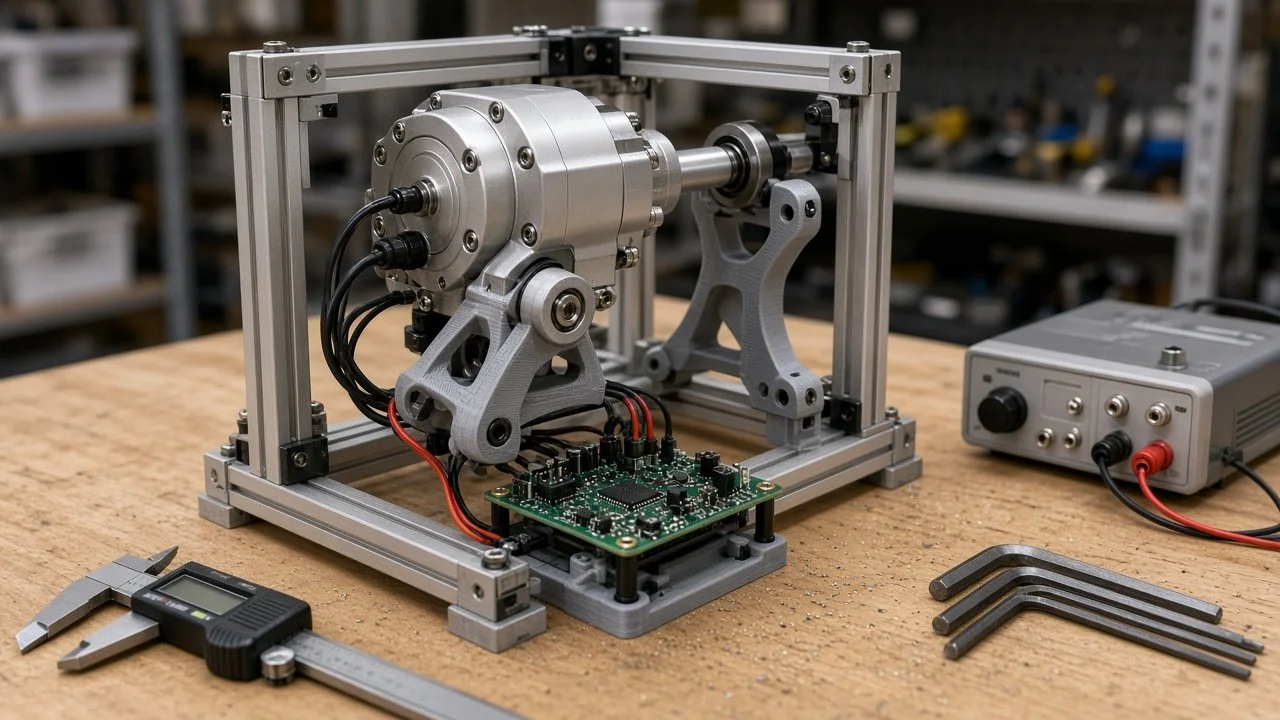
Concept render (illustration) of a generic actuator test rig, not coprod hardware.
What this means for product teams
The practical lesson is not "use modules" or "build everything custom." It is to decide deliberately where each part of your product sits on that spectrum, and when it should move.
- Map your interfaces before you pick parts. List every electrical, data, mechanical and thermal connection between subsystems. The ones with the most unknowns are where integration time will go, so prototype those first.
- Use off-the-shelf or modular hardware to buy learning. In the early prototyping phase, the goal is answering questions quickly. Spending months on a custom motor controller before proving the mechanism is a common way to burn a seed round.
- Plan the transition to production hardware. Engineering validation (EVT) and design validation (DVT) builds are where designs move from proof-of-concept parts toward production-intent electronics, tooling and enclosures. Decide early which modules will be replaced and which will ship.
- Invest in fast iteration loops. coprod's emphasis on an in-house workshop reflects a general truth: teams that can machine, print, assemble and test in a day learn several times faster than teams waiting on outside vendors. Our recent look at the Bambu Lab P3C tool changer covers how desktop equipment is compressing that loop, and our prototyping services page explains how we structure prototype rounds.
- Treat vendor claims as hypotheses. Cost-per-iteration and timeline figures from any platform supplier are starting points. Validate them against your own requirements, volumes and certification path.
When you evaluate outside partners, ask how they handle this hand-off. A good product design firm should be comfortable starting on modules or development kits, and equally able to tell you when it is time to design custom boards, molded housings and a production-ready assembly.
FAQ
What is coprod? coprod is a Lausanne, Switzerland startup founded in late 2024 by EPFL graduates. It builds compatible robot hardware modules for sensing, motion, power and batteries that share one EtherCAT network and one C++/Python interface, and announced a $6M pre-seed round on November 23, 2026.
What is "integration hell" in hardware development? It is the phase where separately sourced components have to be made to work together: reading datasheets, matching protocols and voltages, and debugging interface failures. In robotics and complex electronics it can take longer than designing the individual parts.
Should a hardware startup build on modular components or custom electronics? Modules usually make sense for early prototypes and low-volume products, where speed of learning matters more than unit cost. Custom electronics usually win once volumes, enclosure size, cost targets and certification requirements are clear.
How can a product design firm help with robotics or electromechanical products? A product design firm can map system interfaces, choose where to use off-the-shelf parts, run fast prototype iterations, and carry the design through EVT, DVT, tooling and production. The value is in managing the transition from proof of concept to a manufacturable product.
Work with us
Building a robot, machine or electromechanical product and deciding what to prototype, buy or design custom? See how we approach industrial and product design from early prototypes through production, or contact us to talk through your project.
Jackson Hedden is a product design, development and manufacturing firm helping founders and product teams take consumer and industrial products from concept to production.
Sources
- coprod, "coprod raises $6M to make robot hardware as easy to build as software," November 23, 2026: https://coprod.co/blog/pre-seed-round
- EU-Startups, "Swiss startup coprod raises EUR 5.45 million to solve 'integration hell' in robotics and physical AI hardware," November 23, 2026: https://www.eu-startups.com/2026/11/swiss-startup-coprod-raises-e5-45-million-to-solve-integration-hell-in-robotics-and-physical-ai-hardware/
- European Startup Insider, "Lausanne's coprod makes robot modules that share one EtherCAT bus and one API," November 24, 2026: https://europeanstartupinsider.com/articles/lausanne-s-coprod-makes-robot-modules-that-share-one-ethercat-bus-and-one-api