On November 24, 2026, Tetra Pak announced the launch of Tetra Reva, a square, paper-based carton for spoonable foods such as yoghurt, desserts and soft cheese, which the company calls a world first (Tetra Pak).
Key takeaways
- Tetra Reva replaces the round plastic pot with a square paper-based cup. It opens fully at the top with a pull ring, so people can eat straight from the carton with a spoon.
- The engineering is in the details. Barrier performance, opening force, stacking strength and filling-line fit decide whether a fiber package works.
- Shape is a logistics decision as much as a branding one. Tetra Pak says the square format allows up to 57% more units per pallet, based on its own calculation for one customer case.
- Recyclability claims need their conditions attached. Tetra Pak describes the carton as fully recyclable only where collection and recycling infrastructure is in place.
- Packaging has to be manufacturable, too. A new package succeeds only if it runs reliably on a filling line at production speed.
What Tetra Pak announced
According to Tetra Pak's press release and product page, with coverage by Packaging Europe (November 24, 2026) and Packaging Dive (November 6, 2026), the reported facts are:
- Product: a paper-based package designed for spoonable foods, including yoghurt, puddings, desserts, plant-based alternatives and soft cheeses such as cottage cheese, ricotta and mascarpone. Packaging Dive describes it as made primarily from paperboard with a plastic pull ring.
- Opening and lid: a full-top opening lets consumers eat directly from the carton, and a compact lid is meant for home or on-the-go use. Tetra Pak says the pull ring opens the lid "in one satisfying movement" and contrasts it with conventional foil lids, "which can be difficult to grip and may tear during opening." The product page also lists tethered and untethered lid options.
- Shape: a square format meant to stand out next to round pots and give more room for branding. The product page cites up to 57% more units per pallet, an internal calculation from one South European customer case.
- Filling: the filling system supports chilled or high-acid ambient production, on Tetra Pak's TT/3 UHH filling machine, according to the product page.
- Materials: Tetra Pak describes the carton as "fully recyclable, where collection and recycling infrastructure is in place," and made with up to 93% renewable materials, based on its internal calculation.
- Research and investment: consumer research in Italy (May 2025) showed positive responses to the package's visual appeal, robustness and practicality. Tetra Pak is investing about EUR 100 million a year through 2030 in paper-based packaging.
- Timing: Packaging Dive reports that Tetra Pak showed Tetra Reva at Pack Expo International (October 18-21, 2026), plans U.S. and global launches in the first half of 2027, and is developing single-serve sizes from 125 mL to 200 mL.
Tatiana Liceti, Executive Vice President, Packaging Solutions at Tetra Pak, called it "the world's first globally available, industrialised paper-based packaging solution for yoghurt, desserts and soft cheeses."
We have not handled or tested Tetra Reva. Everything below the next heading is Jackson Hedden analysis, not a description of Tetra Pak's internal engineering.
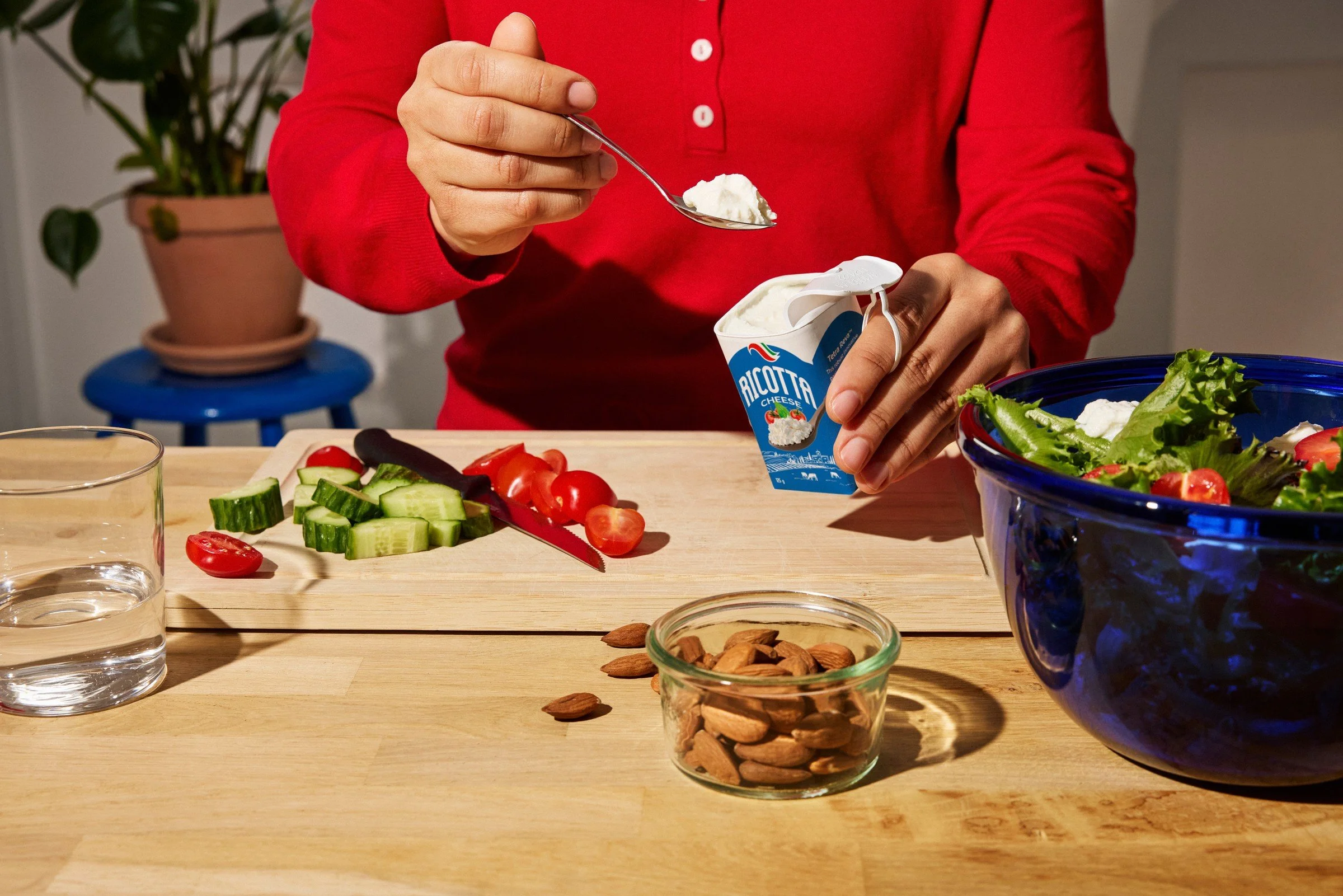
Tetra Reva’s full-top opening lifts away with a pull ring so food can be eaten straight from the carton. Image: Tetra Pak
Why a paper cup for yoghurt is a manufacturing problem
Most yoghurt and dessert cups are made by form-fill-seal: a machine forms plastic cups from a roll of sheet, fills them, and seals a foil or film lid on top in one continuous line. A filling line is the sequence of equipment that sterilizes, doses, seals, codes and packs a product, often at hundreds of units a minute. Switching the cup changes how the package is formed, fed, filled, sealed and stacked.
Paperboard brings its own constraints. Fiber is strong for its weight but sensitive to moisture, so food cartons rely on barrier layers: thin coatings or laminated films that keep moisture, oxygen and grease away from the board and the food. Those layers protect shelf life but affect how easily the package is recycled.
That tension explains the careful wording in Tetra Pak's materials. "Up to 93% renewable" means part of the package is not, including the plastic pull ring Packaging Dive describes. The launch materials we reviewed do not detail the layer structure, which is exactly what a brand team would ask for before making claims on its own label.
Design for manufacturability lessons for packaging and product teams
Design for manufacturability (DFM) means shaping a product's parts, materials and tolerances around how they will actually be made, filled and assembled at volume. In Tetra Reva, each visible feature carries a production consequence.
The pull ring is a mechanism. A pull ring has to open with predictable force for a child, an older adult or someone with wet hands, yet survive filling, shipping and drops without opening early. That balance depends on scoring depth, ring geometry and material variation, so opening-force testing belongs in every prototype round.
Square corners carry load. Flat sides help branding and pallet density, but corners and fold lines take the stacking loads and are where paperboard can crack or wick moisture. Shape changes that look cosmetic are often structural.
The filling line sets the rules. Tetra Pak pairs Tetra Reva with its own filling machine, a reminder that a new package and its equipment are usually developed together. A custom format means planning for line speed, changeover and hygiene, not just shelf appeal.
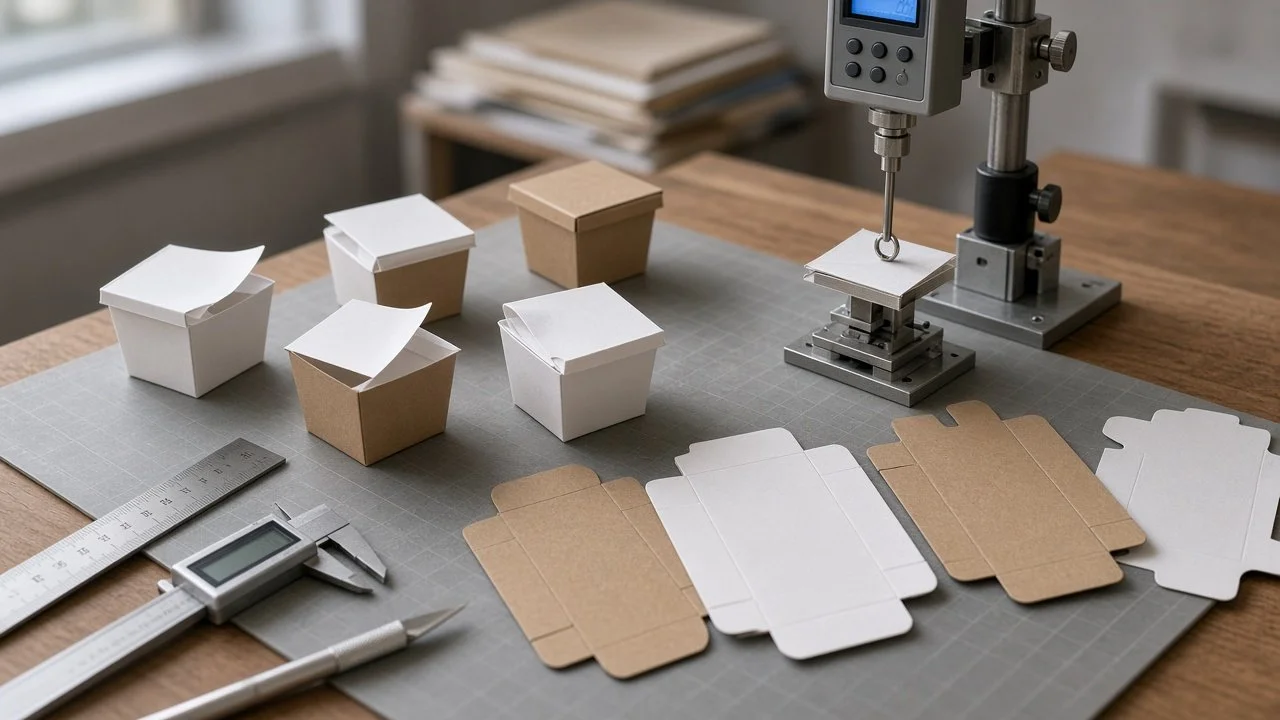
Concept render (illustration) of generic paperboard cup prototypes and a lid-opening force test, not Tetra Pak hardware.
What this means for product teams
Few brands will design a carton system from scratch, but many teams face the same choices when moving from plastic to fiber, whether for a food package, retail box or molded insert.
- Start with the barrier, not the board. List what the contents need protection from: moisture, oxygen, grease or light. That sets the material structure, shelf life and recycling route, so define it before choosing a supplier.
- Test opening and closing early and often. Measure opening force, check tear paths and run usability sessions with a range of users. Easy-open features fail quietly in the lab and loudly in reviews.
- Design around the filling or packing line. Ask early which equipment will run the package, at what speed, with what changeover. A format that needs new equipment changes the business case.
- Prototype the package like a product. Use die-cut flat blanks (the cut and creased sheet a carton folds from), quick-turn tooling and small pilot runs to test folding, sealing, drops and stacking before committing to production tooling.
- Keep recyclability claims tied to evidence. "Recyclable" depends on local collection and sorting. Use qualified wording, document it, and check claims against each market where you sell. Our post on EU repairability rules shows how end-of-life requirements are moving into design decisions.
The takeaway: packaging design and production planning should happen together. The best-looking carton still has to run on the line, protect the food and make honest claims.
FAQ
What is Tetra Reva? Tetra Reva is a square, paper-based carton from Tetra Pak for spoonable foods such as yoghurt, desserts and soft cheese. Announced on November 24, 2026, it has a full-top pull-ring opening so people can eat directly from the package.
Is Tetra Reva recyclable? Tetra Pak describes it as fully recyclable where collection and recycling infrastructure is in place, and made with up to 93% renewable materials. Whether a given carton is actually recycled depends on local collection and sorting systems.
What does design for manufacturability mean for packaging? It means designing a package around how it will be formed, filled, sealed, shipped and opened at volume. That includes material structure, fold and score geometry, filling-line compatibility and opening-force tolerances.
How should a brand prototype a new paper-based package? Start with die-cut blanks and quick-turn samples to test folding, sealing and opening. Then run small pilot fills with real product to check shelf life, stacking and drops before locking production tooling.
Jackson Hedden is a product design, development and manufacturing firm helping founders and product teams take consumer and industrial products from concept to production.
Work with us
Moving a product or package from plastic to fiber, or planning tooling and production for a new format? See how we approach design for manufacturability and sourcing, explore our packaging design and product strategy services, or contact us to talk through your project.
Sources
- Tetra Pak, "Tetra Pak opens a new era for spoonable foods with the launch of Tetra Reva carton package," November 24, 2026: https://www.tetrapak.com/about-tetra-pak/news-and-events/newsarchive/tetra-pak-launches-tetra-reva-paper-based-package
- Tetra Pak, press release PDF, November 24, 2026: https://www.tetrapak.com/content/dam/tetrapak/publicweb/gb/en/corporate/20261124_tetra-reva/Tetra_Reva_global_press_release_final.pdf
- Tetra Pak, "Tetra Reva carton packages" product page (accessed November 25, 2026): https://www.tetrapak.com/solutions/packaging/packages/food-packages/tetra-reva
- Packaging Europe, "Tetra Pak reveals 'world first' paper-based pack for spoonable foods," November 24, 2026: https://www.packagingeurope.com/tetra-pak-reveals-world-first-paper-based-pack-for-spoonable-foods/
- Packaging Dive, "Packaging innovations: Tetra Pak squares up food cartons, Hormel slims down bacon portions," November 6, 2026: https://www.packagingdive.com/news/packaging-innovations-tetra-pak-reva-carton-hormel-bacon-portion-american-packaging-cube/873352/