Logitech published a design story on November 10, 2026 explaining how its industrial design team created the MX Master 4 Creator Edition (launched November 9) and the Developer Edition (launched October 27) without changing the mouse's shape at all.
Key takeaways
- Logitech's two limited editions reuse the MX Master 4's form, haptics, Actions Ring and MagSpeed wheel unchanged; everything new comes from color, graphics and finish.
- The team says early graphics looked right on a monitor but too busy in the hand, so "most of the work was about removing things."
- Manufacturing set the palette: each printed color is a separate pass with its own misalignment risk, so each edition keeps two body tones and one accent.
- A CMF-only edition (color, material and finish) can refresh a product without new tooling, but it still needs a real spec, physical samples and factory sign-off.
What Logitech announced
The Developer Edition went on sale October 27, 2026, timed to GitHub Universe. Logitech describes "laser-etched syntax annotations (//), markup tags (</>), circuit traces, and a compiling {Hello, World} execution prompt printed directly onto a sleek matte body," plus Easter eggs such as 0xFF + 1 for World Programmers' Day.
The Creator Edition went on sale November 9, 2026, with Logitech showing it at Adobe MAX in Miami Beach from November 10 to 12. It carries layout grids, color calibration bands and alignment crosshairs, along with keyframe-style timestamps for World Design Day (04:27) and other dates. Both editions are priced at $119.99 in the U.S. (€119 / £119.99) and sold while supplies last. Logitech's special edition product page listed Creator Edition shipping as starting November 14, 2026 when we checked on November 11.
According to Logitech, these are the first special editions in the MX line's more than 20-year history.
How the design team worked inside a locked form
The most useful part for product teams is Logitech's November 10 interview with industrial designer Hugo Bourguignon. The brief was to celebrate developers and creators without changing the product. "The form, the haptics, the Actions Ring and the MagSpeed wheel stay untouched, so everything we wanted to say had to come from color, graphics and finish," he said.
The team drew directly over renders in Illustrator, trying typography, icon patterns, real lines of code, contour lines and calibration charts. The early ideas covered the whole shell. The turning point came when they put mockups on real units: "What looks right zoomed in on a monitor gets much smaller in your hand."
Bourguignon listed the manufacturing constraints that shaped the result:
- One color at a time. Each color is printed separately, so every extra color adds a pass and a risk of misalignment.
- Flat artwork, curved part. Graphics are drawn flat but land on a doubly curved shell, so line work was built around the real surfaces of the top case.
- Contrast and durability. Every line had to read at real size, on graphite and pale grey, and survive a hand resting on it all day.
- A shared language with the factory. The team handed over a full graphics spec with a color part map, then matched final colors on real parts with manufacturing partners.
His summary: "a constraint can be the best brief you get," and graphics should be treated "as industrial design: something you validate in your hand and with the factory, not just on a screen."
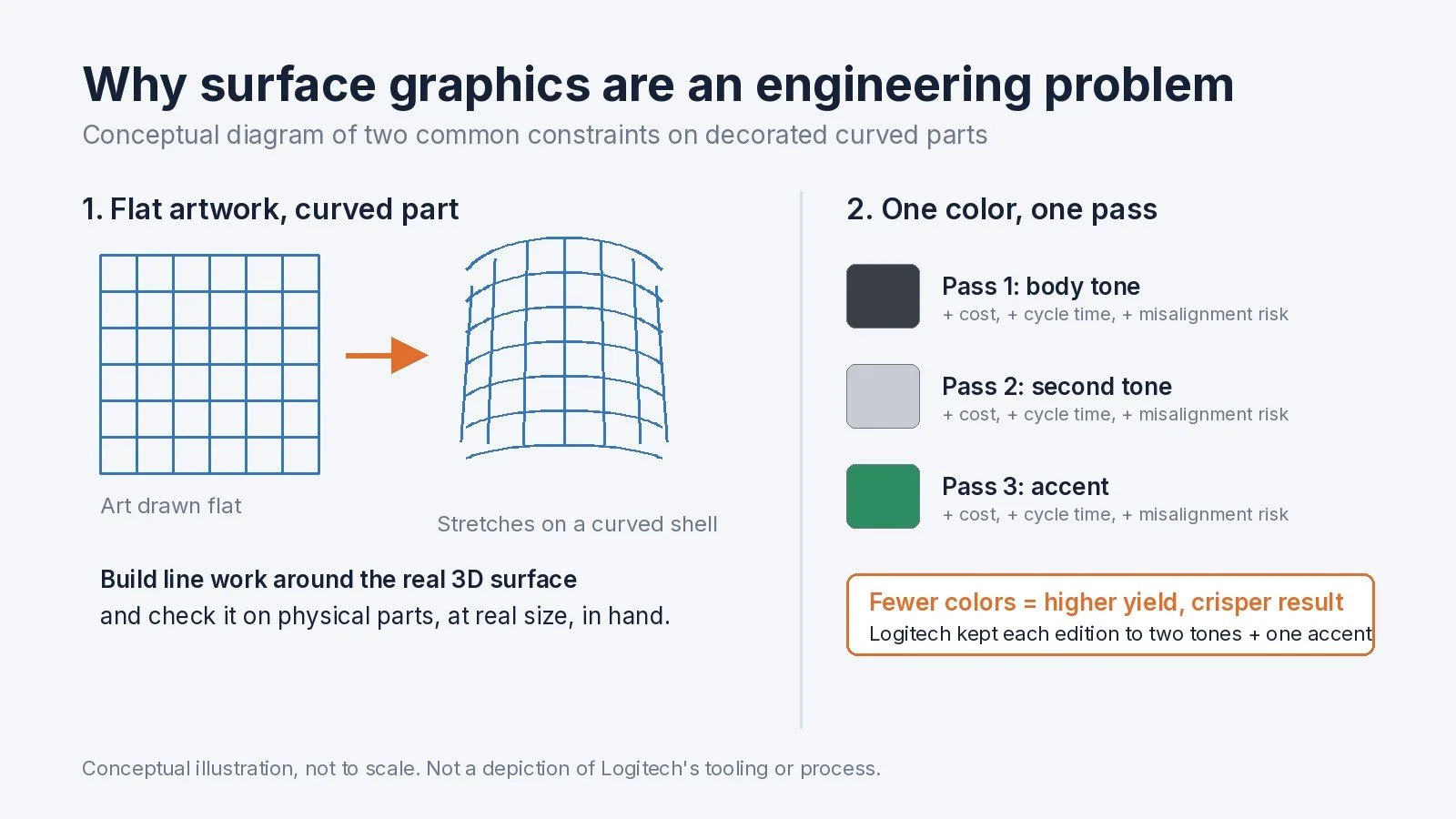
Conceptual diagram of two constraints Logitech’s designer described: flat artwork landing on a curved shell, and one print pass per color. Not to scale and not a depiction of Logitech’s process.
Why a CMF refresh is a real design decision
CMF stands for color, material and finish: the surface decisions (resin color, texture, coating, printed graphics) that shape how a product looks and feels. In hardware, changing a shape usually means changing tooling, the steel molds that form plastic parts, which is slow and expensive. Changing CMF on an existing housing can often reuse that tooling.
That makes CMF one of the cheapest levers a hardware brand has for editions, retail exclusives, seasonal colors or community launches. Logitech's account shows it is not free, though:
- Every added color multiplies process risk. More passes mean more registration (alignment) tolerance to manage and more chances for a reject.
- Curved surfaces distort graphics. Artwork that looks crisp in a flat file can stretch or soften across compound curves, which is why designers build art around the real 3D surface and check it on parts.
- Wear is a design input. A palm rests on a mouse for hours a day. Graphics need abrasion, sweat and chemical resistance testing, not just visual approval.
- Color matching happens on parts, not screens. Screen color and molded-and-coated color differ, so final approval needs physical samples under agreed lighting.
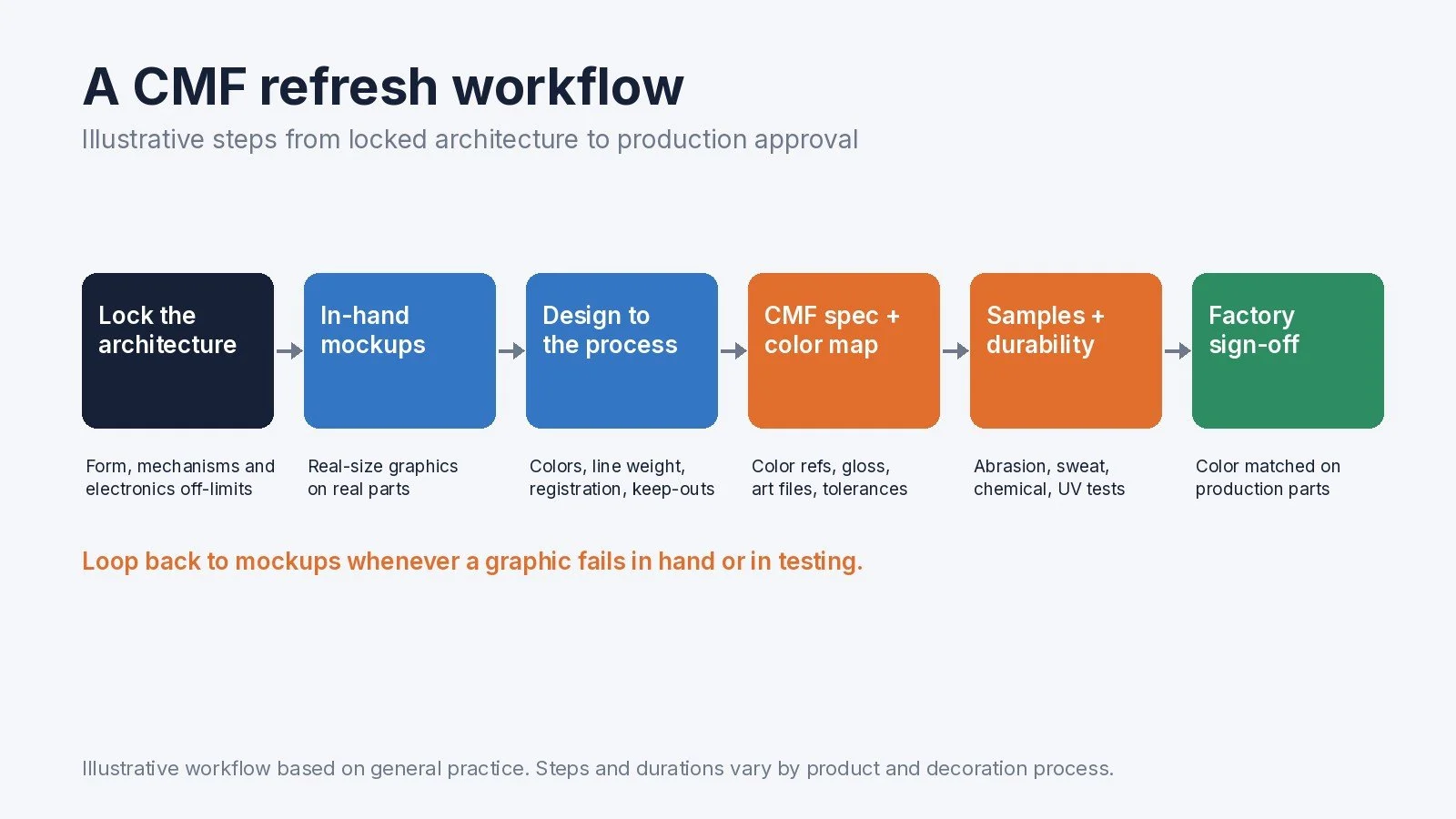
Illustrative CMF refresh workflow based on general practice. Steps and durations vary by product and decoration process.
What this means for product teams
The lesson goes beyond mice. Any team with a successful product and a locked enclosure can use the same playbook. Here is how we would approach it.
Lock the architecture, then define what can change. Write down which parts are off-limits (geometry, mechanisms, electronics) and which surfaces are open. That keeps a "simple color update" from turning into a re-validation program.
Prototype at real size early. Logitech's turning point was holding real units. Apply candidate graphics to production parts or close prototypes as soon as possible, and review them in hand at desk distance. Our prototyping and testing work follows the same principle: decisions about feel and readability are made on physical parts.
Design to the process, not the file. Learn the decoration method's limits before finalizing art: number of colors, minimum line weight, registration tolerance and keep-out zones near edges and seams. Logitech held each edition to two body tones and one accent for exactly this reason. Our guide to CMF design and material selection covers how these choices fit with resin, texture and coating decisions.
Write a CMF spec the factory can execute. A color part map listing each part, color reference, gloss or texture level, graphic artwork file and tolerance, plus approved physical "golden samples," removes guesswork. Logitech describes handing over this kind of full graphics spec and matching colors on real parts.
Validate durability like any other requirement. Include abrasion, sweat, cleaning-chemical and UV tests in the plan, and run them on production-process samples. A graphic that wears off in three months damages the brand more than no graphic at all.
Plan a limited edition as a supply chain event. Limited runs need demand forecasts, packaging updates, separate part numbers and a plan for leftover inventory, and run size is a deliberate tradeoff between scarcity and missed sales.
This connects to a pattern we have covered before. In our look at Suri Pro 2.0 and second-generation products, the theme was improving what works without starting over. A CMF edition is the lightest version of that idea. For founders comparing industrial design firms or consumer product design firms, ask how a partner handles CMF specs and factory color approval, not just renders.
Frequently asked questions
What does CMF mean in product design? CMF stands for color, material and finish. It covers the surface choices, such as plastic color, texture, coatings and printed graphics, that define how a product looks and feels. CMF designers work alongside industrial designers and manufacturing engineers so those choices can be produced consistently.
Can a product get a new look without new tooling? Often, yes. If the shape stays the same, new colors, coatings and printed or etched graphics can usually reuse existing molds. It still takes design work, samples and testing, as Logitech's special editions show.
Why do printed graphics on consumer products use so few colors? Each color is typically applied in its own pass, and every pass adds cost, cycle time and a chance of misalignment. Limiting the palette keeps yield high and the design crisp. Logitech kept each edition to two body tones and one accent for this reason.
How do you approve colors for a manufactured product? Teams agree on color references, then approve physical samples made with the production process, viewed under defined lighting. Approved "golden samples" become the standard the factory checks against during production.
Refreshing a product through CMF and industrial design
If you are planning a colorway, special edition or second-generation refresh for a consumer product, our product design services team can help with CMF strategy, graphic and finish specification, prototyping and factory handoff. You can also contact Jackson Hedden to talk through your product.
Jackson Hedden is a product design, development and manufacturing firm helping founders and product teams take consumer and industrial products from concept to production.
Sources
- Logitech, "How Logitech Gave MX Master 4 a New Look Without Touching Its Shape," interview with industrial designer Hugo Bourguignon, November 10, 2026: logitech.com
- Logitech, "Pixel Perfect or Timeline Driven: How Do You Tell Your Story?" (Creator Edition launch), November 9, 2026: logitech.com
- Logitech, "Desk Mode or Light Mode: Claim Your Terminal Vibe" (Developer Edition launch), October 27, 2026: logitech.com
- Logitech, "MX Master 4 Special Edition" product page, accessed November 11, 2026: logitech.com
Jackson Hedden is not affiliated with Logitech. Product details are as reported by the sources above.