x
Most hardware founders plan obsessively for their first product and barely at all for their second. A DEVELOP3D feature published November 9, 2026 on the Suri Pro 2.0 electric toothbrush is a useful corrective. It describes a second-generation product where the team deliberately kept the industrial design, kept the tooling, and went after performance inside the shell instead.
That is a less glamorous story than a dramatic redesign, and it is the one most consumer product companies actually live through. Below is what the reporting says, followed by our own analysis of what product teams can take from it.
What DEVELOP3D reported
According to DEVELOP3D, London-based Suri launched its first toothbrush in 2022 and approached the next generation as what innovation director Seb Wetherall called "the difficult second album." The key points from the article:
- The form carried over. Strong reviews (the article cites some 20,000 on Trustpilot, analysed with AI sentiment tools) convinced the team not to revisit the core industrial design. The stated goal was to take the product to the US "without changing the core industrial design."
- No new tooling. The challenge became finding improvements "that wouldn't involve changing the tooling." The aluminium body and handle form stayed.
- Late-stage engineering help. With the China-based production partner already at Engineering Validation Test (EVT) and producing prototypes, Suri brought in UK consultancy IDC, which has an engineering office in Shanghai.
- The electronics were the bottleneck. A more powerful motor added unwanted noise and vibration, and battery life needed extending. IDC found the factory-chosen electronics were driving the motor "fairly inefficiently," while its China team tested motor samples at suppliers.
- Feel was turned into measurements. The team quantified noise with decibel readings and amplified the brush head's tiny movements by bouncing a laser off a mirror attached to the head. Internal damping was reworked so energy reached the head, not the hand, using SLA-printed mock-ups to compare alternatives.
- The reported result: up to 33,000 sonic vibrations per minute at around 50 decibels.
The piece also covers regulation (in the US, an electric toothbrush is a Class I medical device that is 510(k) exempt), design for disassembly using non-permanent adhesives, PLA brush heads with a take-back scheme, and a refillable toothpaste pump developed with IDC.
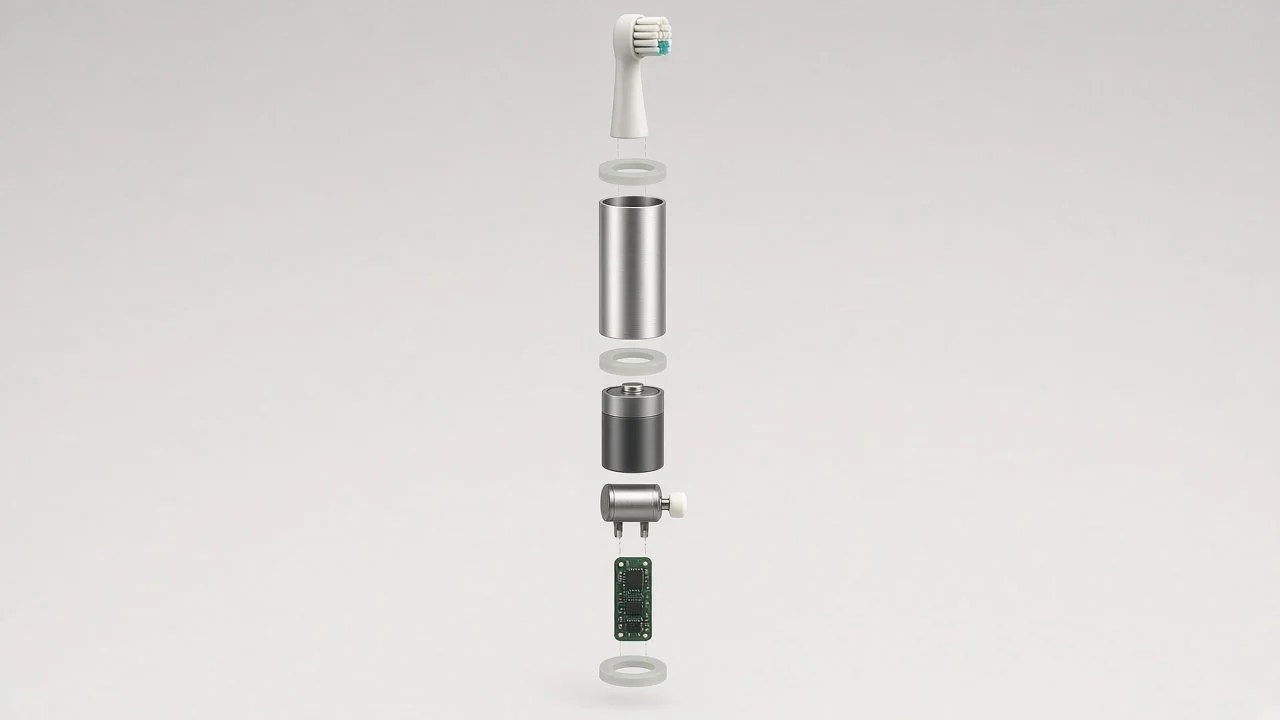
Conceptual illustration of a generic sonic toothbrush architecture. Not a Suri product image.
Why "keep the shell, change the guts" is a strategy, not a compromise
Analysis: When a first product has found its audience, the outer form has become an asset. It carries brand recognition, photography, retail listings, accessories that fit it (Suri's mirror mount and travel case, in this case) and, critically, paid-off injection and extrusion tooling. Changing the exterior resets all of that at once.
Keeping the shell narrows the problem in a productive way. The team is no longer asking "what should this be?" but "what can we improve inside a fixed envelope?" That is a tighter brief, with fewer variables, faster validation and lower capital risk. It is the same logic behind most successful "Gen 2" hardware: the second product earns margin and reliability; the third product earns a redesign.
The tradeoff is real, though. A fixed envelope caps battery volume, motor size and thermal headroom. If the roadmap needs a bigger cell or a new feature that physically cannot fit, protecting the tooling becomes a trap. Teams should decide explicitly, early in the generation, which constraint wins.
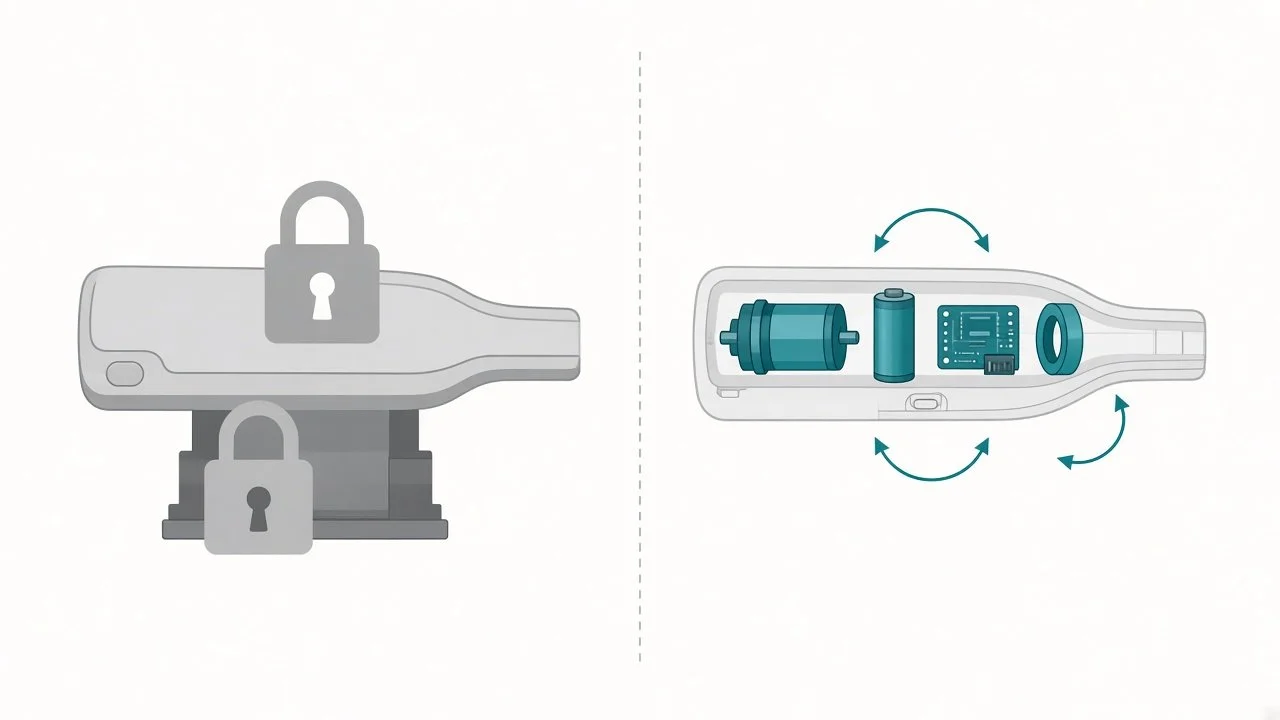
Concept diagram: the exterior and tooling stay fixed while internal electromechanical components are re-specified.
The electronics are often where performance hides
Analysis: The detail that IDC found the factory-selected drive electronics running the motor inefficiently is worth dwelling on. In consumer electromechanical products, contract manufacturers often propose reference circuits and stock motors that are adequate, not optimised. Motor drive waveforms, the match between motor and battery, and firmware control can change runtime, noise and perceived power substantially without touching a single visible part.
For founders, the practical lesson is to own the electrical specification, not just the CAD. That means knowing what signal is being sent to the motor, why that motor was chosen, and how it was qualified. If that knowledge lives only with the factory, the brand cannot improve the product without the factory's cooperation, and it cannot easily second-source parts. Our guide to electronic product design services covers how teams typically split that responsibility stage by stage.
Turning "it feels right" into a test you can repeat
The most transferable idea in the article is the laser-and-mirror rig. Subjective qualities such as "too buzzy in the hand" or "doesn't feel powerful" are where consumer products win or lose reviews, and they are notoriously hard to hold a supplier to.
Analysis: The answer is to convert the feeling into a proxy you can measure every time:
- Pick a measurable proxy. Decibels for perceived noise; amplified deflection for head motion; handle acceleration for the "harsh" feeling the team wanted to avoid.
- Build a cheap, repeatable fixture. A clamp, a mirror and a laser pointer is a perfectly legitimate test method if it gives consistent, comparable readings.
- Calibrate against people. Run a few user sessions to find where the numbers correspond to "good," then set pass/fail limits.
- Hand the limits to the factory. A number in a specification can be inspected in production; "should feel nice" cannot.
This is the bridge between prototype testing and production quality control. We go deeper on choosing methods in prototype testing methods for better prototypes, and on locking acceptance criteria before mass production in our first article inspection guide.
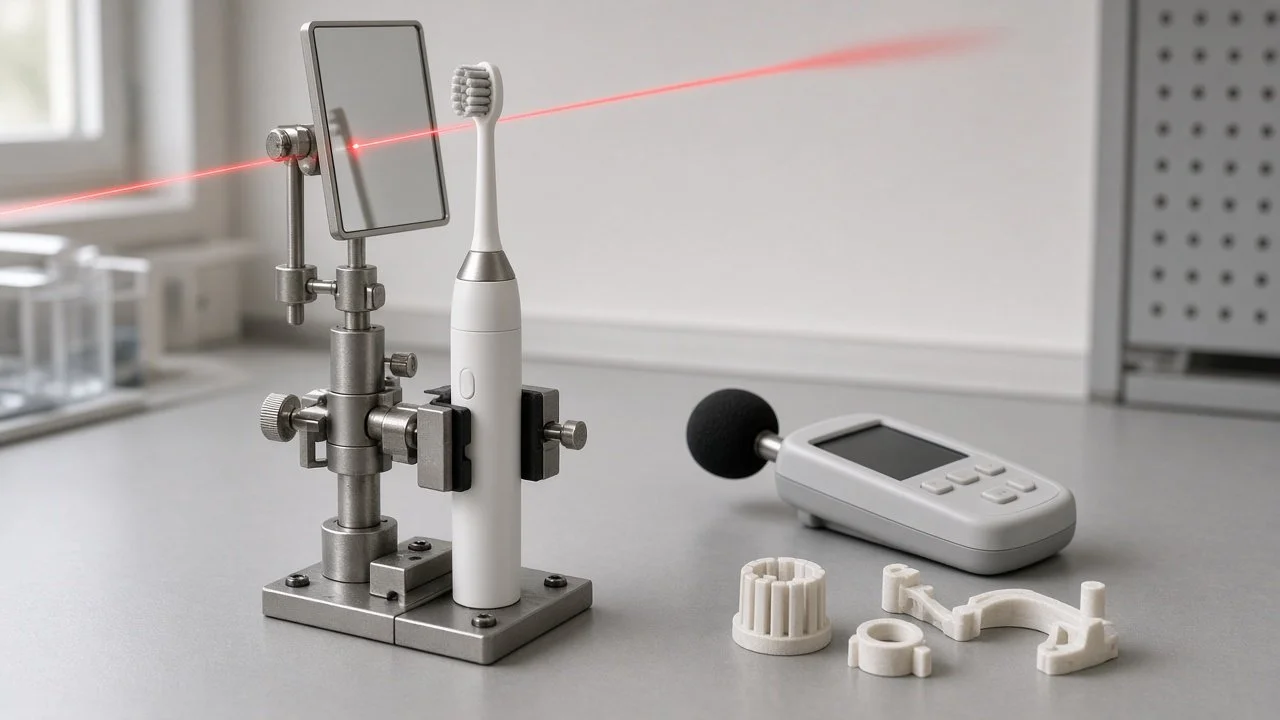
Conceptual illustration of a bench noise and vibration setup of the kind described in the article. Not a photo of IDC’s or Suri’s lab.
Bringing in outside engineering at EVT: late, but not too late
Analysis: Suri brought IDC in once the product was already at EVT. That timing is common, and it is both a risk and an opportunity. Changes at EVT are still cheaper than at Design Validation Test (DVT) or Production Validation Test (PVT), because tooling for cosmetic parts may be fixed while internal brackets, damping parts and boards can still move. But each change now has to be re-validated quickly, which is why fast SLA prototypes of internal parts and an engineer physically at the suppliers mattered here.
The article also highlights a structural point: a design partner with people on the ground near the supply base. Being able to visit several suppliers in a day to check motors, electronics and moulded parts against requirements shortens loops that otherwise take weeks of emails and courier shipments.
Durability, disassembly and regulation all compete for the same space
The DEVELOP3D piece notes that Suri uses non-permanent adhesives so components can be recovered at end of life, while the product must still survive drops on tile, water ingress, abrasive toothpaste and internal heat. Wetherall describes the team's DFMEAs (design failure mode and effects analyses) as "huge."
Analysis: Design for disassembly and water resistance pull in opposite directions. Every reversible joint is a potential leak path or rattle. Teams that commit to circularity claims need to test the joint, not just specify it: drop, immersion, thermal cycling and cleaning-chemical exposure, repeated after reassembly if repair is part of the promise. Regulatory classification adds another layer; even a 510(k)-exempt Class I device in the US carries quality-system expectations that shape documentation and supplier controls.
What product teams can take from Suri Pro 2.0
- Treat a successful first-generation exterior as an asset and decide early whether the next generation protects it.
- Own the motor, battery and drive-electronics specification rather than accepting a factory default.
- Convert subjective feel into measurable proxies with simple fixtures, then write them into the spec.
- Expect to bring in specialist help at EVT, and plan for fast internal-part iteration when you do.
- Validate sustainability features such as reversible joints under the same abuse tests as the rest of the product.
If you are planning a second-generation product, or trying to get a first one from prototype to a stable build, talk to our team at Jackson Hedden about scoping the engineering and testing work.
Sources
Facts about Suri, IDC and the Suri Pro 2.0 are as reported by DEVELOP3D. Sections marked "Analysis" are Jackson Hedden's own commentary. Jackson Hedden was not involved in this product and has no affiliation with Suri or IDC.