On November 20, 2026, Snow Peak announced the Alma Stove (ST-210), a stainless-steel camping wood stove with heat-resistant glass on all four sides, which goes on sale in Japan on November 28, 2026 for ¥162,800 (Snow Peak press release).
Key takeaways
- The stove is only half the product. It must be built into a designated stand or frame and, inside a tent, used only in two designated shelters, so the approved combinations are part of the design.
- Four glass walls trade view for risk. Glass on every side shows the fire from anywhere in the tent, but it adds seals, impact cases and replacement parts that a steel box does not need.
- Building the spark arrestor into the chimney cut parts. Snow Peak's product page says building it into the chimney reduces part count while limiting sparks.
- The manual is doing safety engineering. Leg-height limits, a chimney heat shield and a required carbon monoxide monitor depend on correct setup by the user.
What Snow Peak announced
According to Snow Peak's Japanese-language press release, its online store listing and the English section of the instruction manual:
- Product: the Alma Stove (ST-210), a wood stove with heat-resistant glass on four sides and a spark arrestor built into the chimney. Snow Peak says it was developed for winter camping in its Landlock X shelter, launched in June 2026.
- Price and timing: ¥162,800 including tax, on sale November 28, 2026 at 10:00 (Japan time) on Snow Peak's online store.
- Materials and kit: stainless-steel body and chimney; heat-resistant glass held with ceramic rope; 19.6 kg (about 43 lb) with the chimney set. The kit adds a fire grate, carabiners, four tensioned 3.7 m ropes, leg-fixing plates and an ash scraper.
- System rules: the stove must be installed in designated products, such as the Alma Stand (listed as coming soon) or Snow Peak's Iron Grill Table (IGT) frames, never directly on the ground. Inside a shelter, only the Landlock X or Merak Pro. shelters with their TC fly covers are approved. The approved combinations live in a separate, versioned compatibility list that the manual says to check before every use.
- Safety requirements: inside a shelter, a carbon monoxide (CO) monitor is required (not included); only 300 mm or 400 mm IGT legs are allowed, because taller legs reduce ceiling clearance; and a chimney shield called the "wall" must be fitted at the shelter's stove jack.
The manual also lists an "air curtain" intake and exhaust vent, warns that the glass may shatter if the lift-up door is dropped, and notes that "the glass and the glass-securing rope may need to be replaced depending on the frequency and conditions of use." We have not handled or tested the Alma Stove, and Snow Peak has not published heat output, glass type or test standards. Everything below is Jackson Hedden analysis based on general product development practice.
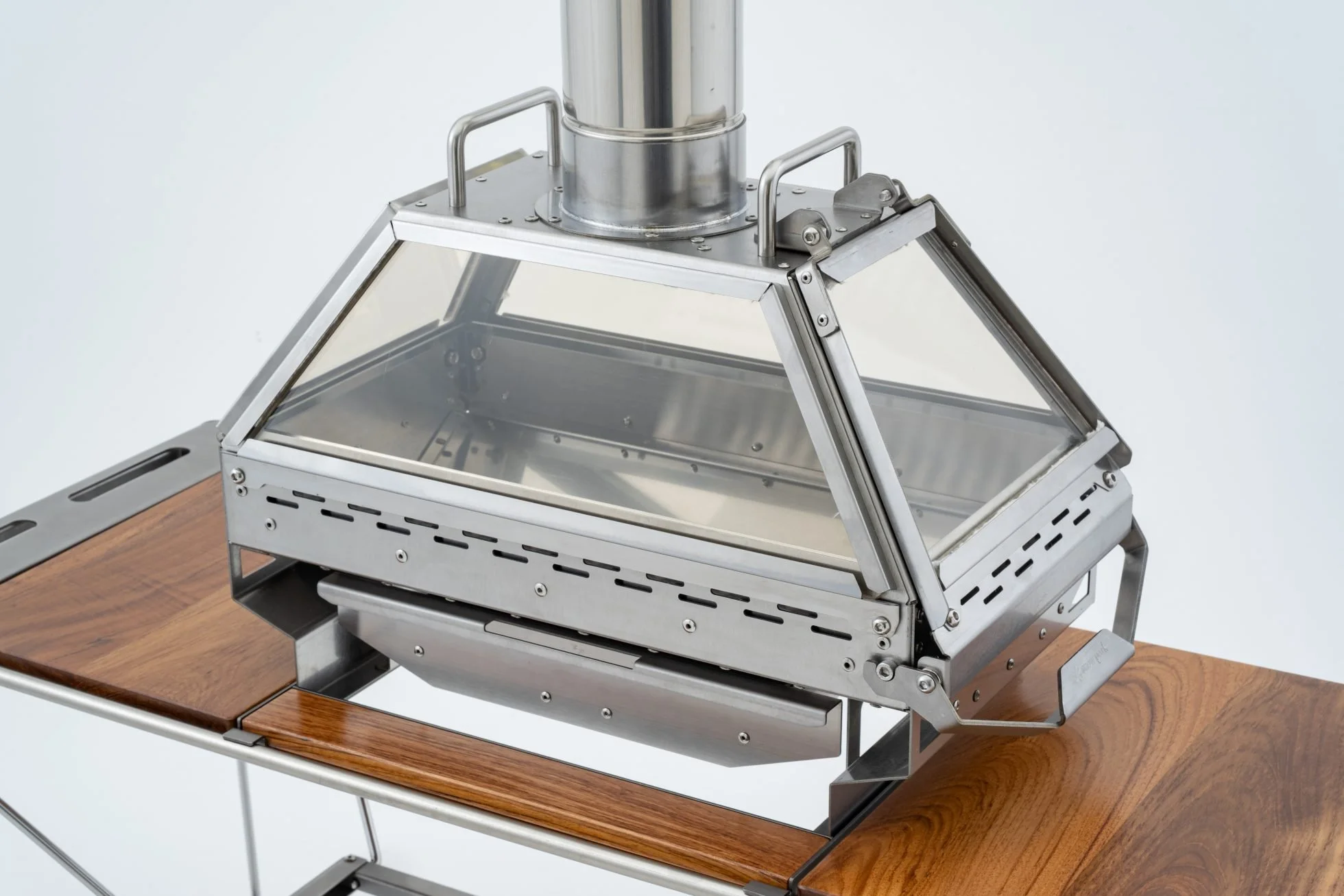
Snow Peak's studio photo shows the Alma Stove's glass panels, slotted vents and ash catcher, set into an IGT frame. Image: Snow PeakWhat an industrial design agency would test in a four-sided glass stove
For an industrial design agency, a product like this is less about the stove's shape than about everything it touches: the frame, the tent fabric, the chimney and the person loading wood. Four tradeoffs stand out.
Glass is a part with its own failure modes. Steel and glass expand at different rates when heated, so glass in a hot stove usually floats in a soft, heat-proof gasket instead of being clamped hard. The ceramic rope Snow Peak lists for securing the glass appears to play that role, and it wears. That is why the manual treats glass and rope as replaceable. Four panes also means four edges to protect from a dropped log, a slammed door or cold rain on hot glass. A wood stove's air curtain (often called airwash) usually sweeps air down the inside of the glass to slow soot build-up; with glass on every side, how evenly that airflow reaches each pane matters more than usual.
A system-only product moves safety into the combinations. By refusing ground use and approving only specific frames, legs and shelters, Snow Peak controls stability, clearances and heat paths. The leg rule makes the point: the same stove is not allowed inside a shelter on 660 mm or 830 mm legs, purely because taller legs bring it closer to the roof fabric. The tradeoff is flexibility: every new shelter or frame needs its own validation and a list update.
Part consolidation still has to pass a heat test. Building the spark arrestor into the chimney removes a part that could be lost or fitted wrongly at a campsite. But a screen inside a pipe collects soot and creosote, so the manual's once-a-season chimney cleaning is part of that design decision.
Some safety layers still rest on the user. Product safety engineering usually prefers designing a hazard out, then guarding it, then warning about it. A stove in a tent cannot design out heat or combustion gases, so it stacks layers: designated shelters, a fitted chimney shield, guy ropes and pegs, and a required CO monitor. Several depend on the user doing a step correctly, a pattern we also saw in the YY Vertical hangboard mount recall, where the remedy narrowed the approved installations.
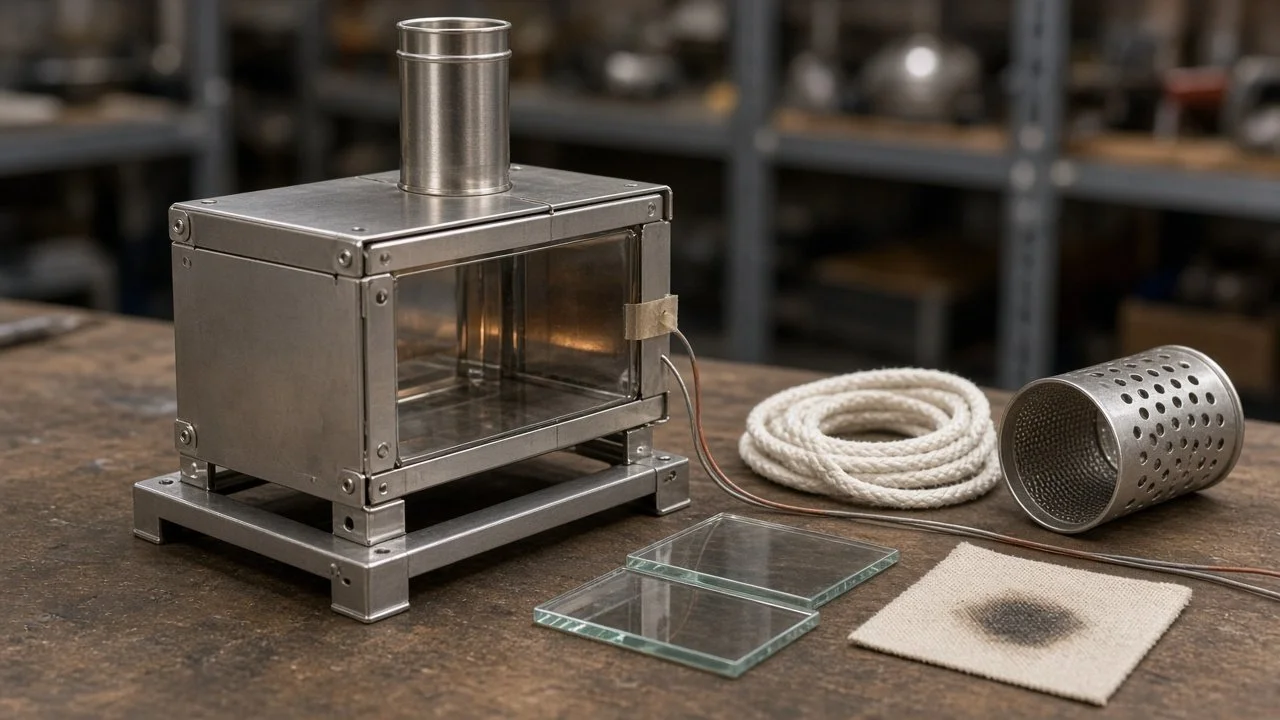
Concept render (illustration) of a generic camp wood stove prototype on a test bench: a stainless body with glass panels, spare glass, ceramic rope gasket, a perforated spark-arrestor section and thermocouple wires. Not Snow Peak hardware.
What this means for product teams
- Treat compatibility as a controlled spec. If a product is only safe in certain combinations, keep the approved list under version control with the same care as a drawing. Version and date each release, link it from the product (Snow Peak uses a 2D code in the manual), and plan for users without a signal.
- Validate the configurations, not just the product. Build a test matrix of every approved frame, leg height and shelter. Measure fabric temperatures, tip-over stability in wind and chimney movement. Run it during EVT (engineering validation test, proving the design works) and repeat it in DVT (design validation test, proving production-intent parts meet requirements).
- Design glass mounts for movement and abuse. Leave room for thermal expansion, choose gasket materials for long heat cycles, and test door drops, impacts and thermal shock on real assemblies before tooling (the dies and fixtures that form production parts) is cut.
- Make consumables easy to replace. If glass and seals wear, let a customer or service center swap them without special tools, and stock them from launch.
- Let hardware enforce the rules where it can. When a configuration must never be used, such as tall legs inside a shelter, ask whether keying, labels on the part or the shape of the mount can prevent it instead of relying on the manual alone. Heat at the interfaces matters in any fire product, as our Blackstone gas grill analysis covers from the cookbox side.
FAQ
What is the Snow Peak Alma Stove? It is a stainless-steel camping wood stove with heat-resistant glass on four sides and a spark arrestor built into its chimney. Snow Peak announced it on November 20, 2026, and it goes on sale in Japan on November 28, 2026 for ¥162,800.
Can the Alma Stove be used inside a tent? Snow Peak says only inside its designated shelters, currently the Landlock X and Merak Pro. with their TC fly covers, installed as the manual describes. A carbon monoxide monitor is required and is not included.
Why can't the stove sit on the ground? Snow Peak designed it to be built into designated stands and IGT frames, and the manual says never to place it directly on the ground. Fixed frames, approved legs and pegged ropes let it control stability and clearances.
What should teams test first on a heat-producing outdoor product? Start with the interfaces: glass and gaskets, the exhaust path and every surface near fabric or skin. Test them hot, wet and over many cycles, in every approved configuration.
Work with us
Developing outdoor gear that lives with heat, weather and setup by the user? As an industrial design agency built for production, we help product teams define system compatibility, design for safe installation and plan validation before tooling. Contact us to talk through your project.
Jackson Hedden is a product design, development and manufacturing firm helping founders and product teams take consumer and industrial products from concept to production.
Sources
- Snow Peak, "冬のキャンプをより暖かく、より豊かに。全方向から炎を楽しめる薪ストーブ「アルマストーブ」を発売いたします。" (Alma Stove launch), press release in Japanese, November 20, 2026: https://www.snowpeak.co.jp/news/p20261120/
- Snow Peak online store, Alma Stove (ST-210) product listing: https://ec.snowpeak.co.jp/item/SNP0126A6873
- Snow Peak, Alma Stove ST-210 Instruction Manual, Ver. 1.00 (Japanese and English): https://ec.snowpeak.co.jp/assets/images/manual/ST-210_manual_web.pdf
- Snow Peak, ST-210 Alma Stove List of Designated Wood Stove Products and Shelters, Ver. 1.00, November 2026: https://www.snowpeak.co.jp/pdf/products/ST-210/ST-210_compatibility.pdf