On November 25, 2026, the U.S. Consumer Product Safety Commission (CPSC) announced a recall of about 227 YY Vertical VerticalBase doorframe mounts for climbing hangboards, because the mount's expansion system can lose pressure over time and detach during use (CPSC recall 27-105).
Key takeaways
- The hazard is in how the product holds on, not in what it holds. CPSC says the VerticalBase's expansion system can lose pressure over time, so the mount can come loose while someone hangs from it.
- Installation options were narrowed after launch. YY Vertical's October 9 notice says earlier instructions allowed setups without safety clamps; it now authorizes only door frames that accept the clamps.
- The fix is a mechanical part. The U.S. remedy is a repair kit of replacement safety clamps, due in late January 2027, or a refund if the clamps do not suit the owner's installation.
- When customers install the product, their homes become part of the design. Door trim, paint, humidity and user technique all affect a pressure-fit product, so they belong in the test plan.
What CPSC and YY Vertical reported
According to the CPSC recall notice dated November 25, 2026:
- Product: the VerticalBase is a doorframe-mounted support system designed to hold a climbing training hangboard (a wooden board with finger holds used for hanging exercises). The system includes safety clamps; the hangboard is sold separately.
- Hazard: "The expansion system can lose pressure over time, causing the recalled doorframe mount to detach during use."
- Incidents: the firm received three reports of the assembly tilting forward when body weight was applied or of users falling from the mount, including one report of an injury.
- Sales: sold on Amazon.com from November 2025 through October 2026 for about $300. The manufacturer is YY Vertical of Saint Vincent de Mercuze, France; the product was made in China.
- Remedy: stop using the mount and request a free repair kit of replacement safety clamps, available beginning in late January 2027. If the clamps are not suitable for an owner's installation, the owner receives a full refund. Owners are asked to report their doorframe trim thickness and width, or hallway width, and send a photo of the installed product.
YY Vertical's product page describes how the mount works: a telescoping system with ratchet extensions applies lateral pressure inside the door frame, while high-friction pads and safety clamps keep it in place. It fits door frames 70 to 95 cm wide, uses painted steel tubes and birch wood, and installs without drilling.
The company's corrective action notice, published October 9, 2026, explains what changed. Earlier instructions described three setups: A, a door frame compatible with the safety clamps; B, a frame too thick for the clamps; and C, a hallway. Setups B and C had been described as suitable for static training. The notice now says that "without clamps, the pressure may no longer be sufficient, even in static conditions," and that only setup A, with trim (architrave) no more than 1.6 cm thick and 1 to 6.5 cm wide, is authorized.
The revised user manual calls the clamps mandatory, asks users to retighten and test the mount before each session, and notes that walls "may contain materials that move over time and with air humidity" and that "vibrations could loosen the clamps."
We have not handled or tested the VerticalBase, and neither CPSC nor YY Vertical has published a root-cause analysis. Everything below is Jackson Hedden analysis based on general product development practice.
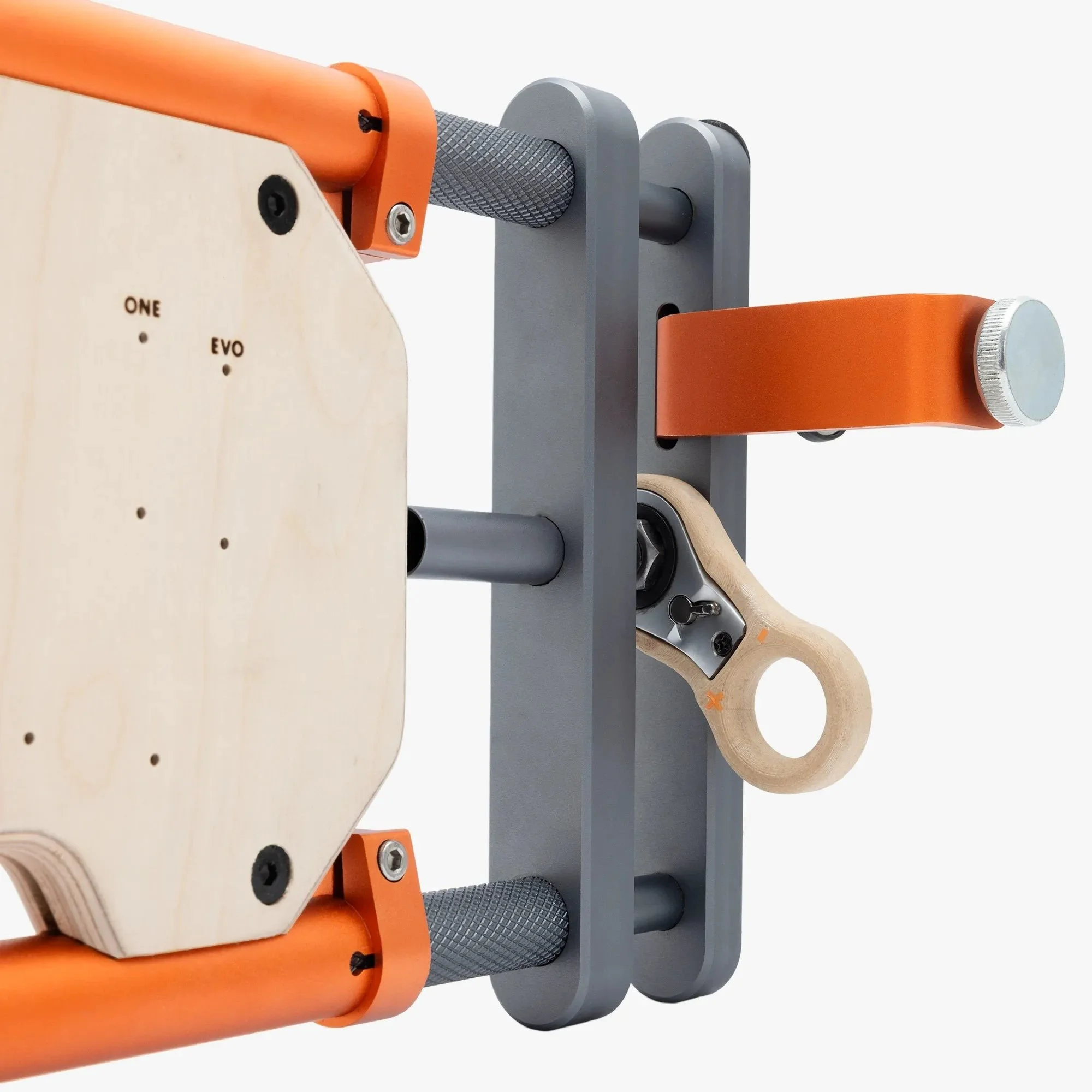
The VerticalBase’s ratchet extension and safety clamp, the retention parts at the center of the recall. Image: YY Vertical
How a product design company reads a pressure-fit recall
A pressure-fit product (also called a tension or expansion mount) holds itself in place with friction. Screw or spring force pushes pads outward against two surfaces, and the friction from that force has to exceed the load trying to pull it down. Shower rods and doorway pull-up bars work this way, and nothing has to be drilled.
The catch is that the holding force depends on things the designer does not control:
- The surface. Painted wood, MDF trim, plaster and metal frames give very different friction.
- The preload over time. Preload is the clamping force set at installation. Pads, paint and wood trim can slowly compress under constant force, so preload can fall even when nothing looks loose.
- The environment and the user. Humidity, dust on the pads and how hard each person turns the ratchet all change the margin. YY Vertical's own manual flags several of these.
- The load direction. A hangboard sits in front of the frame, so body weight also tries to rotate the mount forward, not just slide it down. CPSC's reports of tilting forward point to that turning load, called a moment.
None of this makes pressure-fit designs wrong. It means friction is a variable with a range, not a number from one test in one door.
Why the safety clamps became the fix
Product safety engineers usually work down a hierarchy: design the hazard out first, add a guard or physical safeguard second, and rely on warnings and instructions last. Telling owners that some setups were fine for static training was an instruction-level control. The clamps are a physical safeguard: they hook onto the trim and add positive retention, a mechanical interlock that does not depend on friction alone.
That explains the remedy: replacement clamps add retention, and the refund covers homes where they cannot be fitted. When a remedy narrows the supported installations, it suggests real homes varied more than the original instructions assumed.
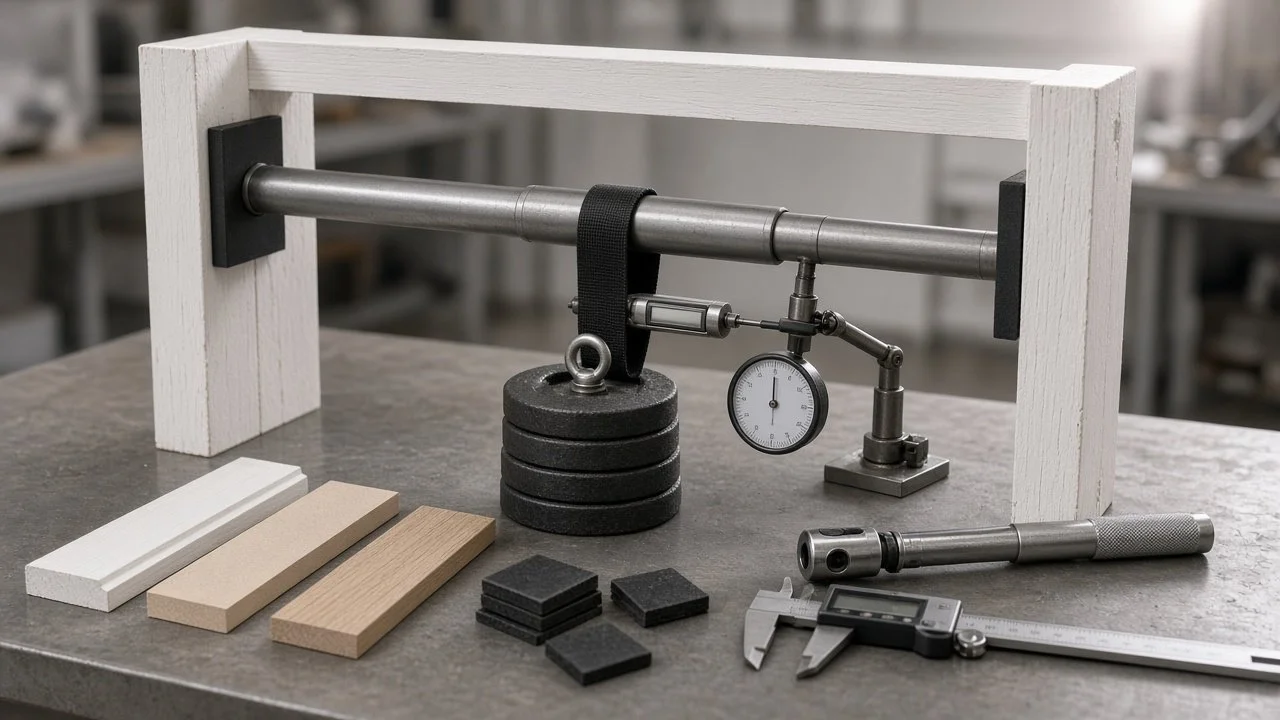
Concept render (illustration) of a generic pressure-fit mount on a sustained-load test fixture, not YY Vertical hardware.
What this means for product teams
These lessons apply to any product customers install themselves and then load: wall mounts, gates, racks, fitness gear and furniture.
- Define the installation envelope before industrial design is frozen. List every surface, dimension and material the product may meet, then decide which you will support. If a setup cannot be made safe, design the product so it cannot be installed that way.
- Test for time, not just strength. Hold a sustained load for hours or days and add cyclic loading that matches real use, such as dynamic pull-ups. Measure how much preload remains at the end.
- Build a test matrix of real frames. Include paint, MDF, hardwood, minimum and maximum widths, humidity swings and dusty pads. Off-center and forward-leaning loads belong in the matrix too.
- Prefer positive retention for anything that holds a person. Use friction to locate the product and a mechanical feature to guarantee it stays put. Make the safety feature standard and hard to skip.
- Plan the field action you hope never to need. Clear lot identifiers on the packaging, a parts-based fix that ships easily and a simple way for owners to report their setup make any recall faster. Our analysis of the Cipton LED bike helmet recall covers the testing and certification side of sporting goods recalls, and our look at the Arc'teryx Alpha SL harness shows the process work behind climbing gear people trust with their weight.
FAQ
What product is being recalled? The YY Vertical VerticalBase, a doorframe mount that holds a climbing training hangboard. About 227 units sold on Amazon.com from November 2025 through October 2026 for about $300 are included in the U.S. recall announced November 25, 2026.
What should owners do? CPSC says to stop using the mount immediately and contact YY Vertical for a free repair kit of replacement safety clamps, available from late January 2027, or a full refund if the clamps do not suit the installation.
What is a pressure-fit mount? A product that holds itself in place by pushing pads outward against two surfaces, so friction carries the load. It needs no drilling, but its grip depends on the surface, the preload and the conditions over time.
How should load-bearing consumer products be tested? Beyond a one-time strength test, test sustained, cyclic and off-center loads across the real range of surfaces and dimensions, then check how much holding force remains.
Work with us
Designing a product that customers install and then trust with their weight? As a product design company, we help teams define installation requirements, engineer retention features and plan load testing before tooling is ordered. Contact us to talk through your project.
Jackson Hedden is a product design, development and manufacturing firm helping founders and product teams take consumer and industrial products from concept to production.
Sources
- U.S. CPSC, "YY Vertical Recalls VerticalBase Hangboard Doorway Mount Holders Due to Risk of Serious Injury or Death from Fall Hazard," recall 27-105, November 25, 2026: https://www.cpsc.gov/Recalls/2027/YY-Vertical-Recalls-VerticalBase-Hangboard-Doorway-Mount-Holders-Due-to-Risk-of-Serious-Injury-or-Death-from-Fall-Hazard
- YY Vertical, "U.S. Product Safety Recall - VerticalBase (CPSC RP270024)," published October 9, 2026: https://www.yyvertical.com/en/pages/verticalbase-recall
- YY Vertical, VerticalBase product page: https://www.yyvertical.com/en/products/verticalbase
- YY Vertical, VerticalBase user manual (October 2026): https://cdn.shopify.com/s/files/1/0285/5010/3128/files/Notice_YY_VerticalBase_-_Octobre_2026.pdf?v=1791564613