Beats 360 Makes Customization a Product-System Decision
Design news and analysis · September 23, 2026
Beats announced Beats 360 on September 22, introducing interchangeable earcup and headband cushions as a central part of its new over-ear headphone. The company lists a U.S. price of $349.99, with orders open and in-store availability beginning September 24. Its launch announcement describes additional cushion kits in different colors and two material families, sold separately. MacRumors’ launch coverage independently reports the announcement and its emphasis on customization; that coverage does not establish long-term performance.
The design opportunity is bigger than a new color choice. Once customers can change a product’s contact surfaces, the brand is selling a stable object and a continuing family of parts. Our analysis concerns what that asks of the design brief, not whether Beats 360 has succeeded in everyday use. Jackson Hedden has not tested the product.
Give customization a specific job
Personal expression can be a legitimate product benefit. It becomes a weak brief when every additional option is assumed to create equal value. A team should distinguish changing appearance, changing tactile feel, replacing a worn surface, and keeping a second set available. Those are different ownership tasks, even if one removable component could support several of them.
Start by writing the moment of change. Does someone switch a part before leaving home, after using the product, or only when the original wears out? What must they carry, store, identify, or clean? A quick style change may call for a different interaction from a replacement performed once a year.
For consumer product design, this is a useful constraint: name the user benefit before expanding the accessory range. A small, coherent set of meaningful choices can be easier to explain and support than a large palette whose differences are mainly visible in a launch image.
The attachment is part of the user interface
A removable component creates an interaction that a fixed surface never needed. People must recognize where to grip, understand the direction of removal, align the replacement, and know when it is seated. The interface includes geometry, resistance, sound, and visibility, not just instructions on a screen.
In an early concept study, ask a participant to complete the change without a demonstration. Observe where they first apply force and whether they stop because they fear breaking something. Then introduce ordinary interruptions: a part placed upside down, low light, or a second component that looks similar. These are proposed evaluation methods, not reports of problems with Beats.
Easy removal and secure retention can pull in different directions. Compare attachment concepts against both actions rather than optimizing one in isolation. Test partial seating deliberately: can the user recognize it, and what happens when the product is subsequently handled? A convincing click is useful only if it corresponds to the intended assembled state.
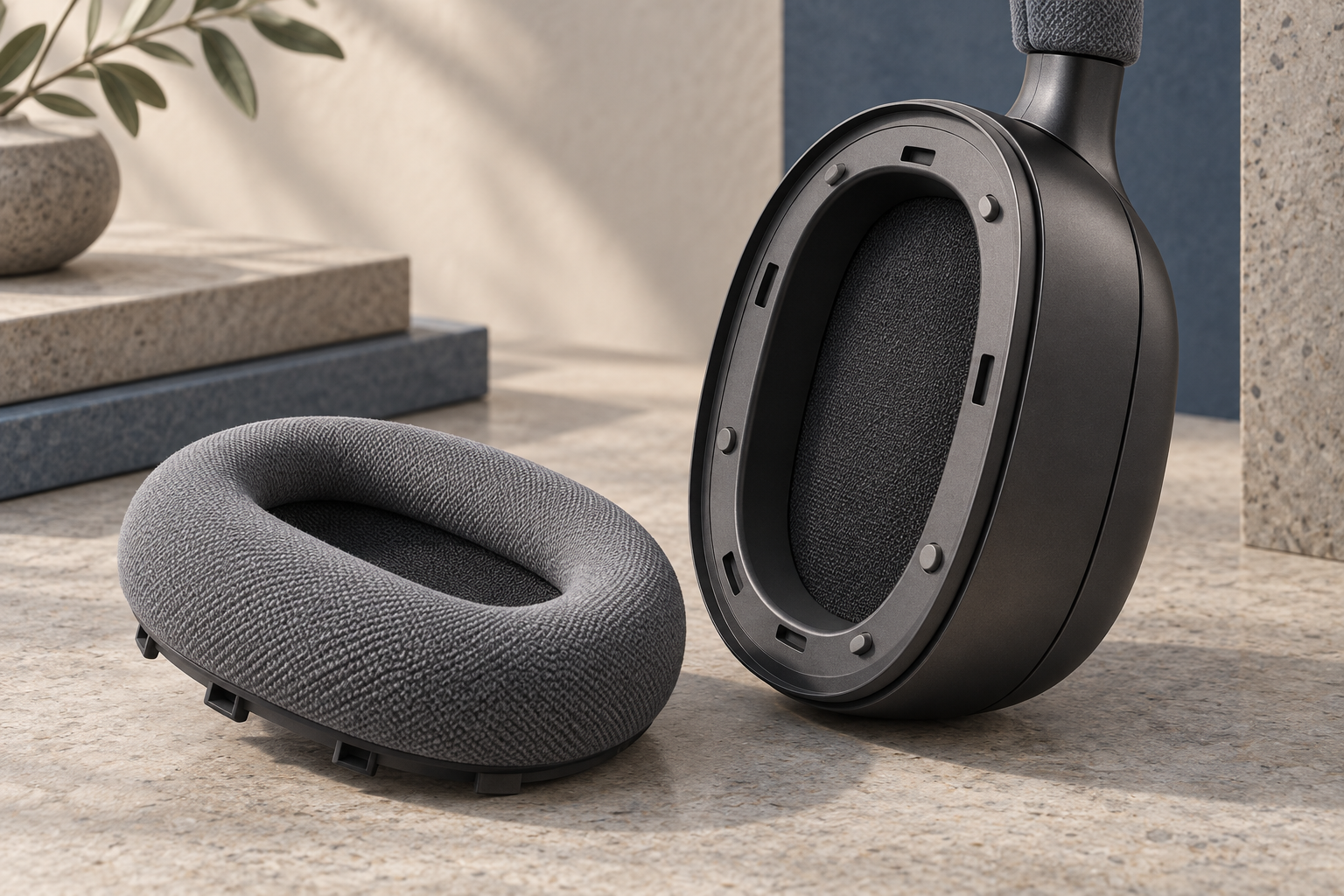
AI-generated attachment study, not Beats engineering or a tested mechanism.
Approve a family, not just one attractive sample
Color and material changes can alter more than appearance. For a cushion concept, the team should evaluate the dimensions and surface behavior that affect its function. Define which properties must remain consistent across variants, and which differences are intentional. Do not assume that one successful sample validates every alternative finish.
A practical review matrix can connect each variant to attachment fit, repeated handling, comfort evaluation, cleaning instructions, and appearance after use. The relevant criteria depend on the product. A luggage grip, a wearable strap, and a headphone cushion should not inherit the same test plan merely because all three are removable.
Use prototypes at different levels of fidelity. A rough model can expose confusion about orientation; a representative attachment can explore retention; production-intent materials are needed for questions that depend on the final surface. Record what each build can and cannot establish so visual polish does not become a substitute for evidence.
The accessory shelf belongs in the design brief
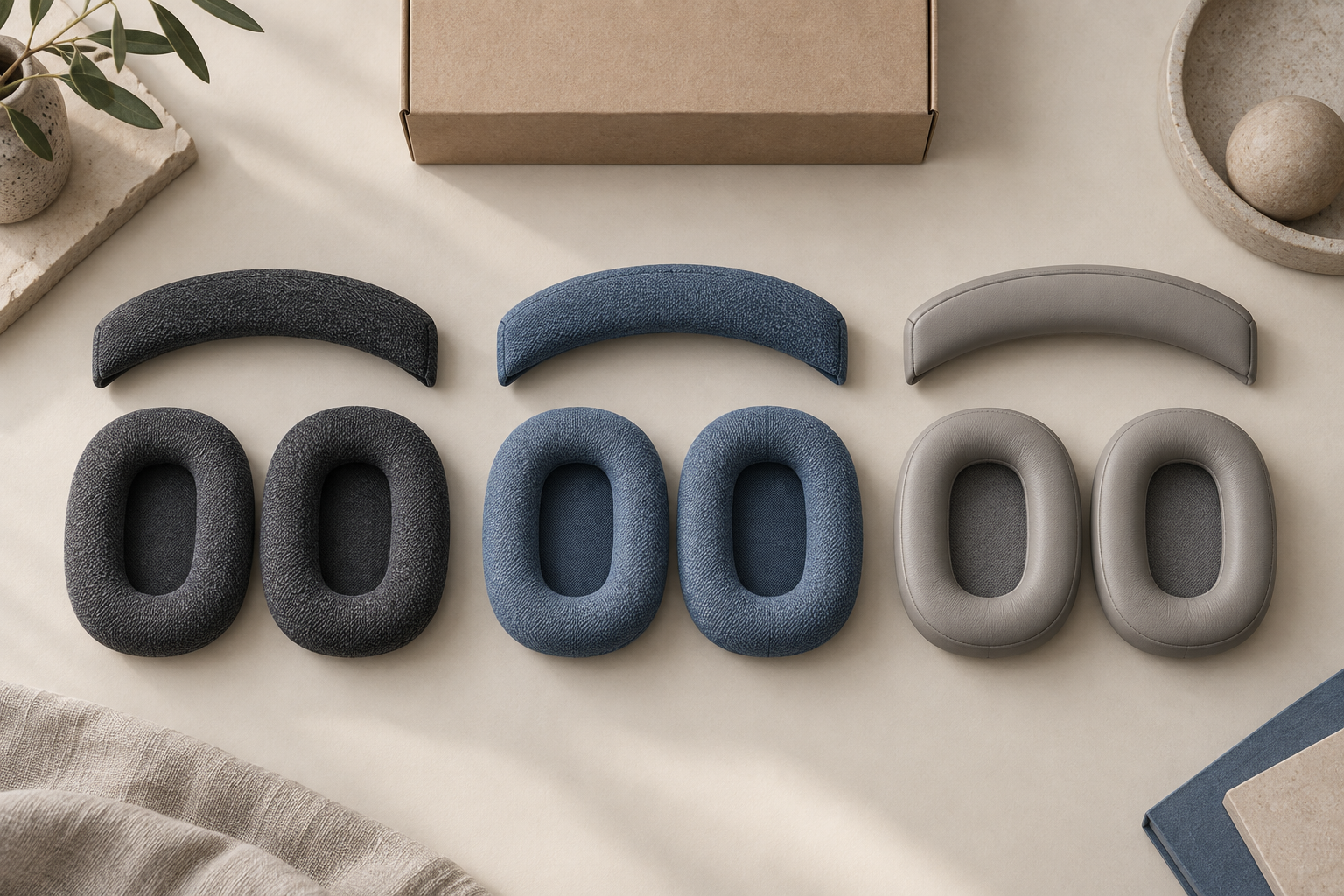
AI-generated conceptual accessory family, not Beats products.
Customization continues after the first purchase. Owners need to identify the compatible part, understand what a kit contains, and distinguish a desired variation from a different product generation. Product naming, packaging, and service information therefore become part of the physical system.
Before approving a range, map the combinations the company is prepared to support. Decide how a customer will recognize compatibility if colors or materials change later. Consider whether an individual lost or damaged piece can be replaced, and explain the actual offering clearly. A design team should not promise open-ended availability that the business has not committed to provide.
Interchangeability also does not, by itself, prove a longer product life or a lower environmental impact. Those outcomes depend on durability, continued parts access, user behavior, and other evidence. Treat replaceability as a capability to substantiate, rather than an automatic sustainability claim.
The useful lesson from this launch is to design the product and its future variations together. A customizable surface needs a clear purpose, a legible attachment, consistent interfaces, and a supportable range. If your team is planning a modular consumer product, discuss the product and accessory brief with Jackson Hedden.
Product facts are attributed to the linked sources. The remaining recommendations are design analysis. Images are AI-generated generic concepts, not Beats products, engineering drawings, or tests performed by Jackson Hedden.