iPhone Duo: What Foldable Design Teaches Product Teams
Design news and analysis · Updated September 23, 2026
Apple announced iPhone Duo on September 9, introducing a folding iPhone with a 5.4-inch outer display and a 7.6-inch inner display. Apple says the two screens share an aspect ratio and that the interface adapts as the device folds and changes orientation. Availability is announced for October 23. These are launch details, not evidence of long-term performance. Source: Apple's announcement.
For product teams, the interesting design question goes beyond adding screen area: can a change in physical form preserve a person's understanding of what the object is doing? That question matters to folding furniture, adjustable appliances, convertible tools, and wearables as much as it does to phones.
Design the transition, not just the two endpoints
A product presentation naturally favors clear states: closed and compact, then open and expansive. Daily use includes the uncertain space between those states. A person pauses halfway through opening, turns the object, changes grip, or puts it down before finishing a task.
Our design interpretation is that these transitions deserve their own requirements. What should remain visible? Which action should continue? Which controls must be protected against an accidental touch? Answering those questions early is more useful than treating the mechanism and interface as separate workstreams until the final prototype.
Apple's announcement describes continuity across the two screens and a side-button fingerprint sensor. That illustrates a broader strategy: preserve a recognizable reference point while the surrounding form changes. The principle does not prescribe a particular sensor or interface. It asks the team to choose which elements should feel stable through the transformation.
Give each physical state a reason to exist
A second configuration adds complexity even when it looks compelling. The design brief should name the task that earns that complexity. Opening a device might support comparing two documents; folding a kitchen tool might improve storage; adjusting a light might reduce glare at a work surface.
Describe the value as a user outcome, then test whether people actually choose the intended state. If participants keep completing a task in the compact configuration, investigate why. The expanded version may be uncomfortable, slow to reach, or simply unnecessary for that task. More capability on a specification sheet does not automatically become a better experience.
This is where product design benefits from a specific behavioral brief. Instead of asking for a transformative object, identify who changes it, under what conditions, how often, and what benefit should be apparent immediately afterward.
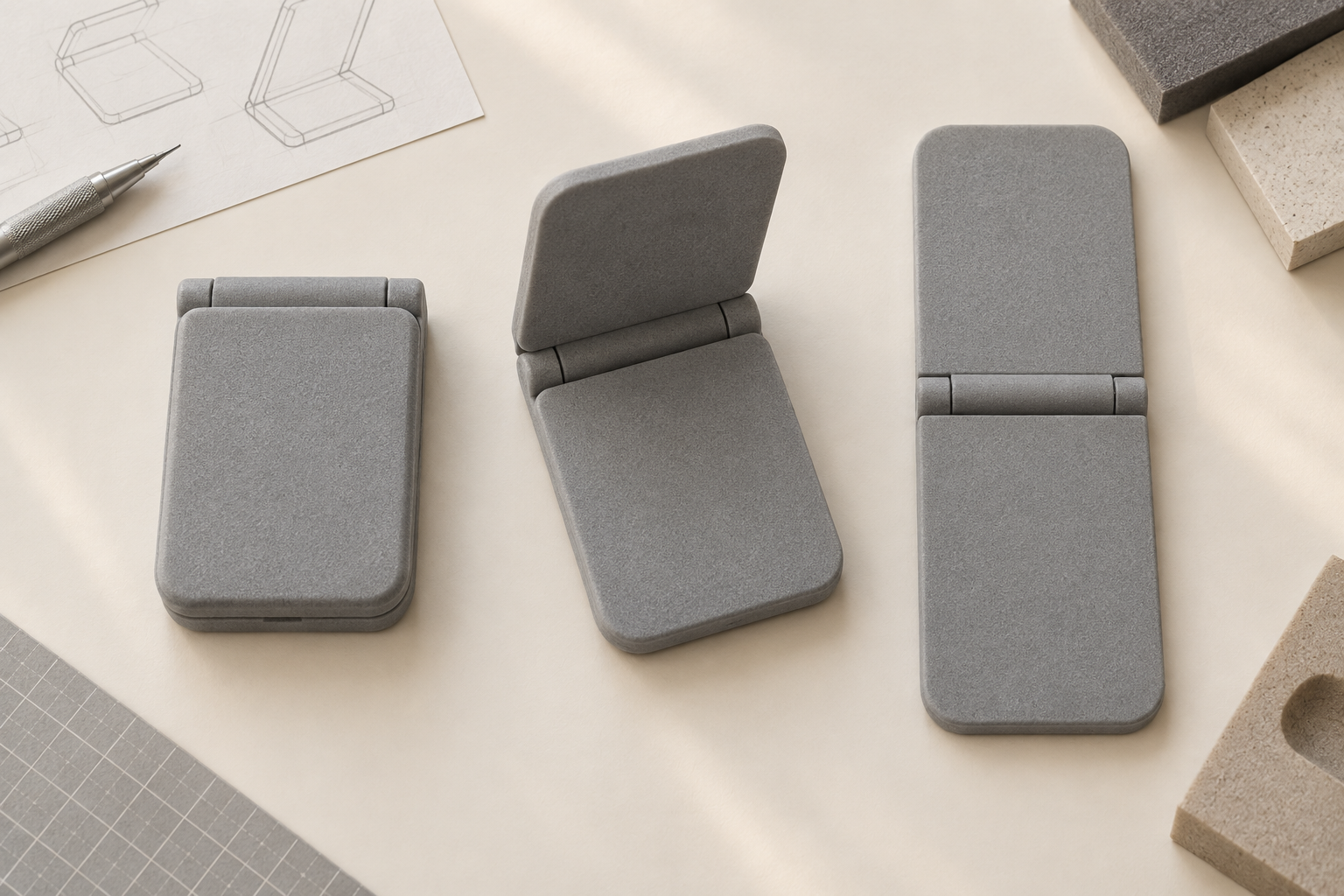
AI-generated conceptual illustration. Not an Apple product or an actual studio test.
Make the mechanism communicate
A moving joint communicates through resistance, sound, alignment, and stopping behavior. Those qualities can help someone understand whether an object is secure or still moving. They can also conflict: a firm detent may feel reassuring while making the action harder for someone with limited grip strength.
Prototype that tradeoff deliberately. Compare alternatives while keeping the rest of the form similar. Observe whether people use one hand or two, where they brace the object, and whether they pinch or avoid particular edges. Do not infer accessibility from a single successful demonstration.
Include interruptions in the study. Ask participants to put the object down midway through an action, pick it up from an unfamiliar orientation, or return to a task after looking away. These moments reveal whether the physical design explains its own state or depends on instructions that users will forget.
Separate launch promises from evidence
A new product announcement can explain intended behavior and engineering choices. It cannot establish years of everyday reliability. At this stage, our analysis concerns the design problem; Jackson Hedden has not conducted hands-on or durability testing of iPhone Duo.
For your own product, build a verification plan that matches how the mechanism will be used. Identify repeated motions, awkward loading, contamination, transport conditions, and foreseeable misuse. Define the observations that count as failure before running the study. An object may still function mechanically while its feel, alignment, or visual quality has deteriorated beyond what the brand considers acceptable.
Bring those criteria into discussions about materials, tolerances, and assembly. Otherwise, a late improvement to one attribute can create a new problem elsewhere. A tighter fit might alter operation; a finish change might alter friction; a different component might change how the assembly is serviced.
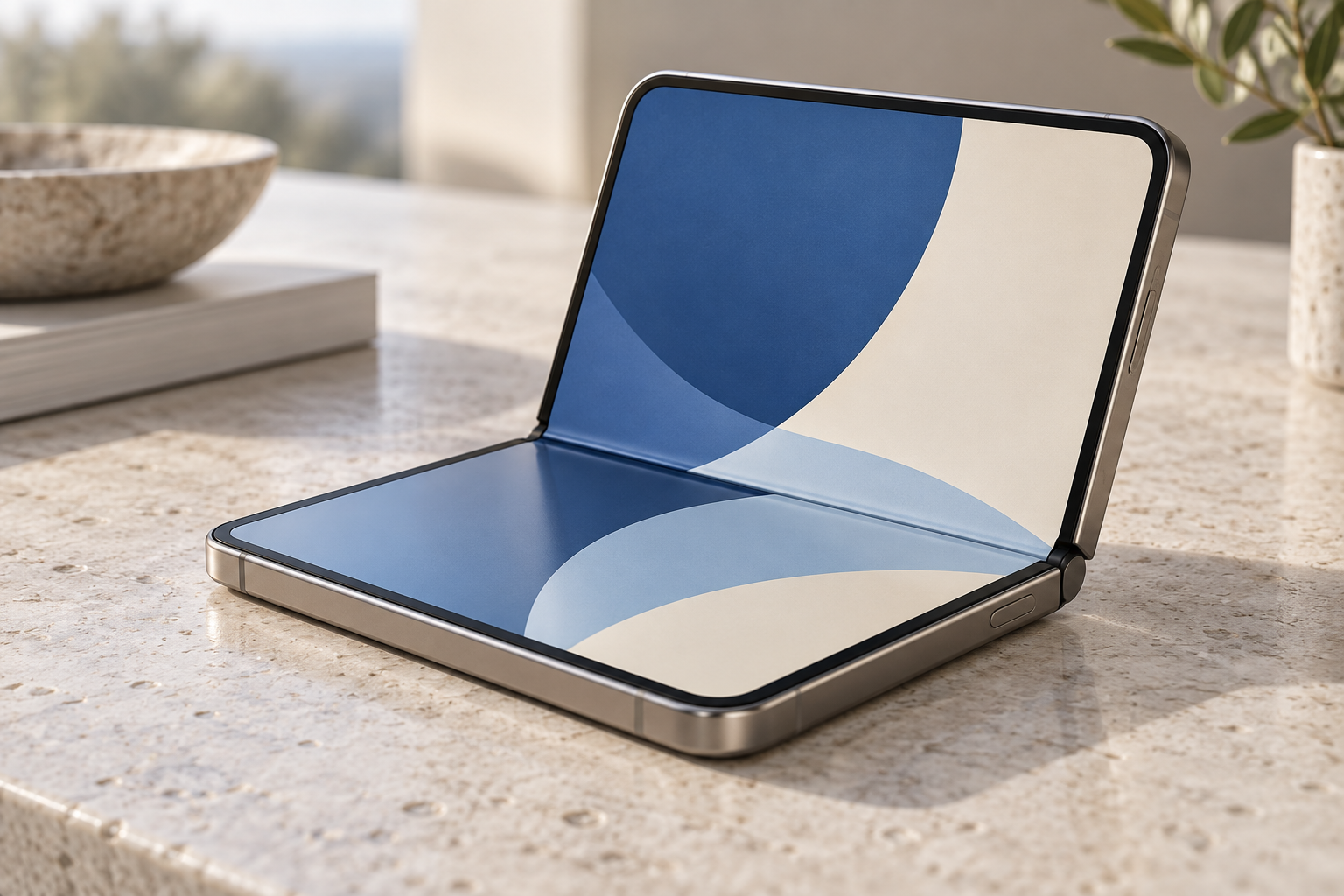
AI-generated conceptual illustration. Not an Apple product or an actual studio test.
A practical brief for products that change shape
Start with three models. Use a simple form model to study size and grip, a mechanism model to study movement, and an interactive prototype to explore what information persists through the transition. They do not need the same level of finish. They need clear questions.
Connect findings through a shared task sequence. Record the starting state, intended action, physical response, interface response, and recovery from an interruption. Prototyping becomes more useful when each iteration resolves a specific uncertainty rather than adding polish everywhere at once.
The lesson from this launch is a design priority, not a prediction of commercial success: if a product changes form, design the moment of change as carefully as the final shape. A coherent transition can make complexity understandable. An unexplained transition can leave even an impressive object feeling uncertain.
Developing a product with moving parts or multiple modes? Talk with Jackson Hedden about aligning form, interaction, and the path to production.
Images are AI-generated conceptual illustrations of generic devices and prototype studies. They do not depict iPhone Duo or testing performed by Jackson Hedden.