Caraway’s Coffee Maker Tests the Appliance Brand Extension
Design news and analysis · September 23, 2026
Caraway announced its first powered appliance on September 22: a 10-cup coffee maker priced at $495. The company describes a glass and stainless steel brew path, a single control dial, and removable components intended to simplify maintenance. For a brand associated with cookware, the launch expands the design challenge from an object people handle to a machine that must communicate what it is doing. These details come from Caraway’s launch announcement; they are manufacturer descriptions, not findings from a Jackson Hedden test.
There is an availability distinction worth preserving. Although the announcement describes availability beginning September 22, the product page checked on September 23 showed an estimated October 30 ship date for the displayed Cream option. A launch date does not necessarily mean immediate delivery for every configuration.
A material promise becomes a system requirement
Caraway’s stated brew-path construction gives the product a specific proposition. The useful lesson for another brand is how an easily understood customer promise can constrain a much larger engineering system. A materials decision affects the interfaces between components, the assembly sequence, the way parts are handled, and the instructions that accompany them.
For a team developing a new appliance, the first exercise is to draw the complete path of the substance the customer cares about. Identify every junction and surface, including the places that disappear behind the enclosure. Then separate what the team has specified from what it has verified. A broad claim about the entire product should not stand in for a precise description of one subsystem.
That discipline also improves the design brief. Instead of asking for a premium feel in the abstract, specify which surfaces people see, touch, fill, empty, or clean, and what evidence will support the intended material claim. This is where consumer product design connects a brand proposition to decisions that can actually be evaluated.
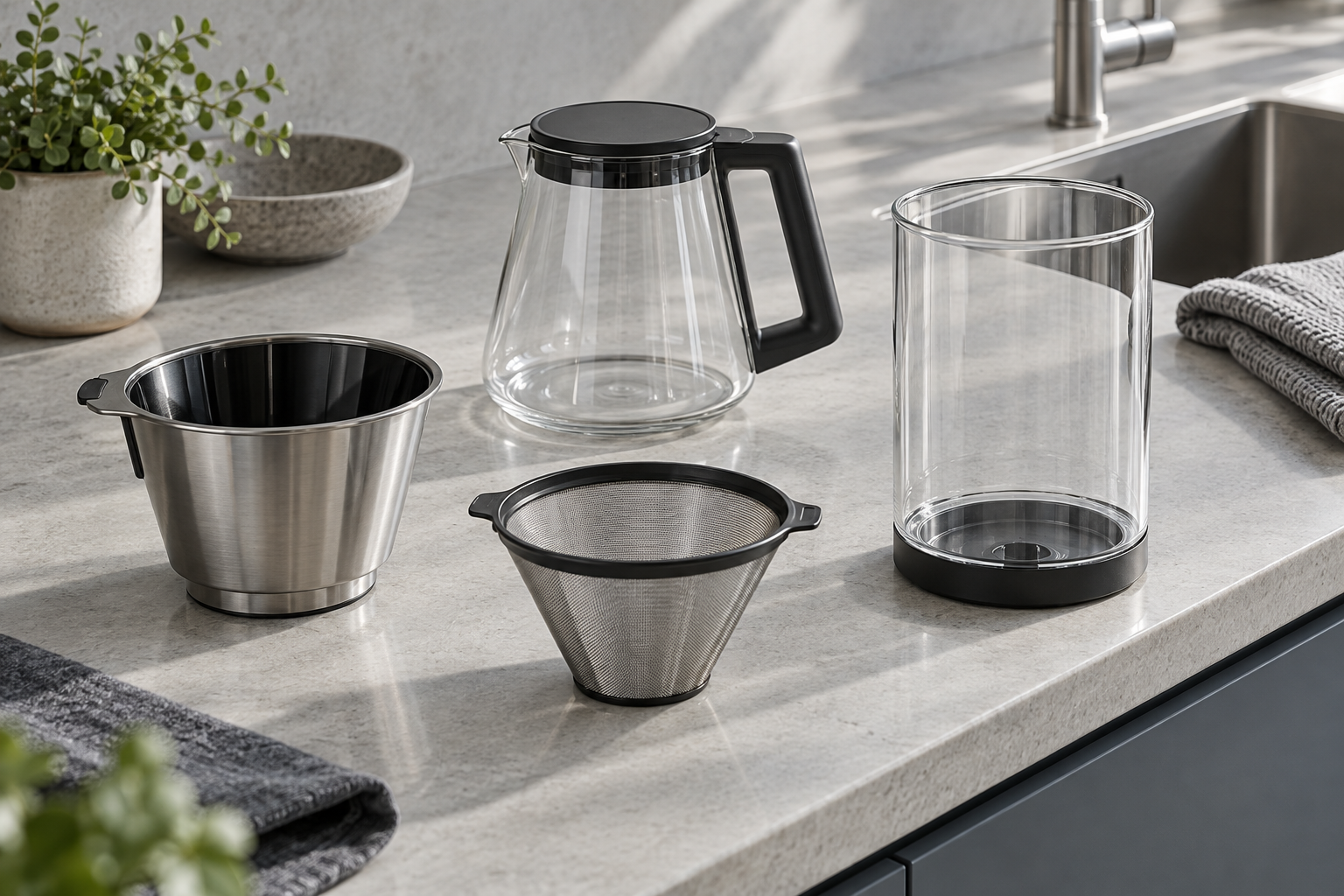
AI-generated conceptual illustration of a cleaning workflow, not Caraway components.
Cleaning deserves its own design review
Brewing is only one episode in a coffee maker’s life. Filling, carrying, pouring, emptying, rinsing, drying, and reassembling are separate interactions. The space required for those activities can exceed the appliance’s footprint on the counter.
A useful concept review therefore includes the sink and the drying area. Can a person hold a removable component securely when it is wet? Does its opening admit the intended cleaning tool? Where does residual liquid go when the part is lifted out? Can it rest on the counter without an awkward balancing act? These are questions to investigate, not conclusions about Caraway’s execution.
Removability introduces a tradeoff. Separating a part can improve access, while also creating another item to carry and reinstall. A fixed assembly may reduce handling but make some surfaces harder to reach. The design team should test the whole sequence before deciding that either arrangement is simpler.
For early prototyping, full-size handling models can reveal clearance and grip problems. A nonfunctional model will not establish cleaning effectiveness or thermal behavior. Those questions require suitable working prototypes and defined evaluation conditions.
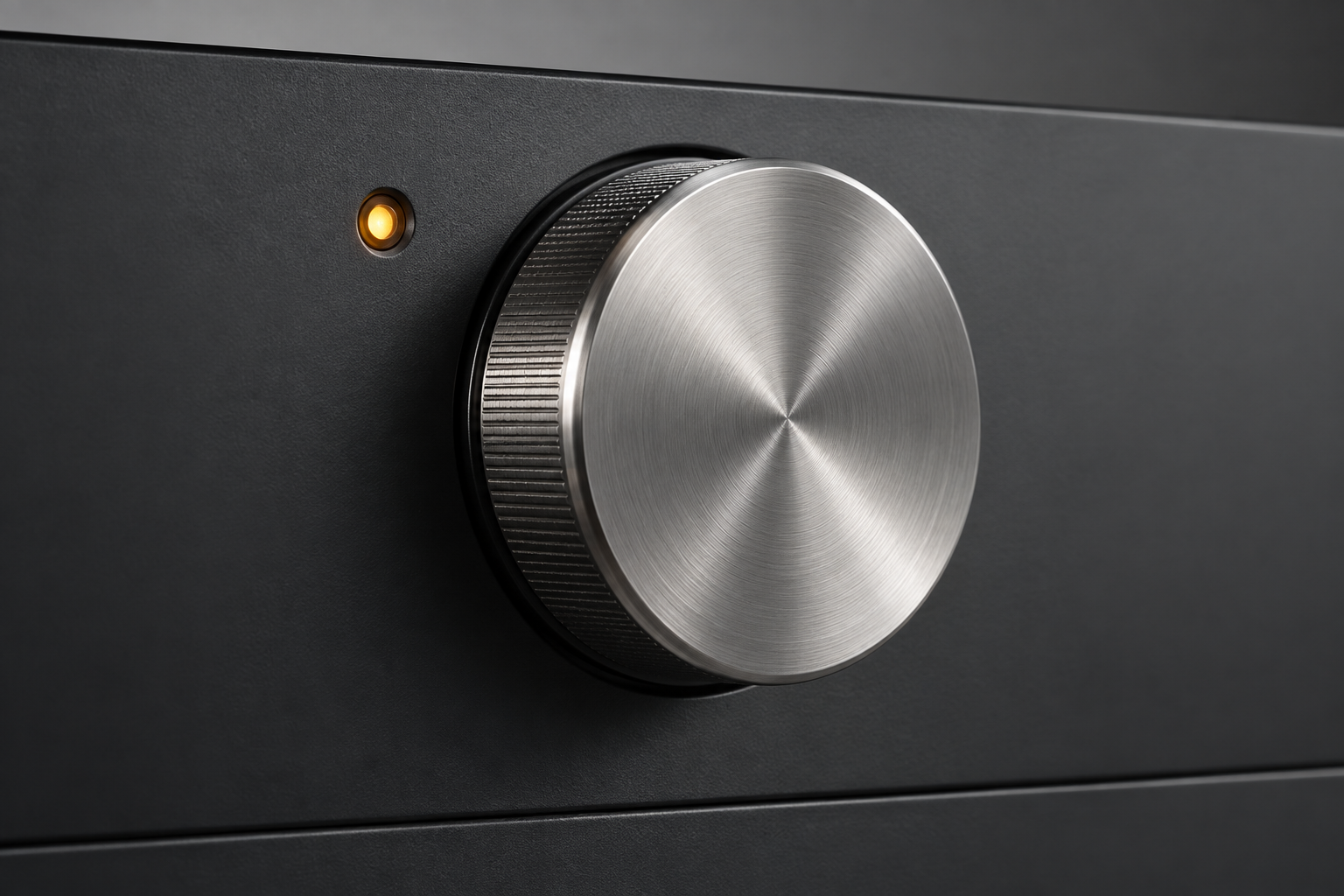
AI-generated conceptual control study, not Caraway’s interface.
One dial still needs a clear conversation
Reducing the number of controls can create a calm appearance. It does not automatically reduce the amount a person must understand. A machine can be ready, operating, waiting for an action, or requiring attention; the user needs to distinguish those states even when the front panel is restrained.
For an appliance concept with one primary control, write down the intended action and expected feedback at each stage. What tells someone that an input registered? What distinguishes a routine pause from a problem? How can a person cancel an unintended operation? If several meanings depend on remembering different gestures, the visual simplicity may be hiding a more demanding interaction.
A second control is not inherently a failure of minimalism. It may make a less frequent but important action easier to find. Conversely, a display can create unnecessary complexity if its information does not help anyone make a decision. Judge the interface by comprehension during the routine, rather than by a count of buttons.
A brand extension must earn repeat use
A familiar color palette can make an appliance feel related to existing kitchenware. Repeat use asks for more: predictable operation, understandable maintenance, and support when a component needs attention. Those responsibilities should enter the brief alongside form and finish.
For founders considering a move into powered products, define the ownership experience before approving the exterior. List the replaceable components, the instructions customers will need, and the questions a support team should be able to answer. Then identify which promises are supported at launch and which still depend on validation.
Caraway’s announcement makes this transition timely. Its ultimate performance requires evidence beyond a launch release. The design opportunity is clear enough to act on now: turn the brand’s central promise into explicit requirements for construction, interaction, and care. If your team is preparing that transition, discuss the appliance brief with Jackson Hedden.
Editorial note: Product facts are attributed to Caraway. The recommendations are design analysis, not a hands-on review or a health claim. All illustrations are AI-generated concepts and do not show Caraway’s product, internals, or testing.