ProClad’s Hybrid Pan Makes Surface Geometry the Story
On October 5, 2026, ProClad announced the retail launch of its Hybrid 2.0 frying pan, a three-ply stainless steel and aluminum pan with raised steel ridges over a ceramic nonstick surface. The company says the raised geometry protects the coating from direct utensil contact. Its announcement describes 8-, 10- and 12-inch sizes, a sealed rim, a flat-grip handle and prices starting at $109. These are manufacturer specifications and claims; independent performance testing was not available in the announcement.
The design challenge is familiar: combine the confidence of a metal cooking surface with nonstick release, without making the product cumbersome or difficult to clean. The more useful story is not whether one pan has solved every cooking problem. It is how the shape of a surface, the hand on a handle and the edge around a body all affect the everyday promise.
Protecting a coating changes the cooking surface
ProClad describes raised stainless ridges that sit above recessed ceramic coating. In principle, the steel takes some direct utensil contact while the lower areas provide release. That geometry makes protection part of the cooking interface, not simply a hidden material treatment.
It also creates design questions that need testing. How high must a ridge rise to shield a coating without making food contact uneven? How do the channels affect stirring, spatula access and cleaning? Does residue collect where two materials meet? The company’s release does not report comparative cooking trials or long-term coating wear, so those remain open questions rather than proven advantages.
For teams commissioning consumer product design, a surface feature should be evaluated across the whole use cycle. A protective pattern can help in one action and add friction in another. Cooking, serving, washing and storing the pan all place different demands on the same geometry.
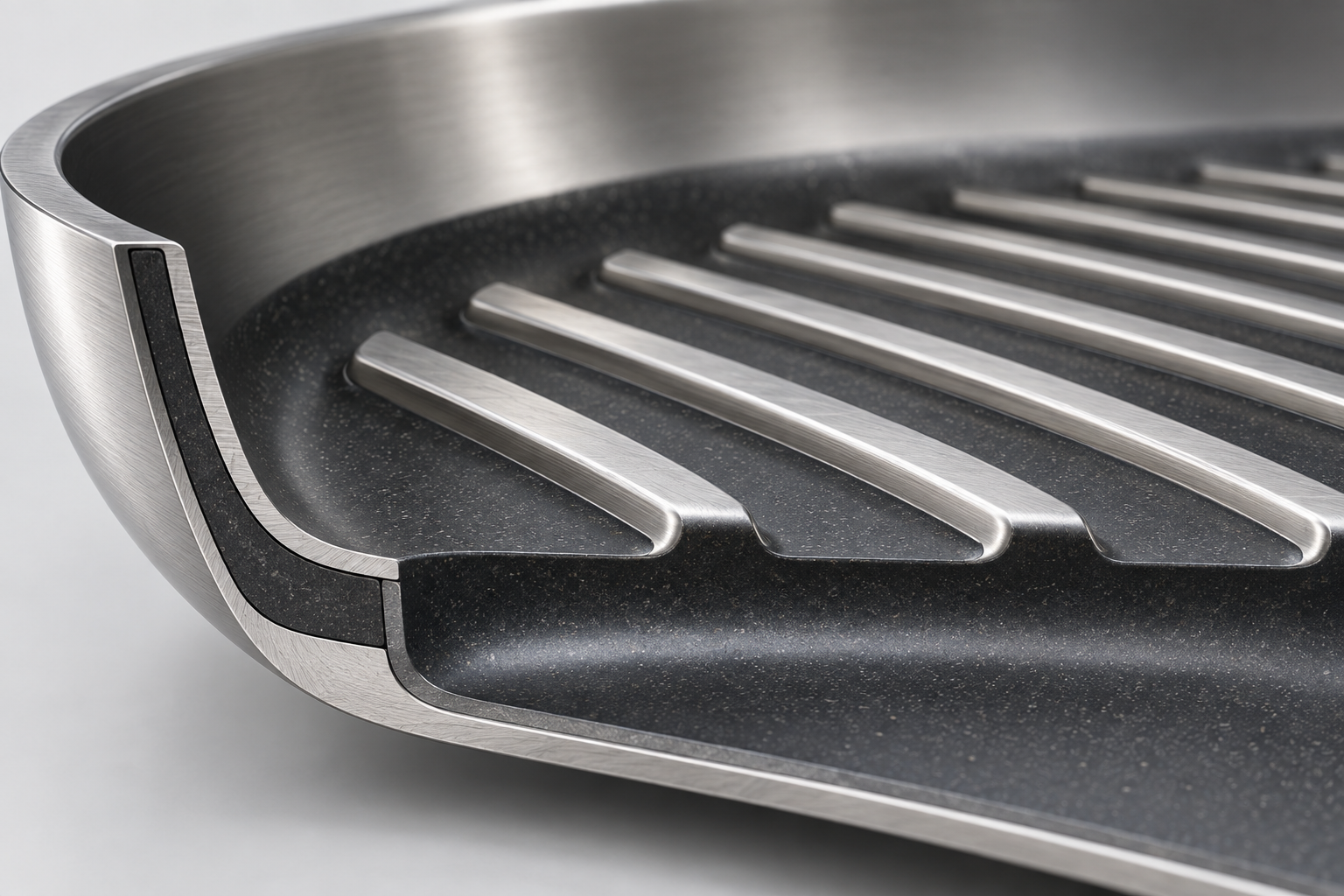
Conceptual surface study; this is not a rendering of ProClad’s actual pan or its exact specifications.
The handle carries the pan’s weight and its identity
ProClad says its stainless steel handle uses a flatter grip shape, intended to resist rotation or slipping when lifting, tilting, pouring or flipping. That is a reasonable human-factors goal: cookware is controlled through the wrist and hand, often while the user is managing hot food and other tasks.
But “flat” is not automatically more comfortable or secure for every hand. Handle length, cross-section, edge radii, surface temperature, pan balance and the location of the load all interact. A grip that feels stable during a showroom lift may feel different when the pan is full or the user is pouring one-handed. The useful next step is comparative handling with varied hand sizes and realistic loads, not inferring performance from an attractive render.
When a handle is a differentiating feature, prototype its geometry early. Teams can test balance and wrist posture using weighted mockups before committing to final tooling. Prototyping can expose whether the grip and pan body work as one object rather than as separately optimized parts.
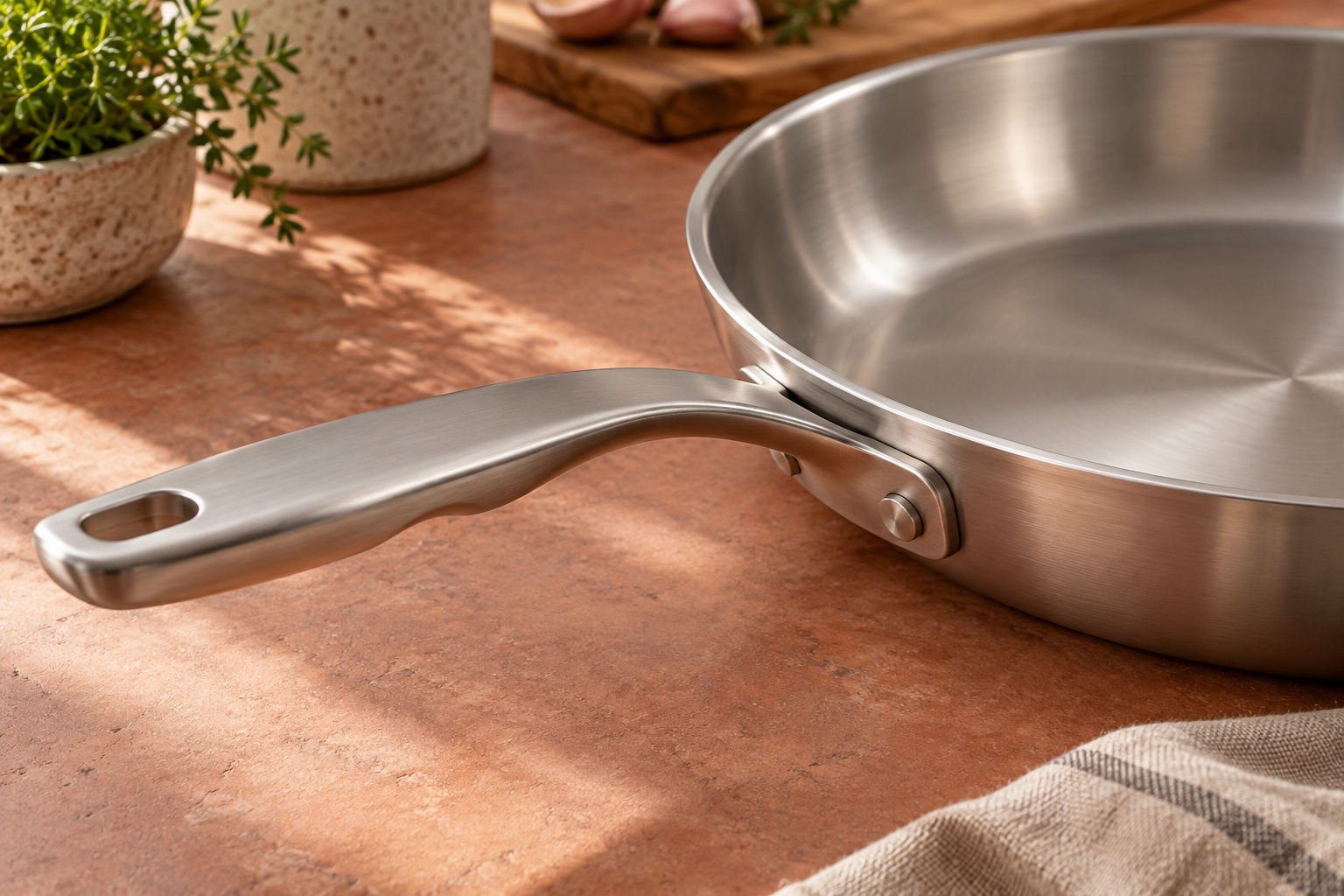
Illustrative design study of grip and rim transitions, not a product photograph or validated specification.
A sealed rim makes a small edge a long-term decision
The company also says the pan’s rim seals the aluminum core beneath stainless steel. An exposed edge is easy to overlook in a product image, yet it sits at the boundary between layers, washing, abrasion and repeated handling. Managing that transition can support a cleaner feel and reduce direct exposure of the core, if the construction performs as intended.
Every closure detail comes with manufacturing and inspection demands. The rim must be consistent around its circumference; finishing must avoid sharp transitions; and the joint needs to tolerate normal cleaning and thermal cycling. A sealed edge can be a meaningful design decision, but it should be evaluated as a repeatable production feature, not only a benefit statement.
ProClad has announced a lifetime warranty against manufacturing defects and a 100-day satisfaction guarantee. Those policies are relevant to the ownership offer, but they do not establish that a nonstick coating will last forever. The company itself distinguishes the pan body from the wear life of the coating in its earlier campaign materials. A credible durability story should name which part is expected to age, how the user can recognize wear and what remedy applies.
Design the use sequence, not only the launch claim
The launch announcement presents a product built around competing cooking expectations: release, searing, cleaning, grip and durability. A team developing a similarly hybrid object should test those tradeoffs in ordinary sequences. Ask users to cook with different utensils, move food through the ridges, wash the surface and store the pan in a crowded cupboard. Observe what needs explanation and what remains intuitive after the first use.
That approach applies beyond cookware. Protective textures, layered materials and carefully shaped grips only earn their place when the benefit survives everyday handling and maintenance. If your team is weighing a material or interface compromise in a consumer product, talk with Jackson Hedden about the design challenge.