Honda’s Retrofit Alert Demo Puts Installation in Focus
On October 5, 2026, Honda announced that its CEATEC exhibit will demonstrate a driver-assistive smartphone app paired with an aftermarket vehicle camera. Honda describes a system that detects nearby road users, assesses potential risks and provides visual and audible alerts. The October 13–16 event is a demonstration, not a confirmed consumer release. Honda’s announcement frames the work as development for both new and existing vehicles, including motorcycles.
The product design question is how to make an added system feel dependable in a vehicle it did not originally belong to. A camera, mount, cable, phone and alert each create decisions that affect the experience. Our analysis focuses on those integration decisions; we have not tested Honda’s system or its safety performance.
A retrofit product has to earn its place
A factory-installed system can be developed around known mounting points and vehicle geometry. A retrofit accessory meets an existing environment with fewer assumptions under its control. The designer has to consider what the user can install, what they can accidentally misalign and what they can recognize as a problem.
For a camera accessory, the industrial design brief extends beyond an attractive enclosure. The bracket must communicate its adjustment range. Cable routing must fit the intended installation. Instructions should show a correct setup without implying that any convenient location will work. These are proposed design requirements, not specifications Honda has published for a retail kit.
Different installation approaches have different consequences. A permanently attached mount may reduce repeated setup but complicate removal or transfer. A removable mount can support portability while introducing another opportunity for misalignment. A professional installation service may reduce user burden but changes distribution, support and cost. The right approach follows the intended customer and validated operating conditions.
For teams commissioning consumer product design, the useful lesson is to include the surrounding object in the brief. Designing only the accessory leaves important interactions to chance.
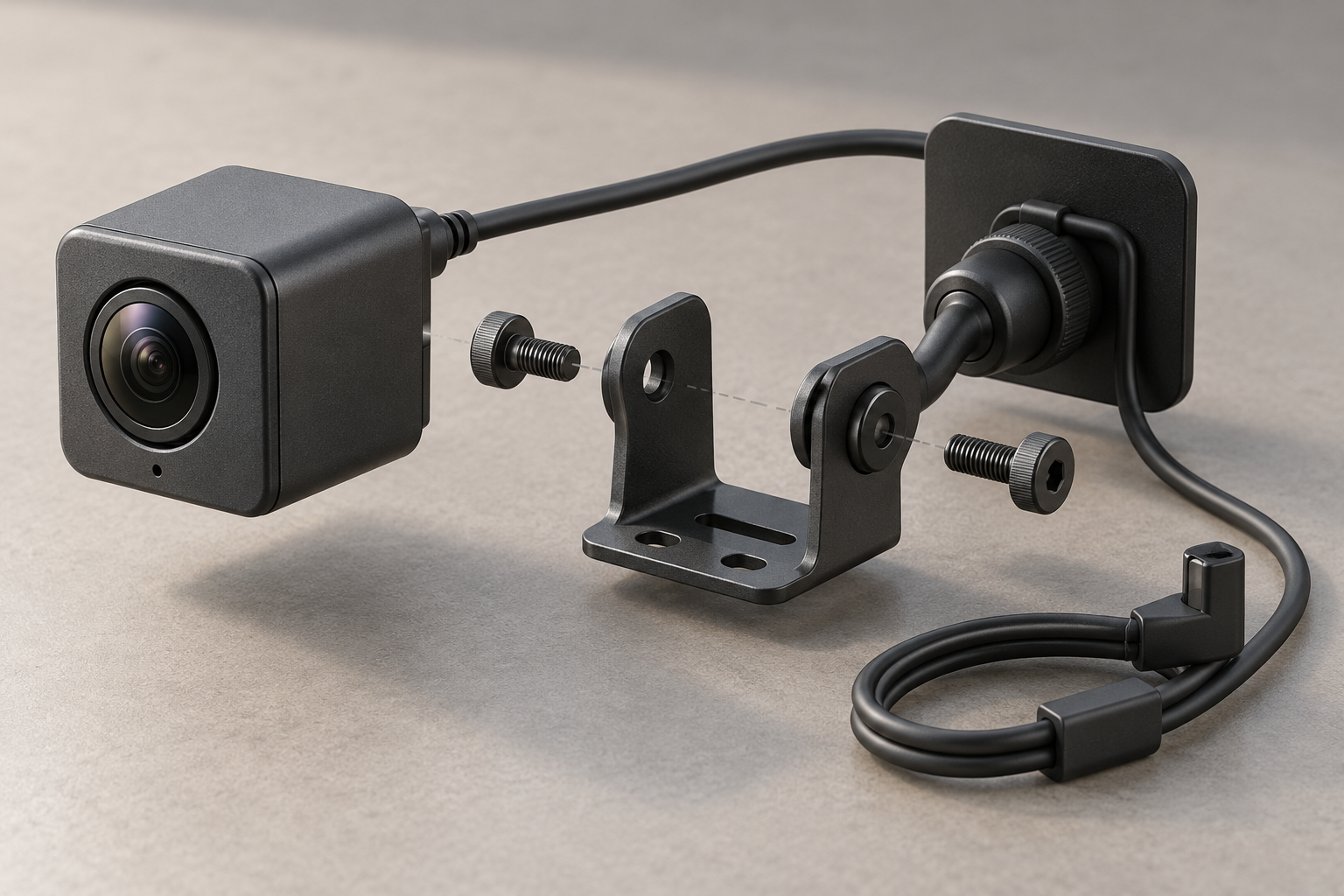
Conceptual illustration of a retrofit mounting study, not Honda hardware or an engineering specification.
Attention is a limited interface resource
The announcement’s combination of visual and audible notifications creates a human-factors question: how should an alert communicate urgency without demanding an unnecessary glance? A warning can be noticeable yet difficult to interpret, especially when a person is already managing movement, sound and other controls.
Our proposed evaluation would separate detection from interpretation. Can a user notice the signal? Can they identify what it means? Is the required response clear? A larger or brighter signal does not automatically answer all three questions. Its position, timing and relationship with other cues need to be studied together.
A product team should also decide what normal operation looks like. An interface that continuously asks for attention risks competing with the activity it supports. An interface that disappears completely may leave the user uncertain whether it is functioning. A restrained status cue, a clear unavailable state and a setup check are different design tools, each with its own burden.
Honda’s earlier technical overview describes a USB-camera-to-smartphone architecture and a wave-like screen color change for notification. That earlier document shows the development predates today’s exhibit announcement. It does not establish that the forthcoming demonstration uses an unchanged interface or that a particular alert is effective for every user.
Trust depends on showing the limits
Assistive products need a language for uncertainty. Users should not have to infer availability from the absence of a warning. A blocked camera, lost connection or incompatible setup can be a different condition from a clear scene; a design review should examine how those distinctions would be communicated.
The same thinking applies to less consequential consumer products. A connected doorbell, home sensor or wearable can create misplaced confidence when its status is ambiguous. Clear product behavior is part of the promise, alongside sensing and computation. Teams should define what the device knows, what it cannot establish and what the user needs to do next.
Independent Car Watch coverage dated October 5 corroborates the planned CEATEC demonstration. That is confirmation of the exhibit news, not independent validation of collision prevention. Honda’s announcement provides no consumer launch date, retail price or quantified field-performance results. Those unknowns should remain visible in any assessment of the opportunity.
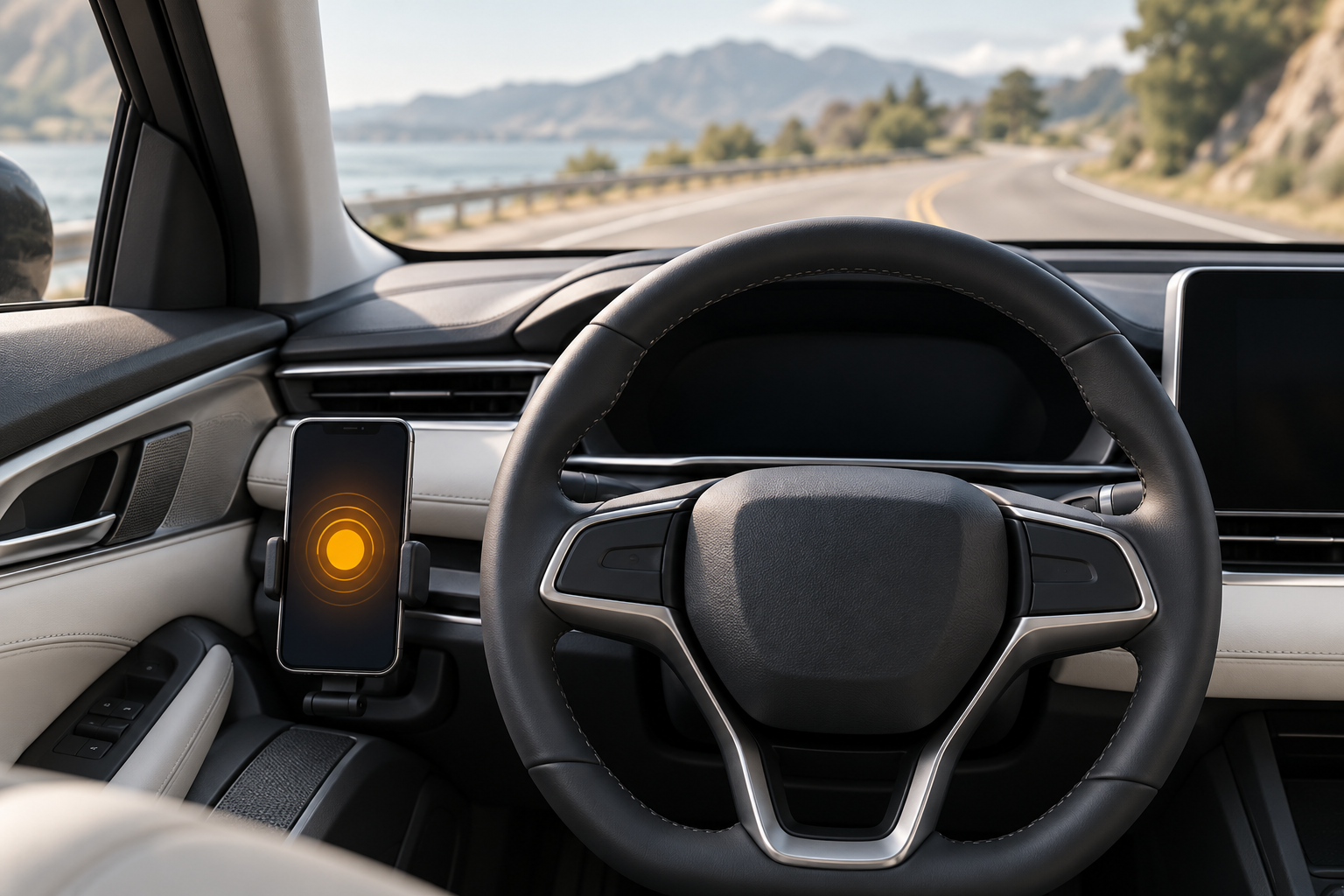
Illustrative design study of alert placement, not Honda’s interface or a validated driving configuration.
Prototype the installation and the interruption
The practical next step for a product team is to test complete sequences, not only an ideal demonstration. Begin with installation, then examine everyday interruptions: disconnecting a phone, moving a mount, restarting the system or handing the vehicle to another user. The goal is to find where the intended mental model stops matching the product’s state.
Early prototyping can compare enclosure and mount concepts alongside interface cues before the team commits to a final architecture. Physical mockups can reveal placement and handling problems; interaction prototypes can reveal confusing states. Neither substitutes for the specialist validation needed to support safety claims.
Today’s news is a useful reminder that a retrofit product succeeds or fails across boundaries. Its enclosure, host object, installation and feedback belong in one development conversation. If your team is working through a connected accessory or mobility interface, discuss the product challenge with Jackson Hedden.