A simpler product can ask more careful questions of its designers. On November 5, 2026, Sony announced the MDR-3R, wired USB-C headphones that revisit the form of its early Walkman headphones. The useful design story is how a familiar object moves into a different device ecosystem.
Sony describes a lightweight, open design with blue and orange ear pads, a microphone and an inline remote. It says compatible devices need no charging or pairing. That gives product teams a concrete question: which steps can disappear from the user’s routine, and where does the resulting complexity go? These details come from Sony’s announcement; the implications below are studio analysis.
Count the steps before counting the features
For a team defining a new accessory, the first comparison should be a use sequence. What must happen between taking the product out of a bag and completing the task? What happens after a week without use? Which failure can the user diagnose without opening a support page?
A wired connection can make that sequence easy to understand: connect, listen, disconnect. It also adds a physical tether. A founder should put both experiences into the brief. Removing a setup screen has little value if the cable repeatedly catches on clothing or makes the intended posture awkward.
This is where industrial design and product definition need to stay connected. A requirement such as “easy to use” becomes useful when it describes a task, a setting and an observable outcome. The number of features alone will not tell a team whether it improved that outcome.
A familiar connector still needs a compatibility plan
Sony’s footnotes qualify the plug-and-play story: the headphones support USB Audio Class 1.0 devices, and behavior can depend on the device, operating system or application. Sony also says use with a Walkman is not recommended. The visual connection to the original listening experience therefore does not establish compatibility with every player carrying the same heritage.
The broader lesson is to separate connector recognition from functional compatibility. At a design review, a USB-C plug may look like a completed decision. For a product team, it should open a validation matrix: intended host devices, calls, playback controls, cases that obstruct insertion and recovery after unplugging.
That matrix should guide prototypes and packaging language. If a function has limits, the customer needs to encounter the limit before relying on it. Clear compatibility information is part of the interface, even when it lives on a box or support page.
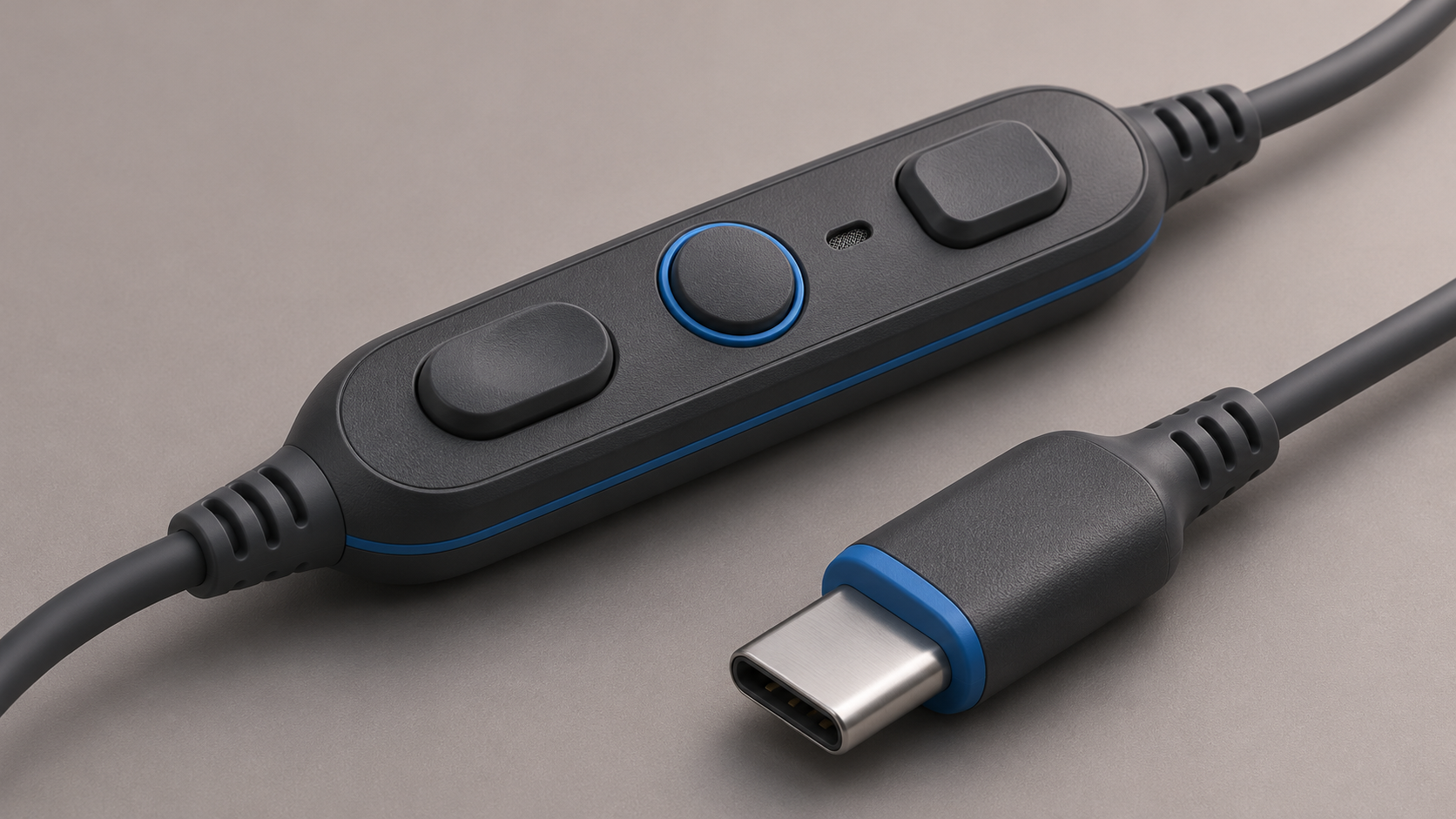
Illustrative design study of remote controls and cable interfaces. Geometry is conceptual and does not document Sony’s construction.
Give the small physical details a real test
Once interaction moves onto a cable, the inline remote becomes an important touchpoint. A useful evaluation would ask whether someone can distinguish its buttons without looking, find the microphone position and operate it while the cable moves. Those are proposed checks for an accessory program, not findings from testing the MDR-3R.
The same discipline applies to fit. A light-looking silhouette cannot establish comfort across different heads, hairstyles or glasses. Teams should compare headband force, contact area and adjustment behavior with physical models, then define how those judgments carry into production samples.
Foam, cable jackets and strain relief also deserve attention beyond the launch image. Ask how parts feel after repeated handling, how the cable leaves the housing and what happens when a user pulls the wrong section. Our prototype-to-production guide provides a framework for organizing development; the product’s actual use cases should determine its test plan.
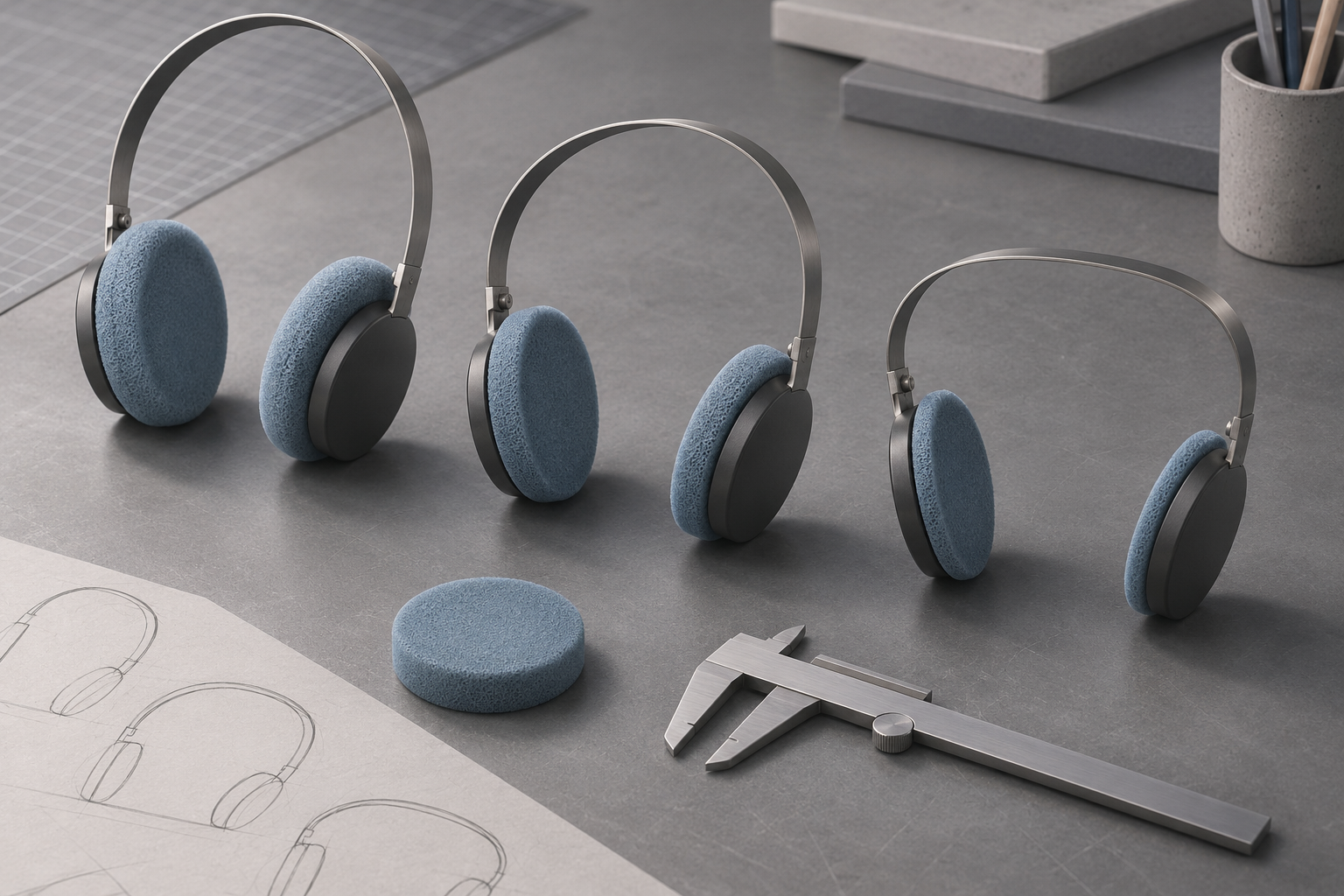
Conceptual illustration of fit prototypes. No measurements or test results are represented.
Keep heritage and engineering on separate review tracks
A recognizable form can give a product an immediate identity. It can also make teams reluctant to change a proportion or seam that no longer suits the hardware. A practical review separates the cues people recognize from the details required to support the current use.
For a heritage-led program, that means recording which elements carry recognition, then checking which can accommodate today’s connector, controls and assembly process. Preserve a cue because it serves the experience. Revise it when physical testing exposes a problem. Neither choice should depend entirely on whether a render looks convincingly vintage.
What a founder should take into the next review
The MDR-3R announcement offers a useful starting point for a narrower product brief. Map the tasks customers repeat. Identify the steps worth removing. Write down the new physical constraints introduced by each simplification. Then build prototypes that expose those constraints early.
The announcement does not establish long-term comfort, durability or sales results, and this article includes no hands-on evaluation. The design opportunity is still clear: reducing interaction can create value, provided the engineering team follows the complexity into its new location.
If your next product needs a clearer relationship between its features, physical form and daily use, talk with the studio about the product challenge.