VZR Delta and the Case for a Focused Headset Design
Design news and analysis · September 22, 2026
VZR Audio announced its Model One MKII “D” Delta headset on September 17, refining an existing wired platform rather than making wireless connectivity the centerpiece. The launch announcement describes revised acoustic tuning, a detachable cable and microphone, and replaceable ear pads. Those details appear in VZR’s announcement reproduced by DigitalChumps. They suggest a useful question for consumer product teams: when does improving the core experience create more value than adding another mode of operation?
VZR attributes spatial presentation to its passive CrossWave acoustic lens. Its product overview describes geometry that reshapes sound before it reaches the listener. These are manufacturer claims, not results from Jackson Hedden testing. The design lesson does not depend on accepting a claim of superior sound. It lies in how the product defines its priorities and makes the accompanying compromises visible.
Make the architecture follow the use case
For a headset intended primarily for a desk, a cable can be a deliberate part of the experience. It creates a physical connection someone can trace. It also introduces a tether that the user must route, move around, and put away. Neither characteristic is automatically decisive; their value depends on the activities the product is supposed to support.
A useful brief begins with a concrete sequence. Someone sits down, connects the headset, joins a conversation, adjusts the level, briefly stands up, and returns. Where can that sequence fail? Perhaps the cable crosses the keyboard, the plug is difficult to identify, or the microphone gets in the way when the headset is removed. Those are physical design questions even if the acoustic performance meets its target.
For teams commissioning consumer product design, the important decision is which routine to optimize. A product for seated use can justify different choices from one meant to move between a commute, exercise, and calls. Trying to serve every routine can obscure the one experience that should be dependable.
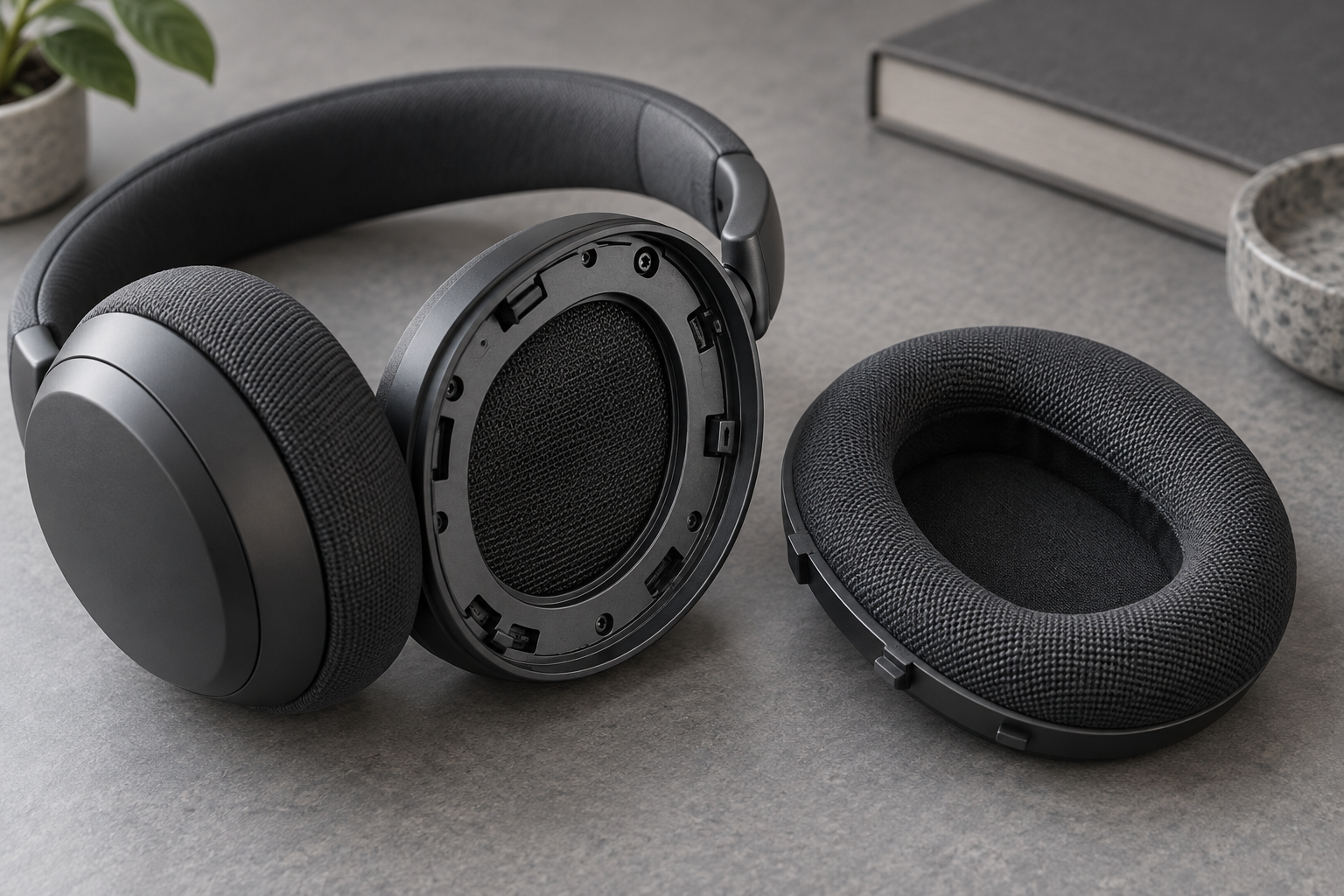
AI-generated conceptual illustration of a removable pad interface, not VZR internals.
Treat removable parts as interfaces
The Delta announcement identifies a detachable microphone and cable, along with replaceable pads. That is useful evidence about the product’s configuration. It is not enough to establish repairability across the whole headset, long-term spare-parts availability, or the ease of every replacement operation.
For a new product, each removable element deserves its own interaction brief. Can the user tell where it attaches? Is the correct orientation apparent? Can someone remove the part without pulling on a delicate surface? Does the connection provide enough feedback to distinguish fully seated from almost seated?
Evaluate the off-product state too. A detachable microphone can disappear into a drawer, and a spare cable can be mistaken for one that does not support the intended functions. Storage, identification, packaging, and replacement instructions all belong to the same decision. Modularity becomes useful when the user can understand and manage the modules.
Separate an acoustic claim from a design conclusion
VZR presents the new model as a refinement of an established acoustic approach. A product team can learn from that strategy without turning the launch copy into a performance verdict. An announcement establishes what a manufacturer intends and claims; it does not settle how different listeners will experience the result.
A responsible development plan should distinguish the questions being asked. A listening comparison, a fit evaluation, and a study of cable handling are different activities. A favorable result in one should not be used as evidence for the others. Define the comparison, the participants, and the conditions appropriate to each question before interpreting feedback.
For an early design review, physical models can help explore access to the cable connection or the movement of a microphone. They cannot establish the sound of a finished acoustic assembly. Conversely, a working audio prototype may answer a listening question while leaving material durability or production assembly unresolved. This distinction keeps prototyping focused on the next uncertainty.
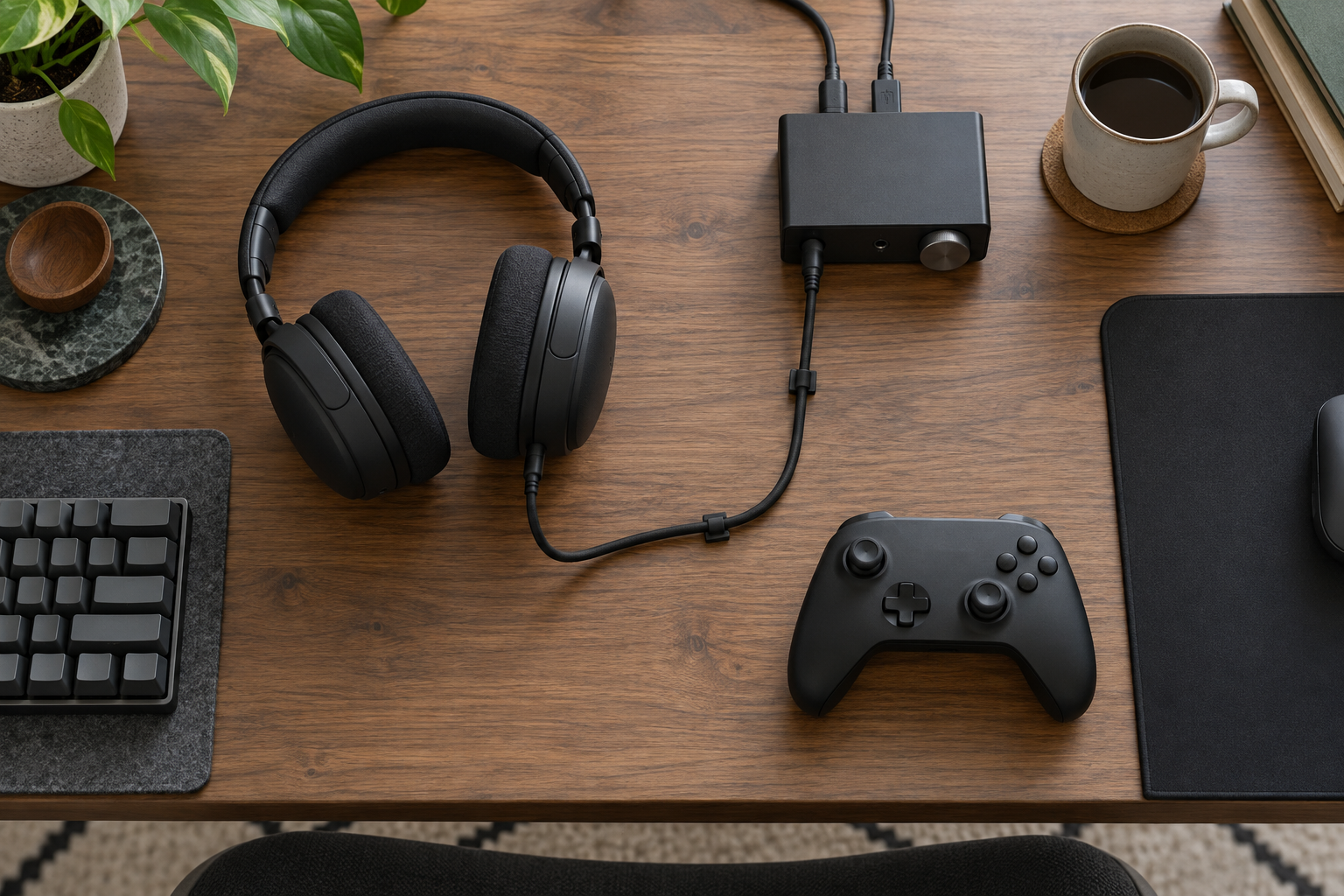
AI-generated conceptual illustration of a desk setup, not evidence of product testing.
Build the commercial story around the chosen compromise
A wired headset has a clear limitation: its connection constrains movement. A coherent product story should explain why the intended customer might accept that limitation, rather than burying it behind a broad claim that the product suits everyone.
For a founder, the practical exercise is to write a short decision statement: this product prioritizes a specific activity, uses a defined architecture to support it, and accepts an explicit tradeoff. Then review the controls, accessories, packaging, and setup instructions against that statement. If an accessory creates a second, conflicting setup story, the team needs to resolve the mismatch before launch.
VZR’s September announcement offers a current example of a company developing its core physical and acoustic proposition through iteration. Whether the Delta delivers its claimed improvements requires evidence beyond the announcement. The broader design principle is immediately usable: choose the experience that matters, make its tradeoffs legible, and test the complete sequence around it.
If your team is deciding which features belong in a new physical product, discuss the product brief with Jackson Hedden.
Editorial note: Product details are attributed to VZR’s announcement and website. Recommendations are design analysis, not hands-on review. Images are AI-generated conceptual illustrations, not VZR products, internals, or test results.