On November 24, 2026, Akuvox announced the MR03, a camera-free 60 GHz millimeter-wave radar that monitors a room for falls, bed exits, sleep, breathing and heart rate, aimed at senior living, care facilities and home-care projects (Akuvox press release).
Key takeaways
- The sensor replaces the camera, not the design work. A radar that watches a room without images still has to solve enclosure, mounting, status lights and claims.
- The plastic cover is part of the radar. At 60 GHz, cover thickness, material and paint affect what the antenna can see.
- Mounting is a performance spec. Akuvox lists different coverage for ceiling and wall mounting, and its sleep and vital-sign mode only supports wall mounting.
- Accuracy claims need a definition. The release cites over 99% detection accuracy and the product page over 95%, both from internal testing.
- Intended use shapes everything. Akuvox says the MR03 is not for diagnosing or monitoring medical conditions, though it reports heart and breathing rates.
What Akuvox announced
According to the press release, the Xiamen-based intercom and access-control company is moving into senior care with the MR03, an AI-powered millimeter-wave (mmWave) radar. mmWave radar uses very short radio waves, here 60 to 64 GHz, to detect position and tiny movements such as breathing. Details below come from the release, the MR03 product page, its key specifications and the MR03 administrator guide:
- Seven functions in one device: fall detection, bed-exit detection, sleep monitoring, heart-rate and breathing-rate monitoring, posture tracking and presence sensing. Akuvox says it replaces mattress pads, infrared sensors and other standalone devices.
- Coverage: 6 m x 4 m when ceiling-mounted; within a 140° field of view up to 5 m when wall-mounted. Multiple people can be tracked, but breathing and heart rate support one person at a time.
- Radar: FMCW (frequency-modulated continuous wave, a radar that sweeps its frequency to measure distance and motion), 4 GHz bandwidth, 11 dBm transmit power, four transmit and four receive antennas.
- Hardware: a plastic disc 110 mm across and 24 mm thick, with a microphone, speaker, status LED, Ethernet and USB-C ports, Wi-Fi, and an optional 433, 869 or 915 MHz radio for an emergency pendant; rated -10 °C to +45 °C.
- Power and setup: PoE (Power over Ethernet, which carries power and data on one cable) or a 5 V, 2 A USB-C adapter; wall or ceiling brackets; a setup wizard and batch deployment for installers.
- Response: alerts to caregivers' phones, two-way emergency calls through the device or pendant, and temporary door access for care staff via Akuvox access terminals and akubela smart locks.
- Stated limits: accuracy above 99% in internal testing (release) or above 95% (product page), varying by room and installation; and a notice that the MR03 is not intended for diagnosis or medical monitoring and does not replace caregivers or life-safety systems.
MR03 documentation has been online since October 8, 2026, and a UK distributor introduced it on November 9; the November 24 release is Akuvox's global announcement. No price has been published. We have not handled or tested the MR03. Everything below is Jackson Hedden analysis based on general product development practice.
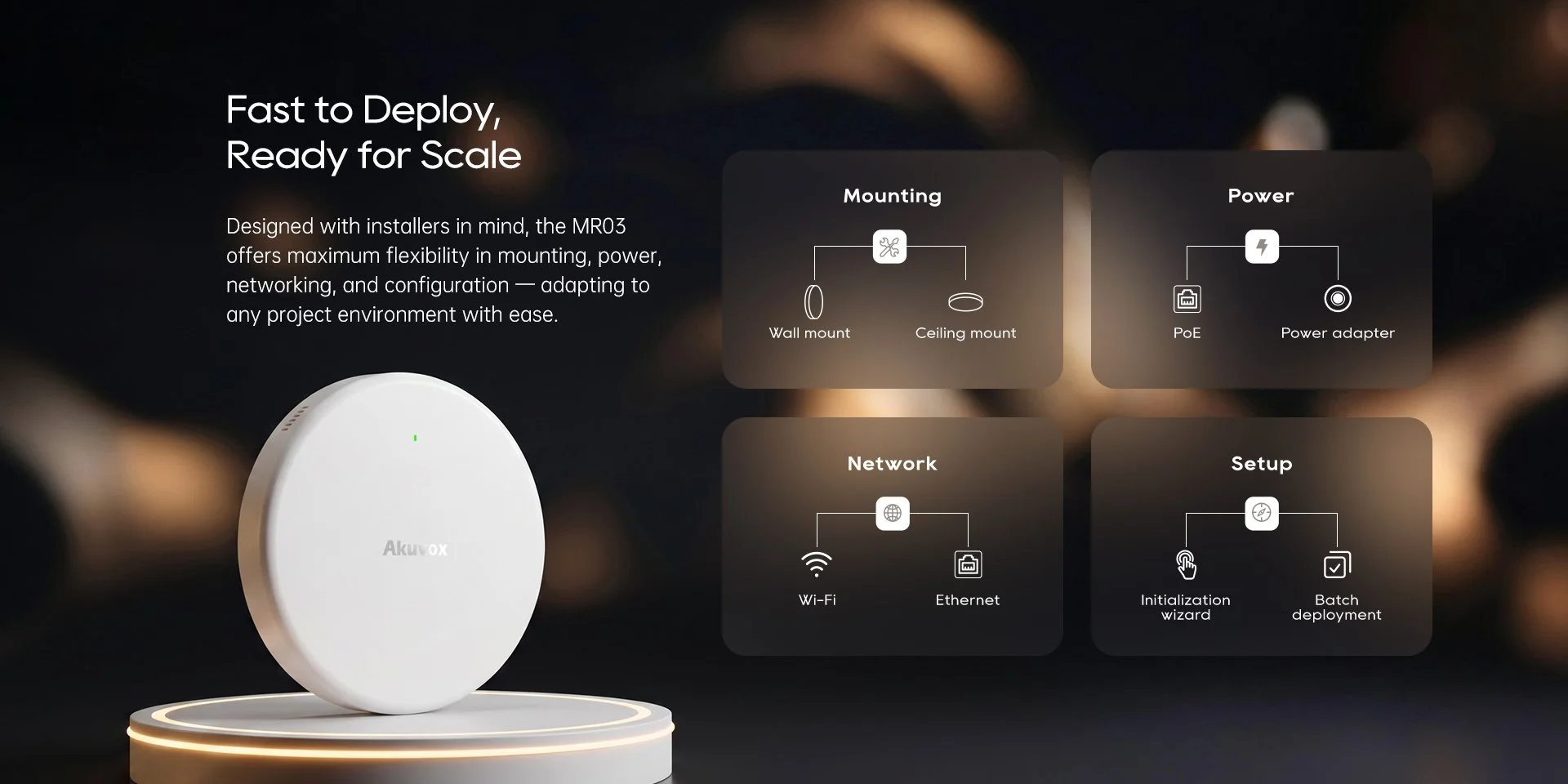
Akuvox's MR03 product page shows the radar disc with its mounting, power, network and setup options. Image: Akuvox
How electronic product development shapes a camera-free radar
Electronic product development turns sensors, radios, firmware and power into a reliable product inside a real enclosure. The MR03 looks like a smoke alarm, but it shows five places where the hard decisions sit.
The cover is part of the antenna. At 62 GHz the wavelength in air is about 4.8 mm, so a cover just a millimeter or two thick is electrically significant. The cover over a radar antenna, called a radome, is often tuned to about half a wavelength inside the plastic, roughly 1.3 to 1.5 mm for common resins. Metallic paints, filled plastics, thick logos and sink marks can all reflect or weaken the signal. Akuvox lists only "plastic," but resin and wall thickness are as much a radar decision as a styling one.
Mounting decides performance. The same device covers a 6 m x 4 m floor area from the ceiling and a 140° cone from the wall. Akuvox's guide says the sleep and vital-sign mode only supports wall mounting, and the LED warns when the device is tilted more than 15° from level. The bracket also carries a level indicator. When geometry drives accuracy, the bracket and a software angle check are part of the sensor.
"Camera-free" is not "sensor-free." Radar avoids images, which matters to people who dislike being watched, but the MR03 also has a microphone and speaker for emergency calls. The LED slow-flashes green during a call, which is the right instinct, but the same red fast flash signals both an alarm and a tilt warning, and the LED can be turned off in settings. In a resident's room, every status should have one meaning.
Accuracy needs a definition. The release says over 99% and the product page says over 95%, both from internal testing. Neither defines the metric. Falls are rare, so a system can score well on average and still miss the one that matters, or wake night staff with alerts from curtains, fans or pets.
Claims and deployment shape the hardware. Heart and breathing rates appear in the logs, yet Akuvox says the device is not for medical monitoring. That wording, the app and the validation plan have to stay consistent. Regional pendant radios, two power options and two network options also add variants to certify and build.
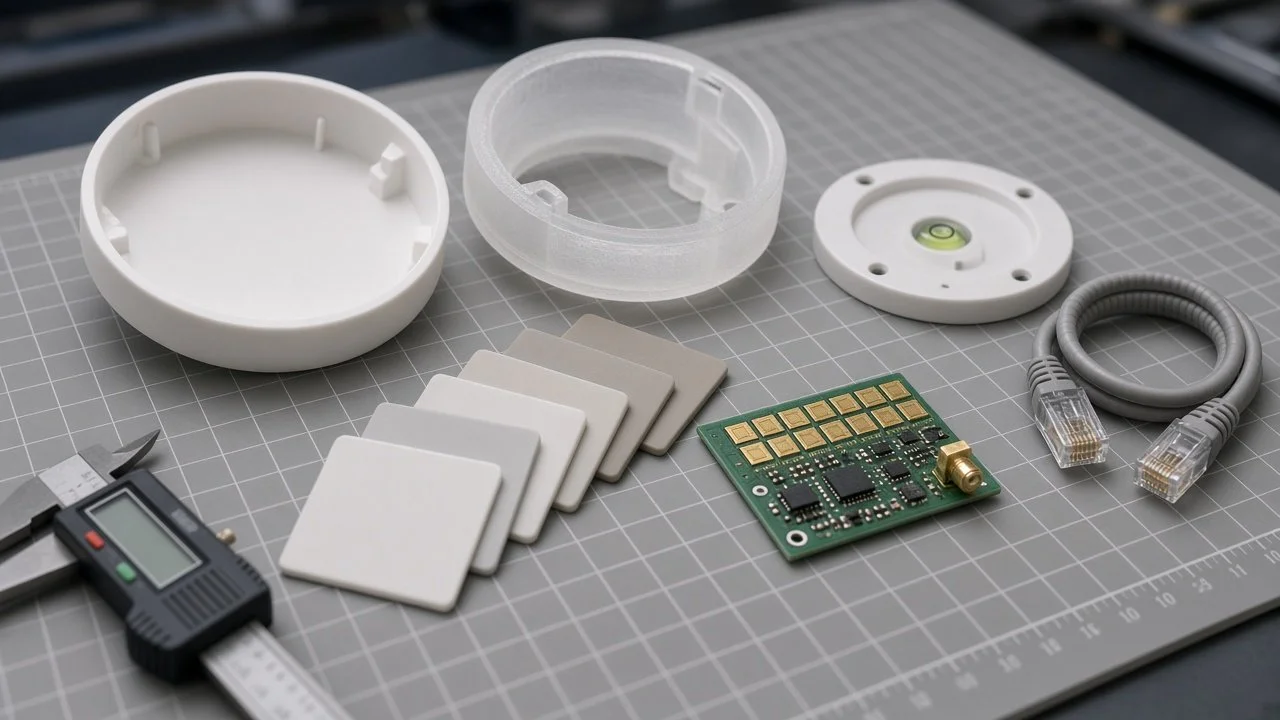
Concept render (illustration) of a generic radar sensor in development: a molded cover, resin prototype, plastic test plaques, antenna board and mounting bracket. Not Akuvox hardware.
What this means for product teams
- Design the cover with the antenna. Mold test plaques in candidate resins, colors and thicknesses and measure them with the radar module before the design is frozen. Treat paint, texture, logo method and sink marks over the antenna as RF decisions.
- Make installation part of the product. Use a keyed bracket, a built-in level and a software angle check, and state which modes each mounting position supports. Test with real installers at the edge of the allowed tilt.
- Define accuracy before you quote it. Pick metrics such as sensitivity (falls caught) and false alarms per room per day. Test with staged falls on mats, multiple occupants, pets, fans and moving curtains, then publish the conditions.
- Be precise about what is sensed. If the device has a microphone, say so and show its state. Give every LED pattern one meaning. Our Tapo C825 analysis looks at making privacy visible on a home camera.
- Gate RF and claims at EVT and DVT, and plan DFM. EVT (engineering validation test) proves the design works; DVT (design validation test) proves production-intent parts meet requirements. DFM (design for manufacturing) means shaping parts so a factory can build them reliably at the target cost. Decide wellness versus medical claims before DVT; our guide to medical equipment design explains how that choice changes the process.
FAQ
What is the Akuvox MR03? It is a ceiling- or wall-mounted 60 GHz millimeter-wave radar that Akuvox announced on November 24, 2026, for senior living and home care. It detects falls, bed exits, posture and presence, tracks breathing and heart rate for one person, and supports emergency calls.
How can radar detect breathing without a camera? An FMCW radar measures tiny changes in distance to objects in the room. Breathing and heartbeats move the chest by fractions of a millimeter, which shifts the reflected signal enough for software to estimate rates without an image.
Is the MR03 a medical device? Akuvox says it is not intended for diagnosis, treatment or medical monitoring and does not replace caregivers or emergency services. Disease-related claims generally bring medical device rules, so wording matters as much as hardware.
Why does the enclosure matter for a radar sensor? At 60 GHz the radio waves are only millimeters long, so the plastic cover's thickness, material and paint change what the antenna can detect. The cover has to be designed and tested with the radar module.
Work with us
Building a sensing device for homes or care? Our electronic product development team helps product teams resolve antennas, enclosures, mounting, status cues and validation before tooling. Contact us to talk through your project.
Jackson Hedden is a product design, development and manufacturing firm helping founders and product teams take consumer and industrial products from concept to production.
Sources
- Akuvox (via PR Newswire), "Akuvox Launches MR03, a Non-Contact Sensing Device for Senior Care," press release, November 24, 2026: https://www.prnewswire.com/news-releases/akuvox-launches-mr03-a-non-contact-sensing-device-for-senior-care-302950019.html
- Akuvox, MR03 product page: https://www.akuvox.com/productsDisp?pid=136
- Akuvox, MR03 key specifications: https://www.akuvox.com/productsDispParameter?pid=136
- Akuvox Knowledge Base, MR03 Millimeter Wave Radar Administrator Guide (Product Overview, Function Settings, Indicator Light Status, Installation Angle Detection): https://knowledge.akuvox.com/docs/akuvox-mr03-millimeter-wave-radar-administrator-guide
- CIE Group, "Introducing Akuvox MR03: Contactless monitoring for UK Projects," November 9, 2026 (context): https://cie-group.com/cie-news/akuvox-mr03-contactless-monitoring/