On November 25, 2026, TP-Link announced the Tapo C825, a $149.99 indoor camera that adds a 4-inch touchscreen and one-tap, hands-free video calling to a 2K pan-and-tilt security camera, on sale the same day on Amazon and Tapo.com (TP-Link press release).
Key takeaways
- One device now does two jobs. The C825 is a security camera and a video phone, with two kinds of users: the relative who sets it up and the person at home who uses it.
- Privacy is shown mechanically. In Privacy Mode, TP-Link says the lens physically tilts up and out of sight while video and audio monitoring pause.
- The screen sits on a moving product. Automatic pan-and-tilt tracking keeps the caller in frame, so the display, the motors, the microphone and the speaker all share one small tabletop body.
- Power and placement are tightly bounded. A 5 V, 2 A USB-C supply and tabletop-only mounting set hard limits on heat, motion and stability at $149.99.
What TP-Link announced
According to the press release, also posted in TP-Link's newsroom, the C825 is Tapo's first dedicated video calling indoor camera. It is "designed with aging parents and young children in mind," launched November 25, 2026, at $149.99, and is also sold in 2-pack and 3-pack options. Hardware details below come from the release and the Tapo C825 product page and specifications:
- Camera: 2K+ (2560 x 1440) video at up to 30 fps, a 1/3-inch sensor, an f/1.6 lens with a 114.5° diagonal field of view, and infrared night vision.
- Motion: automatic pan-and-tilt tracking that follows movement during calls. The spec sheet lists a 333° mechanical pan range (360° coverage) and a 104° mechanical tilt range (156° coverage).
- Screen and controls: a 4-inch full-color touchscreen with adjustable text size, a clock and reminders, plus physical Answer, End and Privacy buttons.
- Calling: calls run between C825 units or from the Tapo app to a C825. Setup needs the Tapo app and a Tapo ID, calls need Wi-Fi (2.4 GHz or 5 GHz), and third-party calling apps are not supported. Trusted contacts can connect automatically when auto-answer is enabled.
- Audio: built-in microphone and speaker with two-way audio and noise cancellation.
- Privacy and detection: Privacy Mode tilts the lens away, Privacy Zones block areas from recording, and on-device detection of people, pets and motion works without a subscription. Recordings go to a microSD card of up to 512 GB or optional Tapo Care cloud storage.
- Power and size: plug-in only, from a 5 V, 2 A USB-C adapter with a 3 m cord; tabletop mounting; 166 x 74 x 77 mm; rated for 0 °C to 40 °C.
We have not handled or tested the C825, and TP-Link has not published internal design or test details. Everything below is Jackson Hedden analysis based on general product development practice.
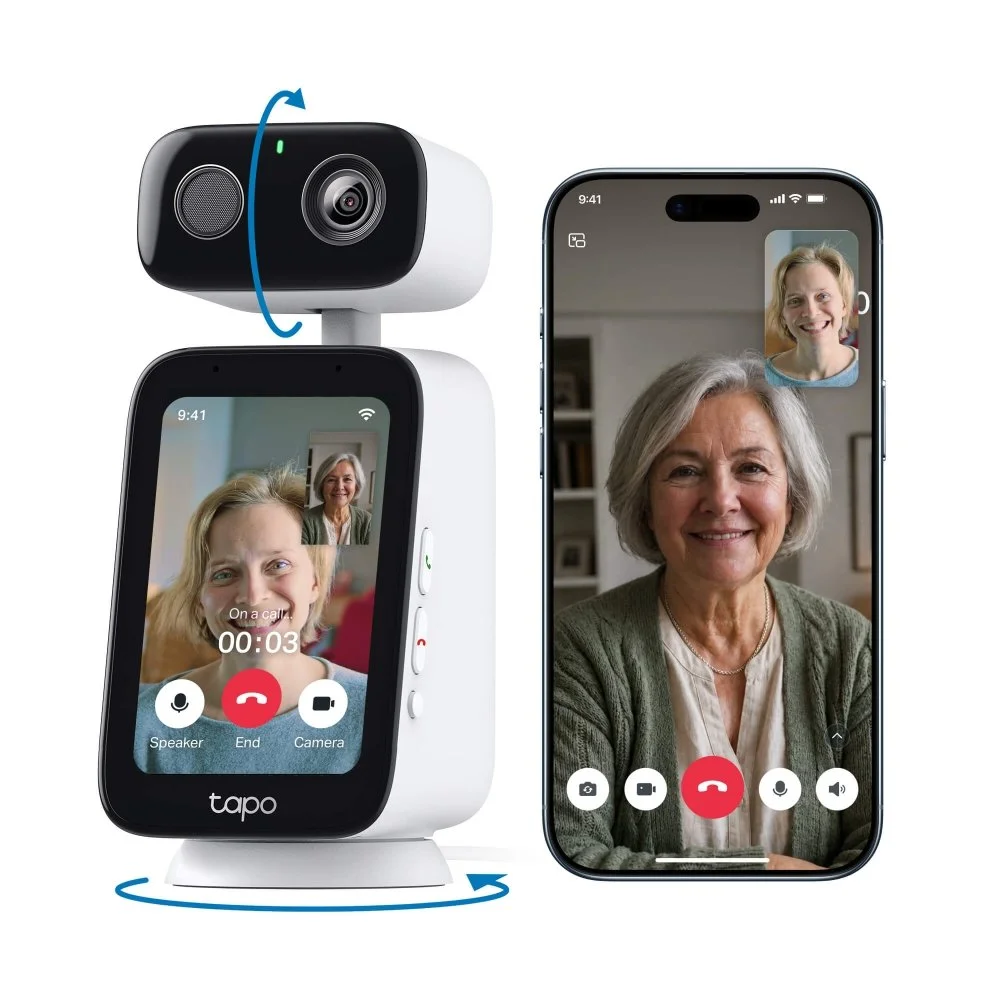
TP-Link's image of the Tapo C825 shows the camera head tilting and the body turning on its base during a video call. Image: TP-Link
How an industrial design company reads the C825
A pan-and-tilt camera is built to watch a room. A video calling device is built to face one person. Merging them creates six tradeoffs.
Privacy has to be visible, not just promised. Tilting the lens toward the ceiling gives people in the room proof they can see, which a software toggle cannot. The microphone is harder: TP-Link says audio monitoring pauses too, but a paused microphone looks the same as a live one. In a shared home, a clear and consistent status light matters as much as the shutter. For a senior-care sensor that avoids cameras entirely, see our analysis of the Akuvox MR03.
Two user groups, two interfaces. The person who sets up the camera is usually a younger relative with the app. The person who lives with it may be an older parent or a child. Physical buttons, adjustable text and auto-answer remove steps for them, but auto-answer also lets a camera connect without anyone touching it. Defaults and how clearly a live call is announced become design decisions, not settings.
A screen on a moving body. TP-Link's product images show the body and screen turning on a round base while the camera head tilts on a short neck. Moving a display adds mass and inertia, so the pan motor needs more torque and finer control to avoid jerky tracking. A pan range of 333° rather than continuous rotation also suggests a hard stop and a cable loop rather than a slip ring, though TP-Link has not said how it routes wiring.
Audio in a small box. The speaker, microphone and pan motor sit in one compact housing. Speaker sound and motor noise travel through the plastic to the microphone, so echo cancellation (software that removes the device's own playback from what the microphone hears) has to work while the camera is moving. Mounting the speaker and microphone apart, with soft gaskets, helps the software succeed.
Placement and stability. The C825 is 166 mm tall and mounts only on a tabletop. Tapping a touchscreen on a light, upright device pushes it backward, and the 3 m cord can pull it sideways. Base weight, foot material and center of gravity decide whether it stays put.
Heat, power and cost. A backlit screen, Wi-Fi, video encoding, on-device detection and motors share a 10 W (5 V, 2 A) supply in a closed plastic body rated to 40 °C. Peak loads have to be managed so tracking does not stall a call. At $149.99, the screen is a large share of the bill of materials, so 2K rather than 4K video, tabletop-only mounting and app-only calling look like deliberate cost and scope limits.
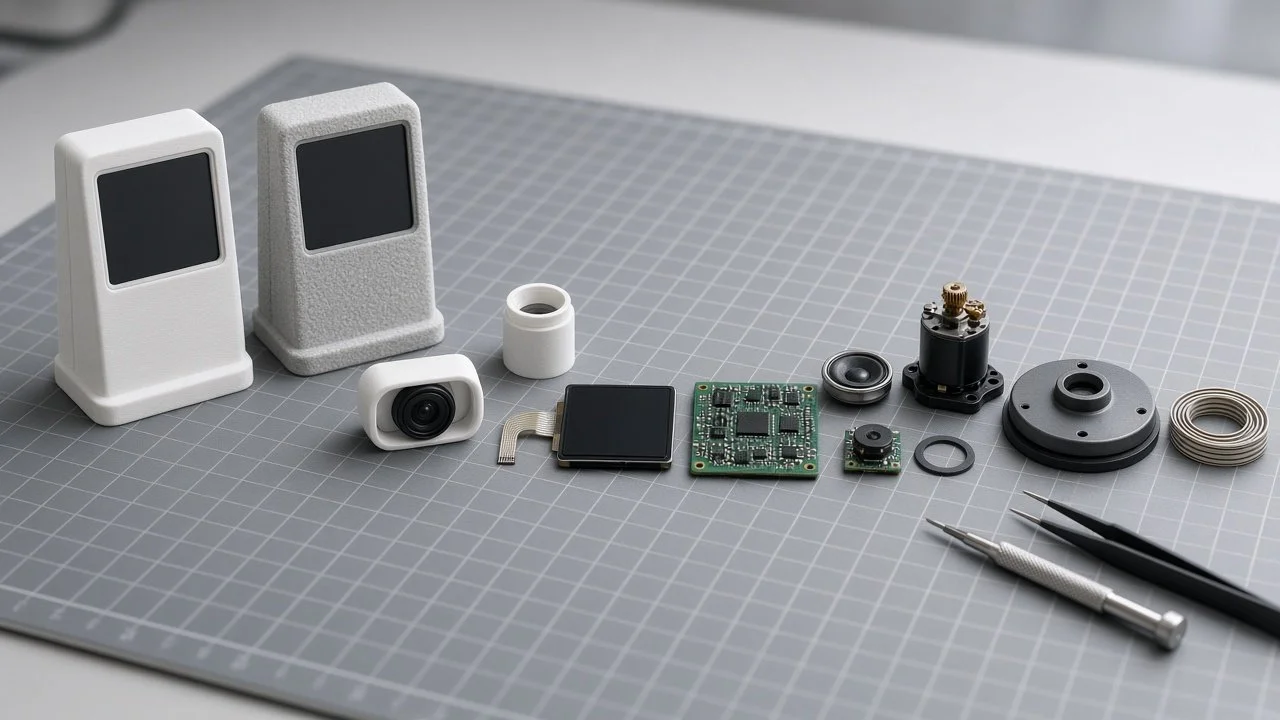
Concept render (illustration) of a generic pan-tilt camera with a small touchscreen in prototype form on an engineering bench, not TP-Link hardware.
What this means for product teams
These lessons apply to any connected home device that combines a camera, a screen and moving parts.
- Make privacy physical where you can. A shutter, a lens that turns away or a hardware mute gives users proof. Pair it with a status light whose meaning never changes, and test it in bright and dark rooms.
- Design for the setup user and the daily user separately. Map each person's tasks, then run onboarding tests with real older adults and children. Decide what the screen shows when Wi-Fi drops.
- Prototype the motion system with the screen attached. Build a motion rig early with 3D-printed or SLA (stereolithography, a precise resin printing process) housings at the real weight. Measure tracking smoothness, motor noise and cable wear. Our OBSBOT Tail 2 ADV analysis covers motion-system tradeoffs in compact PTZ cameras.
- Test audio and stability as a system. Check echo cancellation while the motors run and the speaker plays loudly. Run tip tests with finger taps on the screen and with cable pull.
- Gate the risks at EVT and DVT, and plan DFM. EVT (engineering validation test) proves the design works; DVT (design validation test) proves production-intent parts meet requirements. DFM (design for manufacturing) means shaping parts so the factory can build them reliably at the target cost. Check heat at 40 °C, peak power and motor life.
FAQ
What is the Tapo C825? It is an indoor camera TP-Link announced on November 25, 2026, for $149.99. It combines 2K pan-and-tilt security monitoring with a 4-inch touchscreen and one-tap, hands-free video calling between C825 units or from the Tapo app.
How does the C825's privacy mode work? TP-Link says Privacy Mode physically tilts the lens up and out of sight and pauses video and audio monitoring. Privacy Zones set in the app can also block specific areas from recording.
Does the Tapo C825 need a subscription or a battery? No subscription is required for on-device detection or microSD recording; Tapo Care cloud storage is optional. It has no battery and runs from a plug-in 5 V, 2 A USB-C adapter.
Why is adding a screen to a pan-tilt camera hard? The screen adds weight to a moving body, shares a small power and heat budget with the motors and radio, and puts touch forces on a light tabletop device.
Work with us
Combining cameras, screens, audio and motion in a home device? As an industrial design company, we help product teams resolve privacy cues, motion, acoustics, stability and cost before tooling. Contact us to talk through your project.
Jackson Hedden is a product design, development and manufacturing firm helping founders and product teams take consumer and industrial products from concept to production.
Sources
- TP-Link Systems Inc. (via Business Wire), "TP-Link Announces Tapo C825, a 2K Video Calling Indoor Camera That Makes It Easier for Families to Stay Connected," press release, November 25, 2026: https://www.businesswire.com/news/home/20261125065081/en/TP-Link-Announces-Tapo-C825-a-2K-Video-Calling-Indoor-Camera-That-Makes-It-Easier-for-Families-to-Stay-Connected
- TP-Link, newsroom copy of the same release, November 25, 2026: https://www.tp-link.com/us/press/news/22629/
- TP-Link, Tapo C825 product page and specifications: https://www.tp-link.com/us/home-networking/cloud-camera/tapo-c825/
- The Verge, "Tapo's new indoor security camera includes a touchscreen for video calls," November 25, 2026 (context): https://www.theverge.com/tech/1041221/tapo-c825-security-indoor-2k-camera-video-calls-tracking-pan-tilt