Arc'teryx has launched the Alpha SL Harness, a 76-gram ski mountaineering harness built almost entirely without sewing, with an official release dated November 7, 2026 and U.S. launch coverage from POWDER on November 9, 2026.
Key takeaways
- The Alpha SL replaces most stitching with heat-bonded polyethylene laminates and spliced braided cord. According to The High Route, the only sewing left is four bar tacks.
- Arc'teryx's design director says the team spent at least two years developing the manufacturing process and teaching a factory to build the harness repeatably.
- A new material usually means a new process, so schedule risk sits in tooling, fixtures and operator training as much as in the design.
- Building almost everything from one polymer family could ease future recycling, but Arc'teryx acknowledges the recycling infrastructure is not there yet.
What Arc'teryx announced
According to the Arc'teryx product page, the Alpha SL is the company's lightest harness yet: 76 grams for a size 3, priced at $180 in sizes 1 through 5, for ski mountaineering, glacier travel and fast alpine objectives. Arc'teryx calls the construction WARP Strength Fusion Technology, combining laminated ALUULA composites with braided UHMWPE (ultra-high molecular weight polyethylene, the fiber family sold under names like Dyneema).
The product page lists the main fabrics as ALUULA A175 and A86X, both 100% polyethylene, made in Canada, with the harness manufactured in China. The leg loops open fully so the harness can go on over skis or crampons, and a "BraidLock" system loosens when slack and tightens on itself under load. The rear rise is adjustable and replaceable, "extending harness life span."
The most useful detail for product teams comes from an interview with JJ Mah, Arc'teryx's Design Director, Advanced Concepts, published by The High Route on November 5, 2026. Mah compared the build to a carbon fiber layup, except that instead of resin, "we're fusing the whole package into one material without glue. It's a mono-polymer." The braids are made to length for each size, and The High Route reports the splicing is done by hand.
Mah was candid about where the effort went: "We knew we could design and build one, but then we had to develop the manufacturing processes and tooling, take it to a factory, and teach them how to make this harness in a repeatable way. And we spent at least two years just on that alone." He also described 600 to 700 hours of field testing, balanced with lab testing he called "especially critical for PPE products like harnesses."
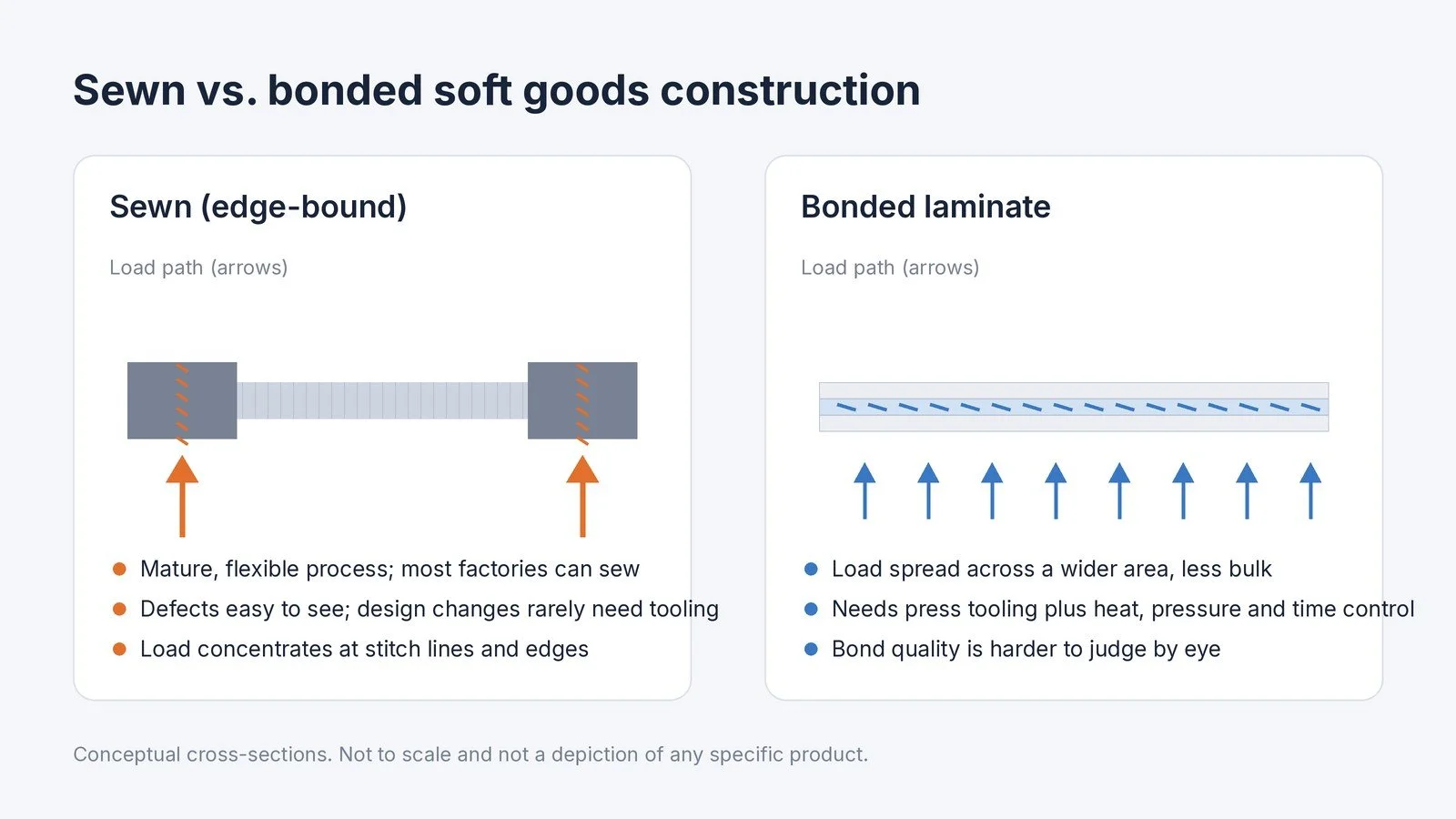
Conceptual cross-sections comparing sewn and bonded construction. Not to scale and not a depiction of any specific product.
Why the construction matters more than the weight
The 76 grams is the headline, but the more transferable story is that Arc'teryx changed how a product category is joined together.
Mah says typical ultralight ski harnesses are edge-bound: webbing sewn over mesh. Sewing is mature and flexible. Almost any soft goods factory can do it, defects are easy to see, and design changes rarely need new equipment. The cost is that every stitch line concentrates load and punctures the fabric.
Bonding (fusing layers with heat and pressure rather than thread) trades that flexibility for performance. It can spread load and reduce bulk, but it brings requirements that look more like hard goods manufacturing: press tooling for each shape, tight control of temperature, pressure and dwell time, and quality checks for bonds that cannot be fully judged by eye. That is why a two-year process effort is believable, not surprising.
The details Arc'teryx disclosed show the tradeoffs:
- Hand labor in a machine-looking product. Hand splicing makes a strong, supple joint, but it puts critical quality in an operator's hands, raising the bar for work instructions and inspection.
- Size-specific components. Braids built to length for five sizes mean more part numbers and a higher cost for adding sizes later.
- Care and returns. The harness is surface clean only, and Arc'teryx does not accept harness returns for health and safety reasons. Material and safety choices shape the customer experience, not just the bill of materials.
- End-of-life potential versus reality. Mah said the harness is mono-polymer except for its metal and plastic hardware, but "the recycling infrastructure isn't there yet." Design for recyclability is a head start, not a finished claim.
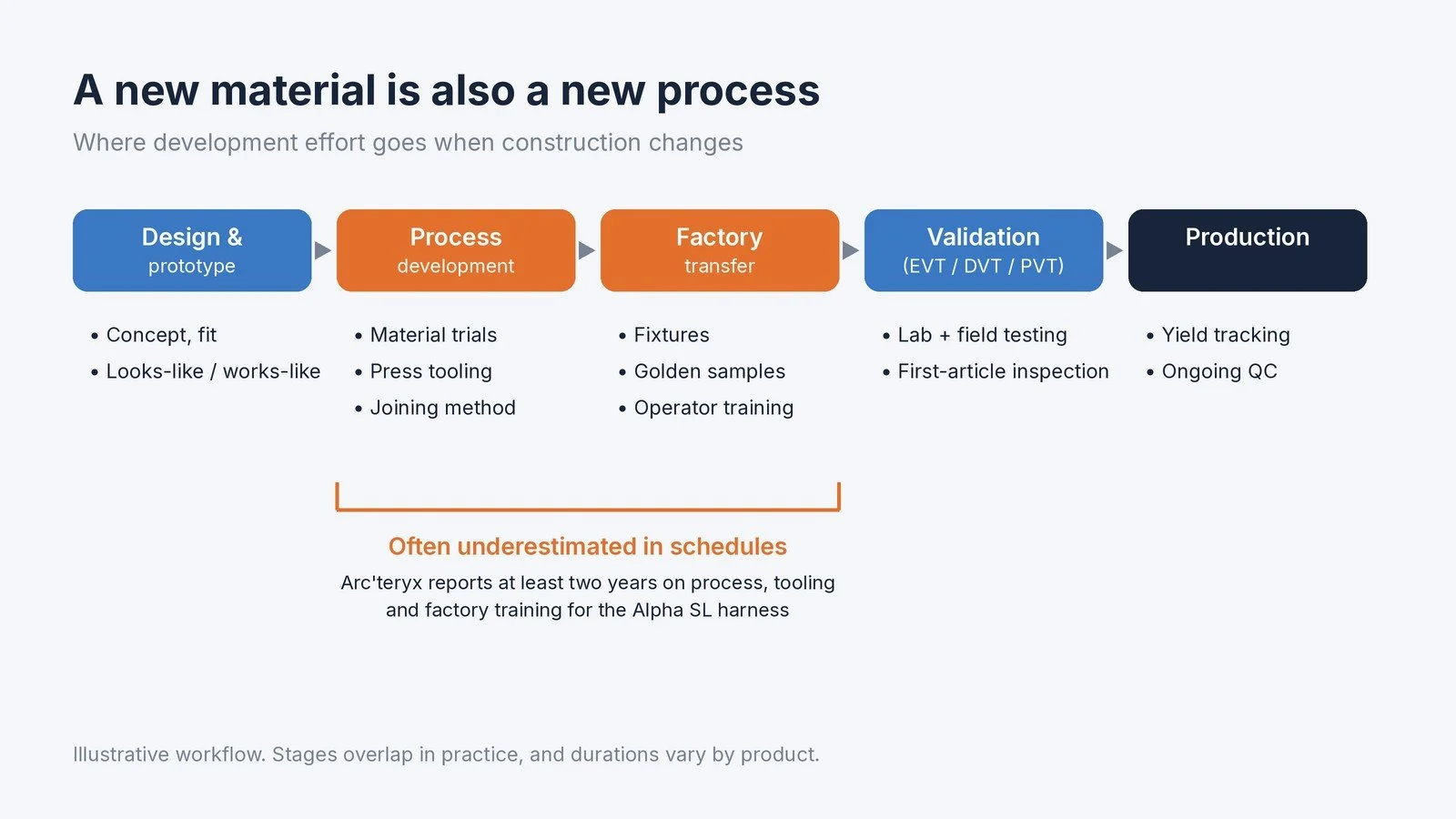
Illustrative workflow for bringing a new construction method to production. The two-year figure is Arc'teryx's own account for the Alpha SL; stages and durations vary by product.
What this means for product teams
This applies well beyond climbing gear. Any team moving from sewn, glued or fastened parts to welded, bonded, laminated or overmolded construction faces the same shift. Here is how we would plan for it.
Treat process development as its own workstream. DFM (design for manufacturing, meaning designing parts so they can be built reliably at the target cost and volume) has to start before the design is frozen, because a new process may push back on geometry, tolerances and materials.
Prototype with the production method early. A sewn stand-in for a bonded part can prove fit but says little about strength or yield. Hardware programs move through EVT, DVT and PVT: engineering validation (does the design work), design validation (does the production-intent design pass testing) and production validation (can the factory build it repeatably). For new construction methods, real process samples should arrive by DVT at the latest. Our prototyping team plans builds around that handoff.
Budget for factory transfer and training. Teaching a factory to build something repeatably is what most schedules underestimate. Plan for tooling (the molds, presses and fixtures that shape parts), golden samples, operator training and first-article inspection, and keep design engineers involved through the first runs. As we noted in our look at Section 301 tariff exclusions and product sourcing, a specialized process is much harder to move between factories than a sewn part.
Make safety-critical testing explicit. For anything people trust with their weight or safety, plan for static strength, cyclic loading, abrasion, cold and aging, and decide early which standards apply. Climbing harnesses, for example, are regulated as personal protective equipment in Europe.
Design wear parts to be replaceable. A replaceable rear rise is a small decision with a big effect on product life. Identify what wears first and make it serviceable, even if the rest is permanently bonded.
Be honest about end of life. Mono-material design (building a product from one polymer family) helps only if hardware comes off easily and a collection path exists. Our guide to soft goods product design covers the material and construction choices worth settling early.
For founders comparing industrial design firms and consumer product design firms, this is a useful filter: ask how a partner handled a process that did not exist at the start of a project, not just how good the first prototype looked.
Frequently asked questions
What is bonded construction in soft goods? Bonded construction joins fabric layers with heat and pressure, and sometimes adhesive, instead of stitching. It can cut weight and bulk and spread load more evenly, but it usually needs dedicated tooling and tighter process control than sewing.
Is a stitch-free product cheaper to manufacture? Not necessarily. Bonding can remove some sewing labor but adds tooling, process development and inspection costs, and the Alpha SL still relies on hand splicing. Total cost depends on volume, yield and process maturity.
What does mono-material design mean? It means making a product mostly from one material family, such as polyethylene, so it can be recycled more easily at end of life. It only pays off if other parts, like metal hardware, separate easily and a recycling route actually exists.
How long does it take to bring a new manufacturing process into production? It varies widely. Arc'teryx's design director said the company spent at least two years on processes, tooling and factory training for this harness. Plan process development, factory transfer and validation as separate milestones.
Turning new materials into manufacturable products
If you are designing an outdoor, sporting or lifestyle product around a new material or construction method, our product design services team can help with concept development, DFM and prototyping through production. You can also contact Jackson Hedden to talk through your project.
Jackson Hedden is a product design, development and manufacturing firm helping founders and product teams take consumer and industrial products from concept to production.
Sources
- Arc'teryx, "Alpha SL Harness" product page, accessed November 10, 2026: arcteryx.com
- Arc'teryx, Alpha SL Harness launch release (Chinese), PR Newswire Asia, November 7, 2026: prnasia.com
- The High Route, "First Look: Arc'teryx Alpha SL Harness," including an interview with JJ Mah, November 5, 2026: the-high-route.com
- Max Ritter, "Arc'Teryx Launches New Ultralight Ski Mountaineering Harness," POWDER (via Yahoo), November 9, 2026: yahoo.com
Jackson Hedden is not affiliated with Arc'teryx or ALUULA. Product details are as reported by the sources above.