On November 10, 2026, the Office of the U.S. Trade Representative (USTR) published a Federal Register notice extending all 178 remaining Section 301 tariff exclusions on certain products of China through January 9, 2027, a window of about 60 days.
Key takeaways
- All 178 current Section 301 exclusions now run through 11:59 p.m. Eastern on January 9, 2027, instead of expiring on November 9, 2026.
- An exclusion only applies when a product matches both the 10-digit HTS number and the written product description, so design choices can affect whether a part qualifies.
- A 60-day window is shorter than most tooling and validation schedules, so product teams should plan for the exclusion ending, not count on another extension.
- Quotes and cost models should carry a dated duty assumption, and bill of materials and country-of-origin decisions belong in design reviews.
What was announced
Section 301 refers to the part of the Trade Act of 1974 that lets USTR respond to unfair foreign trade practices. Since 2018, USTR has used it to place additional duties on many products of China. An exclusion is a carve-out that removes those additional duties for a narrowly described product.
According to the USTR notice, the extension covers exclusions under HTSUS headings 9903.88.69 and 9903.88.70 for goods entered for consumption, or withdrawn from warehouse for consumption, on or after 12:01 a.m. Eastern on November 10, 2026, and before 11:59 p.m. Eastern on January 9, 2027. USTR cited "ongoing discussions with China," said U.S. Customs and Border Protection will issue entry guidance, and said it "may continue to consider further extensions or additional modifications." KPMG's TaxNewsFlash confirmed the exclusions had been scheduled to expire November 9, 2026.
Trade law firm Liang + Mooney breaks the 178 into 164 general product exclusions under 9903.88.69 and 14 solar manufacturing equipment exclusions under 9903.88.70. Its summary lists product types that will look familiar to hardware teams, including DC electric motors, printed circuit boards, power adapters, electrically powered air purifiers, non-electric kitchen implements such as peelers and whisks, and portable wireless gas monitors.
For a sense of how much classification matters at one consumer hardware company, Swedish PC hardware maker Fractal said its computer cases remain covered by the exemption and listed its current U.S. tariff levels by category: cases at 0%, headsets at 12.5% and chairs at 37.5%. Same brand, same customers, very different landed costs.
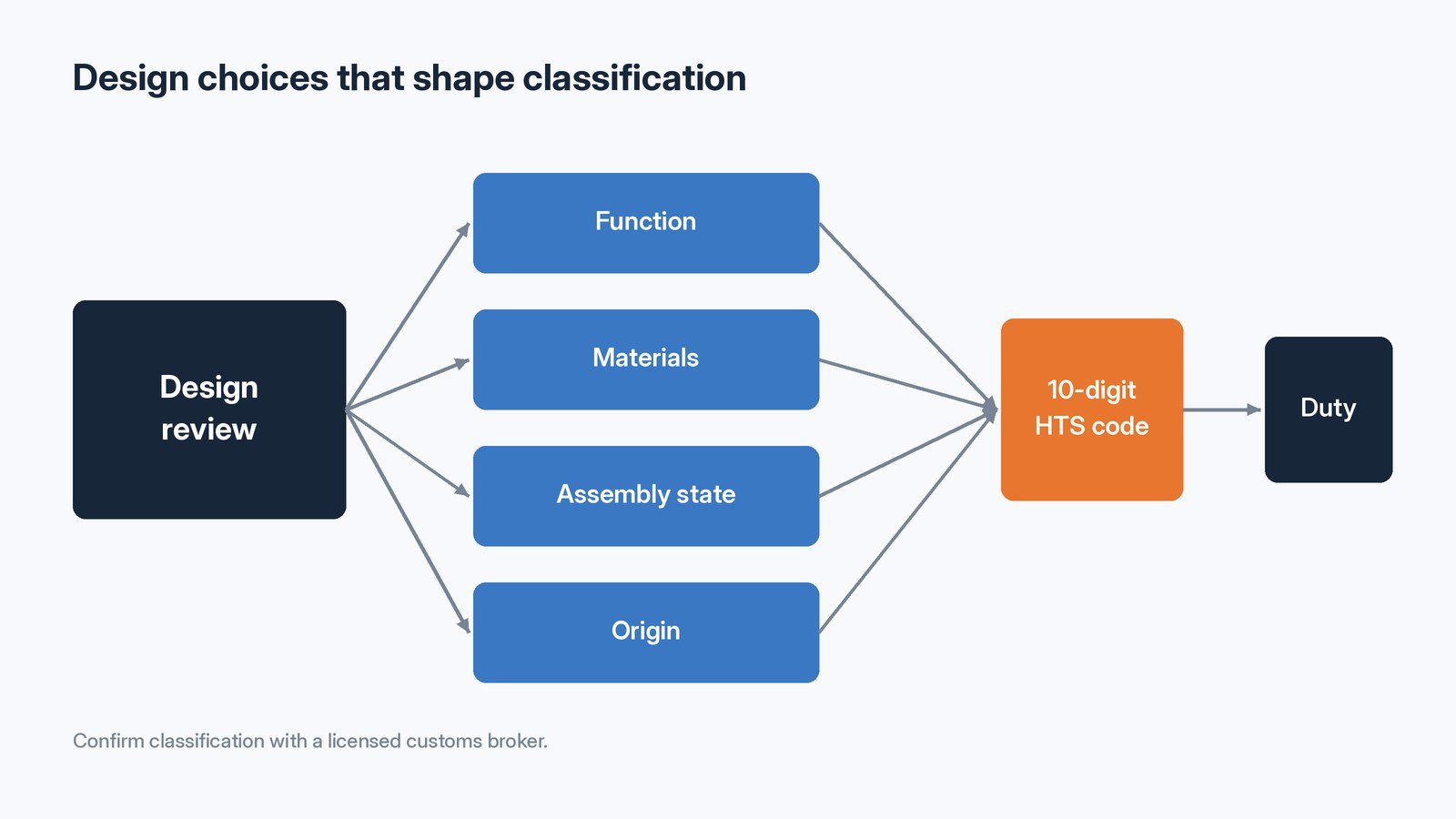
Conceptual diagram of design decisions that can influence tariff classification and duty. Classification itself should be confirmed by a licensed customs broker.
Why tariff classification is partly a design decision
An HTS code (Harmonized Tariff Schedule code) is the number U.S. Customs uses to classify an imported product and set its duty. Classification depends on what a product is, what it is made of and what it does. Those are things a design team decides.
That does not mean teams should design around a tariff code. Customs looks at the product as imported, and misclassification carries real penalties. But it does mean engineering choices have trade consequences that rarely get discussed until a purchase order is already placed:
- Function and integration. Combining functions in one housing, or splitting them into separately shipped modules, can change what the imported article is.
- Materials. Switching a housing from steel to aluminum or from metal to plastic can move a part into a different heading.
- Assembly state. Whether a subassembly ships complete, as a kit or as components affects how it is described at entry.
- Origin. Where the substantial transformation happens, not just where the last screw goes in, shapes country of origin.
Our view is simple: bill of materials and origin questions belong in design reviews, next to cost, reliability and appearance. A licensed customs broker should confirm classification and origin, but the questions should come up while the design can still change. This is part of DFM, or design for manufacturing: shaping a product so it can be built reliably at the target cost. Our DFM for consumer products playbook covers the rest of that handoff.
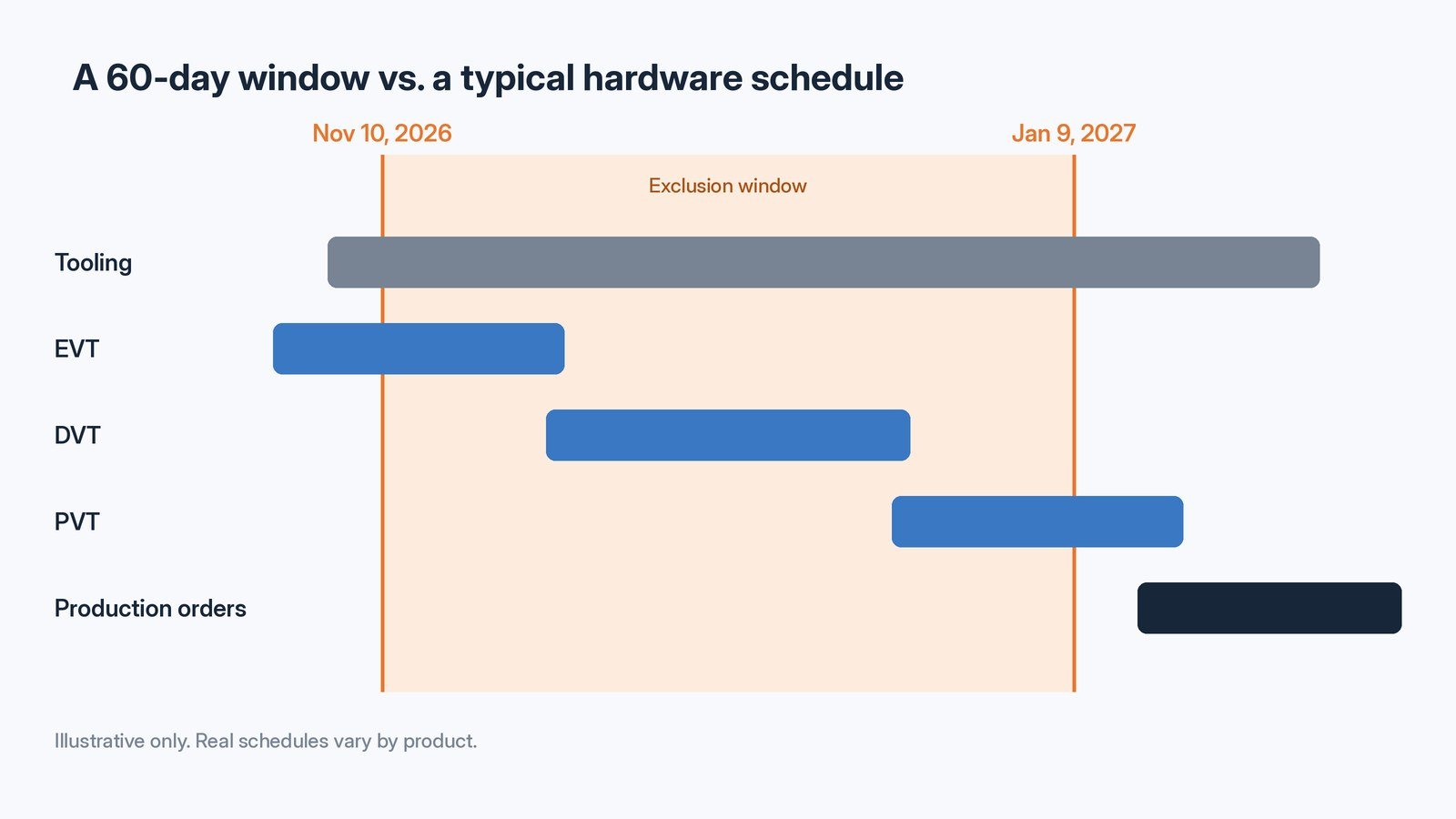
Conceptual timeline comparing the roughly 60-day exclusion window with an illustrative hardware schedule. Actual tooling and validation durations vary by product.
What this means for product teams
A short exclusion window is a planning problem more than a pricing gift. Here is how we would use the next 60 days.
Plan the schedule against January 9, not past it. Hardware programs move through EVT, DVT and PVT: engineering validation (does the design work), design validation (does the production-intent design pass testing) and production validation (can the factory build it at rate). Those stages, plus tooling, the production molds and fixtures for making parts, usually take months. If an excluded component is critical, pulling a production order forward may make sense. Restarting a design to chase a window that may close rarely does.
Quote with dated duty assumptions. Every landed-cost model should state the duty rate it assumes, the HTS number it assumes and the date that assumption expires. When the exclusion lapses or is extended again, the team knows which quotes to revisit instead of rediscovering margin problems at invoice time.
Design for more than one source. Supply chain scholar Christopher Tang argued in IndustryWeek that companies should "postpone differentiation," keeping products generic as long as possible, and noted that importing a generic module and adding differentiating content in the U.S. lowers the dutiable base. In practice, that means standard electrical and mechanical interfaces, second-source components qualified early, and variants that live in late-stage parts like trim, labels or software. We looked at a related architecture idea in our analysis of Beelink's swappable-motherboard NAS.
Own and document your tooling. Tooling ownership terms, steel specifications, drawings and inspection plans determine whether a mold can move to another factory or country. If tooling transfer is not in the contract, moving production becomes a negotiation at the worst possible time.
Keep domestic options honest. Reshoring every part is rarely the fastest answer, but final assembly, packaging or certain high-value parts in the U.S. can reduce exposure. Our guide to manufacturing your product in America walks through those trade-offs. Experienced industrial design firms and consumer product design firms increasingly treat sourcing scenarios as part of the design brief rather than a purchasing afterthought.
Frequently asked questions
What are Section 301 exclusions? They are narrow carve-outs from the additional Section 301 duties on certain products of China. Each one is defined by a 10-digit HTS number and a written product description, and a product has to match both to qualify.
How long do the extended exclusions last? USTR extended them for goods entered from 12:01 a.m. Eastern on November 10, 2026, through 11:59 p.m. Eastern on January 9, 2027. USTR said it may consider further extensions or modifications, but has not promised any.
Can a design change make a product qualify for an exclusion? Material, function and assembly choices can affect how a product is classified, but that question is for a licensed customs broker or trade attorney. Product teams should raise classification and origin questions during design reviews so there is time to get qualified advice.
Should we change suppliers because of this extension? Not because of a two-month window alone. Use the time to qualify second sources, confirm tooling ownership and update cost models so you can move quickly whichever way the policy goes.
Planning production around tariff uncertainty
If your product is heading into tooling or a first production run and duty exposure is part of the decision, our manufacturing team can help with DFM, supplier selection and production planning. You can also contact Jackson Hedden to talk through your project.
Specialized construction methods make factory moves harder still, as we explore in our look at what Arc'teryx's bonded Alpha SL harness teaches about new manufacturing processes.
Jackson Hedden is a product design, development and manufacturing firm helping founders and product teams take consumer and industrial products from concept to production.
Sources
- Office of the U.S. Trade Representative, "Notice of Product Exclusion Extensions: China's Acts, Policies, and Practices Related to Technology Transfer, Intellectual Property, and Innovation," Federal Register, November 10, 2026: federalregister.gov
- USTR notice (PDF): ustr.gov
- KPMG, "USTR extends Section 301 product exclusions for certain imports from China," TaxNewsFlash, November 9, 2026: kpmg.com
- Liang + Mooney, "USTR Further Extends All 178 Section 301 Tariff Exclusions Through January 9, 2027," November 9, 2026: customscourt.com
- Fractal, "Extended Section 301 Tariff Exemption for Computer Cases in the U.S.," November 9, 2026: fractal-design.com
- Christopher S. Tang, "Can't Control the Tariff or the Strait? Redesign the Product," IndustryWeek, September 8, 2026: industryweek.com
This article is general information, not legal or customs advice. Confirm classification, origin and exclusion eligibility with a licensed customs broker or trade attorney.