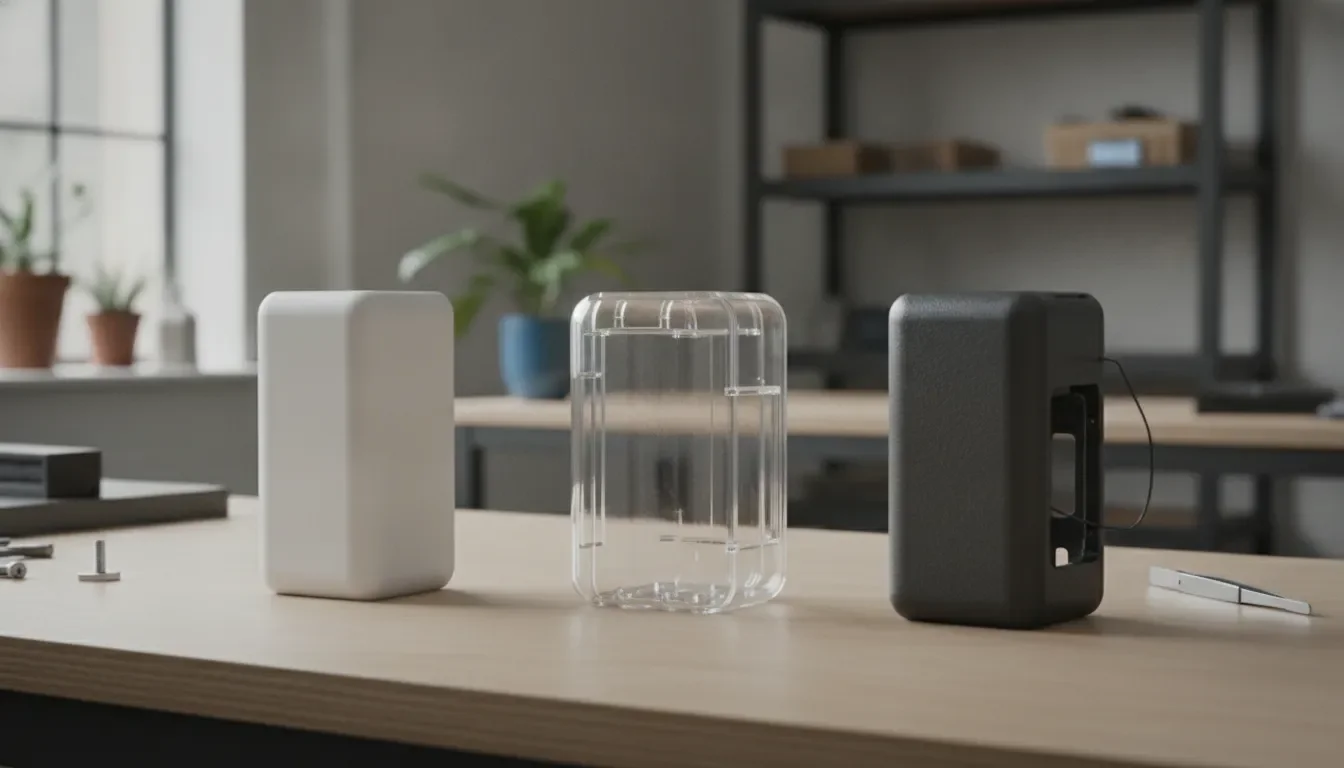
Product teams ask which prototype tests should happen before manufacturing. The useful answer is a short set of prototype testing methods, not one perfect sample. Appearance, fit, function, real use, and a production-representative build each answer a different question. A pretty model can hide a part that will not assemble. A working bench unit can hide a finish, a tolerance stack, or a material the factory cannot repeat.
Run the tests in that order, and write a pass rule before anyone builds the next round. Stop when the open risks are small enough to freeze the design. Do not stop because the latest prototypes look finished in a photo.
Talk through your prototype test plan
Which Prototype Tests Should Happen Before Manufacturing?
Five checks cover most physical products before a factory handoff. Each one uses a different build, and each one has a limit.
Appearance. Judge form, color, finish, and brand cues on a looks-like model. It does not prove strength or assembly.
Fit. Check gaps, alignment, snaps, fasteners, and service access on a dimensionally serious model. It does not prove long-term wear.
Function. Confirm the product does its main job through the full cycle. It does not prove a user can do that job easily.
Use. Watch the intended user complete real tasks. It does not prove the factory can repeat the build.
Production-representative build. Use the intended material and a process as close as you can get to production. It does not replace first-article inspection after tooling.
Match the test to the decision in front of you. A campaign mock needs appearance and a light handling check. A connected device needs function, use, and a build that represents the real enclosure and power path. Packaging has its own checks. Keep those on the packaging design testing path instead of folding them into the product sample.
How Should Teams Choose Prototype Testing Methods?
Start from the decision, not from the shop's favorite machine. Write the question the next sample must answer, the evidence that would change the design, and the evidence that would let you move on.
Four filters keep the plan honest:
Risk. Test the failure that would be expensive or unsafe if it shows up after tooling. A cosmetic scuff and a latch that opens in a bag are not equal.
User. Name who must succeed: the buyer, a clinician, a child with a parent nearby, or a tech at a service bench.
Process gap. Say where the sample differs from production. A printed enclosure will not show knit lines, sink, or gate marks from a mold.
Timing. Do not buy a production-like run to answer a question a foam model can answer this week.
A practical plan for a first production release often looks like this:
Approve appearance on a looks-like model before you spend on accurate internals.
Approve fit on a model with the real wall stock, bosses, and fasteners.
Approve function on a works-like unit, including power, heat, and the full use cycle.
Approve use with five to eight people from the real audience, on the tasks that matter.
Repeat the failed checks on one production-representative build before you freeze the CAD for tooling.
That sequence is a selection method. It is not a tour of prototype stages, and it is not a substitute for the production handoff. If you still need the boundary between a development build and a factory build, read prototyping versus production after the test plan is clear.
What Should an Appearance Prototype Prove?
An appearance test answers one question: will the intended viewer accept the form, color, finish, and brand cues? Use it for stakeholder reviews, retail mockups, photo shoots, and campaign samples. The model should carry the final proportions, parting-line intent, and color as closely as the process allows.
Set the pass rule in writing. Examples that work:
Color stays inside the approved swatch under store light and daylight.
No visible sink, witness line, or gate scar lands on a hero surface in the planned production method.
Logos and icons read at arm's length, and at the closer distance a buyer actually uses.
The sample survives a light handling pass without scuffs that would fail a shelf check.
Record what the model cannot prove. Paint on a printed part is not molded-in color. A hand-finished edge is not a production parting line. Teams get into trouble when a beautiful sample becomes the silent spec. Label the model with its process and its limits, then keep the photos next to that note.Appearance work stops when the look is approved and the remaining questions are about fit, function, or process. It does not stop because a stakeholder said the sample "feels premium" with no pass rule attached.
How Do You Test Fit Before Tooling?
Fit testing asks whether parts assemble, align, and come apart the way the CAD promises. Build it from a process that holds dimensions, such as CNC or a high-resolution print with recorded deviation. Include the fasteners, gaskets, screens, and cables that change the stack.
Run these checks and write the result, not a vibe:
Assemble the unit with the planned tool, in the planned order, without force that would crack a boss.
Measure the gaps a buyer will see. Set a maximum before the build, then record the actuals.
Cycle snaps, doors, and battery doors enough times to expose a weak hinge or a latch that walks open.
Confirm service access. A battery, filter, or board that cannot be reached will become a factory complaint.
Check the product against the body or the gear it must fit: a hand, a dock, a carton, a wearable strap.
Fit testing does not prove fatigue life, chemical resistance, or outdoor exposure. It also does not prove the mold. Printed and machined parts skip flow lines, weld lines, and the shrink a production resin will show. Note those gaps in the report so nobody treats a perfect CNC shell as a molded shell.
When fit fails, change the CAD and repeat only the failed check. A full cosmetic rebuild at this stage burns time and hides which change fixed the gap.
What Does a Functional Prototype Need to Prove?
Function testing asks whether the product completes its job across the full cycle, not just the happy path on a bench. Define "done" before the build. A dispenser must meter, seal, and reset. A powered device must start, run, shut down, and survive the charge state you will ship.
Cover the conditions that change the result:
The full motion, including the end stops and the return.
Power, heat, and noise at the duty cycle you expect, not a ten-second demo.
The off-spec cases you already know: a low battery, a tilted install, a wet hand, a cold morning.
A short abuse pass for the drop, bend, or button mash a real owner will cause in week one.
Keep the sample's limits visible. A works-like unit often uses stand-in boards, thicker walls, or lab power. Those choices can hide a heat path or a tolerance the production unit will have. Say so in the test note. If the product is electronic, pair this check with the electronic product development plan so board, enclosure, and power are tested as one product.
Renaud Anjoran at Agilian Technology treats an early look-like and work-like build as the moment to freeze the product design. After that, the work shifts to the manufacturing and test process. He also recommends highly accelerated life testing on that build to expose weak points before tooling. Use that idea as a gate, not as a lab shopping list. If the main function fails on the bench, a life test will only fail louder.
How Should Real People Test the Prototype?
Use testing asks whether the intended person can complete the real task without a coach in the room. Function can pass while use fails. A latch that closes on the bench can be impossible for the buyer who must do it one-handed in a store aisle.
A small, serious study is enough before manufacturing:
Recruit five to eight people who match the buyer or operator, not the internal team.
Give them the product, the environment, and the job. Skip a guided tour.
Score task success, time, and the moments they hesitate or blame themselves.
Ask what they expected to happen, then what they would tell a friend.
Change the design only for repeated failures. One person's preference is not a spec.
Separate this from early idea checks. Interviews and landing-page tests answer whether anyone wants the product. They do not answer whether this sample can be used. Keep early market checks on their own track, and keep regulated design-validation language for products that actually require it.
Medical and safety-critical products need a tighter version of the same idea. The RelieVRx case is a useful reminder: a product used at home, for a few minutes a day, across an eight-week program, has to be obvious in the hand. A bench demo will not show that.
When Is a Production-Representative Build Worth It?
Build a production-representative sample when the remaining questions depend on the real material or the real process. Typical triggers are a molded surface, a soft-touch coat, a living hinge, a gasket stack, a battery door, or any part whose strength changes with the production resin.The sample should use the intended material and the closest process you can get before hard tooling. Then repeat only the checks that the earlier samples could not answer:
Appearance under the real color and texture.
The fit stack that changes with shrink or flex.
Function that depends on stiffness, friction, or heat.
A short life or drop check aimed at the weak point you already found.
This build is still not the golden sample. Molded parts will show gates, flow, and shrink that a machined part never had. Plan those marks now. Reworking a tool later costs more than an honest note in the prototype report.
Stop this round when every failed check from earlier rounds has a recorded pass on the representative build, and when the open items are factory issues rather than design issues. Factory issues belong to the manufacturing handoff, including the DFM handoff for consumer products and, after real production parts exist, first article inspection.
What Should the Test Record Include?
A prototype test that lives in a chat thread will be rerun, or worse, ignored. Keep one record per build. One page is enough if it is specific.
Identity. Sample name, date, process, material, and how it differs from production.
Question. The single decision this build was meant to unlock.
Method. What you did, who did it, and the conditions that matter.
Pass rule. The number, photo standard, or task result you set in advance.
Result. Pass, fail, or limited pass, with the measurement or the quote.
Next change. The CAD, spec, or process note that will change before the next build.
Add photos of the failure, not only the hero angle. Name the person who can approve a limited pass. A limited pass is allowed when the miss is cosmetic and the production process will fix it. It is not allowed when the miss is safety, core function, or a fit the tool cannot correct.
Share the record with the factory contact before you call the design frozen. If they cannot build what you tested, the test was a studio exercise. The manufacturing support page is the right next conversation when the record says the design is ready and the open work is sourcing, cost, and quality checks.
Which Prototype Tests Can You Skip?
You can skip a test only when the question is already answered or does not apply. A simple, unpowered object with no assembly may not need a function build. A product that never meets a hand may not need a use study. You still need to write that decision down.
Do not skip a test for these reasons:
The schedule is tight. A skipped fit check becomes a tool change.
The CAD looks clean. Models do not reveal a hand that cannot open the door.
A vendor sent a sample that "worked on their line." Their line is not your user and not your spec.
An earlier prototype passed in a different material. The pass belongs to that material only.
Agencies often need a smaller plan than a funded hardware team. For a photo sample or a pitch model, appearance plus a handling check is the right scope. Say that in the brief so the client does not expect life data from a painted model. For a product you will actually ship, the five-check sequence above is the minimum.
If you are unsure which checks apply, bring the decision list, not a finished CAD dump. Jackson Hedden builds physical products with creative teams and product teams, from early models through a manufacturing handoff. A short review can cut the tests that do not apply and keep the ones that protect the tool.
Review your prototype plan before tooling
Frequently Asked Questions
How many prototype rounds do we need before manufacturing?
Most physical products need an appearance round, a fit round, a function round, and one production-representative build. Simple objects can combine fit and function. Add a round only when a recorded check fails. Extra rounds without a failed check are delay, not rigor.
Can one prototype cover appearance, fit, and function?
Sometimes, late in the program. Early on, a single sample usually hides a limit. The paint, the stand-in board, or the machined wall answers one question and invalidates another. Split the build when the pass rules conflict.
What is the difference between use testing and function testing?
Function testing proves the product completes its job. Use testing proves the intended person can complete that job in the real setting. Both can pass or fail on their own. You need the failure mode before you change the CAD.
Do we need a production-representative prototype before tooling?
Yes, if material or process can change the result. Molded color, living hinges, gaskets, and heat paths are common reasons. A printed or machined part cannot stand in for those. You can skip it only when the production process matches the samples you already passed.
Who should approve the prototype test record?
The person who owns the design decision, plus the person who will build the tool or place the order. A client approval of a photo is not a test approval. The record needs a pass rule, a result, and a named next change.
When should we stop testing and talk to a factory?
Talk early for cost and process advice, and freeze the design when the failed checks have passed on a build that represents production. Open factory questions then move to the handoff: drawings, materials, and first-article inspection after real parts exist.
