News hook: On October 29, 2026, Keurig Dr Pepper launched the Keurig Alta System, a brewer built around plastic-free, aluminum-free pressed coffee rounds (Keurig Dr Pepper, Oct. 29, 2026). DesignWanted covered the launch on November 9 (DesignWanted).
Most appliance launches change the machine. Keurig Alta changes the thing the machine consumes. That makes it a useful case study for any team designing hardware and consumables together, from brewers to water filters to cartridge-based devices.
What Keurig announced
These facts come from Keurig Dr Pepper's release, plus one detail from DesignWanted, marked as such.
- The consumable. AltaRounds are ground coffee pressed into a round and wrapped in a proprietary plant-based coating. The coating includes alginate, which is derived from seaweed. The rounds contain no plastic or aluminum.
- Certifications. AltaRounds are certified by BPI as home and commercially compostable. The coating is NSF-certified.
- Machine-readable recipes. Each round carries a recipe code that the brewer reads. The brewer then adjusts pressure, temperature and the water-to-coffee ratio.
- Brewing range. The brewer delivers up to 10 bars of pressure for espresso and has an integrated milk frother.
- Backward compatibility. The system also brews Keurig K-Cup pods.
- Price and availability. The brewer costs $499.99 at KeurigAlta.com in the U.S. AltaRounds come in packs of eight for $9.99 to $10.99. A limited pre-order sold out in less than 24 hours.
- Ecosystem. Keurig says more than 47 million households in the U.S. and Canada use a Keurig brewer. Peet's Coffee "will follow soon," and more brands are expected.
- Finishes (per DesignWanted). White, sandstone with satin stainless, and graphite.
Neha Mallik, Senior Director of Product Development at Keurig Dr Pepper, said in the release: "It withstands the pressure authentic espresso requires while delivering the simplicity consumers expect from Keurig. After brewing, the grounds and coating come out as one piece that can be composted or disposed of like coffee grounds."
Everything after this point is our analysis as product designers. It is not reporting on how Keurig developed the system.
Changing the format means designing two products at once
A capsule is a package. It protects the coffee from oxygen and moisture, sets the dose and doubles as the brew chamber. Take the shell away and the brewer has to do some of those jobs, and the coating has to do the rest.
For a product team, that means the consumable and the brewer can't be specified separately. The brewer's chamber geometry, its seal and the way it pierces or compresses the round all depend on how much the round varies in diameter, thickness and density. The coating's strength sets limits on the brewer's pressure profile. Each side's tolerance stack has to be designed around the other.
The practical lesson for smaller brands: if your product has a refill, a cartridge or a pod, put the consumable's drawings and the hardware's drawings under the same design review from the start.
Backward compatibility is a migration strategy, and it costs something
Supporting K-Cup pods lowers switching costs for the large installed base Keurig cites. A household can keep using the pods it already likes while trying the new format. That kind of on-ramp is often what decides whether a new platform gets adopted.
From an engineering point of view, though, compatibility usually means carrying two brewing paths in one chassis. A pierced plastic capsule and a coated pressed round need different holding, sealing and flow conditions. Teams in this position typically have to manage:
- two sets of seals and wear surfaces to validate for life;
- detection logic that reliably tells the formats apart, including a misloaded or damaged consumable;
- cleaning and cross-contamination between paths;
- more parts, more assembly steps and a larger service matrix.
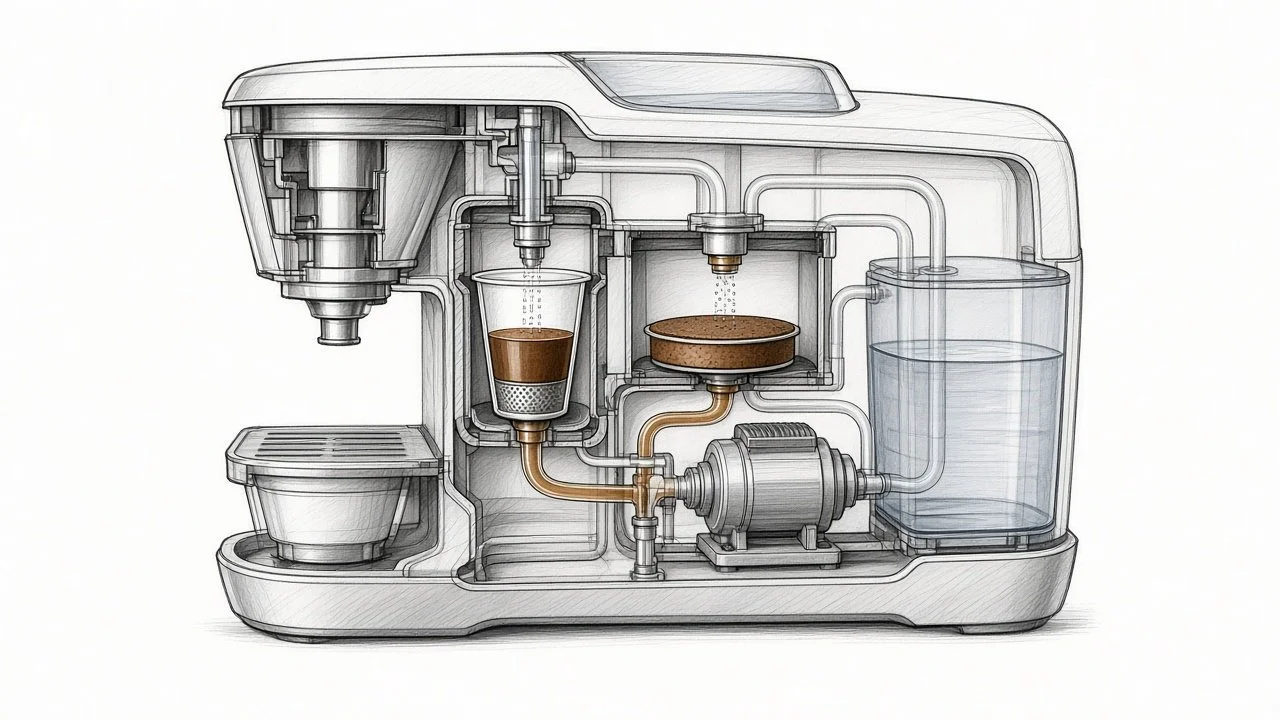
Conceptual diagram of a dual-path brewer. It illustrates the compatibility tradeoff and does not show Keurig’s internal design.
We don't know how Keurig built this internally. The general point stands: compatibility is a feature that is paid for in bill of materials, test hours and reliability risk. Price it in early.
Machine-readable consumables move the recipe into the pod
A recipe code lets the brewer change pressure, temperature and water ratio for each round. In effect, product behavior is defined by the consumable rather than by a button on the machine. That simplifies the interface for the user and gives the brand a way to add new drinks without changing the hardware.
It also brings new design questions. How does the code survive moisture, steam and abrasion? What does the brewer do if a code can't be read? How is a recipe validated before a new coffee partner ships it? For any machine-read consumable, a safe fallback when the code fails matters as much as reading it correctly the rest of the time.
What a compostable coating has to survive
A coating that holds up at espresso pressure and then composts is a hard materials problem. Keurig cites BPI and NSF certifications. If a team were building something comparable, the validation plan would likely include:
- Humidity and shelf life. Aging at temperature and humidity to see whether the coating softens, cracks or lets the coffee stale.
- Handling and transport. Drop, vibration and abrasion tests in retail and subscription packaging. Rounds that chip become dose and jamming problems.
- Pressure and burst behavior. Repeated tests across the full brew profile, including worst-case rounds at the edge of tolerance.
- Jamming and ejection. Making sure spent rounds eject cleanly across thousands of cycles.
- Residue and cleaning. What the coating leaves in the chamber, and how often users have to clean.
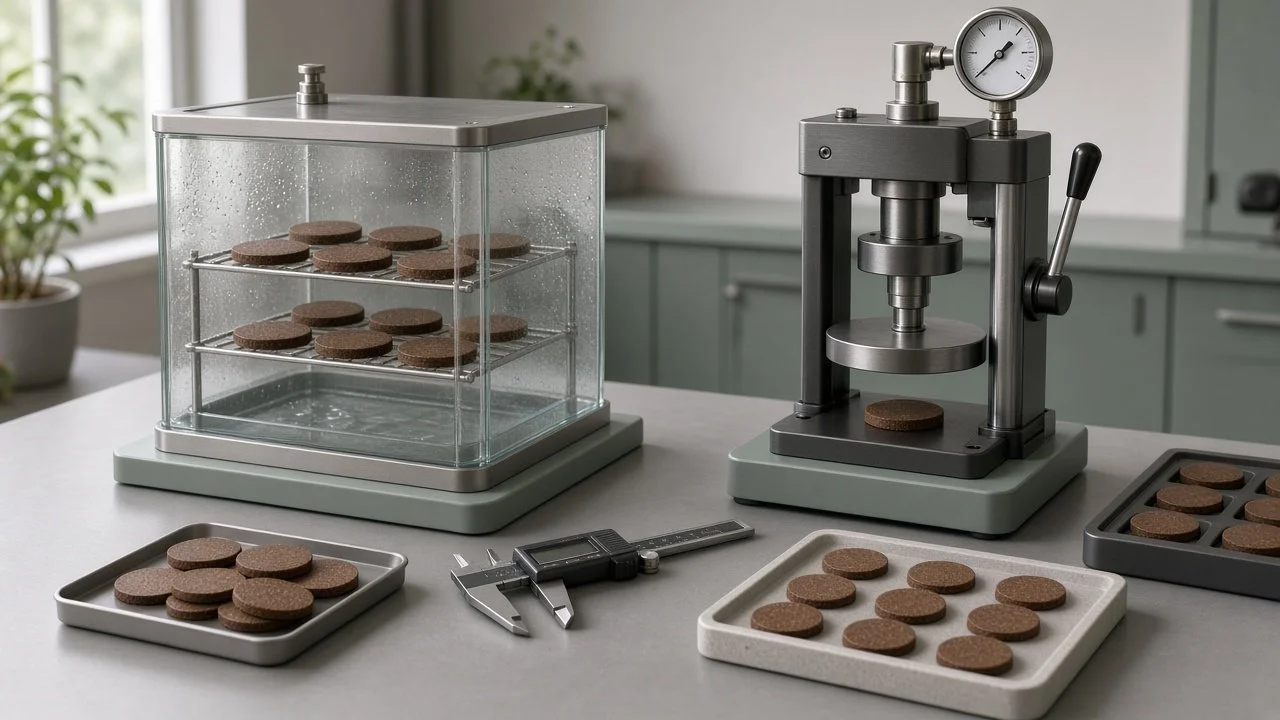
Conceptual illustration of humidity and pressure testing for a compostable coating. Not a depiction of Keurig's testing.
Our guide to CMF design and material selection covers how material choices tie back to these test plans. For the consumable's outer packaging, see packaging design testing before production.
Countertop design and price positioning
At $499.99, the brewer is priced as a premium countertop appliance. At that price, buyers expect finishes that hold up next to good kitchen hardware, and DesignWanted reports three of them. CMF has to do two jobs here: signal quality and survive daily contact with water, milk and coffee oils. An integrated frother adds another surface that needs regular cleaning.
How to state end-of-life claims honestly
Keurig's claims are specific: BPI certification for home and commercial composting, and an NSF-certified coating. That's the right model. Name the certifying body, say what the certification covers, and don't stretch it.
The open question is access. Home composting depends on user behavior, and commercial composting depends on local programs that accept the material. The release itself says spent rounds can be "composted or disposed of like coffee grounds," which is a fair way to acknowledge both paths. Smaller brands should be just as careful. A certification describes what a material can do, not what will happen to it in every household.
Open questions
Several things can't be known from a launch announcement:
- long-term reliability of the dual brewing paths and of code reading;
- how the rounds perform after months in humid kitchens;
- how much of the market can actually use home or commercial composting;
- how the economics of the rounds compare with pods over the life of the brewer.
Lessons for smaller brands
You don't need Keurig's scale to apply the same discipline. Design the hardware and the consumable as one system. Treat compatibility as a cost you choose. Build fallbacks into anything machine-read. Prototype and abuse-test the consumable as hard as the appliance. Early prototyping is usually where these system-level problems are cheapest to find.
If you're developing a kitchen appliance or a consumable-based product and want a second view on the system architecture, get in touch with Jackson Hedden.