AirPods 5 Teardown: Repair Is More Than a Removable Battery
On September 29, 2026, iFixit published a teardown showing a modest but meaningful change inside AirPods 5: the earbud batteries can be removed more readily, while opening the charging case still caused destructive damage. Its firsthand teardown awarded the product 2 out of 10 for repairability. That is progress, with substantial limits.
The news is the teardown, not a new launch today. Apple announced AirPods 5 on September 9, with store availability beginning September 18. For teams developing small consumer electronics, the fresh evidence raises a useful question: when does a removable component become a repairable product?
All images, including the featured image, are AI-generated conceptual illustrations of generic devices, not photographs of AirPods or their actual internals.
A connection is only one part of access
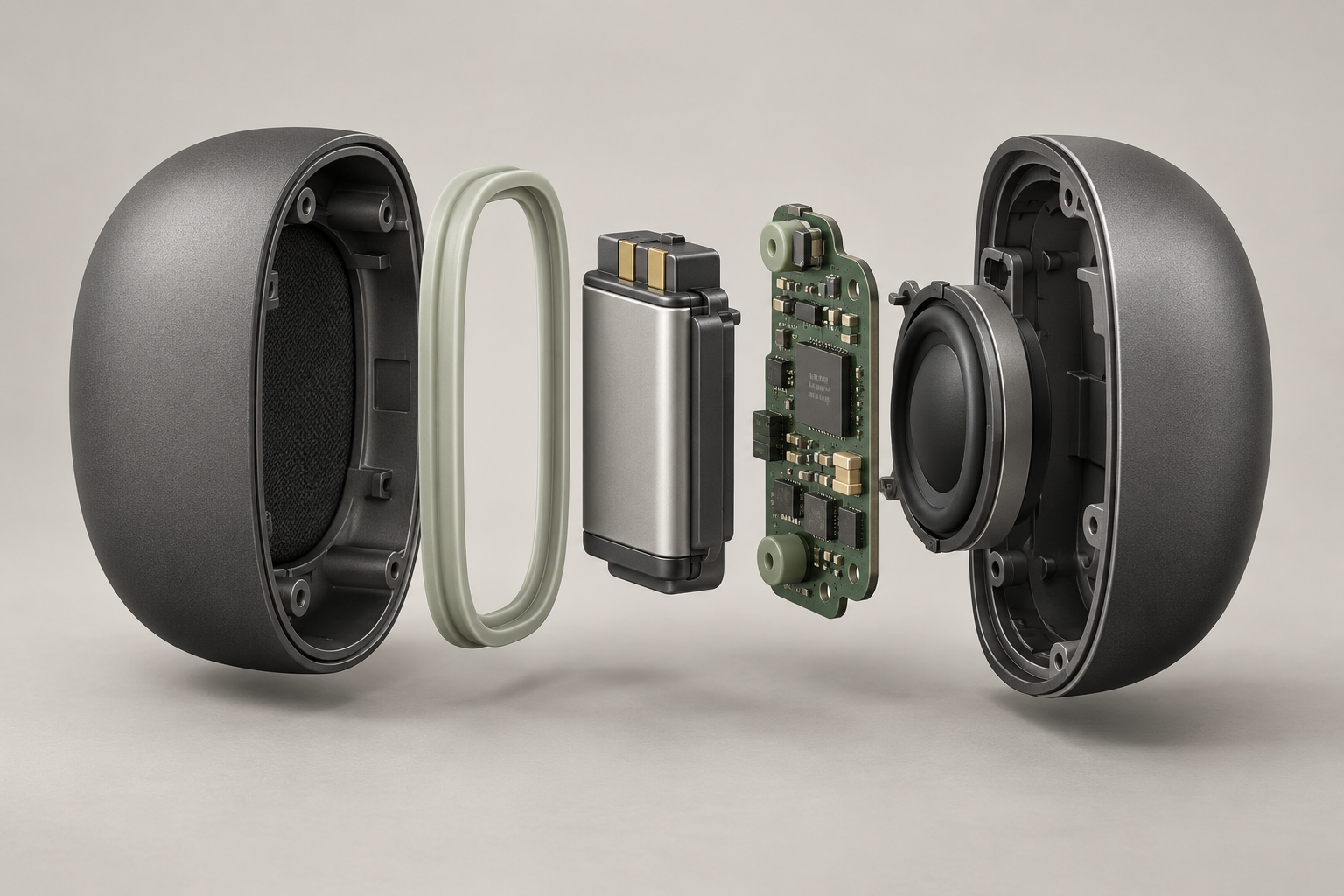
AI-generated conceptual illustration. This is not an AirPods rendering, teardown image, or repair instruction.
iFixit reports that the batteries use detachable prongs rather than soldered leads. Its technicians opened the earbuds cleanly and removed adhesive around the batteries. However, the left and right batteries differ in polarity and physical details, so a battery from one side cannot simply substitute for the other. MacRumors' September 29 coverage also describes the asymmetric batteries and the difficult case access.
Our design interpretation is that serviceability begins before the connector. A technician needs to find the opening, separate the enclosure, reach the part, identify the correct replacement, and put the object back together. A detachable contact improves one step. It does not answer the rest.
For a new device, sketch that entire sequence alongside the assembly sequence. Where does a tool enter? Which surface takes the load? Can the enclosure survive opening without losing alignment? Can the replacement be oriented incorrectly? These are practical design-review questions, even when a product is intended for professional servicing rather than user repair.
Make the permitted service route explicit in the product design brief. Otherwise, a team can approve a replaceable battery on a drawing while leaving the surrounding enclosure impossible to service economically.
Design the case as part of the ownership experience
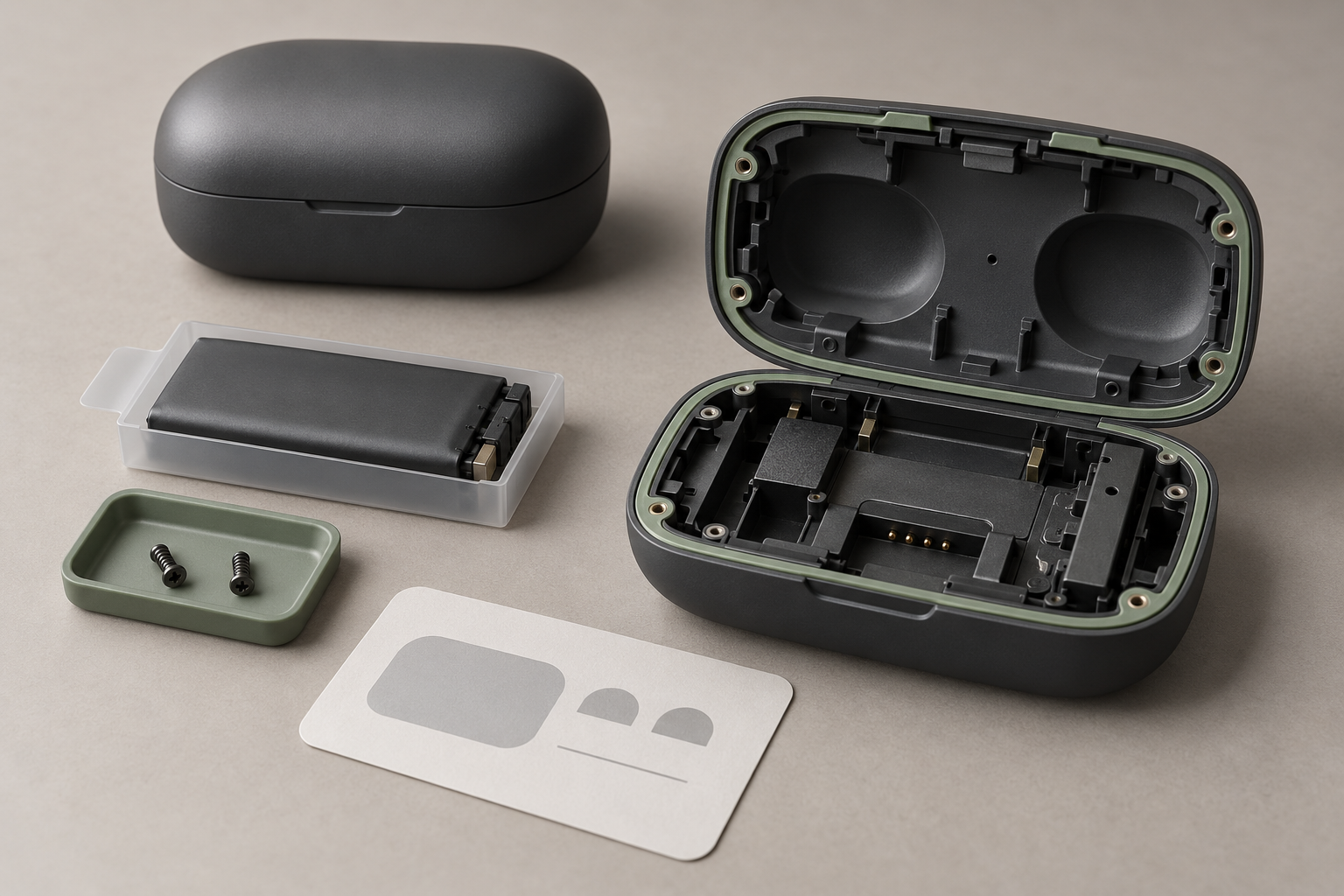
AI-generated conceptual illustration of a service system, not actual AirPods internals or a validated repair procedure.
The charging case is an essential partner to the earbuds. In iFixit's test, reaching its battery destroyed the housing; the teardown identified welded plastic inside. Its account also notes that Apple does not offer the relevant replacement parts or repair manuals. Those observations explain why the improved battery access did not translate into a high repairability score.
For product leaders, the useful inference is broader than earbuds. A portable device and its charger should be reviewed as one ownership system. If a dependent accessory has a shorter useful service life, the owner still encounters a failure in the overall experience.
A serviceable case may require space for fasteners, access clearance, alignment features, and a repeatable sealing strategy. Those requirements compete with a compact silhouette and rapid assembly. An adhesive or welded joint may support production priorities, but its consequences should be visible when the architecture is chosen, rather than discovered after tooling.
Separate cosmetic damage from functional failure in the review. A scuffed seam, a broken retention feature, and a damaged seal have different consequences. Establish what condition is acceptable after service, who checks it, and what must be replaced. The finished product's appearance should reflect a deliberate decision about that service path.
Compactness and repair need a measured comparison
There is an existing alternative architecture. Fairphone specifies replaceable batteries in both Fairbuds and their charging case, and identifies user-replaceable components including the case shell and core. This does not establish that every smaller audio product can use the same construction. It demonstrates that replacement can be part of the product's intended operation.
The comparison should therefore concern requirements, not appearance alone. A different enclosure can change fit, mass, acoustic volume, sealing, manufacturing operations, and the way an owner handles the device. A team needs to decide which constraints are fixed and which can move. Copying a service feature without checking the surrounding design would miss that work.
Use prototypes to compare competing service routes. Evaluate an opening and reclosure sequence on representative parts; then check fit, retention, charging contact alignment, and the relevant protection requirements after service. Record damaged components and the time spent identifying the right part. These observations make tradeoffs concrete without assuming that a neatly separated rendering represents a viable repair.
The next brief should include the second assembly
The first assembly takes place in production. A second may take place years later, when a worn component is replaced. Designing for that moment means planning parts availability, identification, instructions, tooling, and post-service checks alongside the physical joint.
The September 29 teardown supports a narrow conclusion: access inside the earbuds improved, while the case and support system remain obstacles. It does not demonstrate restored water resistance after repair, long-term reliability of serviced units, or a universal environmental benefit. Jackson Hedden has not performed this teardown or tested these products.
For a brand commissioning small hardware, the practical takeaway is to define a successful repair as an end-to-end outcome. A removable battery matters when the correct part can be obtained, installed, and verified in a product that still works. If your team is deciding how compactness and serviceability should meet, discuss the product challenge with Jackson Hedden while those architectural choices are still open.