Cargill’s Tokyo Showcase Puts Film Processing in Focus
At Material Week Tokyo, which runs September 30–October 2, 2026, Cargill Bioindustrial is presenting Incroflo P50, a processing aid for polyethylene film. Packaging Insights reported the showcase on September 30. The timely development is its presentation at the show; this article does not treat the additive as a product launched today.
For consumer brands, an ingredient used on a film line can seem distant from design. Yet packaging is a manufactured surface that customers see, handle, and open. Our design interpretation of this week's showcase is that changing a processing aid deserves a complete package trial, with a brief that connects factory performance to the user's experience.
All three images are AI-generated conceptual illustrations of generic film and testing equipment. They do not depict Incroflo P50, measured trial results, or Cargill's production equipment.
A small ingredient can change the manufacturing brief
Cargill specifies Incroflo P50 for replacing fluoropolymer processing aids in linear low-density polyethylene, or LLDPE, extrusion. The supplier describes an 86% bio-based additive, measured according to ASTM D6866, intended to improve flow and reduce melt fracture, including the surface defect known as sharkskin. It lists typical addition levels of 500–2,000 parts per million and claims output gains of at least 5% in benchmark trials.
Those are supplier specifications and claims, not a performance result independently established for a brand's particular film. A benchmark is a reason to investigate. It is not a basis for promising a faster line or a clearer package before the intended formulation and process have been evaluated.
For a founder commissioning packaging, the useful question is therefore not simply whether the additive is available. Ask which manufacturing problem the converter needs to solve. Is visible surface variation driving rejection? Is a particular operating condition limiting output? Is the team changing an ingredient to meet a purchasing requirement? Each problem needs different evidence.
Put that objective into the manufacturing and sourcing brief. An attractive sample and a productive trial can both matter, but neither should quietly replace the other as the acceptance criterion.
Judge the surface in the finished package

AI-generated conceptual illustration of generic film. This is not a measured surface comparison or an Incroflo P50 sample.
A film sample on a light table is only one view of the product. Our recommendation is to inspect a representative finished package alongside the raw sample. Use the intended artwork, contents, geometry, and handling sequence. Establish what appearance is acceptable before reviewing the trial, so a polished presentation does not set the standard after the fact.
Consider a clear pouch used to display a consumer good. The design team might care about the visibility of the contents, consistency across panels, and how the pouch looks under retail lighting. A printed wrap creates a different review: the surface must support the intended visual treatment and still look acceptable at folds and seams. These are proposed evaluation scenarios, not claims that this additive improves either application.
Retain samples from the existing formulation as a reference. Compare like with like, and record which variables changed. If film thickness, artwork, or lighting changes at the same time, the team may attribute an attractive result to the wrong decision. A simple sample library can make that comparison easier to revisit.
Test the package after the film leaves the line
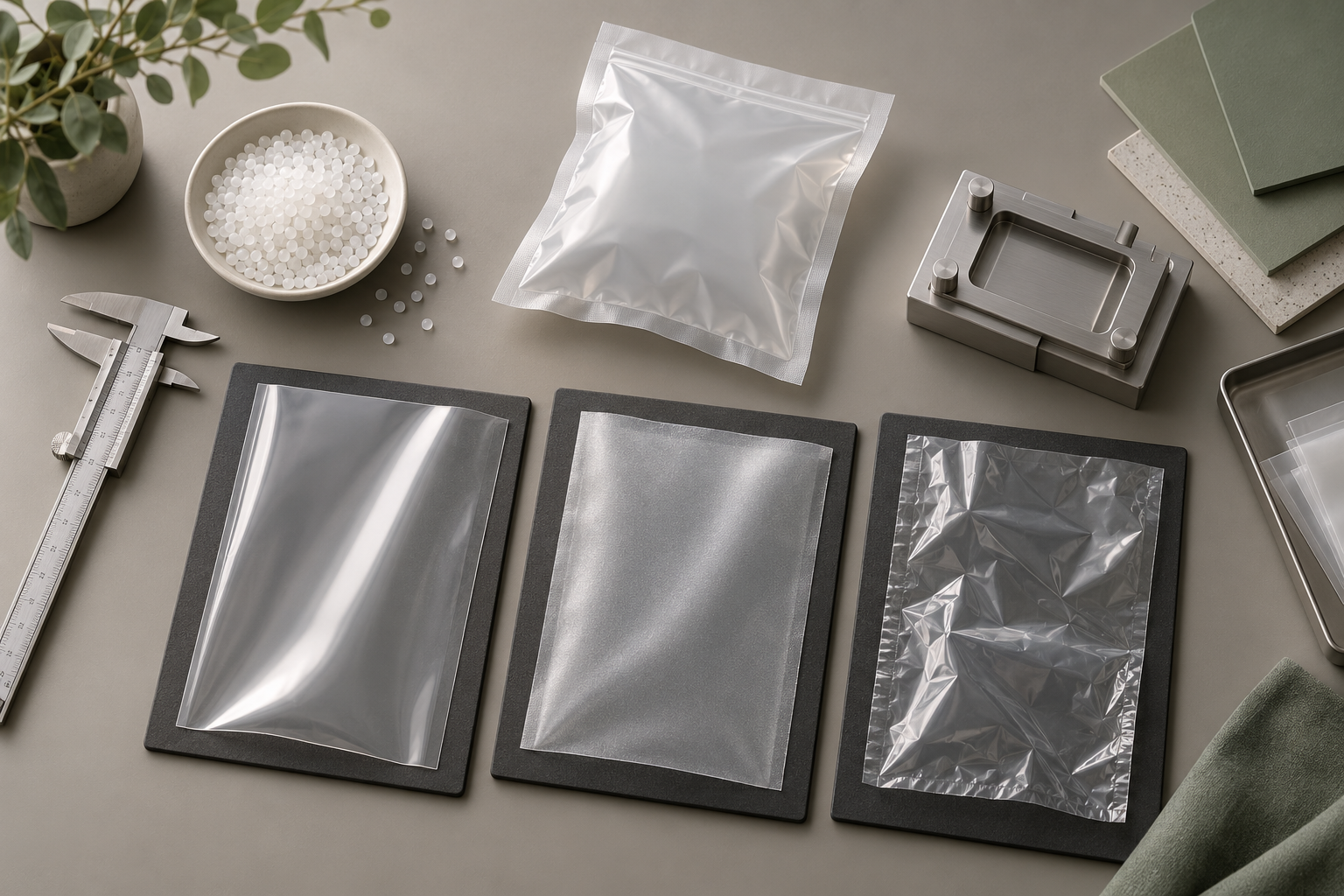
AI-generated conceptual illustration of a packaging trial bench, not actual Cargill equipment or experimental results.
Our proposed trial brief has three levels: document the extrusion conditions, evaluate conversion into the intended package, and review use. A processing gain only has commercial value if the resulting package still meets the requirements of the product it protects.
Agree with the converter on which observations to collect at each level. The production team can identify its relevant process and quality measures. The package team can define the sealing, printing, and handling checks needed for the application. The design team can examine opening, grip, visibility, and the presentation of the contents. Avoid assuming that a smoother-looking film proves successful performance further downstream.
Prototyping helps turn these questions into reviewable objects. Ask for representative packages, then handle them through the actual sequence: delivery, storage, display, opening, and removal of the product. The point is to expose a consequential difference early, while the specification can still change.
Keep material claims attached to their evidence
A percentage stated for an additive must not become the percentage stated for the whole package. Likewise, a change to one processing ingredient should not be presented as proof of a package's recyclability, compostability, or overall environmental benefit. Those are separate propositions requiring appropriate evidence.
Cargill's product page states that detailed food-contact statements, including restrictions, are available on request. Teams considering that application should obtain the documentation for their intended use; a headline about approval does not supply the full application scope.
The practical lesson from the Tokyo showcase is to write an acceptance brief before choosing the story the brand will tell. Specify the manufacturing objective, evaluate the finished object, and keep public claims narrower than the evidence. Jackson Hedden has not tested this additive. If your team is connecting a material change with a consumer product or packaging challenge, discuss the brief with Jackson Hedden while the options remain open.