BASF’s Recycled-PET Grades Put the Molded Part First
On September 30, 2026, BASF announced new Ultradur RC1 grades: glass-fiber-reinforced PBT/PET engineering plastics containing up to 30% post-consumer recycled PET. The intended uses include automotive brackets, housings, and connectors. BASF says the grades were developed to approach the properties of comparable virgin materials; that is a supplier claim, not proof that an existing component can change materials without evaluation.
The useful development for consumer product teams is the proposed route from discarded packaging into demanding molded components. It makes recycled content a question for the engineering brief, alongside fit, service life, production consistency, and appearance. The launch concerns automotive applications. It does not establish that these grades are suitable for a particular appliance, wearable, or food-contact product.
All three images are conceptual illustrations of generic parts and material studies. They are not BASF samples, actual Ultradur RC1 parts, or experimental results. Jackson Hedden has not tested these materials.
Start with the part's job, not the recycled percentage
A housing is rarely just a shell. It locates other components, holds fasteners, creates an assembly seam, and may define how someone grips or opens the product. A bracket might be visually inconspicuous while carrying the load that keeps the experience reliable. Our recommendation is to describe these jobs before comparing candidate materials.
For an existing design, identify the interfaces that cannot move and the features that can change. A screw location, sealing surface, or connector alignment may be more consequential than the overall silhouette. For a new design, keep the architecture open long enough to consider where reinforcement, wall geometry, and assembly method belong together.
Do not interpret “up to 30%” as a specification for every grade or every finished product. BASF describes variants with different reinforcement levels. Ask for the exact grade, its recycled-content basis, and the relevant data before assigning a percentage to a product claim. A compound-level percentage also should not be presented as the recycled content of the entire assembled device.
Check the molded assembly, not only a material coupon
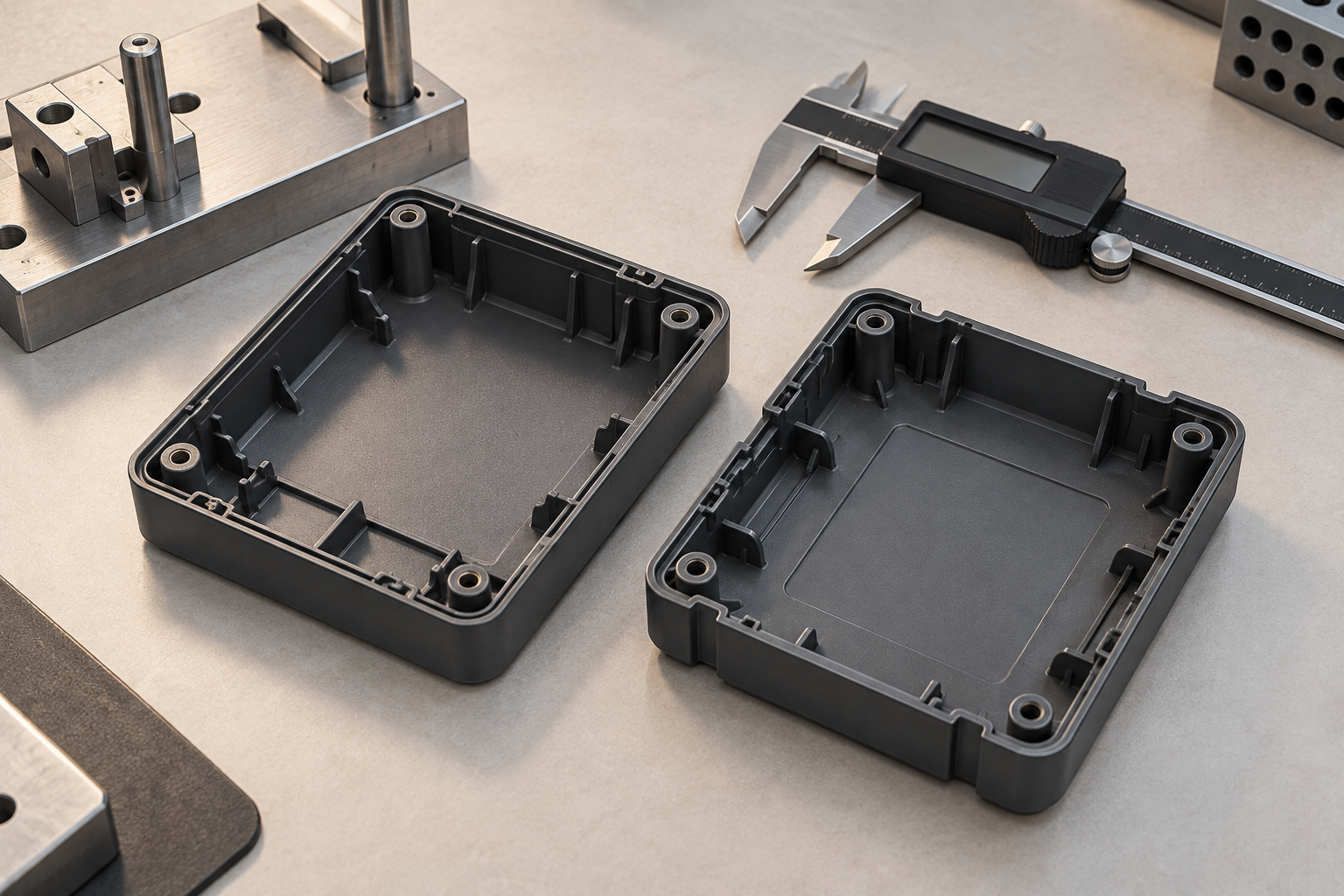
Conceptual illustration of an assembly review, not an Ultradur RC1 part or measured result.
A test coupon is useful for comparing a property under defined conditions. The product introduces geometry, flow paths, and mating parts. BASF's general Ultradur brochure illustrates how shrinkage in glass-fiber-reinforced grades differs with direction relative to melt flow. It is background guidance for the material family, not qualification data for the new RC1 grades.
For a housing trial, our suggested sequence is to inspect the critical dimensions, assemble the mating parts, and then evaluate the complete use cycle. Does the seam stay consistent? Can the intended fasteners be installed repeatedly? Do the mounting features preserve alignment? Set acceptance criteria before reviewing the first attractive sample.
Appearance prototypes can establish proportions and access, but they cannot confirm the behavior of a production material in its intended molding process. Plan the transition from prototyping to representative molded parts explicitly. Otherwise, a model that answers a form question can be mistaken for evidence about a different manufacturing question.
Make processing part of the qualification plan
The same general brochure explains that excessive moisture during processing can degrade thermoplastic polyesters and reduce properties such as impact resistance. That is a reason to involve the processor early, not to copy a general drying recipe into a new grade's production instructions. Obtain current, grade-specific processing guidance.
Our suggested trial record links the material lot, conditioning, molding setup, and inspection results. If a part misses its target, that record helps the team distinguish a geometry issue from a processing issue or material variation. It also gives the next trial a clear purpose.
Review the features that carry the user's experience alongside the engineering measurements. A visible seam, surface texture, button clearance, or opening action can expose a change that a single strength value misses. Integrating these checks into the manufacturing plan keeps visual and functional acceptance criteria connected.
Keep the environmental claim specific
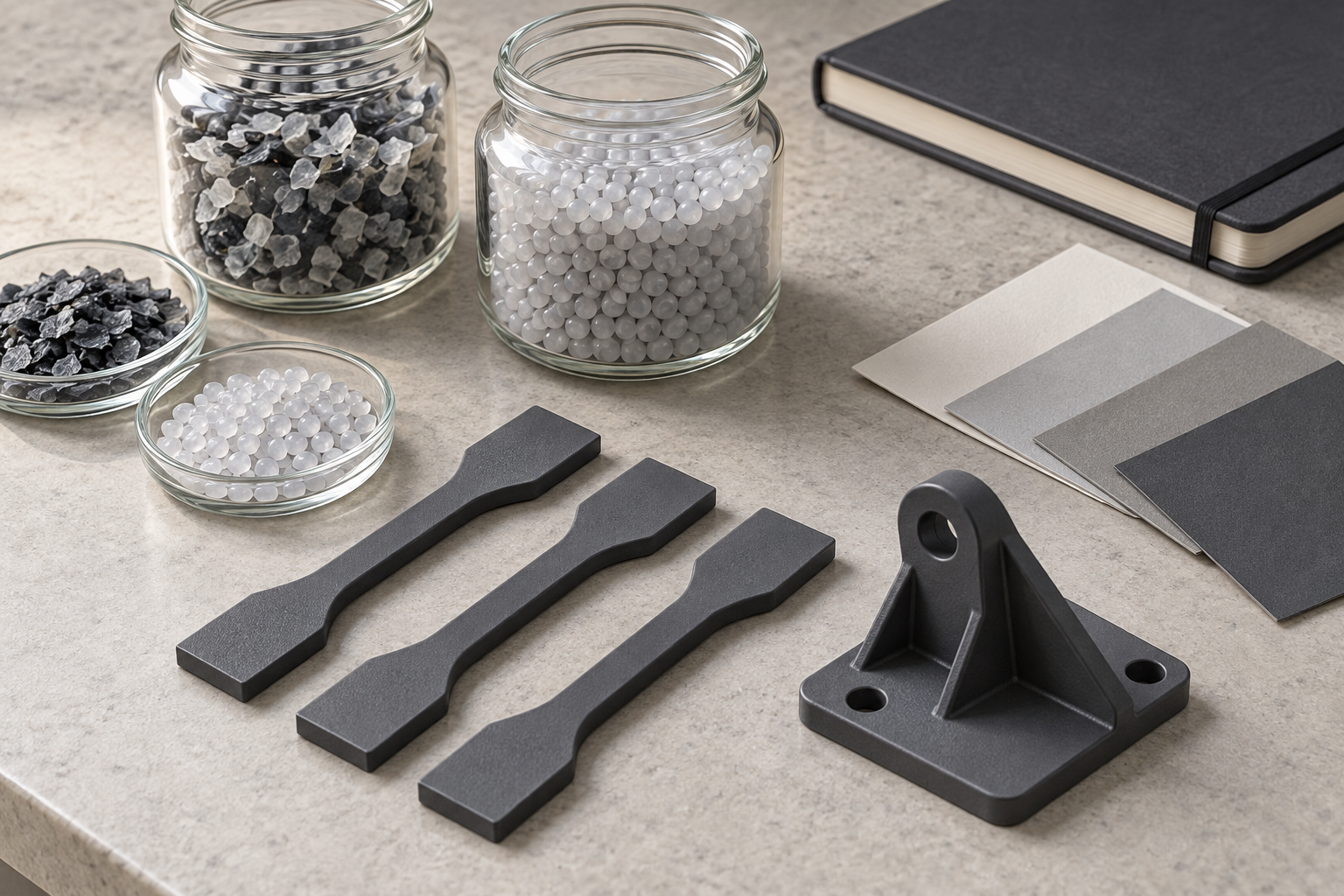
Conceptual illustration of material samples, not actual BASF samples or experimental results.
BASF says the recycled PET comes from packaging waste outside established bottle-to-bottle streams. Collision Repair Magazine's September 30 coverage also reports the announcement, attributing the performance expectations to BASF. Neither report supplies independent lifetime results for a finished consumer product.
A useful supplier discussion therefore asks several distinct questions: what is the documented recycled content, what comparison supports an environmental claim, what part-level validation is required, and what supply commitments are available? Those answers should not collapse into a single sustainability adjective.
Recycled feedstock does not, by itself, establish that the finished assembly has an accessible recycling route. Nor does a material announcement establish a quantified reduction in a particular product's footprint. Evaluate the whole proposed design and its intended market before writing the customer-facing claim.
The practical opportunity is to consider a new material while design decisions can still adapt to it. Specify the job, test representative parts, and document the claim at the level the evidence supports. If your team is considering a material change for a consumer product, discuss the part and production brief with Jackson Hedden before the tooling decision is fixed.