IKEA’s YXSTABY Launch Makes Shared Space the Design Brief
IKEA and Xbox marked the October 1, 2026 launch of YXSTABY, a nine-piece furniture and accessories collection for gaming at home. The collection was first unveiled at Gamescom on August 26; this week's news is its retail launch, not its first announcement. The October 1 Xbox announcement says it is launching in IKEA stores, with availability varying by market and online availability following later this year.
The useful design question reaches beyond gaming: what happens when a product must support one person's activity without making everyone else organize their lives around it? YXSTABY offers a concrete starting point for a brief about shared space, equipment storage, and recognizable brand details.
All three images are conceptual illustrations of generic furniture and design studies. They do not depict YXSTABY, its components, or actual development tests. Jackson Hedden has not tested the collection.
Design the return to ordinary life
In its August 26 announcement, IKEA describes a rolling TV stand with equipment storage at the back and a portable toolbox whose closed lid also serves as a laptop stand. These features address the transition into and out of an activity, as well as the activity itself.
Our interpretation is that putting things away belongs in the core experience. A device may work beautifully while in use yet leave a room difficult to share afterward. For teams commissioning furniture, appliances, or accessories, a useful product design brief should describe both states: ready for the task, and ready for whatever happens next.
Map the intervening actions. What must be unplugged? Which objects need to travel together? Where does the equipment land temporarily? A handle has little value if moving the organizer also requires several loose trips. Conversely, a container that accommodates everything can become too large to fit the intended storage location. Capacity, carryability, and the room's available space need to be reviewed together.
This is a tradeoff to resolve through observation and prototypes, not a claim that portable storage automatically makes a product convenient. A permanently installed setup can be the better choice when it reduces repeated effort and the room is dedicated to the activity.
Give storage an understandable sequence
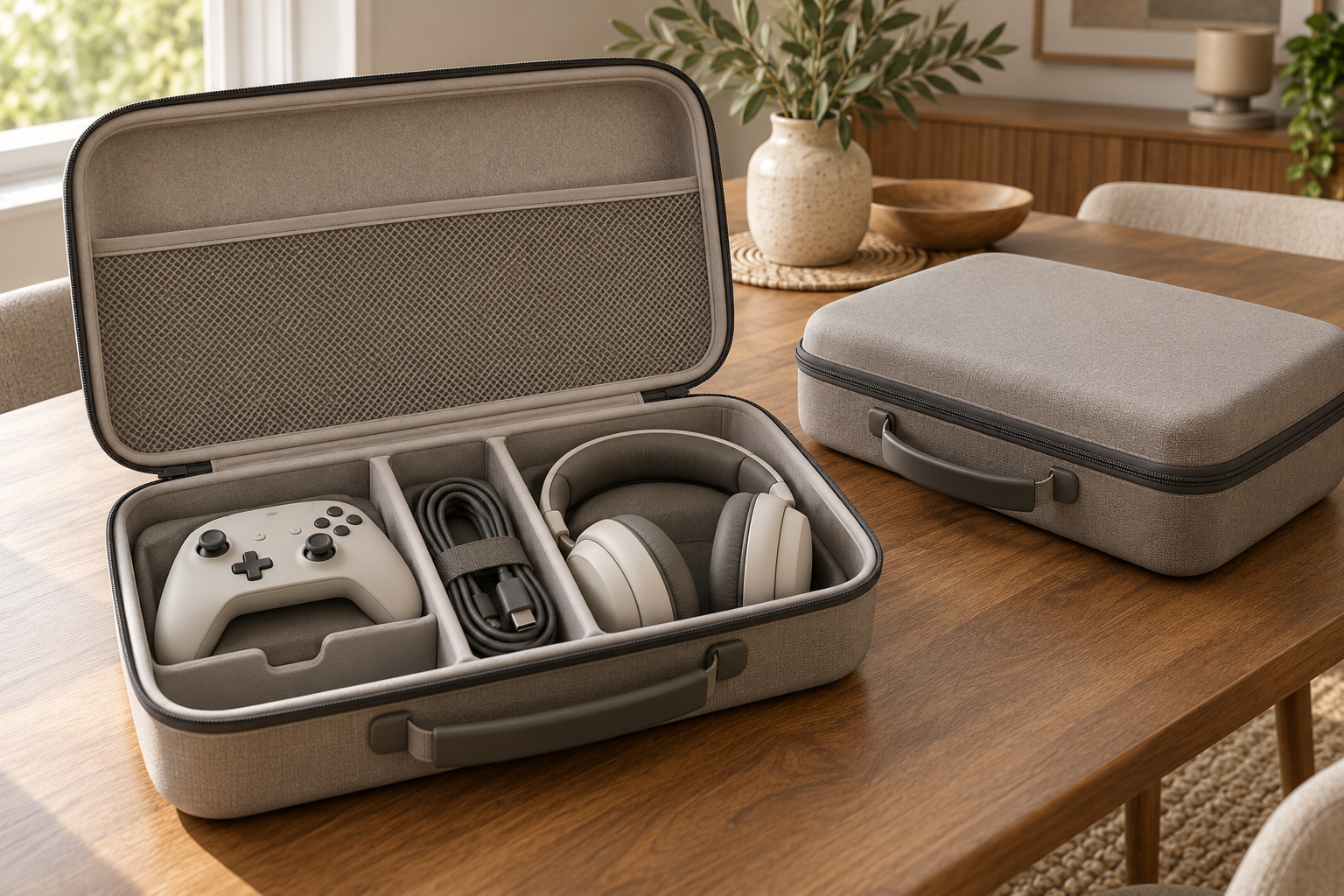
Conceptual illustration of equipment storage, not a YXSTABY product or tested packing routine.
The portable-box idea prompts another practical question: can the user tell how the contents belong inside? An organizer can look tidy in a launch photograph while relying on an arrangement that is slow or difficult to reproduce.
For a new product, test packing with the actual intended assortment of equipment. Include cables in the condition they will usually be in, rather than assuming perfect coils. Try replacing only the most frequently used item. Watch whether someone needs to remove everything else first. These are suggested evaluation tasks, not findings about YXSTABY.
Dedicated compartments can make locations clear but may become obsolete when an accessory changes size. Open space accommodates variation but allows items to shift or obscure one another. A team should decide which objects require a defined position and which need tolerance for change. This decision affects the internal geometry, the user's routine, and the product's usefulness beyond its first equipment configuration.
Translate identity instead of simply enlarging it
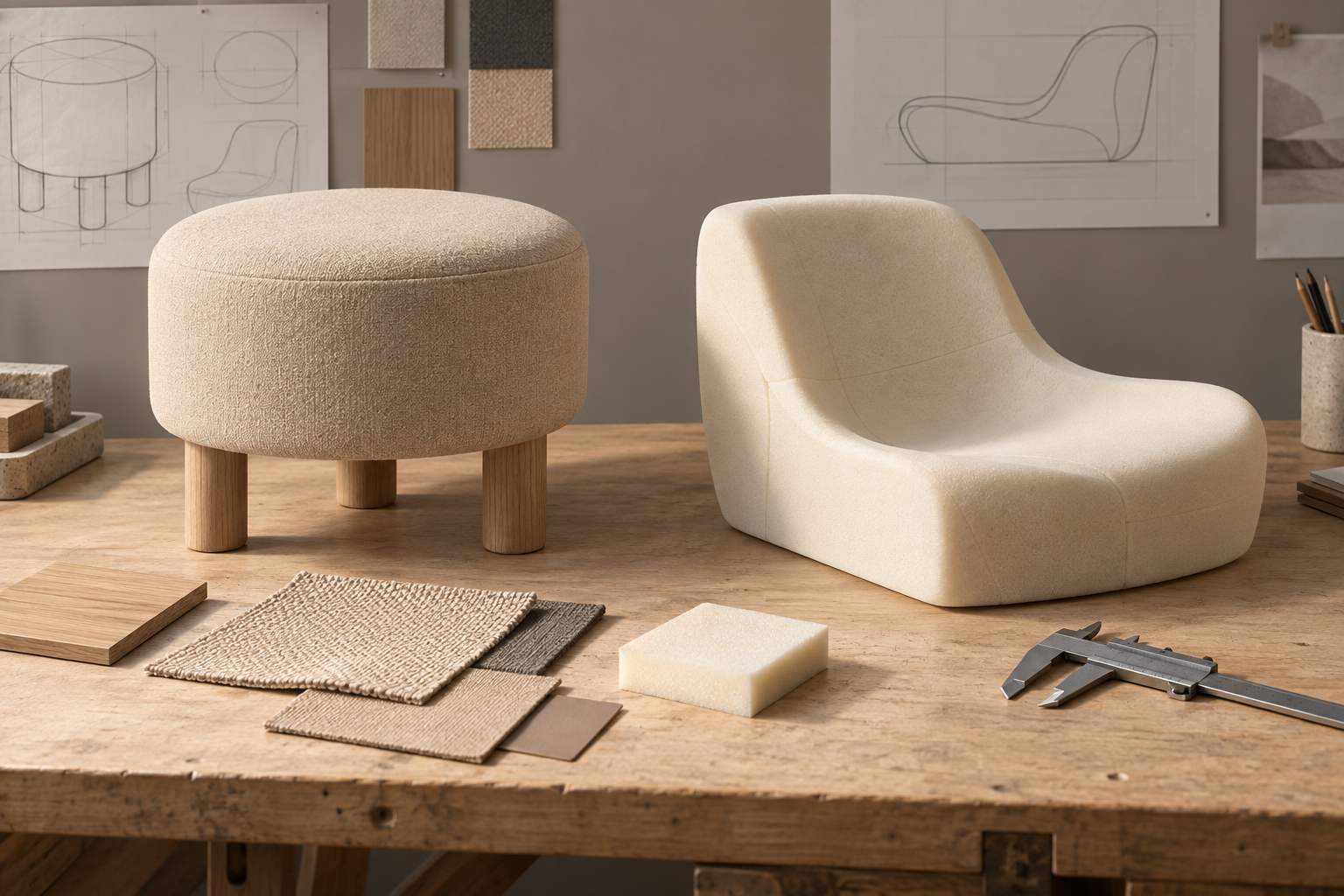
Conceptual illustration of a seat design review, not an IKEA prototype or measured result.
IKEA says the controller inspired several pieces, including a thumbstick stool developed using Xbox's original 3D design files. It describes adapting the seating curve and stability, rather than treating a scaled controller part as a finished furniture design. The brand reference supplies a direction; the new object still needs its own requirements.
For founders considering a collaboration, that distinction matters. A recognizable shape may attract attention, but the person using the object encounters its edges, proportions, surfaces, and behavior. A familiar detail at a new scale can become a different physical proposition.
Our recommendation is to list which qualities should transfer and which must change. Recognition might come from a silhouette or texture. Comfort, support, clearance, and cleaning access should follow the new use. Review these through appropriate prototypes, including full-scale models where the body interacts with the form. A small appearance model cannot settle a seating question.
Evaluate the collection as a system
Wallpaper's coverage, updated October 1, reports that the development involved multiple iterations and prototypes, with some concepts discarded. That is context about the collaboration, not evidence that every piece works for every household.
A collection creates obligations between objects. Ask whether storage remains accessible when a seat is in use, whether a moved item blocks a route, and whether the visual language holds together alongside existing furniture. Evaluate the transition as a complete sequence, not just as isolated product photographs.
The commercial lesson is equally specific: communicate availability at the market level. An international launch date does not guarantee that every item is immediately available through every channel. For the design brief, define the shared-space problem before selecting the visual motif. If your team is developing a product that must fit into an existing routine, discuss that transition with Jackson Hedden while the architecture is still open.