Medical Equipment Design: A Practical Guide
Medical equipment design turns a clinical, care, or monitoring need into a physical product that people can understand, handle, maintain, and produce consistently. The strongest programs connect user needs, industrial design, electronics, prototyping, testing, and manufacturing decisions from the beginning instead of treating each as a separate handoff.
Talk with Jackson Hedden about your medical equipment design project
What is medical equipment design?
Medical equipment design is the process of defining, shaping, prototyping, testing, and preparing physical equipment for its intended use in a healthcare setting. It includes the visible enclosure and controls, the internal architecture, the user experience, the supporting electronics, the materials, and the documentation needed to move toward production.
That scope is broader than making a product look clinical. A successful design must account for who uses the equipment, where it is used, how it is cleaned or serviced, how information is presented, how components fit together, and how the product can be built repeatedly. The design should make important actions clear without claiming that appearance alone establishes safety or clinical performance.
This guide focuses on the product-development decisions behind physical medical equipment. It does not provide clinical, legal, regulatory, or certification advice. Intended use, classification, testing, quality systems, and market requirements vary by product and jurisdiction. Teams should involve qualified regulatory and clinical specialists for those decisions. The U.S. Food and Drug Administration provides general information about medical device classification, but a general article cannot determine a product's pathway.
Start with the use environment, not the enclosure
The first design question is not what the equipment should look like. It is what users must accomplish, in what environment, under which constraints, and with what consequences if an action is misunderstood. A clear use definition gives the design team a practical basis for making decisions about form, controls, materials, access, and feedback.
Map every user and handoff
Medical equipment may have several user groups. A patient may interact with the product directly, while a clinician configures it, a caregiver cleans it, a technician services it, and a procurement team evaluates its ownership requirements. Each person brings a different task, context, and expectation.
Primary user: Who operates the equipment and what must be obvious at a glance?
Patient or recipient: Who experiences the equipment, its contact points, sound, light, weight, or movement?
Caregiver or support user: Who prepares, cleans, transports, or stores it?
Technician: Who diagnoses issues, replaces components, or performs service?
Purchaser: Who evaluates workflow fit, durability, training, and total ownership effort?
Mapping these interactions early helps prevent a common failure pattern: optimizing the main operator's experience while making cleaning, service, charging, transport, or setup unnecessarily difficult. The result should be a prioritized set of user needs and design requirements, not a collection of assumptions about what a healthcare product should resemble.
Describe the real operating conditions
Document where the equipment will be used, how much space is available, whether it is stationary or portable, and what users may be wearing or carrying. Consider lighting, noise, gloves, mobility limitations, storage, cleaning routines, transport, and the possibility that the equipment will be used under time pressure.
A use-environment review can also expose requirements that are easy to miss in a studio. A handle may need to work from more than one direction. A cable may need controlled routing. A service panel may need to be accessible without disturbing the user. A display may need a deliberate viewing angle rather than a larger screen. These observations make the design brief more useful than a list of preferred colors and features.
Translate user needs into a design brief
A medical equipment design brief should convert the use case into decisions the team can evaluate. It should explain the intended users, core tasks, environment, physical constraints, connected components, cleaning and service expectations, production goals, and open questions. A well-structured brief keeps the project focused as ideas become more detailed.
Define the product boundary
State what the project includes and what it does not. The boundary may include a handheld instrument, a powered enclosure, a patient-facing accessory, a monitoring station, or a set of connected physical components. It may exclude the clinical protocol, software platform, disposable consumable, or hospital infrastructure that interacts with the product.
This distinction matters because physical design decisions often depend on neighboring systems. A charging method affects the enclosure. A sensor affects placement and access. A disposable component affects interfaces and cleaning. A remote workflow affects indicators and connectivity. Write down those dependencies before the team commits to a form.
Turn vague goals into reviewable requirements
Words such as intuitive, compact, premium, safe, and easy to clean can be useful starting points, but they are not yet review criteria. Convert them into questions that a prototype or design review can address.
Can the intended user identify the primary control without searching?
Can a caregiver reach the surfaces that require cleaning?
Can the equipment be held, positioned, or transported as the use case requires?
Can internal components be arranged for assembly and service?
Can the product communicate its current state without relying on color alone?
Can the design accommodate the expected battery, sensor, board, cable, and fastening needs?
The answers do not replace formal testing or regulatory work. They make the design process more disciplined by giving the team a shared way to compare concepts and identify unresolved risk.
Shape the product around people and components
Industrial design gives medical equipment its physical logic. It establishes how the product is held, positioned, opened, cleaned, understood, and recognized. The best form decisions support the workflow and the underlying components at the same time, rather than adding a polished shell after the technical layout is already fixed.
Use form to clarify action
Controls, handles, ports, access panels, and contact surfaces should communicate their intended use through proportion, spacing, texture, resistance, and location. A product may need a clear primary interaction, a deliberate grip, a stable base, or a visual distinction between user-accessible and service-only areas.
Color and visual styling can reinforce hierarchy, but they should not carry the entire burden of communicating state. Shape, position, tactile feedback, sound, and explicit interface language may all contribute to a clearer experience. The right combination depends on the people, environment, and tasks documented in the brief.
Plan the internal architecture early
Before the exterior is finalized, reserve space for the components that determine the product's behavior and service needs. This may include a circuit board, battery, sensor, display, connector, speaker, light source, fasteners, shielding, thermal paths, and cable routing. Account for assembly access, tolerance variation, and the sequence in which the product will be built.
Jackson Hedden's product design services are relevant when a project needs the physical concept, enclosure, and production intent to develop together. The goal is not to freeze every detail immediately. It is to make the important relationships visible while there is still time to change them.
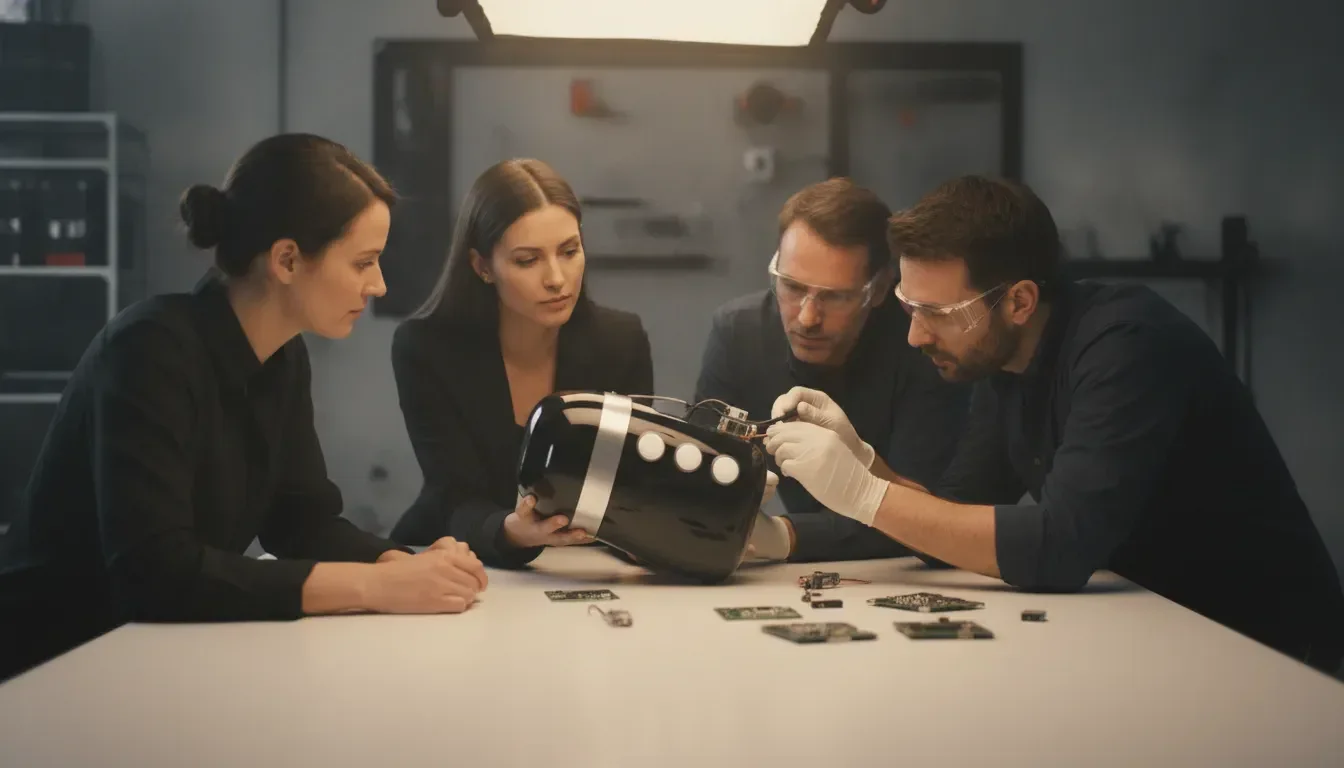
A physical prototype helps the team evaluate form, fit, access, and component relationships together.
A physical prototype helps the team evaluate form, fit, access, and component relationships together.
Coordinate electronics with the physical product
For powered or connected medical equipment, the enclosure and electronics must develop as one product system. Board size, battery placement, sensor location, connectors, indicators, charging, heat, and cable routing all affect the form, assembly, and user experience. Coordinating these decisions early reduces late changes that can compromise usability or manufacturability.
Key questions include:
Where must a sensor sit to support the intended interaction and physical arrangement?
How will a user charge, connect, start, stop, or reset the equipment?
Can the battery and other serviceable components be accessed in the intended workflow?
What physical protection and strain relief do cables and connectors need?
How will lights, sounds, and displays communicate product state in the actual environment?
Does the enclosure leave enough room for assembly variation and future revisions?
Jackson Hedden's electrical design services page describes support for product electronics such as circuit boards, embedded systems, sensors, and firmware collaboration. A project does not need to answer every electronics question before industrial design begins, but it does need a shared architecture and a process for resolving dependencies.
Prototype the decisions that carry the most risk
Prototypes are most valuable when each one answers a specific question. A rough model can reveal grip, scale, reach, placement, or access problems. A more detailed prototype can evaluate component fit, controls, charging, assembly, or the interaction between the enclosure and the electronics. The right prototype is the least elaborate model that can produce a trustworthy observation.
Match prototype fidelity to the question
Appearance and scale model: Evaluate overall proportion, visual hierarchy, placement, and how the product occupies a space.
Ergonomic model: Evaluate grip, reach, posture, weight distribution, and the size of key interactions.
Fit-check model: Evaluate board, battery, sensor, connector, fastener, and cable relationships.
Functional prototype: Evaluate a physical interaction, control sequence, sensor position, or connected behavior.
Production-intent prototype: Evaluate materials, assembly approach, finish, tolerance strategy, and likely manufacturing constraints.
Jackson Hedden's prototyping services can support looks-like and works-like models, including 3D-printed and machined parts. Prototype results should be recorded with the question tested, the observation made, the design implication, and the next decision. That simple record keeps the project from treating a prototype as a demonstration instead of a learning tool.
Test with representative tasks
Ask people to perform the tasks the product is meant to support, using realistic constraints where appropriate. Observe where they pause, reach, rotate, misread, or ask for help. Pay attention to setup, cleaning, charging, transport, and handoff, not just the central interaction.
Do not describe an informal prototype session as clinical validation. Early testing can reveal design questions and usability opportunities, while formal verification, validation, clinical evaluation, and regulatory evidence follow the product's requirements and applicable pathway.
Design for manufacturing and service from the start
Manufacturing readiness is not a final packaging exercise. It begins when the team chooses a concept, material direction, part split, attachment method, and level of customization. A design that looks strong in a single prototype may still require substantial work before it can be assembled consistently and supported over time.
Review the production logic
Evaluate how many parts the product contains, how they are oriented, how they are located, how they are fastened, and how a person or process will assemble them. Check draft, wall thickness, access, tolerance stack-up, surface transitions, material compatibility, and the difference between a prototype process and the expected production process.
Also consider what happens when a component changes or a part is no longer available. A flexible architecture can reduce the impact of supplier and revision changes. A clear bill of materials, control drawings, assembly information, and defined interfaces can make the handoff more dependable.
Include cleaning, maintenance, and repair
Serviceability should be treated as a design requirement rather than an afterthought. Identify surfaces that need regular cleaning, areas where residue or moisture could collect, components that may need replacement, and panels that should be opened by a technician rather than a general user.
These questions influence seams, fasteners, gaskets, access paths, materials, and the relationship between disposable and durable parts. They also help the team distinguish between a product that is merely compact and one that is practical to operate and support in its intended setting.
For projects moving toward production, Jackson Hedden's manufacturing services can help connect production-ready files, assembly information, sourcing considerations, and manufacturing review. The exact deliverables should be defined around the product, the manufacturer, and the project's quality and regulatory plan.
Choose a product-development partner carefully
A medical equipment design partner should be evaluated on how well it connects the full physical product, not only on the quality of concept images. Ask how the team handles user needs, industrial design, electronics, prototypes, design reviews, manufacturing handoff, documentation, and collaboration with clinical and regulatory specialists.
Questions to ask during selection
How will you translate the use environment into measurable design requirements?
Who will coordinate the enclosure, electronics, prototypes, and production decisions?
What will be tested at each prototype stage, and how will findings change the design?
How will service, cleaning, assembly, tolerances, and future revisions shape the product?
Which deliverables will be ready for the next partner, manufacturer, or internal review?
How will you work alongside our clinical, quality, regulatory, and manufacturing specialists?
Look for a partner that can explain tradeoffs in plain language and show how decisions move from brief to prototype to production. The right fit is usually less about a single portfolio image and more about whether the team has a repeatable way to surface risk early.
For an example of Jackson Hedden's work in a health-related product context, see the RelieVRx case study. A case study should be read as evidence of the type of collaboration and product work performed, not as a guarantee of a particular outcome for a new project.
Request a conversation about medical equipment design with Jackson Hedden
Frequently Asked Questions
What does medical equipment design include?
Medical equipment design can include user and use-environment research, industrial design, enclosure development, electronics integration, prototyping, usability-focused design reviews, manufacturing preparation, and service planning. The exact scope depends on the product and should be coordinated with qualified clinical, quality, and regulatory specialists.
How early should manufacturing be considered?
Manufacturing should be considered during concept development, not after the appearance is complete. Material choices, part splits, fasteners, tolerances, assembly access, supplier constraints, cleaning, and service needs can all affect the form. Early review keeps the team from validating a concept that is difficult to build consistently.
Do I need a prototype before starting design?
No. A project can begin with a need, workflow, existing product, technical concept, or early sketch. The team can then choose the first prototype based on the largest unknown, such as scale, grip, component fit, sensor placement, or assembly access. Existing prototypes are useful inputs, but they do not replace a structured design review.
Can an industrial design firm provide regulatory approval?
An industrial design firm can support product definition, physical design, prototypes, documentation, and collaboration with a regulatory team, but it should not promise approval without knowing the product, intended use, jurisdiction, evidence plan, and responsible authorities. Regulatory strategy and submissions should be handled with qualified specialists.
How do electronics affect the enclosure design?
Electronics affect enclosure size, internal layout, user controls, sensor placement, charging, heat, cable routing, service access, and production assembly. Developing the electronics and physical product together allows the team to resolve those relationships before the design is locked around an incomplete component set.
What should a medical equipment design brief contain?
A strong brief identifies users, intended tasks, operating environment, physical constraints, key components, cleaning and service expectations, production goals, open risks, and the decisions the first prototypes must answer. It should also state which clinical, quality, regulatory, and manufacturing questions require specialist input outside the design brief.