JennAir’s Dekton Panels Put Material and Motion in One Brief
On September 30, 2026, JennAir and Cosentino announced a made-to-order JennAir x Dekton panel collection for selected refrigeration and wine columns. The announcement describes five finishes and a 4 mm slim surface engineered around appliance weight tolerances, handle drilling and hanging compatibility. Those qualifications are the interesting part: the material becomes a moving component, not simply a decorative layer. Read the manufacturer announcement.
The collaboration was already previewed in Cosentino’s February 23 KBIS recap. September’s announcement is an ordering and collection update, rather than the first appearance of the idea. For teams developing home products, it exposes a practical question: how do you preserve a calm architectural surface while giving the user a dependable mechanical interface?
A surface becomes a door system
Our design reading is that material continuity shifts attention toward the joints. When cabinetry, backsplash and appliance fronts share a visual language, an uneven gap or awkward handle becomes more noticeable. The quieter the composition, the harder each small interface has to work.
A material sample cannot answer whether a finished door will feel balanced. The development team needs the complete assembly: surface, carrier, attachment hardware, handle and the appliance’s permitted configuration. Thinness can help an integration strategy, but thickness alone does not establish acceptable mass, stiffness or durability. A successful mockup must represent how the panel is supported and how forces travel through it.
For a founder commissioning a household product, the broader lesson is to put the mechanism into the product design brief as soon as the appearance is chosen. A premium finish is an input to engineering. It is not evidence that engineering is finished.
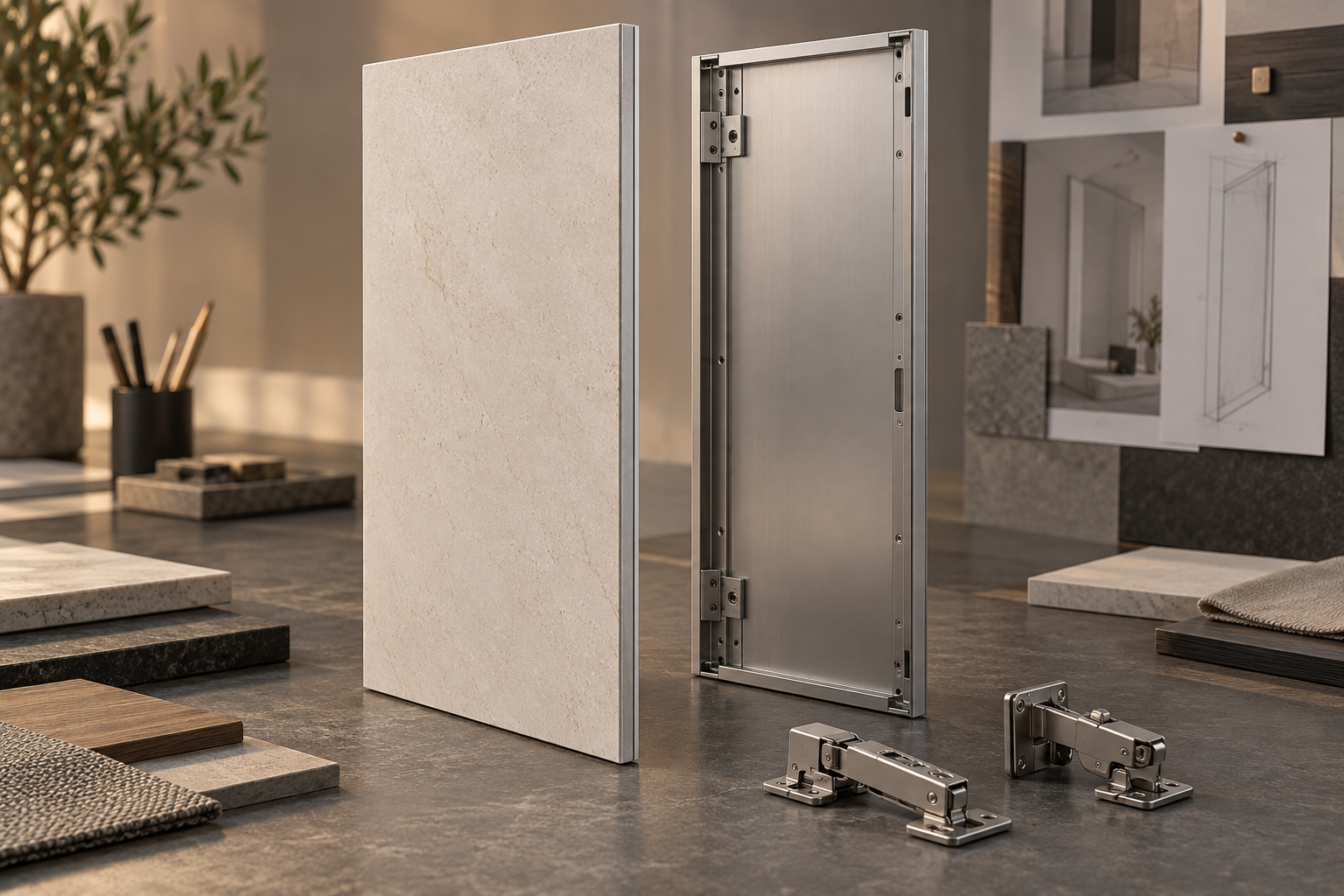
Conceptual illustration of panel and hardware interfaces, not JennAir components or verified construction.
Specify the interfaces before approving the finish
Start with a compatibility table, not a mood board alone. Which exact appliance models accept which panel sizes? What hardware and handle arrangements are permitted? Who performs fabrication, and which installation document controls the work? These questions become especially important when the appliance maker, surface supplier, fabricator and installer contribute different parts of the system.
JennAir’s custom panel page lists Laurent, Grafite, Trance, Rem and Albarium and provides a column configuration checklist. That is a useful starting point for specification; teams should still confirm current model eligibility, dimensions and installation requirements with the supplier. A visual match across a room should never be treated as blanket mechanical compatibility.
Prototype the opening sequence at realistic scale. Check the hand approach, handle reach, grip clearance and behavior near an adjacent wall or neighboring door. Examine the edge during opening, not just when everything is closed. Where fingers approach a moving gap, ask whether the geometry is understandable and forgiving. These are proposed validation tasks, not results from testing this collection.
Finish decisions also need realistic light. A small sample under showroom lighting may not communicate the appearance of a tall panel beside an existing countertop. Evaluate the chosen surfaces together, including seams, edges and installation tolerances, before promising a continuous effect.
Conceal the appliance without hiding the interaction
The commercial appeal of integrated refrigeration is easy to understand: it allows equipment to belong to the room’s architecture. But visual quietness and usable discovery are separate objectives. Guests should be able to identify a door, find its grip and understand how it opens without needing an explanation.
Design teams can explore several solutions. A deliberate handle provides a direct cue and a tactile contrast. A recessed grip can keep the surface quieter, but its reach and clearance need attention. A contrasting edge or shadow gap may communicate separation without introducing another dominant material. The appropriate choice depends on the user, room and approved appliance system.
Service is part of the interaction too. Ask how an installer adjusts alignment and how a technician gains access. Consider whether a damaged facing can be replaced separately and what that replacement would require. Do not assume that a concealed product is also modular or easy to repair. The design documentation should make those relationships explicit.
For this kind of development, physical prototyping earns its place by exposing motion, reach and assembly constraints that a frontal rendering can leave out. An attractive closed-door image should be one view in the review, alongside the open position and service sequence.
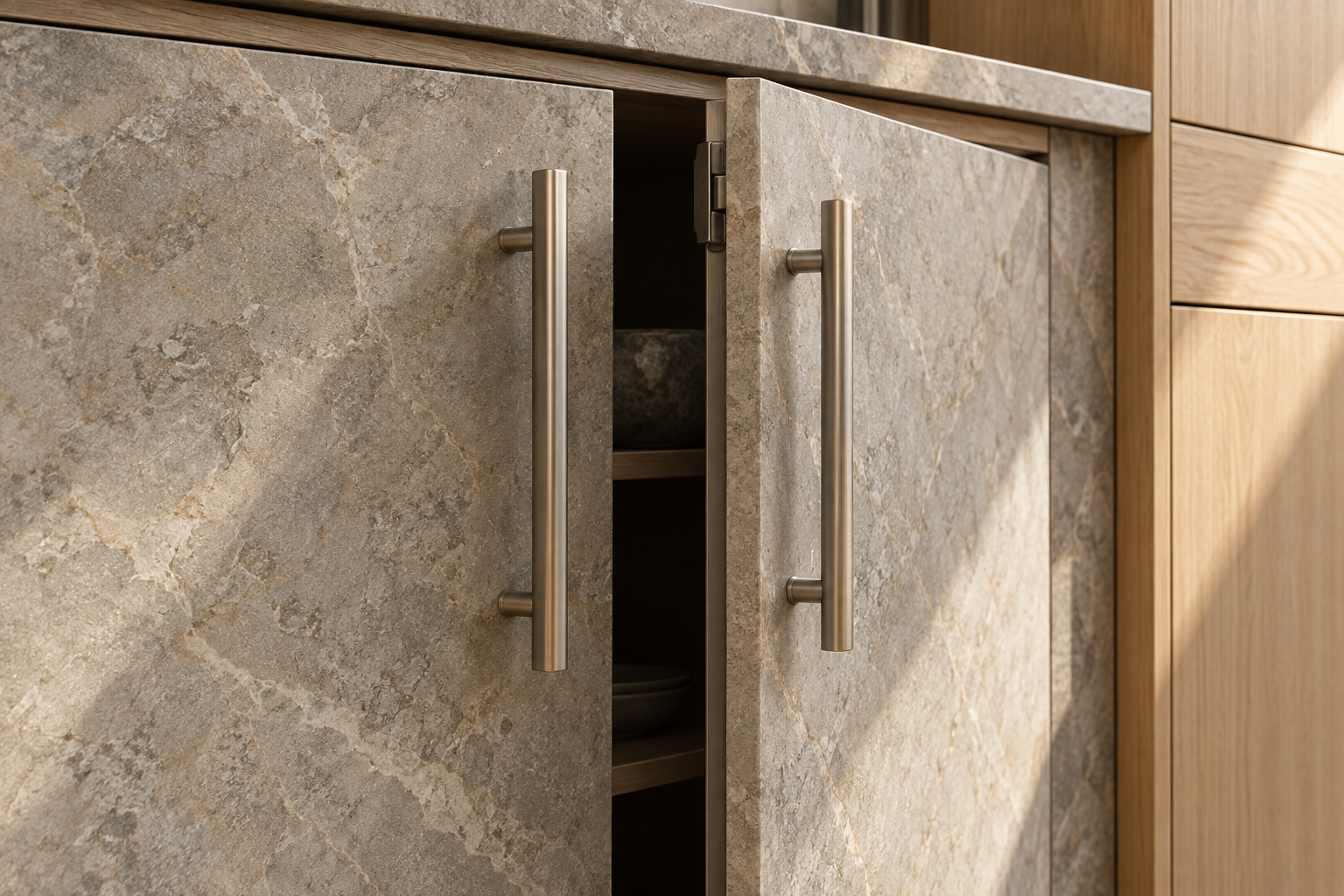
Illustrative design study of grip and opening clearance, not the announced product or test results.
Build a purchasing brief that includes delivery
Trade publication Stone Update reported the collection on September 30, describing approximate lead times of 12–14 weeks and an undercounter option expected before year end. That is useful launch context, not a current delivery guarantee. Confirm availability and timing before committing an installation schedule.
Our practical takeaway is to review four things together: the desired appearance, approved mechanical configuration, opening experience and replacement path. A sample that satisfies only the first criterion is too early for final approval. Record who owns each interface and what evidence will close each question.
The September update shows how material development can expand the design vocabulary of a familiar household appliance. The opportunity is not simply to make a refrigerator less visible. It is to make the surface, mechanism and everyday use feel intentionally connected. If your team is developing a home product where materials and motion have to work together, discuss the product challenge with Jackson Hedden.