Neurable One Makes Headphone Fit Part of the Sensing Brief
On October 1, 2026, Neurable announced Neurable One, a headphone with EEG sensing integrated into its ear cushions. The company lists 12 sensors, active noise cancellation and audio battery life of 22 hours, falling to 12 hours with EEG operating. Its launch announcement lists a $499 price and planned US shipping in November. This is an announced consumer product, not evidence of completed deliveries.
For product teams, the interesting design question is how a familiar object changes when it also becomes a measurement interface. Our analysis: the success of that integration depends on contact comfort, understandable feedback and the freedom to use the underlying product without sensing.
The accompanying images are conceptual illustrations. They do not depict Neurable One, its internals, its app or measured performance. Jackson Hedden has not tested the product.
The cushion becomes part of the system
A headphone cushion usually mediates pressure, heat, acoustic sealing and perceived quality. Adding sensing makes that contact surface responsible for another job. Our design interpretation is that the cushion should be reviewed with the whole assembly, rather than handed off as an isolated trim component.
A softer surface may feel welcoming in a short fitting session yet settle differently during extended wear. A firmer assembly may hold its position more consistently but make the product less comfortable. Neither direction can be selected from a rendering. Teams need a fit study that compares the intended contact arrangement with comfort over the actual duration of use.
For an industrial design brief, define the conditions explicitly: seated work, conversation, head movement, different hairstyles and users wearing glasses. These are proposed evaluation conditions, not claims about this product's performance. Document when an adjustment changes comfort and when it changes the usable sensing condition. A pleasant fit and a reliable measurement are separate acceptance questions.
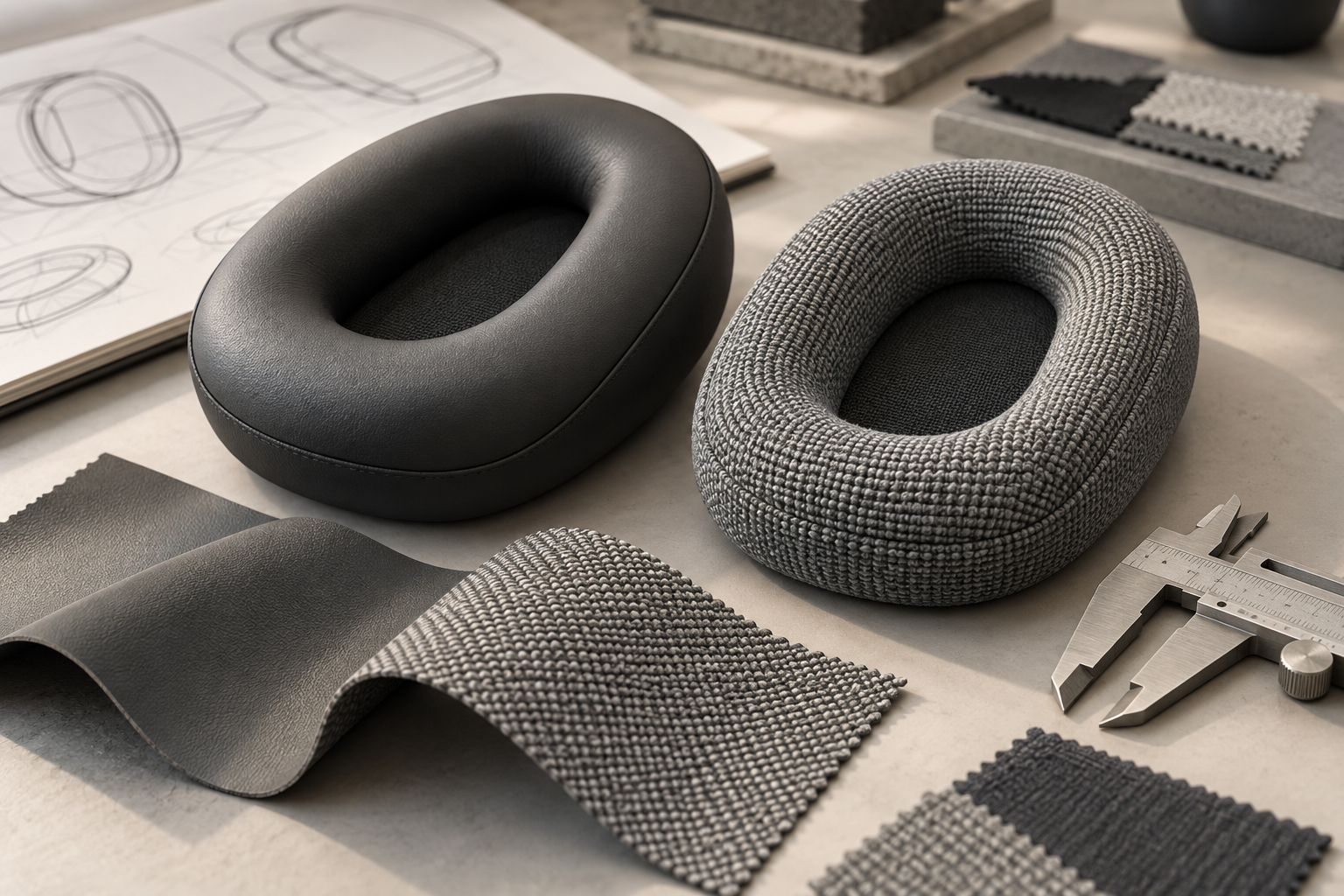
Conceptual illustration of contact materials, not Neurable components or test results.
A sensing mode has a visible battery cost
The stated 22-hour audio and 12-hour EEG figures expose a practical choice: the added function changes the charging routine. Treat those numbers as manufacturer specifications, not independently measured endurance.
For a new connected wearable, the brief should specify how the user knows which mode is active and how that choice affects the rest of the day. A single battery icon can be inadequate if switching functions changes expected runtime substantially. Explain the mode clearly, keep the remaining-life estimate tied to the current state and make the transition reversible.
There is also a product-positioning decision. A device can offer continuous sensing, a deliberate session or an ordinary listening mode. Continuous collection reduces the number of actions required to gather data; a deliberate session makes the purpose more explicit. An audio-only option supports days when someone simply wants headphones. Teams should prototype these paths together instead of treating the less instrumented path as an afterthought.
The feedback should help without taking over
Neurable says its app presents focus feedback and suggests breaks. It also describes the product as consumer wellness hardware rather than a medical device, and says it does not read thoughts. Those boundaries belong beside the experience, not only deep inside a support page.
Independent WIRED launch reporting confirms the hardware direction and reports that new effectiveness research for these latest headphones was not yet available. A launch claim therefore should not be presented as a demonstrated improvement in concentration or health.
Our recommendation is to design the response before polishing the score. If a device suggests a break, can the user dismiss it, defer it or stop those prompts? Can an uncertain reading remain uncertain? Showing a confident number may be visually tidy, but the better interaction may be a modest suggestion with a clear explanation and an easy exit.
Conceptual illustration of a listening routine, not the Neurable app or measured performance.
Prototype the ordinary day, including the off switch
A useful prototype plan separates three questions: whether people enjoy wearing the object, whether the sensing arrangement works under defined conditions and whether the feedback changes a task in a helpful way. A strong result on one does not answer the other two.
Start with a routine: put the headphones on, begin listening, change modes, receive a prompt, take them off and return later. Observe which steps require explanation. Then test the interruption cases: a low battery, an unavailable phone, a failed connection or a reading that cannot support a useful conclusion. Decide what the device should still do well in each case.
The commercial lesson is equally concrete. A feature-rich wearable still needs a credible everyday role. A simpler headphone, a separate sensing accessory or a session-based device may be more appropriate for a different audience. The right form depends on the action the product is meant to support and the evidence available to justify it.
Neurable One makes that decision visible: one contact surface now connects comfort, sensing and software feedback. For teams commissioning a physical product, put those relationships into the brief early. If your team is exploring a wearable or connected product, discuss the design challenge with Jackson Hedden.