Pregis’ New Metallized PE Film Tests the Barrier Brief
On September 24, 2026, packaging supplier Pregis announced a new metallized polyethylene (PE) high-barrier sealant film for food formats that have often relied on metallized polypropylene or polyester. The company says the mono-material structure is prequalified for How2Recycle Store Drop-off and is designed for barrier performance and processability comparable to legacy materials. Pregis plans to show it at PACK EXPO International in Chicago, October 18–21. That makes this a product announcement, not yet independent evidence of broad commercial performance.
For product teams, the design question is bigger than replacing one film with another: can a package keep protecting food, run on existing equipment, communicate disposal instructions clearly, and fit the collection system consumers can actually reach?
The material choice is also a system choice

AI-generated conceptual illustration of barrier-layer design; not Pregis material or test data.
Flexible food packaging has to do several jobs at once. It must protect contents from oxygen, moisture, light, aroma loss, and handling damage, while sealing at speed and presenting a usable opening and closure. Historically, a package might combine different polymers and a metallized layer to meet those needs. Such structures can complicate recycling because sorting and reprocessing systems are generally optimized around more compatible material streams.
Pregis describes its new structure as metallized PE, a high-barrier sealant film intended for uses such as coffee, snacks, and pet food. Its September 24 release positions the film as an option for applications that have relied on metallized OPP or PET, and says it is prequalified for Store Drop-off through How2Recycle. The details that would let a design team compare it rigorously—specific oxygen and water-vapor transmission rates, seal windows, puncture resistance, gauge, and line-speed data—are not provided in the announcement.
That distinction matters. A material family name is not a complete package specification. Performance depends on the full structure, gauges, inks, adhesives, seals, product chemistry, and the conditions the product sees through filling, shipping, storage, and use.
Recyclability claims need a route, not just a resin
“Mono-material” can make a package easier to align with a recycling stream, but it does not mean every PE package is collected everywhere. How2Recycle explains that most plastic bags, wraps, and films are not accepted in standard U.S. curbside programs. Its Store Drop-off label applies to qualifying packages that consumers take to participating retail collection bins; local access and package-specific instructions still matter. How2Recycle also says labels are assigned after reviewing the complete package specification, not simply the resin identification code.
So a designer should treat a recyclability designation as a set of design and communication constraints. Confirm the finished construction—including metallization, coatings, printing, zipper or fitment, labels, and food residue implications—with the labeling program and relevant recyclers. Then design the disposal instruction into the package hierarchy. If the consumer must find a collection point, “recyclable” needs a clear next step that matches the market where the package is sold.
For a product sold across several regions, this may lead to different constructions or labels by market. That can add operational complexity, but it is more accurate than making a broad claim that consumers cannot act on.
Existing equipment can reduce transition risk—but must be tested
Pregis says the new film is developed to run on existing converting and filling equipment. That could reduce the capital and process changes required for adoption. It does not eliminate qualification work. A package team still needs to test forming, sealing, filling, line speed, seal integrity, drop and transport performance, shelf-life protection, and production variability with the actual product and equipment.
A useful validation plan starts with the failure modes the current package prevents. For coffee, for example, aroma retention and oxygen exposure may dominate. For pet food, puncture resistance and closure behavior may matter more. The point is not to assume this film works for every category, but to compare each candidate structure against the job the existing package performs.
Teams should also inspect the full user experience: Can the pouch stand as intended? Does the opening tear predictably? Does the seal reseal after first use? Is the metallized surface compatible with print, color, and shelf recognition? Material substitution can change stiffness, crinkle, gloss, and hand feel—the small cues that make a package feel familiar or premium.
A practical brief for the next material trial
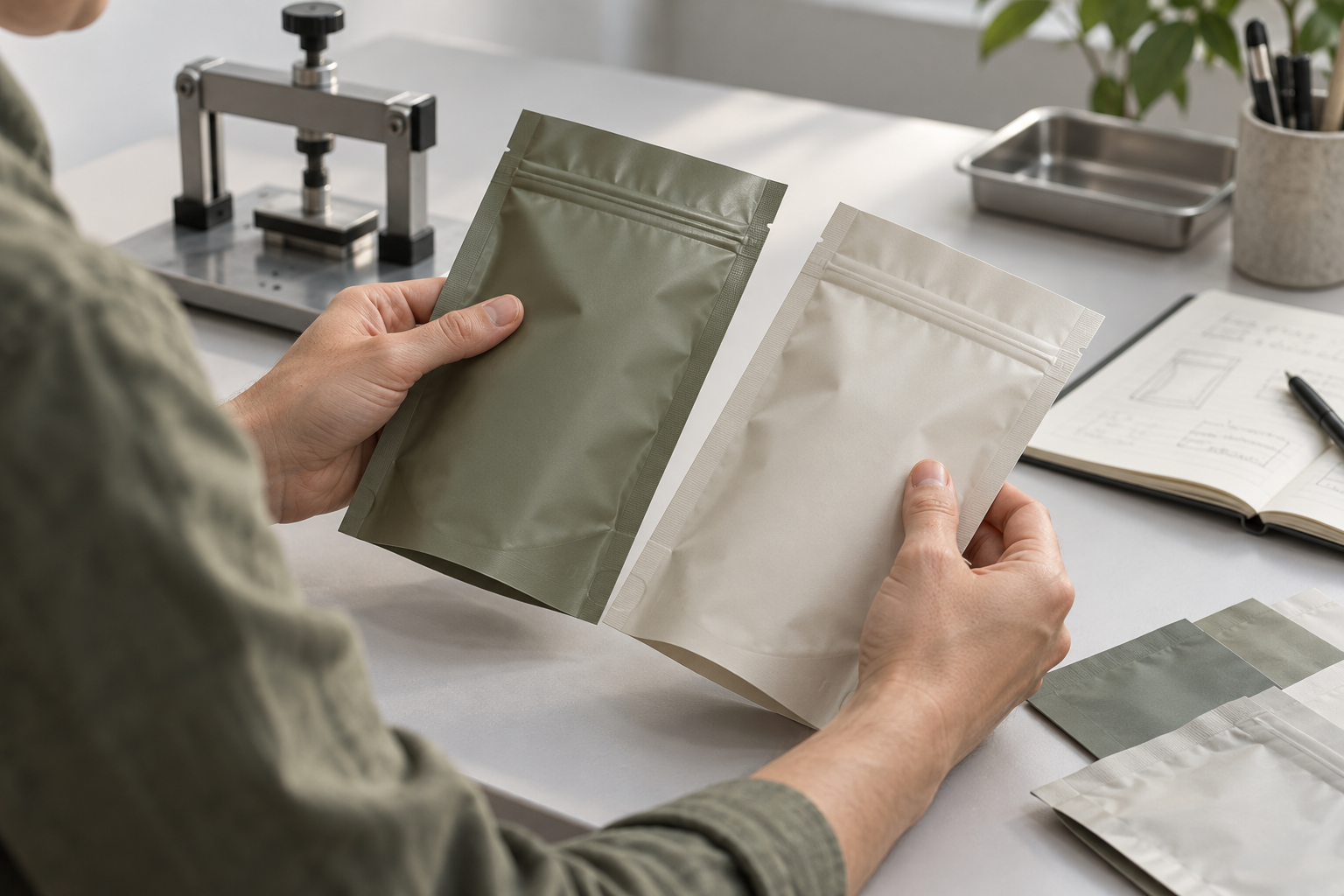
AI-generated conceptual illustration of packaging validation; not a photograph of Pregis equipment.
Before switching a flexible package, bring procurement, packaging engineering, brand design, manufacturing, and sustainability into one brief. Record the minimum barrier and mechanical performance, the filling-line conditions, required shelf life, graphics and finish needs, disposal route by market, and what evidence would count as a successful pilot. Request full technical data and test the finished package, not a film sample in isolation.
Pregis’ announcement is a relevant signal that mono-PE structures continue to target applications that depend on high barrier. The strongest design opportunity is not a sustainability claim by itself; it is an evidence-backed package that protects the product and gives users a realistic disposal instruction without disrupting production.
If your team is evaluating a packaging change, Jackson Hedden can help connect the product brief, material choices, user experience, and manufacturing requirements. Explore our product design, prototyping, and manufacturing work.
Sources: Pregis announcement, September 24, 2026; How2Recycle Store Drop-off guidance; How2Recycle package-specific label FAQ.