ULTRALOQ’s New Smart Locks Turn Entry into a Design Choice
On September 25, ULTRALOQ announced a three-model smart-lock collection built around two different ways of entering: hands-free approach detection on Bolt Mission, and digital-wallet tap access on Bolt Pro and Latch 5 Pro. The launch is a useful design case because it treats access as a physical interaction to shape, not simply a connectivity feature to add. The practical question for product teams is how much automation feels helpful at a threshold—and how people understand, trust, and override it.
Two entry gestures, three door contexts
The manufacturer says Bolt Mission combines Bluetooth Low Energy discovery, ultra-wideband ranging, radar-based presence sensing, and local decision logic to distinguish an approach from ordinary movement near the home. Its other two models take a more deliberate route: Bolt Pro is a deadbolt with wallet credentials and other entry methods; Latch 5 Pro brings similar credential options to lever-style doors. The company describes all three as Matter certified, with Aliro certification applying to the two tap-access products. An independent trade publication reports the same lineup and notes the planned October retail availability. ULTRALOQ’s announcement and Security Systems News coverage establish what was announced; they do not establish long-term real-world reliability.
That distinction matters. “Walk up and unlock” removes a deliberate action, while “tap to unlock” preserves one. Neither interaction is universally better. Hands-free entry can help when someone has full hands, but it also asks the device to infer intent correctly. A tap is more explicit and easier to understand at the door, though it requires a reachable reader and a compatible credential. Offering both gestures across separate models lets a brand serve different entry patterns instead of forcing one automation rule onto every home.
Make the invisible action legible
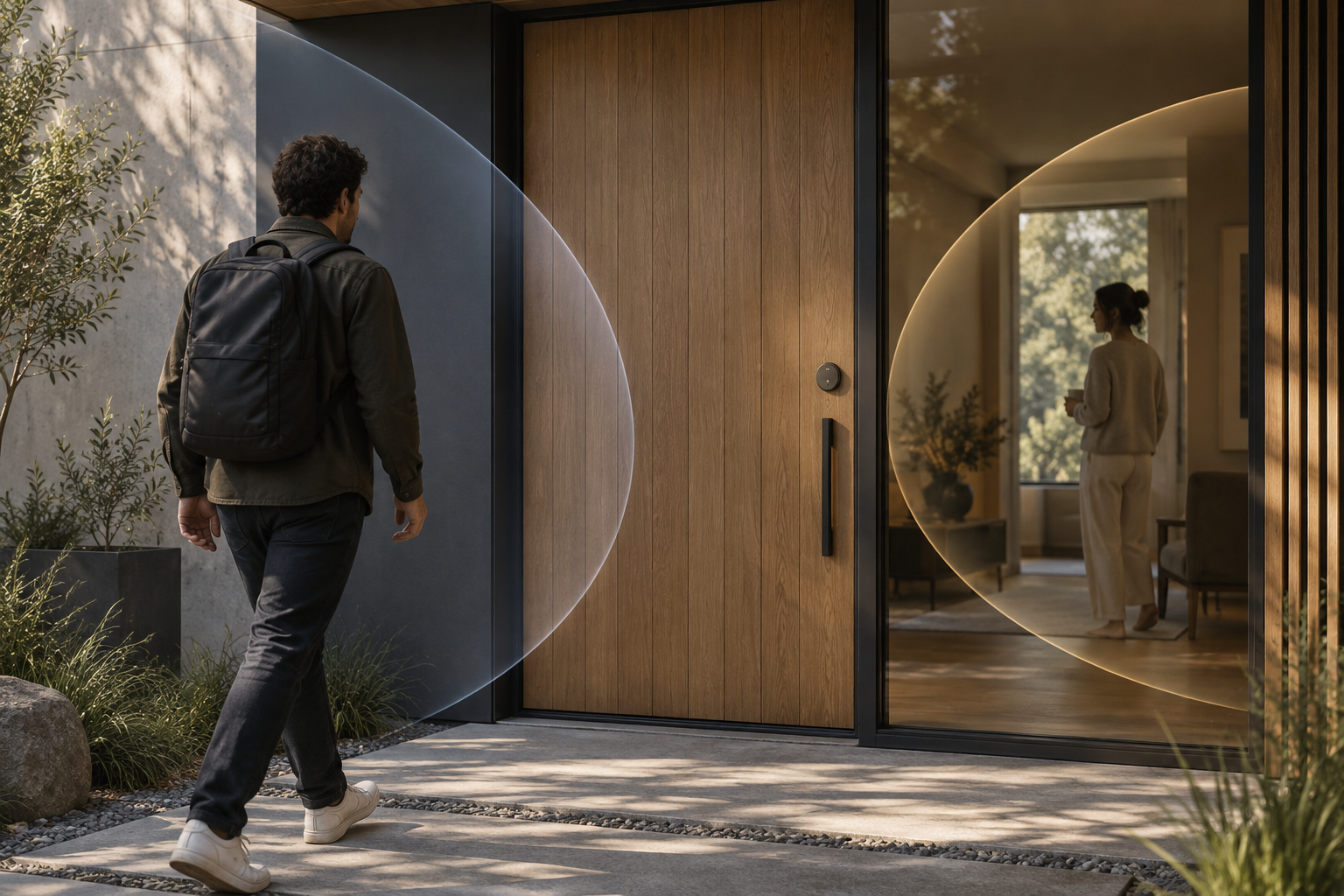
AI-generated conceptual illustration of arrival context; not a technical rendering or test result.
Automatic products need feedback at the moment they act. A lock that opens before a person expects it can feel like a loss of control; a lock that waits too long can feel broken. ULTRALOQ’s product page describes an illuminated ring that responds as the user approaches. That visual cue is a design move worth examining: can it communicate “recognized,” “ready,” and “locked” distinctly enough at night, in bright sun, and for someone who cannot rely on color alone? A quiet visual signal may be less intrusive than a voice prompt, but it has to be visible from the user’s natural approach angle.
For design teams, the lesson is to prototype the whole doorway sequence, not just the lock face. Test arrival from several directions, stopping outside the door, walking past it, carrying bags, approaching with another household member, and leaving from inside. Those are scenarios to validate, not claims about this product’s performance. They expose edge cases where a proximity system can misread movement, and they clarify what feedback and fallback controls must do.
A useful prototype can be low fidelity: a temporary door panel, a mock latch, and an indicator light can reveal whether the interaction is understandable before the team invests in a polished enclosure. Later testing should include the actual sensing hardware, door geometry, phone models, and installation conditions. Our product design process and prototyping services help teams move from an interaction hypothesis to something people can evaluate in context.
Interoperability still has a user-facing edge
Aliro is a Connectivity Standards Alliance access credential and communication protocol intended to let certified phones, wearables, and readers work together. Standardization can make a tap experience more familiar across brands, but it does not erase setup decisions: which phone and wallet are supported, how a household member receives access, what a guest can use, and what happens when a phone is unavailable. ULTRALOQ’s release lists Apple Wallet and Samsung Wallet for the Bolt Pro and Latch 5 Pro. Teams should validate exact device, region, and software requirements rather than treating “wallet access” as a universal promise. The Alliance’s Aliro overview explains the standard’s interoperability goal.
This is where product architecture and service design meet. A lock’s physical interface, companion app, onboarding, credential sharing, and support instructions form one system. A compatible protocol may reduce integration friction for manufacturers, but consumers still need clear installation guidance, understandable permission flows, and a reliable way to regain entry. The physical key, PIN, fingerprint, or app-based route is not clutter by default; it can be an intentional recovery path for a missed credential or a dead phone.
Design the fallback before the feature
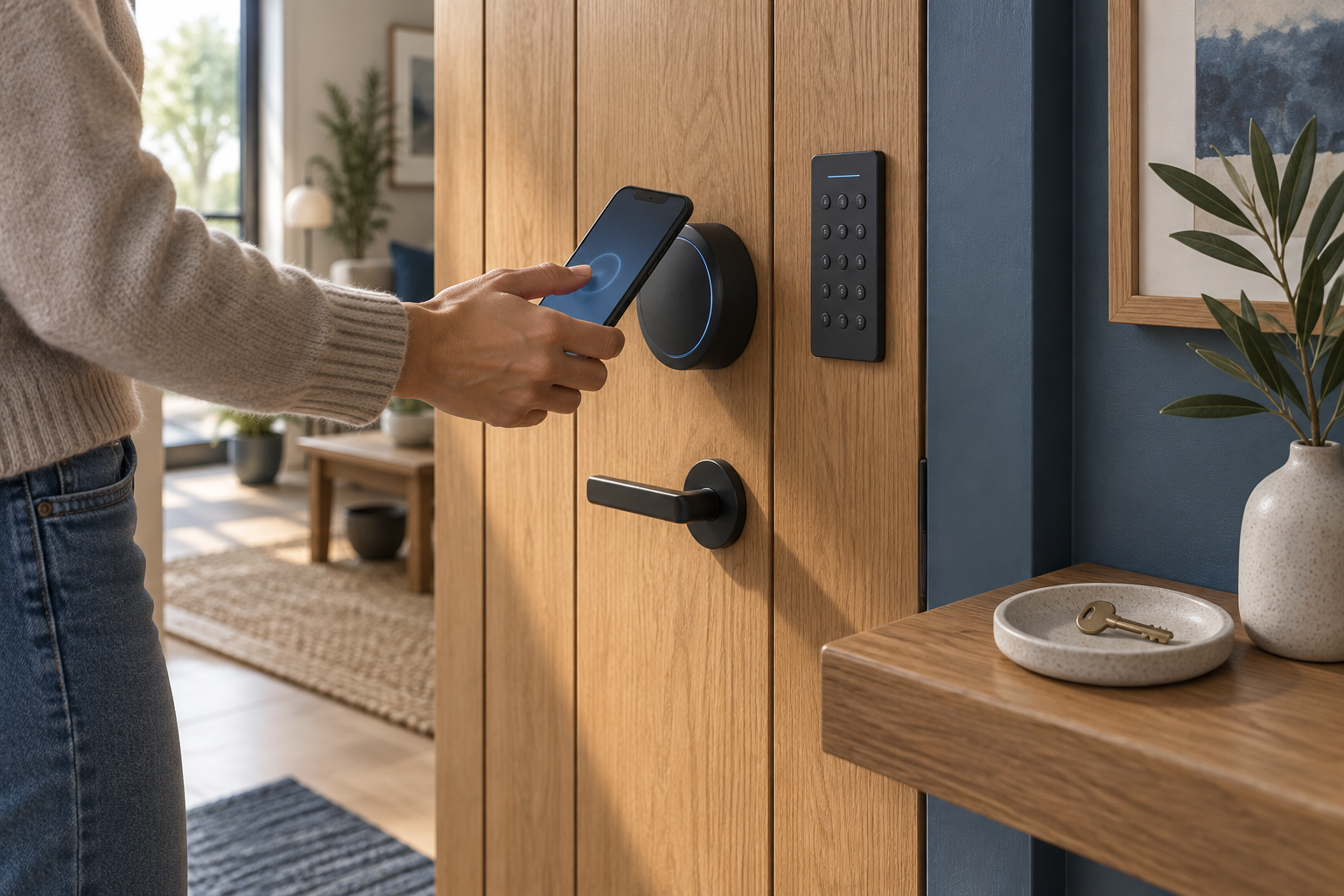
AI-generated conceptual illustration of alternative access interactions; not a depiction of an ULTRALOQ product.
A practical review for any connected entry product should ask three questions. First, what is the primary gesture, and can a new user predict it without reading a manual? Second, what visible or tactile signal confirms that the device understood the gesture? Third, what is the least confusing fallback when the preferred phone, network, or power source is unavailable?
Those questions apply well beyond door hardware. Any product that automates a physical action—dispensing, unlocking, heating, charging, or adjusting—must balance reduced effort with legibility and user agency. The best interaction is not necessarily the one with the fewest steps; it is the one whose behavior remains understandable when conditions change. If you are developing a connected consumer product, Jackson Hedden can help shape and test the physical-digital experience from early concepts through manufacturing preparation.
AI-generated conceptual illustrations accompany this article; they do not depict ULTRALOQ products or demonstrate actual performance.