S.Pellegrino’s New Label Makes the Bottle Part of the Conversation
On September 24, Nestlé Waters France announced a limited-edition S.Pellegrino bottle whose label carries questions intended to prompt conversation at the table. The French release is planned in 1-liter PET for grocery retail and returnable 1-liter glass for cafés, hotels, and restaurants, with a supporting campaign beginning October 19. The news is a useful packaging-design case because the interaction sits on an object people already pass, pour from, and look at—not in a separate app or screen.
The brand’s broader “Dinner Dialogues” idea has already used question-led bottles as part of a campaign. The September announcement describes a French limited edition built around that same premise. Nestlé Waters France’s release describes questions on each label; the company’s campaign page also presents the label as a prompt for discussion. Packaging trade publication PKN included the concept in its September 29 review of current packaging innovations.
The label becomes an interface at the moment of use
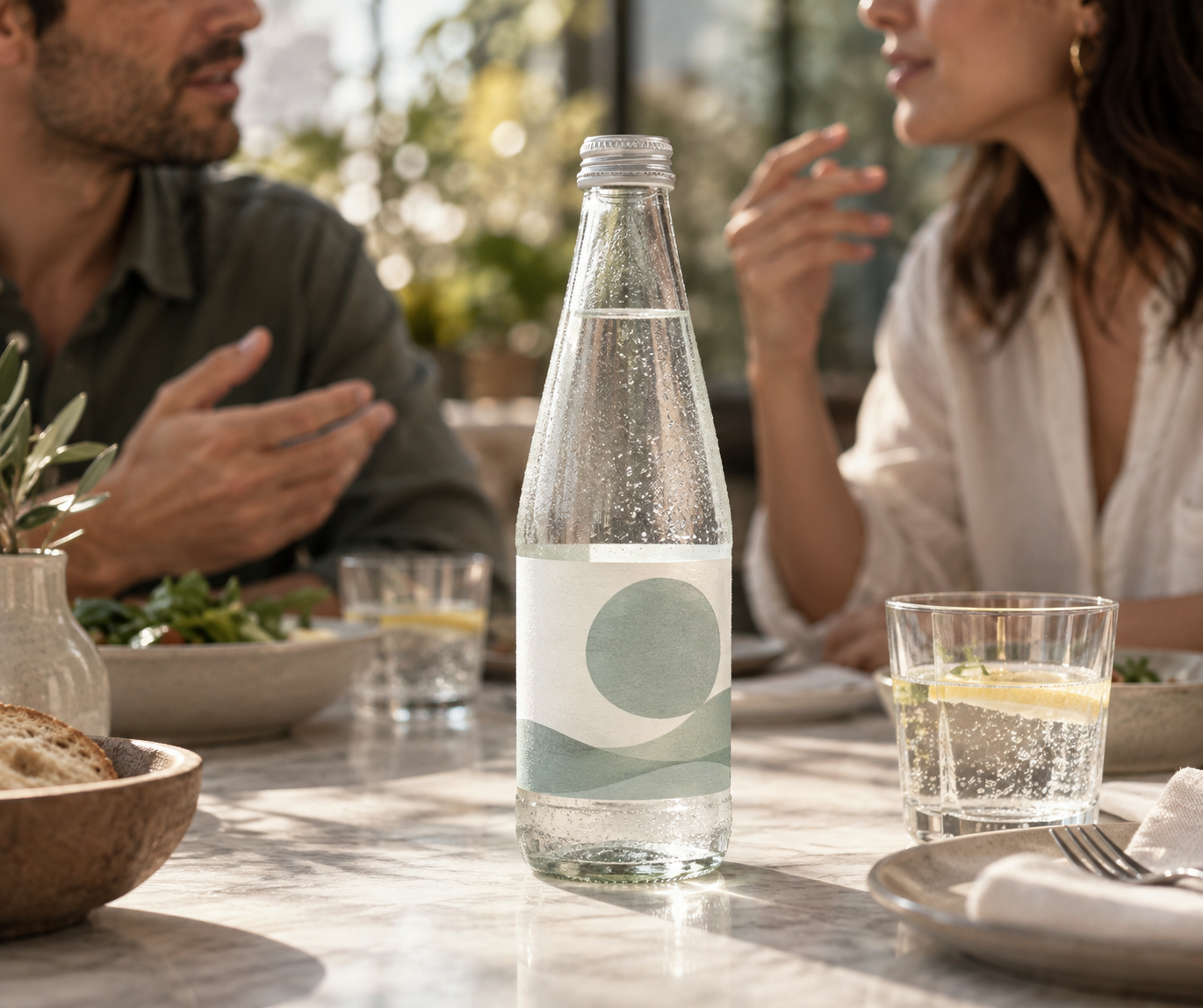
AI-generated conceptual illustration; not an actual S.Pellegrino campaign image.
Most packaging communicates from brand to buyer: what the product is, why to choose it, and how to use it. A question printed on the label adds another role. It can give people sharing a meal a small, optional starting point for talking with each other. The bottle is no longer only a container on the table; it becomes a cue in the social setting where the beverage is consumed.
This is a low-tech interaction, but that does not make the design automatic. A prompt needs to be visible from the places where people sit, readable at ordinary dining distance, and understandable without an explanation. The bottle may rotate as it is handled, so the question’s placement and the number of prompts per version affect whether anyone notices it. A label can be turned toward a guest, but the interaction should not depend on someone staging the package like a presentation card.
The limited-edition questions also ask people to share something. That can make a table feel more personal, but it can also feel awkward if the prompts are too intimate, culturally mismatched, or poorly timed. The useful design target is an invitation, not a forced activity: the group should be able to ignore the label without disrupting the meal.
One idea has to work across two package systems
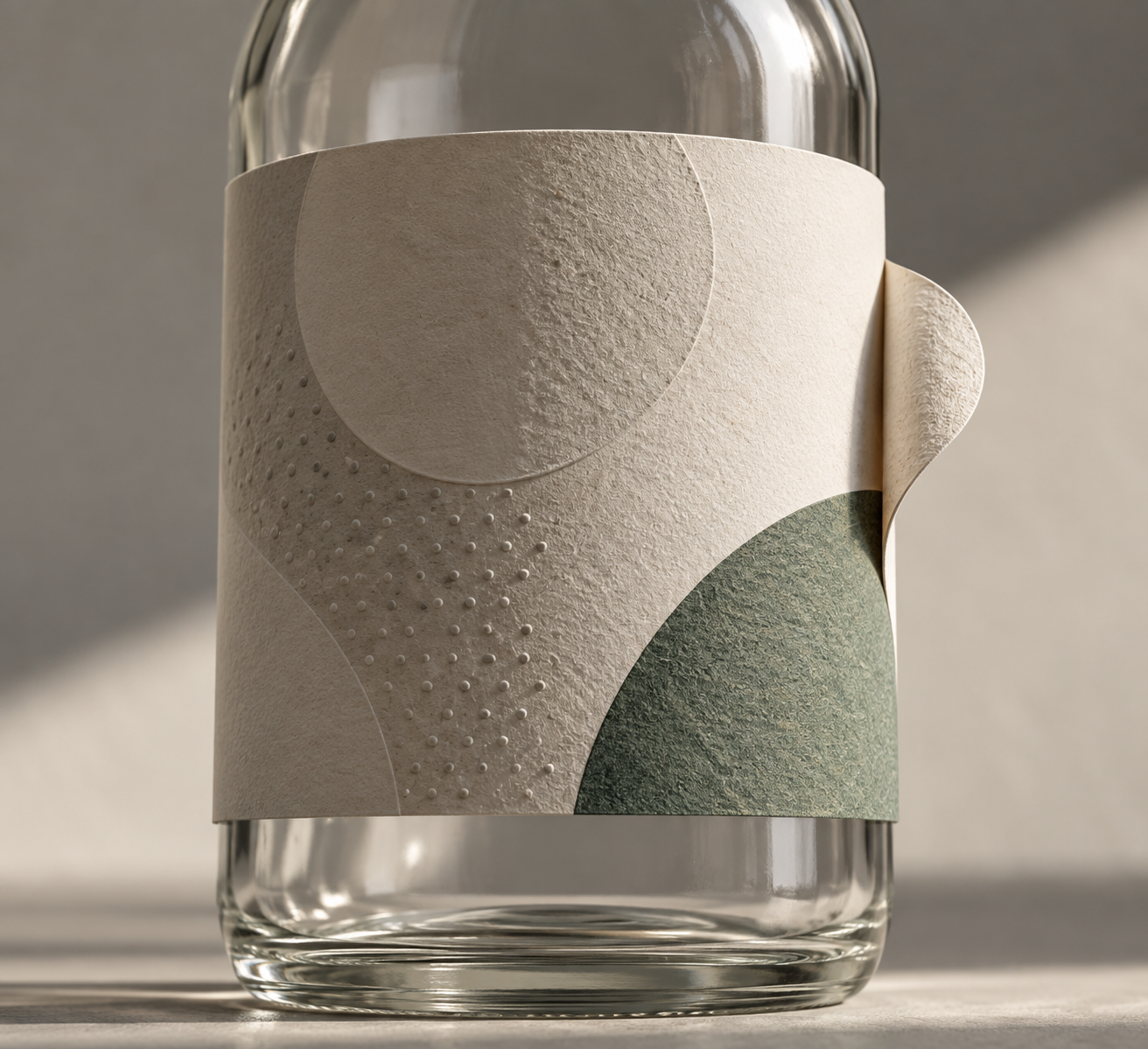
AI-generated conceptual illustration; the label artwork is invented and does not depict the real edition.
The French announcement names two formats: a PET bottle for retail and a returnable glass bottle for hospitality. That gives the same communication idea two different environments. A retail customer can notice a limited label before purchase, then take the bottle home. In a restaurant, the bottle sits among glasses and dishes and may be shared across a group. The prompt therefore has both a point-of-sale job and an in-use job.
The label must also coexist with the information and visual identity already required on the pack. The release does not specify how the questions are distributed across variants, how much label area they occupy, or how accessible the text is. Those details matter. A conversation prompt that competes with product information, disappears behind a hand, or becomes hard to read under dim restaurant lighting loses its practical value.
Material and reuse affect execution as well. A returnable glass bottle will be washed and returned through a service loop, while PET follows a different collection and recycling path. The announcement does not detail label adhesives, removability, or how the limited graphics perform through repeated handling or washing. Those are questions for validation, not assumptions to fill with campaign language. Designers working across multiple package formats should test the complete label system on each production surface, including condensation, abrasion, handling, and the expected return or disposal process.
A useful interaction does not need a screen
Packaging teams often explore QR codes, apps, and connected features to extend a product experience. A printed prompt takes a different route: it uses a surface already present and works without a phone, battery, or network connection. That reduces setup friction and avoids adding an electronic component. It also has limits. Printed copy cannot adapt to a person or respond to what happens at the table; its value depends on the question, placement, contrast, language, and social context.
For product and brand teams, this is a reminder to look at the use occasion before adding a new feature. Ask what people are already doing when they encounter the package. Then test whether the physical object can help in that moment with a small, clear cue. Observe whether users notice it, understand it, and feel comfortable engaging. If the interaction needs instructions or a campaign video to make sense, the package itself may not be doing enough.
What designers can take from the release
Design for the actual use setting: a grocery shelf and a shared restaurant table impose different viewing distances and handling patterns.
Keep the interaction optional, legible, and subordinate to essential product information.
Test the label on every relevant package material under realistic light, condensation, handling, and reuse or disposal conditions.
Separate the intended brand effect from evidence. The announcement describes a conversation goal; it does not report measured changes in conversation or consumer behavior.
The label is a modest design move with a clear lesson: interaction can come from the way a familiar physical product is presented and used. For teams developing packaging or connected physical products, Jackson Hedden’s product design and prototyping work can help evaluate those decisions early. Talk with the studio about a product challenge.
Sources
Nestlé Waters France press release, September 24, 2026 (French-market formats and campaign timing).
S.Pellegrino campaign page (brand description of the question-label interaction).
Packaging News / PKN, “The Packaging Innovation Edit: September”, September 29, 2026 (packaging trade roundup).