Synaptics’ SR200 Makes On-Device AI a Physical Design Brief
Synaptics announced its Astra SR200 processor family on October 20, 2026, positioning it for wearables, battery-powered sensors, connected cameras and other devices that combine voice, vision and local AI. The design story is not simply that a smaller chip can run a larger model. It is that sensing, computing, memory, power and feedback have to share the same compact object—and that changes what the industrial-design brief needs to specify.
What Synaptics announced—and what remains unproven
Synaptics describes the SR200 as a new “xMCU” tier: a microcontroller family pairing low-power control with an AI accelerator, vision and audio capabilities, and custom memory integrated into a system-in-package. The company announced three pin-compatible versions: SR210 at 200 GOPS, SR230 at 300 GOPS and SR250 at 400 GOPS. The higher tiers add more vision and display paths. Synaptics says the parts can scale to hundreds of megabytes of custom DRAM and that its architecture uses less power than typical external system memory, as detailed in its SR200 product brief. Those performance and power comparisons are manufacturer claims, not independent product tests.
A VentureBeat report published October 20 says the SR200 family is in sampling, with no individual chip prices or firm volume-production schedule disclosed. It also distinguishes the newly available Coralboard SL from the forthcoming Coralboard SR; that matters because an announced processor family is not the same thing as a finished consumer product on shelves. The public announcement signals a platform direction. It does not yet establish the battery life, thermal behavior, reliability or user value of any specific device built around it.
Local intelligence moves constraints into the enclosure
When a device can interpret camera, microphone and sensor data locally, teams may be able to reduce dependence on a cloud connection and keep more raw input on the product. That can support quicker response and a more private architecture, but only if privacy is made legible to the person using it. A camera-equipped wearable still needs a clear way to communicate when sensing is active, and a local inference path does not remove the need for secure storage, permissions, deletion and update policies.
For physical design, the chip’s capabilities become a set of coupled placement decisions. A camera needs an unobstructed field of view; microphones need acoustic access while resisting wind and handling noise; a display or haptic cue needs to be noticeable without being disruptive. These parts compete with the battery, structural supports, antenna clearances and service access. A product concept that treats those elements as independent rectangles on a board can meet a compute target and still produce awkward proportions or poor everyday use.
The useful early question is therefore not “How much AI can fit?” It is “Which user decision improves when this device processes a signal locally?” A smart camera might identify an event without sending continuous video. A wearable might translate a short voice command while offline. Each scenario implies a different camera angle, microphone location, wake cue, interaction duration and privacy signal. If there is no specific action for the user, the extra sensing may add battery drain and social friction without improving the product.
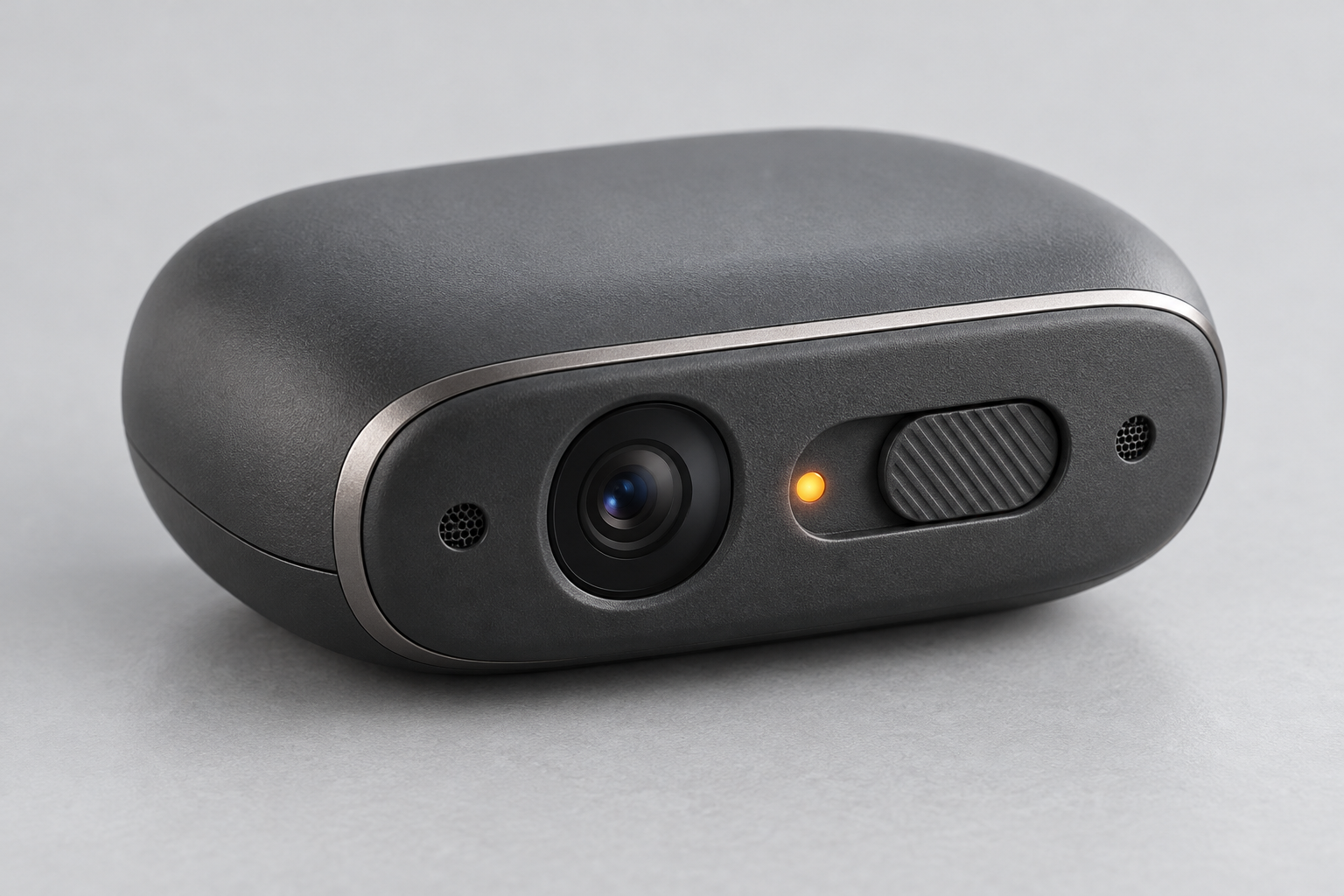
Conceptual illustration: a visible physical privacy cue for a camera-equipped wearable.
A pin-compatible family is a portfolio decision
A shared board layout across SR210, SR230 and SR250 could help manufacturers explore tiers of a device family without redesigning the whole board. But pin compatibility alone does not guarantee that the visible product, battery, cooling strategy, optics, memory configuration or certification work can stay identical. Each variant still needs measured power profiles and a check of the complete system under realistic duty cycles—not just peak inference performance.
That creates a practical product-planning opportunity: teams can sketch a lower-cost configuration and a higher-capability configuration around a common user experience, then identify which features actually justify the upgrade. Perhaps one tier supports voice and sensing, while another earns its extra cost by adding a camera or display. Keeping the exterior and control logic coherent across those versions is a design task in its own right. Avoid feature ladders where a premium model adds sensing that users cannot understand or disable.
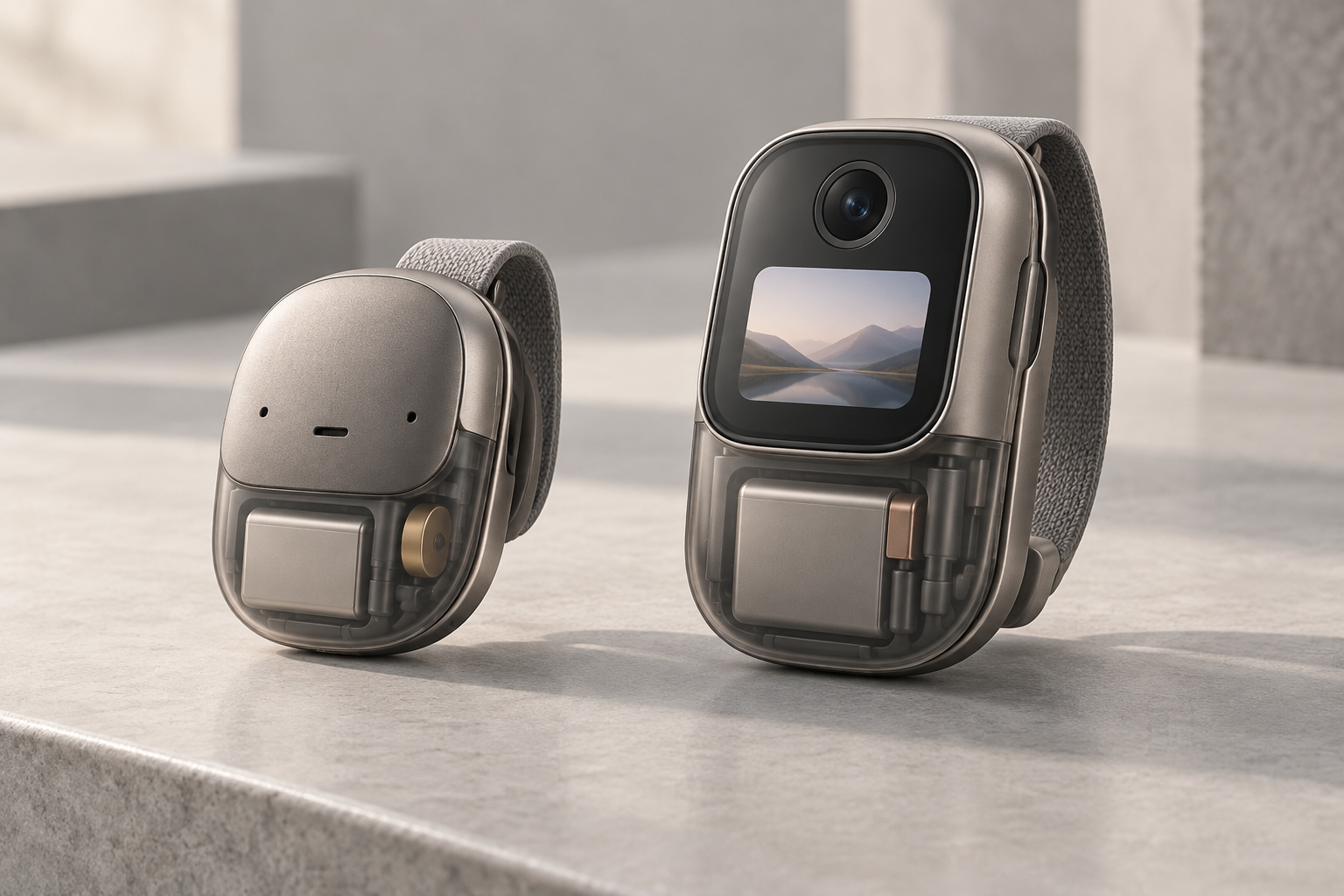
Conceptual illustration: adding camera and display capability changes wearable volume and packaging.
Prototype the behavior before refining the shell
Before committing to detailed surfacing, define the product’s sensing states: what runs continuously, what wakes on an event, what requires explicit user action, and what happens when the network is unavailable. Then mock those states physically. Test indicator visibility in bright and dim conditions, microphone placement during movement, the reach and timing of controls, and how a user can confirm that a camera or voice feature is off. These tests can use representative electronics and interaction mockups; they do not require claiming that the SR200 itself has been evaluated.
For teams moving from concept into engineering, this is where product design and new product development need to meet. Early product prototyping should resolve sensor placement, battery volume, thermal paths, antenna zones and service strategy together. If you are defining a connected product with local AI, talk with our team about the physical and engineering decisions that need to be tested before the enclosure is locked.
Editorial note: This article analyzes a newly announced component platform. The three images are conceptual design studies, not depictions of Synaptics hardware or products using it.
Sources
Synaptics, Astra SR200 announcement, October 20, 2026