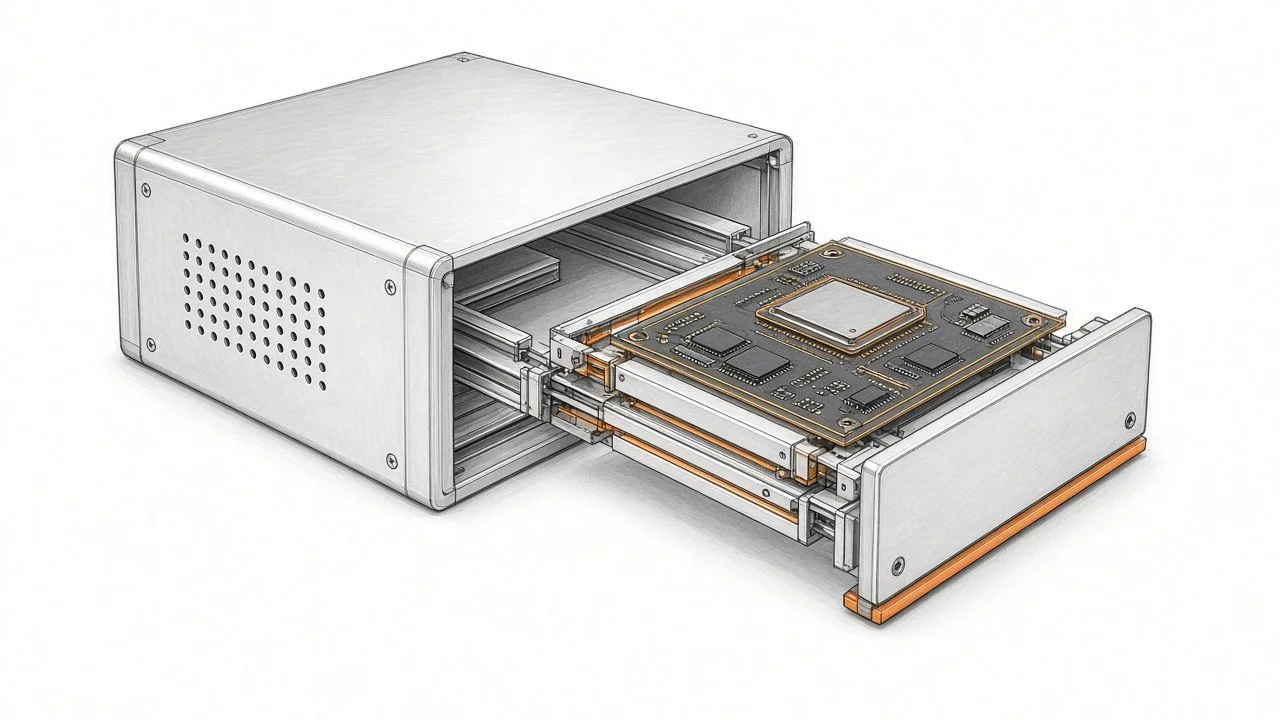
Conceptual illustration, not the Beelink ME Pro.
What was announced
Beelink describes the ME Pro as a modular NAS, sold in two-bay and four-bay versions. According to the announcement:
A slide-out design takes compatible Intel and AMD motherboard modules.
The same module can move between compatible two-bay and four-bay enclosures in either direction, so buyers can keep their motherboard when they add storage.
The one-piece metal chassis is said to take up about 50% less space than NAS systems with the same number of bays.
Heat is handled with thermally conductive silicone, aluminum brackets, a vapor chamber, and an internal blower, and Beelink claims noise as low as 34 dB.
These are the company's own claims from a crowdfunding launch. Nobody has independently tested them yet, and Kickstarter products can change before they ship. The interesting part for product teams isn't the spec sheet. It's the architecture decision underneath it: Beelink made the compute board a part the customer can swap, and treated the enclosure as a separate part of the product.
Why that decision ripples through the whole product
Making an internal board swappable sounds like a feature. In practice it turns an internal boundary into a public interface, and every interface brings obligations.
The interface becomes a promise. If modules can move between a two-bay and a four-bay enclosure, the connector, the mounting rails, the power budget, and the thermal path all have to stay compatible across both housings, and probably across future modules too. Every later revision now has a constraint it can't quietly break. Teams should decide early how many generations they're willing to support, and write that down before industrial design locks the form.
Thermals get harder, not easier. In a fixed design, engineers can tune the heat path to one board. In a modular design, the enclosure has to cool any compatible module, including faster ones that don't exist yet. Beelink's mention of a vapor chamber, blower, and conductive brackets shows how much hardware this can take. Margin for future heat costs money and space now.
Mechanical tolerance stacks multiply. A drawer-style module needs rails, guides, a reliable connector mate, and retention that holds up through many insertions without rattling. Beelink says a “tightly secured assembly” helps reduce vibration noise. That's exactly the tension: an assembly that's easy to slide out also has to feel solid and quiet once it's in. Prototyping the insertion and retention mechanism early, with real users, usually pays off better than refining the outer surfaces first.
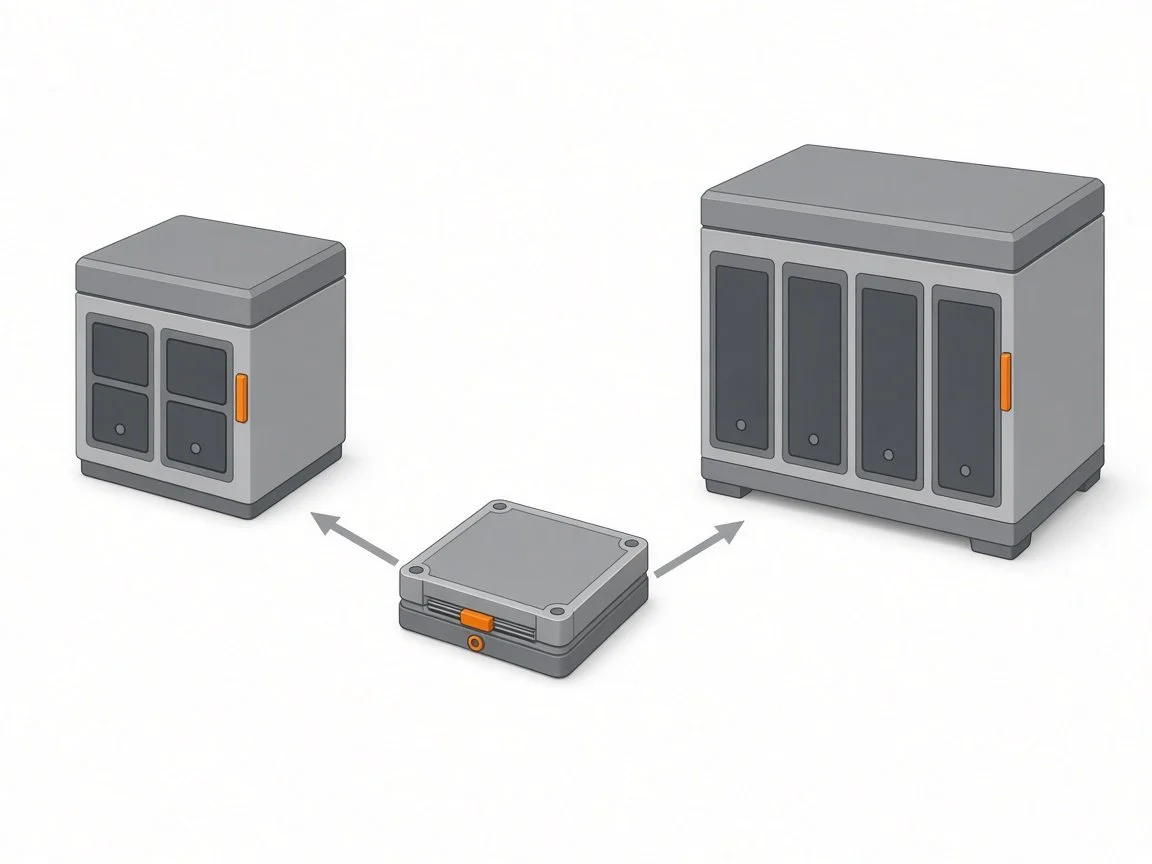
Conceptual diagram: one shared module serving two enclosure sizes.
The business tradeoff
Modularity can lower the cost of an upgrade for the customer and extend a product's life. That's a real selling point, especially for buyers who resent replacing a whole device to get more capacity. It can also let a company build several SKUs from one core module, which may simplify inventory.
But it has costs:
Unit cost and volume. Connectors, rails, and spare thermal capacity add parts and size. The claimed compact chassis suggests Beelink worked hard to win that space back, and teams shouldn't assume the overhead is free.
Validation scope. Every supported module-and-enclosure pair is a configuration you have to test for heat, EMC, and reliability.
Revenue model. If customers keep their board for years, the upgrade cycle changes. Some brands welcome that. Others will see it as cannibalization.
Questions to ask before you build a modular product
Which part does the customer actually want to upgrade, and how often?
How many module generations will the enclosure promise to support?
What’s the worst-case thermal and power load the enclosure must handle?
How many insertion cycles must the connector and rails survive?
Can a non-technical user swap the module safely without instructions?
What does modularity add to unit cost, and will buyers pay for it?
The takeaway
The ME Pro is a useful, current example of a broader idea: deciding what customers may replace is a core architecture decision, not a late feature. It shapes the thermal design, the mechanisms, the tolerances, testing, and even the business model. Whether Beelink's version delivers on its claims will only be clear once units ship and get reviewed. The design question it raises applies to any connected hardware team right now.
If you're weighing a modular or upgradeable architecture for a new product, Jackson Hedden's industrial design and engineering team can help you pressure-test the tradeoffs early.