On November 19, 2026, the U.S. Consumer Product Safety Commission (CPSC) announced a recall of about 16,730 Cipton youth bicycle helmets with built-in LED light strips because they do not comply with the federal bicycle helmet standard's impact attenuation, positional stability and certification requirements.
Key takeaways
- About 16,730 white, youth-size-small Cipton helmets (model CPSK300CC) with a multi-colored LED strip are being recalled for a full refund. No injuries have been reported.
- CPSC says the helmets fail three parts of 16 CFR Part 1203: how much crash force reaches the head, whether the helmet stays on, and certification.
- Neither CPSC nor Cipton has said why the helmets failed. Nothing in the notice ties the failures to the LED strip.
- Federal helmet rules say a helmet must pass with and without any attachments the manufacturer offers, and changes to parts, suppliers or methods can require new lot testing.
- For product teams, the lesson is to treat a "feature" added to a safety-regulated product as a change to the safety system itself.
What CPSC and Cipton announced
According to the CPSC recall notice and Cipton's own recall page, the recall covers Cipton-branded bicycle helmets sold in white in youth size small, fitting a head circumference of about 19.7 to 21.3 inches. They have black padding, straps and buckle, and a built-in, multi-colored LED light strip. "CPSK300CC" is printed on a label inside.
CPSC says the helmets "do not comply with the impact attenuation, positional stability and certification requirements" of the mandatory standard, so they "can fail to protect the user in the event of a crash." The helmets were sold at Dick's Sporting Goods and JCPenney nationwide and online at Dickssportinggoods.com from April 2024 through May 2026 for about $35. CPSC lists the firm as Hardline Group, dba Cipton, of Brooklyn, New York, and the helmets as made in China. No injuries have been reported.
Consumers are told to stop using the helmets, cut the straps, write "Recalled" on the helmet, and email a photo for a full refund. The notice also warns that the device contains a lithium-ion battery that must not go in the trash, curbside recycling or retail battery bins; owners should check with a household hazardous waste center.
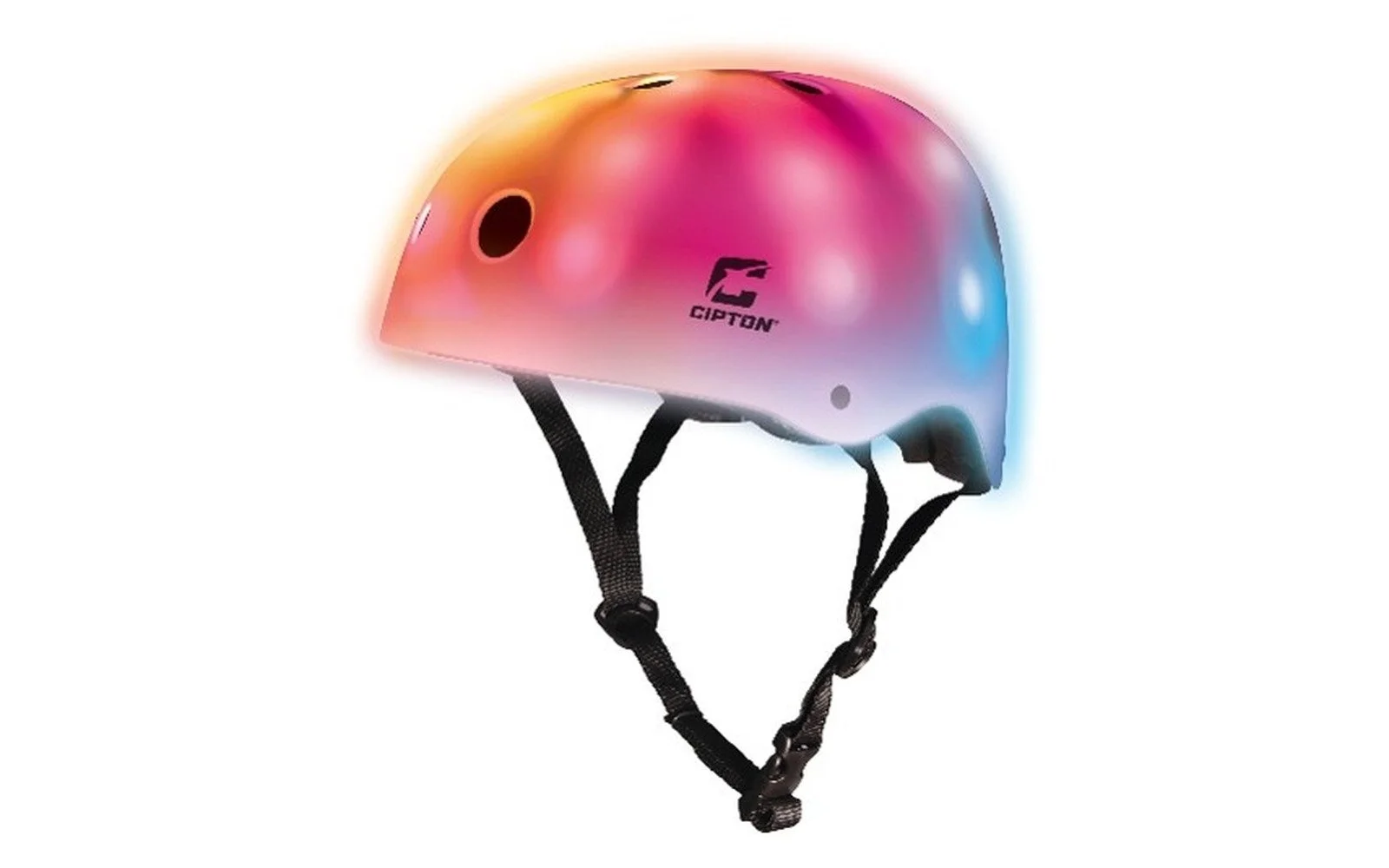
The recalled helmet’s built-in multi-colored LED strip. Image: U.S. CPSC and Cipton recall notice.
What the federal bicycle helmet standard requires
A mandatory standard is a federal rule a product must meet before it can be sold. For bicycle helmets it is 16 CFR Part 1203. CPSC's business guidance summarizes four performance tests:
- Impact attenuation: how much crash force the helmet absorbs. Helmets are dropped onto flat, hemispherical and curb-shaped anvils, and any impact above 300 g of peak acceleration at the headform is a failure.
- Positional stability: whether the helmet rolls off. With the headform tilted face down and then face up, a 4 kg weight dropped about 0.6 m (2 feet) pulls on the helmet, and it must not come off.
- Retention strength: the straps may not break or stretch more than 30 mm (1.2 inches) under a dropped load.
- Peripheral vision: at least 105 degrees of clear view to each side.
The tests use eight helmets of each size of each model, conditioned at room temperature, in cold, in heat and after water immersion. CPSC says helmets "must meet all of the requirements of the regulation when tested both with and without any attachments that the manufacturer offers." External projections over 7 mm must break away or collapse on impact, and nothing inside may project more than 2 mm toward the head.
Certification is its own requirement. Under Subpart B, manufacturers and importers must run a reasonable testing program by production lot and start a new test lot "whenever there is a change in parts, suppliers of parts, or production methods" that could affect compliance. Each helmet carries a permanent certification label. Bicycle helmets also appear on CPSC's list of children's product rules requiring third-party testing by a CPSC-accepted lab, and the same page notes that importers of most regulated products must electronically file certificates with U.S. Customs beginning July 8, 2026.
Jackson Hedden analysis: consumer product design inside a safety standard
The analysis below is Jackson Hedden's view, based on general professional practice. We have no information about Cipton's design, suppliers or test records beyond the public notices, and CPSC has not said the LED strip caused any failure.
An added feature changes the system. A bike helmet is mostly an engineered liner, usually EPS (expanded polystyrene foam), under a thin shell. Its job is to crush in a controlled way. A light strip, wiring, a battery pod and a switch take up space, add mass and can create hard points or cutouts in the liner. Any of those can change how the helmet absorbs a hit or sits on the head, so they belong in the safety design from the first sketch.
Fit is the second half of safety. Positional stability depends on shell shape, the retention system, padding and how far the helmet sits down on the head. Youth helmets cover a narrow size band, so small changes to pads or strap anchors matter. Fit has to be tested on the real size range, not just a mid-size sample.
Batteries bring their own conditions. A lithium-ion cell has to survive the same heat, cold and water exposure as the helmet, plus charging, flexing and end-of-life disposal. Its housing also must not become an inside projection or a rigid edge where the liner needs to crush.
Certification is a process, not a document. A certificate is only as good as the samples behind it. When a supplier changes foam density, a strap material or an electronics module, the regulation expects new lot testing.
What this means for product teams
Write the standard into the brief. Before concept work, list every mandatory standard, which tests apply and whether third-party testing is needed. Good consumer product design starts with that list.
Prototype the risky part early. Build test helmets or test articles with the electronics installed and run informal drops and roll-off checks before industrial design is frozen. Test the smallest and largest sizes.
Freeze safety-critical parts before tooling. Tooling, the steel molds used to make production parts, is costly to change. Lock liner geometry, shell and electronics packaging during EVT (engineering validation test, proving the design works), then confirm with production-intent parts in DVT (design validation test). This is part of DFM, or design for manufacturing.
Control the bill of materials. Name approved suppliers and materials in the specification, and require notice and retesting before any substitution.
Design for the recall you hope never comes. Clear model and lot labels, plus a battery that can be removed or safely disposed of, make a field action faster. Our post on Hultafors' button battery recall and Reese's Law covers a related compliance failure.
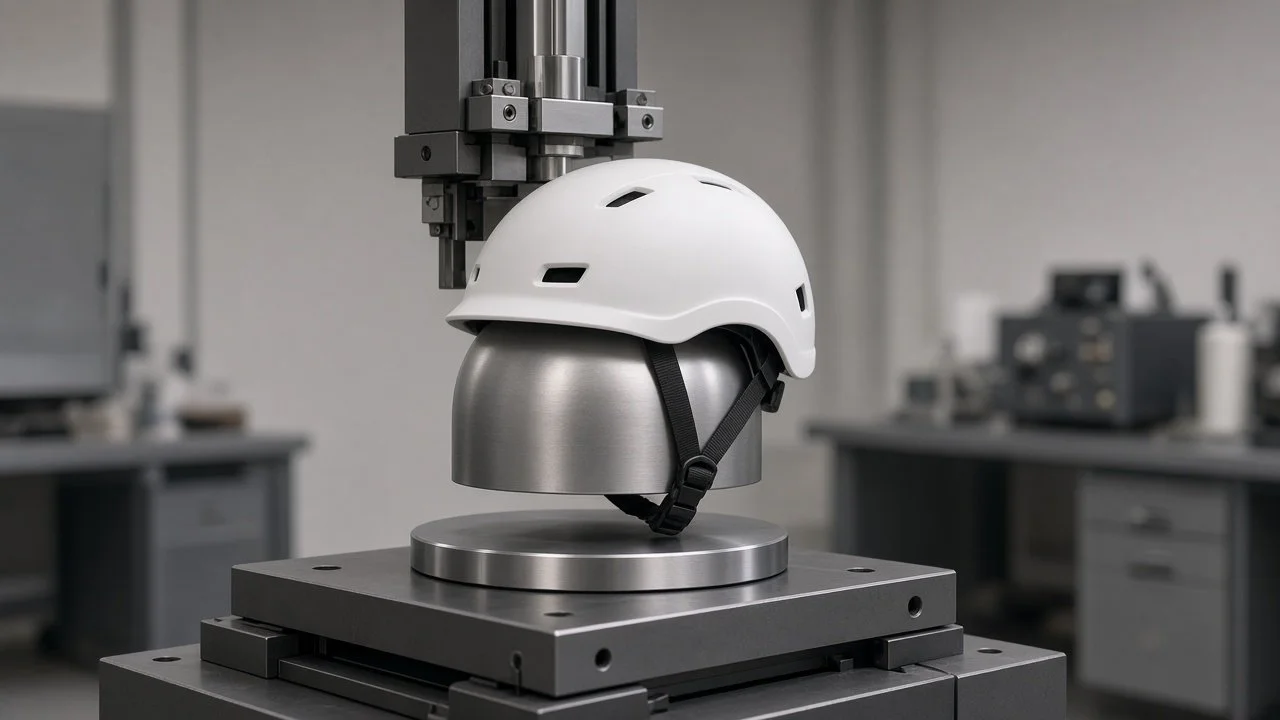
Concept render: a generic helmet on a drop-test headform, the setup used for impact attenuation testing. Illustration by Jackson Hedden; not the recalled Cipton helmet or any specific lab.
Frequently asked questions
Which Cipton helmets are recalled? White Cipton youth bicycle helmets in size small with a built-in multi-colored LED strip and "CPSK300CC" printed on a label inside. They were sold at Dick's Sporting Goods and JCPenney from April 2024 through May 2026 for about $35.
Why were the helmets recalled? CPSC says they do not meet the federal bicycle helmet standard's impact attenuation, positional stability and certification requirements, so they may not protect a rider in a crash. No injuries have been reported, and the notice does not identify a root cause.
Can a bicycle helmet have built-in lights? Federal rules do not ban lights, but the helmet must pass every test in 16 CFR Part 1203 with and without any attachments the manufacturer offers. External projections over 7 mm must break away, and interior parts may not project more than 2 mm.
Do children's bicycle helmets need third-party testing? Yes. Bicycle helmets are on CPSC's list of children's product rules that require testing by a CPSC-accepted laboratory to support a Children's Product Certificate. Importers must also electronically file certificate data with U.S. Customs beginning July 8, 2026.
Work with us
If you are adding lights, sensors or other electronics to a safety-regulated consumer product, see our consumer product design services or contact us to talk through your design and test plan.
Jackson Hedden is a product design, development and manufacturing firm helping founders and product teams take consumer and industrial products from concept to production.
Sources
- U.S. CPSC, Cipton Recalls Bicycle Helmets Due to Risk of Serious Injury or Death from Head Injury; Violate Mandatory Standard for Bicycle Helmets, November 19, 2026
- Cipton (hosted on southerntelecom.com), Recall – CPSK300CC Bicycle Helmets, November 19, 2026
- U.S. CPSC, Bicycle Helmets Business Guidance
- eCFR, 16 CFR Part 1203, Safety Standard for Bicycle Helmets
- eCFR, 16 CFR Part 1203 Subpart B, Certification
- U.S. CPSC, Rules Requiring Third-Party Testing and a Children's Product Certificate