On November 19, 2026, The Information reported, as relayed by Reuters, that Meta Platforms plans to price Muse Charm, its pocket-sized AI device, at $300 and to include up to 12 months of free 5G data from Verizon; Meta has not confirmed the price or the data plan.
Key takeaways
- The $300 price and free Verizon data are reported by The Information, citing a person familiar with the matter. Meta has not confirmed them.
- Reported details include a roughly 2-inch thumb-navigated screen, a fingerprint sensor, a built-in 5G modem and no calling.
- In a cellular device this small, antennas, certification, battery life, heat and cost all compete for the same few cubic centimeters.
- The core industrial design question is not "can we build it" but "why would someone carry this instead of using their phone."
- Racing a holiday date compresses validation and certification. Meta's smartwatch has reportedly slipped to 2027.
What was reported about Muse Charm
According to Reuters, via Investing.com and CNA, The Information reported on Thursday that Meta plans to price Muse Charm at $300 and offer buyers up to 12 months of free 5G data from Verizon. Reuters says the device has a roughly 2-inch (5 cm) screen that can be navigated with a thumb, with a customizable Muse character at its center, and a built-in 5G modem that allows access to Muse without Wi-Fi, though it cannot make calls. Verizon did not immediately respond to Reuters.
Meta spokesperson Tyler Yee told The Information and The Verge: "We're charmed by the interest in our AI devices, and we'll have more to share soon." The Verge, citing The Information, adds that Meta's smartwatch has been pushed to 2027 as Meta works to get Muse Charm out the door. Meta has also open-sourced code for building DIY Muse gadgets.
Meta first showed the device at Connect in September. Meta's own Connect recap describes Muse Charm as a device "built for you to talk and interact with your Muse" that "fits in your pocket." CNBC reported that Zuckerberg said Meta still needed to "finalize laying out the components" and planned to have it "ready to ship in time for the holidays in December." The Verge's Connect coverage said Zuckerberg had "only built a few of these so far," described a fingerprint sensor you press to start speaking to the agent, and noted what appeared to be a small camera and at least three microphone holes.
Jackson Hedden analysis: what a cellular AI companion demands of electronic product development
The analysis below is Jackson Hedden's view, based on general practice. We have no information about Meta's design, suppliers, costs or schedule beyond the reports above.
Antennas are the first space fight. A 5G modem needs antennas, and antennas need clearance from metal, the battery, the display and the user's hand. In a device roughly the size of a large watch face, that clearance competes directly with battery volume. Antenna placement, enclosure material and internal layout have to be decided together, because changing one detunes the others.
Certification is part of the schedule, not paperwork at the end. In the US, a device with radio transmitters needs FCC equipment authorization before it can be marketed, and a device used against the body is also evaluated for radio frequency exposure. Cellular devices usually face a second layer: carriers run their own device approval processes, and industry programs such as PTCRB certify that devices conform to cellular standards for many North American networks. Lithium batteries also need transport testing (UN 38.3) before units can ship. Each of these needs production-intent hardware and lab time.
Battery life is set by the radio and the microphones. An always-ready voice device keeps microphones and some processing awake, and a cellular connection draws power each time it wakes to send or receive. The display adds more. The power budget, meaning how much energy each function may use per day, should be written before the board is laid out.
Heat has nowhere to go in a pocket. Running voice, a screen and a 5G radio at once produces heat, and a pocket or a closed hand traps it. Skin-contact temperature limits, not chip limits, often decide how hard the device can work.
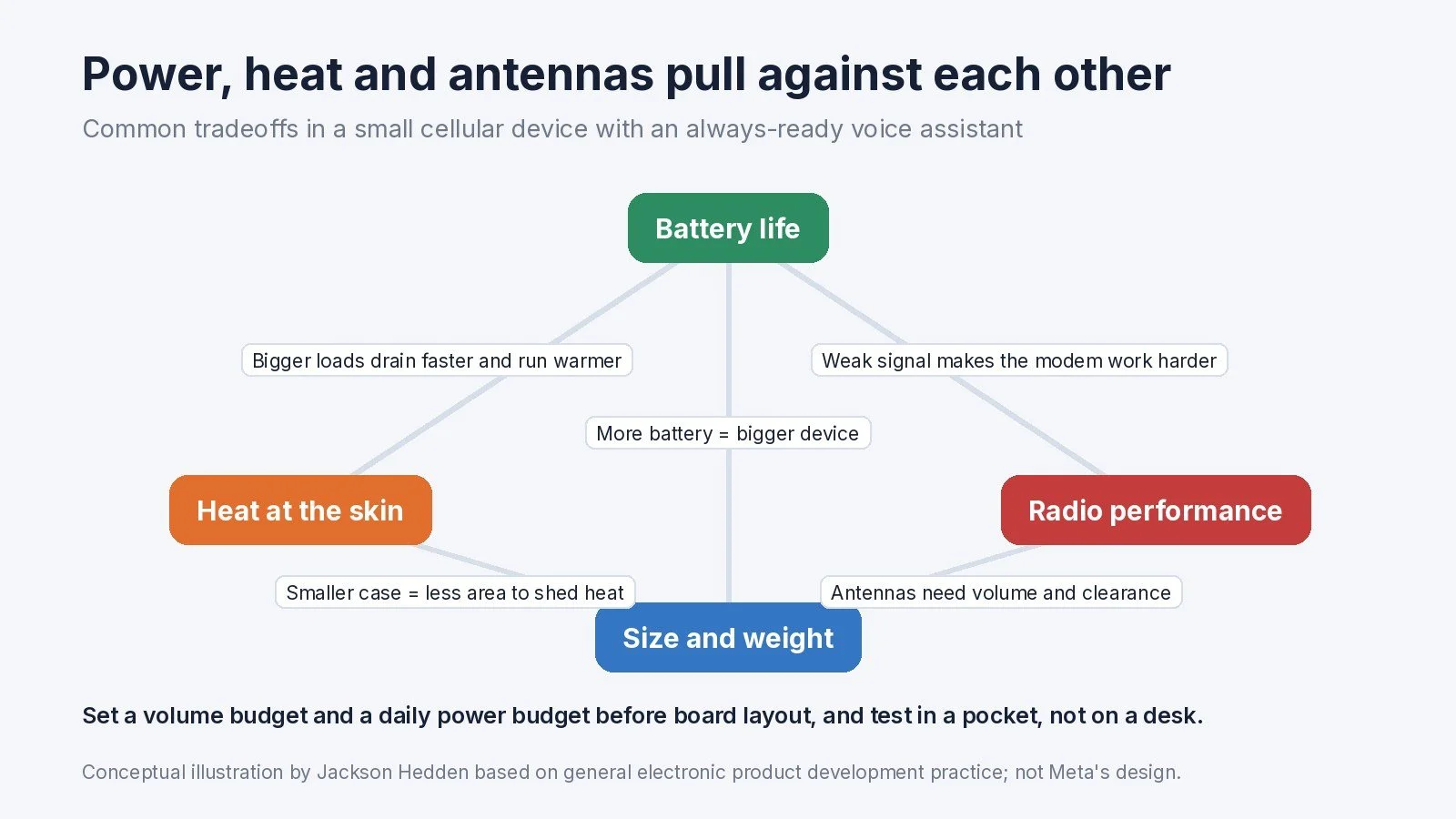
Power, heat and antennas pull against each other. Conceptual illustration by Jackson Hedden based on general electronic product development practice; not Meta’s design.
A fingerprint sensor is a mechanical part as much as an electronic one. It needs a clear path to the finger, a seal against sweat and dust, and a position that the thumb finds without looking. Used as the talk trigger, its placement shapes how the device is held.
Small-screen UX needs physical answers. On a 2-inch screen, a dedicated control, haptic feedback and clear audio cues do much of the work. Teams should test in pockets, gloves and bright sun, not only on a desk.
Is it better than the phone? This is the core industrial design question for any companion device. It has to be faster to reach, quicker to start, or more pleasant to use than an app on a phone the user already carries. Time from pocket to answer matters more than the spec sheet.
Cost and connectivity are product decisions. A reported $300 price has to cover the bill of materials (BOM), meaning every component, the enclosure and assembly, plus certification, packaging, returns and margin. Bundled data adds a recurring cost that someone carries. The reports we read do not say what happens after the free period, and that renewal moment is part of the product experience.
Holiday dates compress validation. Hardware usually moves through EVT (engineering validation test, proving the design works), DVT (design validation test, using production-intent parts and processes for reliability and certification testing) and PVT (production validation test, proving the factory line at volume). Radio or thermal fixes found in any build can force re-testing. The reported smartwatch slip is a reminder that companies trade programs against each other when a date is fixed.
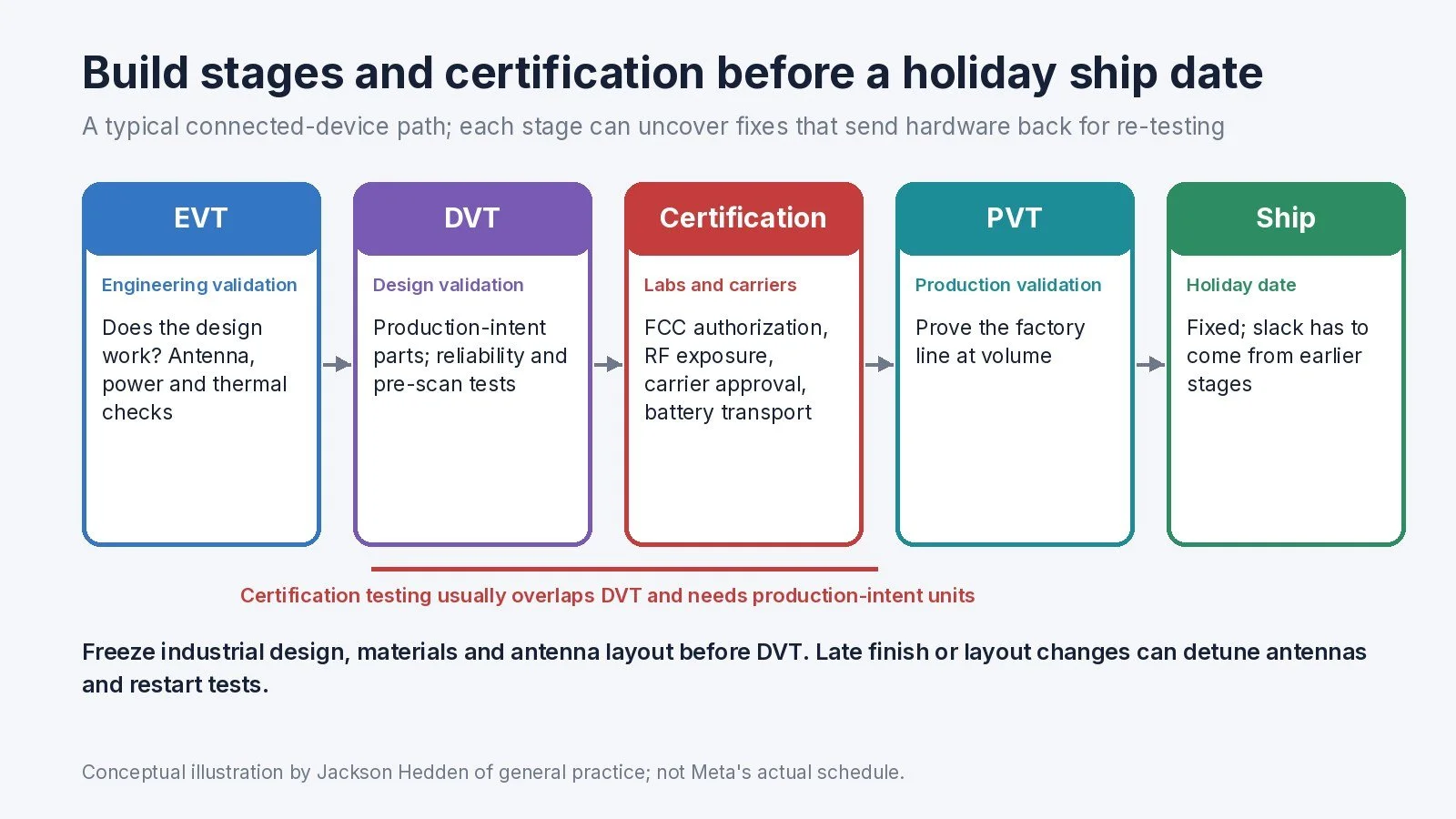
Build stages and certification before a holiday ship date. Conceptual illustration by Jackson Hedden of general practice; not Meta’s actual schedule.
What this means for product teams
Answer the phone question first. Write down the one job your device does better than a phone, and test that claim with users before locking the architecture.
Lay out antennas, battery and thermals together. Start with a volume budget and a power budget. Good electronic product development treats the enclosure, board and antennas as one system.
Consider pre-certified radio modules. A pre-certified cellular module can shorten the path, but the finished product still needs its own authorization, exposure testing and carrier approval. Book labs early.
Plan EVT, DVT and PVT backward from the ship date. Leave room for at least one unplanned build, and freeze industrial design and materials before DVT. Late finish or material changes can affect antennas and heat.
Model total cost, not just BOM. Include certification, data, returns and support. If connectivity is bundled, decide what the customer sees when it ends. Our posts on Yeasound's in-canal hearing aid and Google's intelligent eyewear cover related miniaturization and wearable design tradeoffs.
Frequently asked questions
How much will Meta's Muse Charm cost? The Information reported a $300 price with up to 12 months of free Verizon 5G data, citing a person familiar with the matter. Meta has not confirmed the price and said it will have more to share soon.
What is Muse Charm? It is a pocket-sized device for talking to Meta's Muse AI agent, shown at Meta Connect in September 2026. Reuters reports a roughly 2-inch screen and a built-in 5G modem, with no calling.
Why is a cellular AI device hard to design? Antennas, battery, display, microphones and heat all compete for very little space, and the radio drains power. The device also needs FCC authorization, exposure testing and carrier approval, which all depend on production-intent hardware.
What are EVT, DVT and PVT? They are the usual hardware build stages: engineering validation (does the design work), design validation (do production-intent parts pass reliability and certification testing) and production validation (can the factory build it at volume). Late problems can force another build.
Work with us
If you are developing a connected device and want to pressure-test the antenna, power and certification plan before tooling, see our electronic product design services, or contact us to talk through your project.
Jackson Hedden is a product design, development and manufacturing firm helping founders and product teams take consumer and industrial products from concept to production.
Sources
- The Information, Meta Bets on $300 Muse Charm to Boost AI Hardware Business, November 19, 2026 (paywalled; cited as reported by Reuters and The Verge)
- Reuters via Investing.com, Meta to price Muse Charm gadget at $300, The Information reports, November 19, 2026
- Reuters via CNA, Meta to price Muse Charm gadget at $300, The Information reports, November 19, 2026
- The Verge, Meta's Muse Charm might cost $300, November 19, 2026
- Meta, The Biggest News From Connect 2026, September 24, 2026
- CNBC, Mark Zuckerberg debuts $1,299 Meta VR Glasses and Muse Charm pendant, September 23, 2026
- The Verge, Meta is making a standalone Muse AI gadget, September 23, 2026