x
On November 19, 2026, at a launch event in New York, OBSBOT introduced two AI-tracking PTZR cameras, the long-zoom Tail 2 ADV and the 1-inch-sensor Tail Air 2, with general sales scheduled to start December 8.
Key takeaways
- Tail 2 ADV puts 21x optical zoom, a three-axis pan-tilt-roll gimbal, PoE+, 3G-SDI, HDMI 2.0 and a 5000 mAh battery into a body OBSBOT says is about 4 inches wide and 6 inches tall.
- Tail Air 2 pairs a 1-inch sensor with a roll axis and a lens module that rotates 90 degrees for native vertical 4K at up to 60 fps.
- At long focal lengths, tiny gimbal errors become visible. OBSBOT quotes angular jitter as low as ±0.0005° on Tail 2 ADV.
- For product teams, the lesson is that optics, motion control, power, heat and AI tracking firmware have to be designed together from the first architecture sketch.
What OBSBOT announced
According to OBSBOT's Tail 2 ADV release, the camera combines a 21x optical zoom (40x hybrid) with a 12-element lens, a custom lens motor and a custom 1/2-inch sensor recording 4K at up to 60 fps. A physical variable aperture runs from f/1.7 to f/7.0 at the wide end and f/3.8 to f/7.0 at telephoto. AI Tracking 2.0 follows subjects up to 240 meters away, compared with 95 meters on the earlier Tail 2.
The connections read like a broadcast camera: 3G-SDI up to 1080p/60, full-size HDMI 2.0 up to 4K, Gigabit Ethernet with PoE+, a 2.5 mm RS-232 port, two USB-C ports, Wi-Fi 6 and a tally light. OBSBOT says its auto-leveling system works in inverted or non-standard mounting positions. The built-in 5000 mAh battery is rated for up to 4 hours 36 minutes, and a "low-noise cooling fan" supports long sessions.
OBSBOT's Tail Air 2 release describes a 1-inch sensor with an f/1.9, eight-element lens, a dedicated roll axis, auto leveling on uneven surfaces and a lens module that physically rotates 90 degrees for uncropped vertical 4K60. It has Micro HDMI, two USB-C ports, Wi-Fi 6 and Ethernet, plus a 2,630 mAh battery rated for up to 205 minutes at 1080p/30.
OBSBOT's newsroom pages show $1,399 for Tail 2 ADV and $799 for Tail Air 2, which reflect pre-order discounts of $200 and $100. RedShark News reports list prices of $1,599 for Tail 2 ADV and $899 or $999 for Tail Air 2, depending on whether the NDI version is chosen. Both cameras go on sale December 8 through OBSBOT's store, Amazon US and other retailers, according to the company.
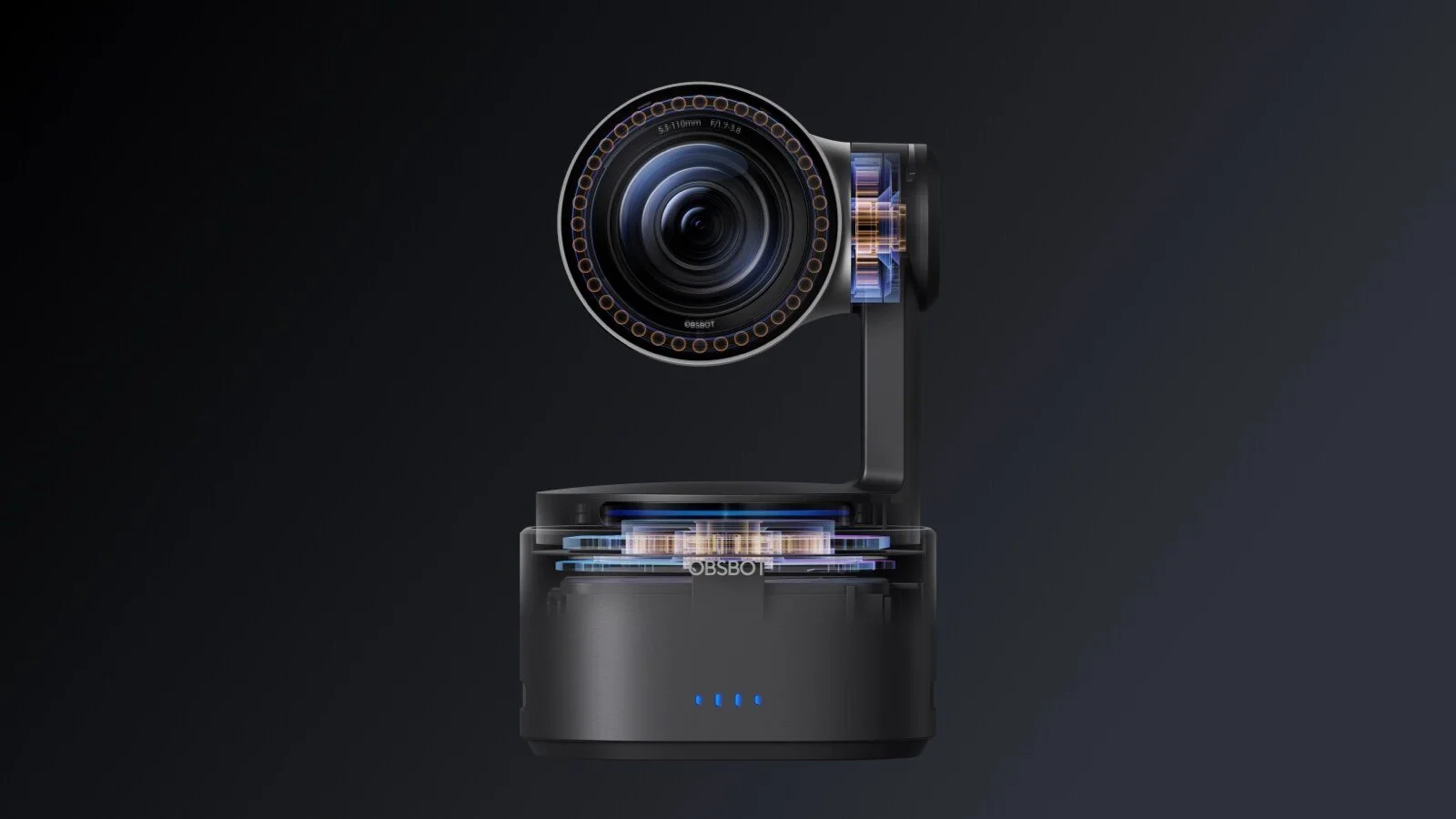
OBSBOT’s render of Tail 2 ADV’s pan-tilt-roll motion system. Image: OBSBOT
Electronic product design inside a moving camera
The analysis below is Jackson Hedden's view, based on general practice. OBSBOT has not published its internal design or test process, and we are not describing it.
A PTZ camera (pan, tilt, zoom) is already a small robot with a lens on the end. A PTZR camera adds a third gimbal axis, roll. Good electronic product design for this class of product starts with the motion system, because every other choice depends on it.
Stiction and backlash. Stiction is the extra force needed to start a part moving. Backlash is the small dead zone between gear teeth when direction changes. Both make a camera hesitate or overshoot when a subject changes direction, and both show up badly at 21x zoom. Teams usually choose between direct-drive brushless gimbal motors, which avoid gear backlash, and geared motors, which give more torque in a smaller size. Encoder resolution has to match the angular precision the product promises.
Cables through rotating axes. Video, power and data have to pass through joints that turn. The options are slip rings, which allow continuous rotation, or flexible printed circuits wound as a service loop, which limit travel but cost less. Either way, cable stiffness adds drag the control loop must handle, and repeated flexing is a classic failure point.
Mounting orientation. A camera that works upside down on a ceiling mount sees gravity pulling on each axis differently. Motor sizing, balance, auto-leveling firmware and cooling airflow all need to be checked in every supported orientation, not just on a desk.
Power, heat and noise in a compact body
PoE+ gives a fixed power budget over a single cable, so the sensor, image processor, AI processing, motors, Wi-Fi and battery charging have to share it. Peaks matter: motors drawing current during a fast preset move while the battery charges can exceed what the cable delivers. A battery helps buffer those peaks, but it also adds weight to the moving or base assembly and brings shipping and safety tests.
Heat follows power. Image processing and AI inference run continuously, and a sealed compact body leaves little room for heat to escape. A fan helps, but a fan and zoom motor both make noise in a room where the camera may sit near a microphone. Acoustic testing of the fan, lens motor and gimbal motors should be part of validation, especially for creator products used in quiet rooms.
Platform thinking across two SKUs
A SKU is a single product version a company sells. OBSBOT positions Tail 2 ADV for large venues and Tail Air 2 for creators, and both share AI Tracking 2.0, OBSBOT Log and timecode and PTP sync, according to the releases. Where products share firmware, control protocols and software, a team can spread development and certification work across a product line. The hard part is deciding early which modules are shared, such as the tracking stack and control apps, and which are tuned per SKU, such as the optics, connectors and battery.
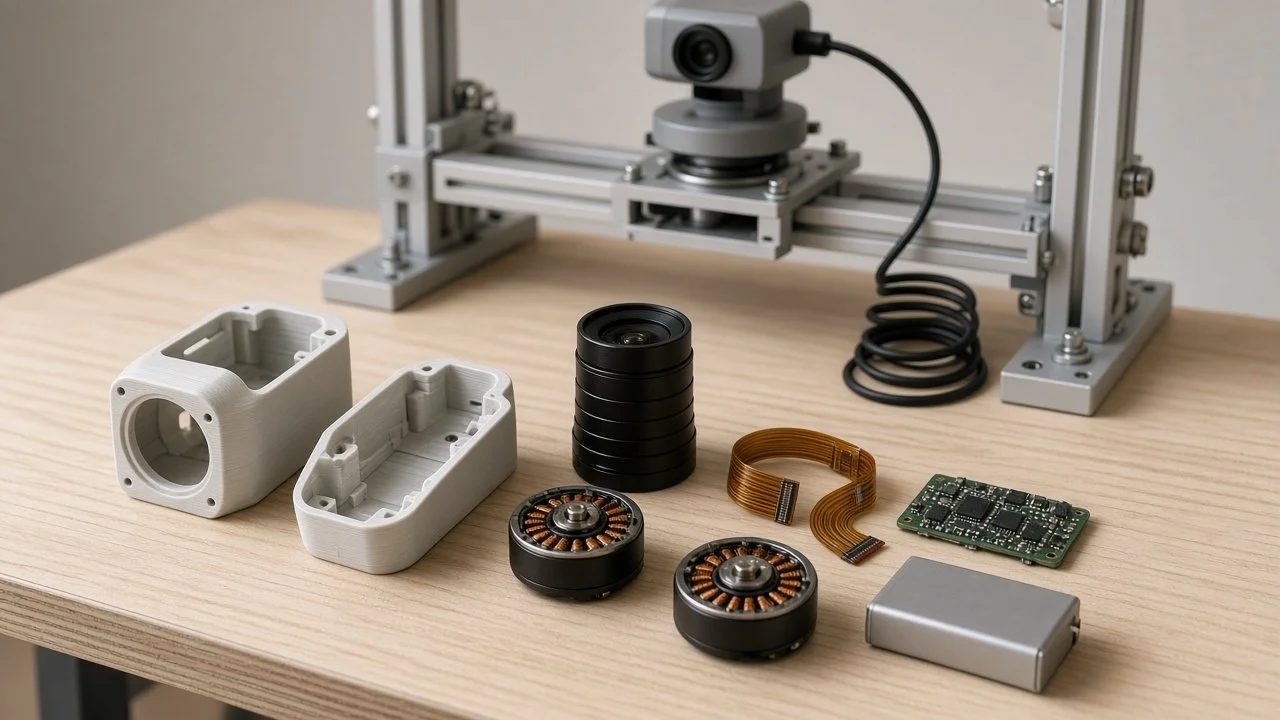
Concept render (illustration), not an OBSBOT product.
What this means for product teams
Co-design firmware and hardware for tracking. AI tracking is only as good as the motion system it commands. Agree on latency, motor speed limits and encoder resolution together, and test the tracking stack on the real gimbal early.
Prototype the motion system first. Build a motion test rig with 3D-printed or SLA (stereolithography) housings to measure jitter, noise and cable wear before industrial design is final.
Plan EVT, DVT and PVT. EVT (engineering validation test) proves the design works. DVT (design validation test) checks production-intent parts against reliability, thermal and compliance tests. PVT (production validation test) proves the factory can build it at rate with good yield.
Write power and thermal budgets on day one. List every load against the PoE and battery limits and the worst-case room temperature.
Design for manufacturing (DFM) the rotating parts. Gimbal alignment, motor calibration and cable routing need fixtures and end-of-line tests. For another product with many small mechanisms, see our post on Xiaomi's robot vacuum with mechanical arms, and for a camera robot moving from crowdfunding to retail, our look at the Beni camera robot.
Frequently asked questions
What is a PTZR camera? A PTZR camera can pan, tilt, roll and zoom under motor control. The roll axis lets the camera level itself or turn to a vertical frame, which OBSBOT uses for auto leveling and native vertical video.
What is the difference between Tail 2 ADV and Tail Air 2? Tail 2 ADV is built for long-range live production, with 21x optical zoom, PoE+, 3G-SDI and HDMI 2.0. Tail Air 2 is aimed at creators, with a 1-inch sensor, Micro HDMI and a lens module that rotates 90 degrees for vertical 4K.
Why does gimbal jitter matter more with long zoom? At long focal lengths, each tiny angular error moves the image across many more pixels. That is why motor control, encoder resolution and mechanical stiffness matter more as optical zoom increases.
When do Tail 2 ADV and Tail Air 2 go on sale? OBSBOT says both go on sale December 8, 2026, after pre-orders opened November 4. RedShark News reports list prices of $1,599 for Tail 2 ADV and $899 or $999 for Tail Air 2.
Work with us
If you are packaging motors, optics, batteries and connectivity into a compact device, see our electronic product design services or contact us to talk through your architecture and validation plan.
Jackson Hedden is a product design, development and manufacturing firm helping founders and product teams take consumer and industrial products from concept to production.
Sources
- OBSBOT, OBSBOT Introduces Tail 2 ADV and Tail Air 2: Expanding Creative Freedom for Professional Production Teams and Creators, November 19, 2026
- OBSBOT, OBSBOT Unveils Tail 2 ADV with 21× Optical Zoom, Variable Aperture and OBSBOT Log & LUT Support for Professional Live Production, November 19, 2026
- OBSBOT, OBSBOT Tail Air 2 Advances Professional Video Production with 1-Inch 4K Imaging, OBSBOT Log and Greater Flexibility, November 19, 2026
- PR Newswire, OBSBOT Introduces Tail 2 ADV and Tail Air 2, November 20, 2026
- Andy Stout, RedShark News, OBSBOT Tail Air 2 and Tail 2 ADV: specs and price, November 19, 2026