On November 19, 2026, the U.S. Consumer Product Safety Commission (CPSC) announced that Hultafors Group North America is recalling about 229,430 lighted portfolios, digital angle locators, a digital caliper and a building calculator because their button cell batteries can be reached easily by children and the products lack the warnings required under Reese's Law.
Key takeaways
- CPSC says nine Johnson Level and Custom Leather Craft (CLC) models violate the federal standard for consumer products with button cell or coin batteries, 16 CFR part 1263.
- CPSC cites two separate failures: battery compartments children can open easily, and missing warnings on the product and packaging.
- The recalled tools were sold at hardware stores and on Amazon from February 2023 through November 2026, for about $45 to $400, and were made in China.
- Reese's Law requires a battery compartment that needs a tool or two independent, simultaneous hand movements to open, and that survives use and abuse testing.
- A small battery can pull a whole product under a safety standard. Battery access, warnings and testing belong in the first design review, not the final packaging check.
What happened: a design for manufacturing lesson from a trade tool recall
Most product teams think of button battery rules as a concern for toys, remote controls and key fobs. This recall is a reminder that the standard follows the battery, not the product category. Measuring tools, calculators and a lighted portfolio are mainly bought by tradespeople and adults, but they still end up in homes where children live.
Design for manufacturing (DFM) means designing parts so they can be made reliably, consistently and affordably at volume. In practice, good DFM also includes regulatory requirements that every production unit must meet, because a compliant prototype means little if the production version, its labels or its packaging drift from it.
What CPSC reported
According to the CPSC recall notice (recall number 27-090), the recall covers:
- Custom Leather Craft Lighted Portfolio, model L217.
- Johnson Level digital angle locators and rulers, including the 12-inch Digital Angle Locator, two Professional Magnetic Digital Angle Locators, 7-inch and 11-inch Angle Locator and Ruler models, and a 21-inch Digital Magnetic Level and Angle Locator with Dot Laser.
- Johnson Level Digital Caliper, model 1889-0600, and Building Calculator, model CALC-1500.
CPSC states the products "violate the mandatory safety standard for consumer products with button cell and coin batteries because the button batteries can be accessed easily by children," and that "the packaging and product do not have the warnings required under Reese's Law." The products were sold at Lowe's, Menards, W.W. Grainger, True Value and other hardware stores, and on Amazon.com. The manufacturer is listed as Hultafors Group North America, Inc., of Mequon, Wisconsin, with manufacturing in China. The remedy is a refund: owners upload a photo of the product and certify it has been disposed of. The recall was one of eight CPSC announced the same day.
What Reese's Law requires
Reese's Law was enacted in August 2022. CPSC adopted the voluntary standard ANSI/UL 4200A-2023 as the mandatory rule, codified at 16 CFR part 1263 (Federal Register, September 21, 2023). CPSC's business guidance summarizes the core product requirements:
- Compartments holding replaceable button cell or coin batteries must need a tool, or at least two independent and simultaneous hand movements, to open.
- Batteries must not become accessible or come loose during use and abuse testing.
- The product's packaging must carry a warning, and the product itself must too where practicable.
- Instructions and manuals must include the applicable warnings.
CPSC applied these requirements, through enforcement discretion, to products manufactured or imported after March 19, 2024. Manufacturers must also certify compliance in a General Certificate of Compliance (GCC), or a Children's Product Certificate for children's products, citing 16 CFR 1263.3. CPSC's 2023 announcement explains why: it was aware of 27 deaths and an estimated 54,300 emergency room-treated injuries from swallowed or inserted button and coin batteries from 2011 through 2021.
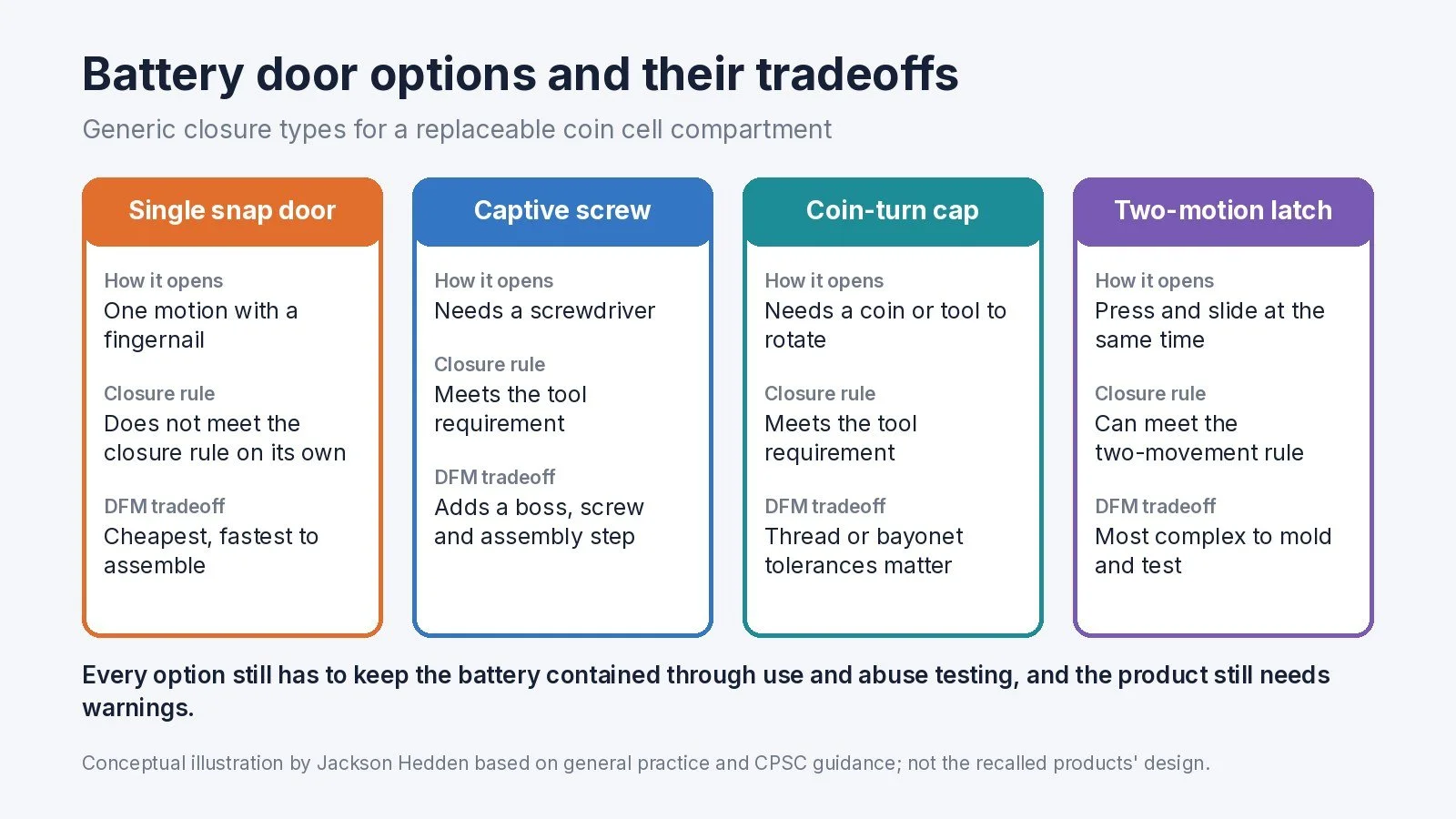
Battery door options and tradeoffs. Conceptual illustration by Jackson Hedden based on general practice and CPSC guidance; not the recalled products’ design.
Jackson Hedden analysis: why compliance gets lost between design and production
The analysis below is Jackson Hedden's view, based on general product development practice. We have no information about how Hultafors designed, sourced or tested these products beyond what CPSC published.
The battery is often a late, small decision. A light, a digital readout or a memory backup gets added to an existing product, and a coin cell looks like the simplest power source. That one choice brings a federal standard, abuse testing, warning labels and certification with it. When the battery is treated as a minor feature, nobody owns those requirements.
A secure compartment is a mechanical design problem. A snap-on battery door is cheap and convenient, but it often opens with one fingernail. Compliant options include a captive screw, a door that needs a coin or tool to turn, or a latch that needs two separate, simultaneous movements. Each choice affects wall thickness, boss design (the molded post a screw threads into), tolerances, assembly time and how users replace the battery. These are design for manufacturing decisions, best made while the enclosure is still being designed.
Abuse testing finds weak doors and thin walls. The standard expects the battery to stay contained after reasonably foreseeable use and misuse, such as drops and force on the compartment. A door that holds on a prototype can fail when production plastic, a different molding process or a cheaper screw is used.
Warnings are physical design features too. CPSC flagged missing warnings on both product and packaging. On a slim caliper or ruler, space for a durable warning is tight. If no one plans where the warning goes, how it is printed or molded, and how it survives use, it is easy to leave out.
Sourced products need compliance written into the spec. When a product is made by an overseas supplier, the brand still has to certify it. A supplier may reuse a familiar battery door from an earlier design. Clear specifications and production checks, not assumptions, keep the compliant design in every shipment.
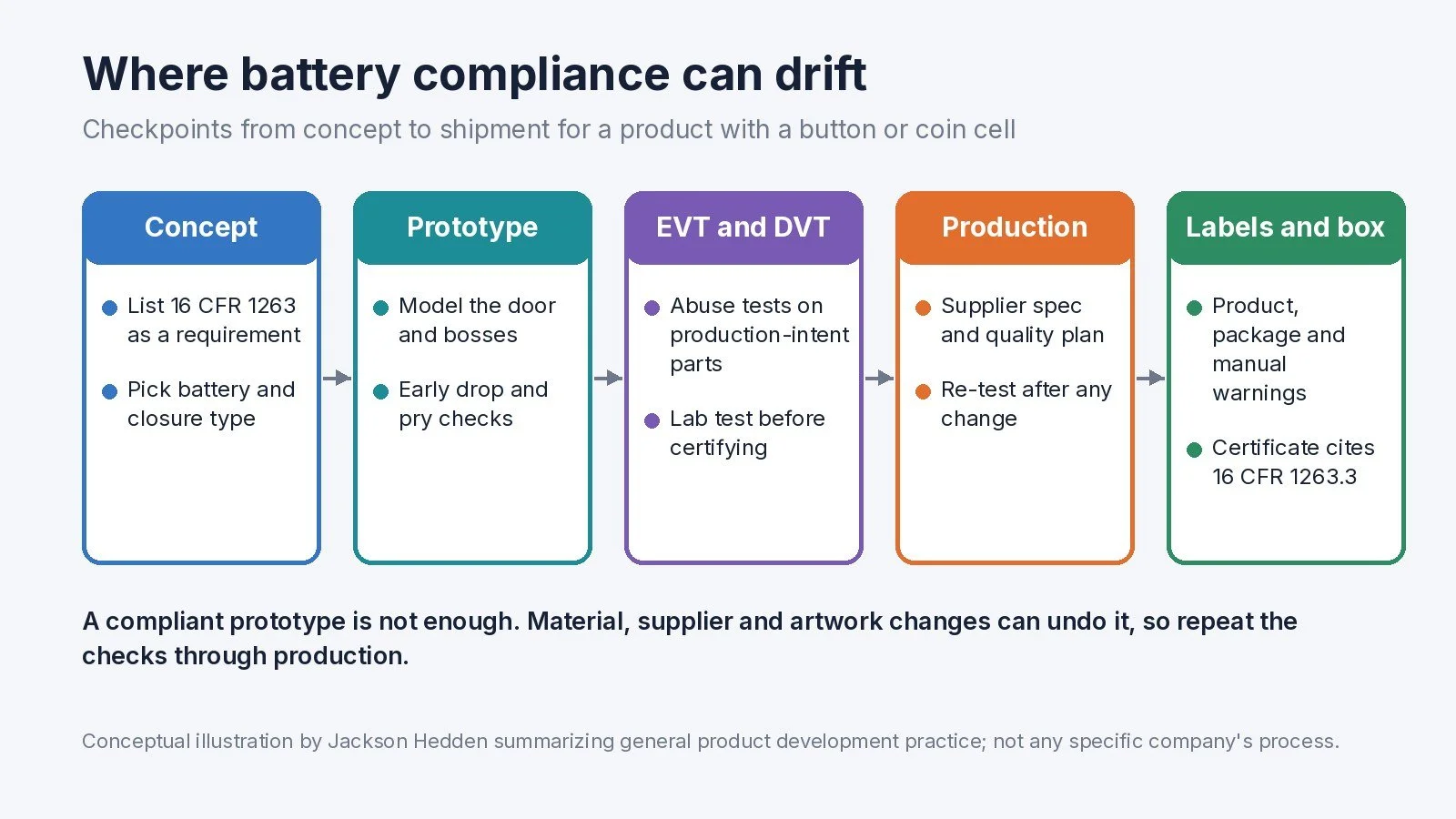
Where battery compliance can drift. Conceptual illustration by Jackson Hedden summarizing general product development practice.
What this means for product teams
Flag every battery in the first design review. Any product that contains or can use a button cell or coin battery should have 16 CFR part 1263 on its requirements list from day one, alongside other standards. Good design for manufacturing starts with that requirements review.
Choose the compartment closure early. Decide on a tool-operated or two-motion closure before the enclosure is tooled. Tooling, the custom steel molds used for injection molding, is expensive to change after it is cut.
Test production-intent parts, not just prototypes. Run drop and abuse checks during EVT (engineering validation test, which proves the design works) and again in DVT (design validation test, which uses production-intent parts and processes). Repeat them after any material or supplier change.
Design the warnings with the product. Reserve space for on-product warnings, include warnings in packaging and manuals, and keep the artwork under the same revision control as the parts.
Lock compliance into supplier documents. Put battery requirements in the specification, the quality plan and the certificate you will issue. Our posts on Welly's reshored drinkware factory and on Keychron's paused EU keyboard launch and replaceable batteries cover related sourcing and battery-rule decisions. For another November 2026 recall tied to a federal mandatory standard, see our look at Cipton’s LED youth bike helmet recall.
Frequently asked questions
What products are in the Hultafors recall? CPSC lists nine models: the Custom Leather Craft Lighted Portfolio L217 and Johnson Level digital angle locators, angle locator rulers, a digital caliper and a building calculator. About 229,430 units are affected, and the remedy is a refund.
What is Reese's Law? Reese's Law is a 2022 federal law that led CPSC to adopt ANSI/UL 4200A-2023 as the mandatory standard for consumer products with button cell or coin batteries, codified at 16 CFR part 1263. It covers secure battery compartments, use and abuse testing, warning labels and certification.
Does Reese's Law apply to products made for adults? Yes. The rule applies to consumer products that contain or use button cell or coin batteries, not only to children's products. This recall involves trade tools and a portfolio sold mainly through hardware stores.
How should a battery compartment be designed to meet the standard? It must require a tool, such as a screwdriver or coin, or at least two independent and simultaneous hand movements to open, and it must keep the battery contained after use and abuse testing. Teams should choose the closure early and test it on production-intent parts.
Work with us
If your product uses a coin cell or another battery and you are moving toward production, we can help review the design, the closure and the supplier requirements before tooling starts. See our manufacturing and sourcing services, or contact us to talk through your project.
Jackson Hedden is a product design, development and manufacturing firm helping founders and product teams take consumer and industrial products from concept to production.
Sources
- U.S. Consumer Product Safety Commission, Hultafors Group North America recall notice, November 19, 2026
- U.S. Consumer Product Safety Commission via PR Newswire, CPSC Posts Product Recalls and Product Safety Warnings, November 19, 2026
- U.S. Consumer Product Safety Commission, Button Cell and Coin Battery Business Guidance
- U.S. Consumer Product Safety Commission, Reese's Law leads to new federal mandatory safety standard, September 11, 2023
- Federal Register, CPSC direct final rule incorporating UL 4200A-2023 under Reese's Law, September 21, 2023