x
On November 23, 2026, Cleer Audio launched Cleer Bridge, $159.99 open-ear clip-on wireless earbuds that the company says won a 2026 Red Dot "Best of the Best" design award (Cleer via EIN Presswire).
Key takeaways
- Clip-on earbuds are a mechanical design problem first. With nothing in the ear canal, the bridge that wraps the ear has to hold the product in place, carry wiring and stay comfortable for hours.
- Fit across many ear shapes decides the product. Cleer itself notes that comfort "may vary depending on ear shape," the core risk in any clip-on design.
- Open-ear audio trades isolation for awareness. Getting bass and call quality without sealing the ear pushes work into driver placement, acoustics and software.
- A design award is a useful signal, not a full answer. When choosing a design partner, ask what the award judged and what it did not.
What Cleer announced: Bridge at a glance
According to Cleer's announcement, dated November 23, 2026 in San Diego, and the company's US product page, reported details are:
- Form: an open-ear clip-on design that sits on the outer ear and leaves the ear canal open, so wearers can hear their surroundings. Cleer describes a nature-inspired continuous loop form and an iridescent arch, designed to be worn as a visible accessory.
- Fit features: the product page describes a curved, "highly-flexible bridge" and soft silicone cushions "designed to distribute contact pressure," and says the clip avoids pressing into the ear or getting in the way of hats, glasses and masks.
- Weight: 7.8 g per earbud and 80.6 g for both earbuds and the case.
- Audio: a 12mm titanium composite driver, Cleer's DBE 5.0 bass enhancement, Dolby Audio, Snapdragon Sound with aptX Lossless and Hi-Res Wireless certification.
- Battery and durability: up to 7 hours per charge (23 with the case), Bluetooth 6.0, IPX5 sweat and water resistance and two call microphones.
- Award: Cleer says Bridge received a 2026 Red Dot "Best of the Best," the competition's highest distinction. Red Dot says its product awards are decided by around 40 design experts who examine the submitted products in Essen, Germany.
- Earlier debut: Cleer's China newsroom shows Bridge debuted at a Cleer event in China on April 22, 2026, described as an arc that spreads clamping force, with replaceable pressure-relief cushions.
What the sources do not state: clamping force, bridge materials, cushion sizes in the US box or how fit was tested. We could not find Bridge in Red Dot's online database at the time of writing, so the award is reported as Cleer states it. We have not tested the product.
Why clip-on earbuds are hard to design
A conventional earbud is held by the ear canal: a silicone tip seals in, and the seal also delivers bass. A clip-on earbud gives that up. It hangs on the outer ear, usually with a speaker pod resting near the canal opening, a second pod behind the ear holding the battery, and a flexible bridge connecting the two across the rim of the ear.
That bridge does most of the work. It is a spring that must grip firmly enough to survive a run but gently enough to wear through a workday, across ears that vary widely in thickness and curvature. It also carries wires between the pods, flexes thousands of times and has to look good, especially when sold as an accessory.
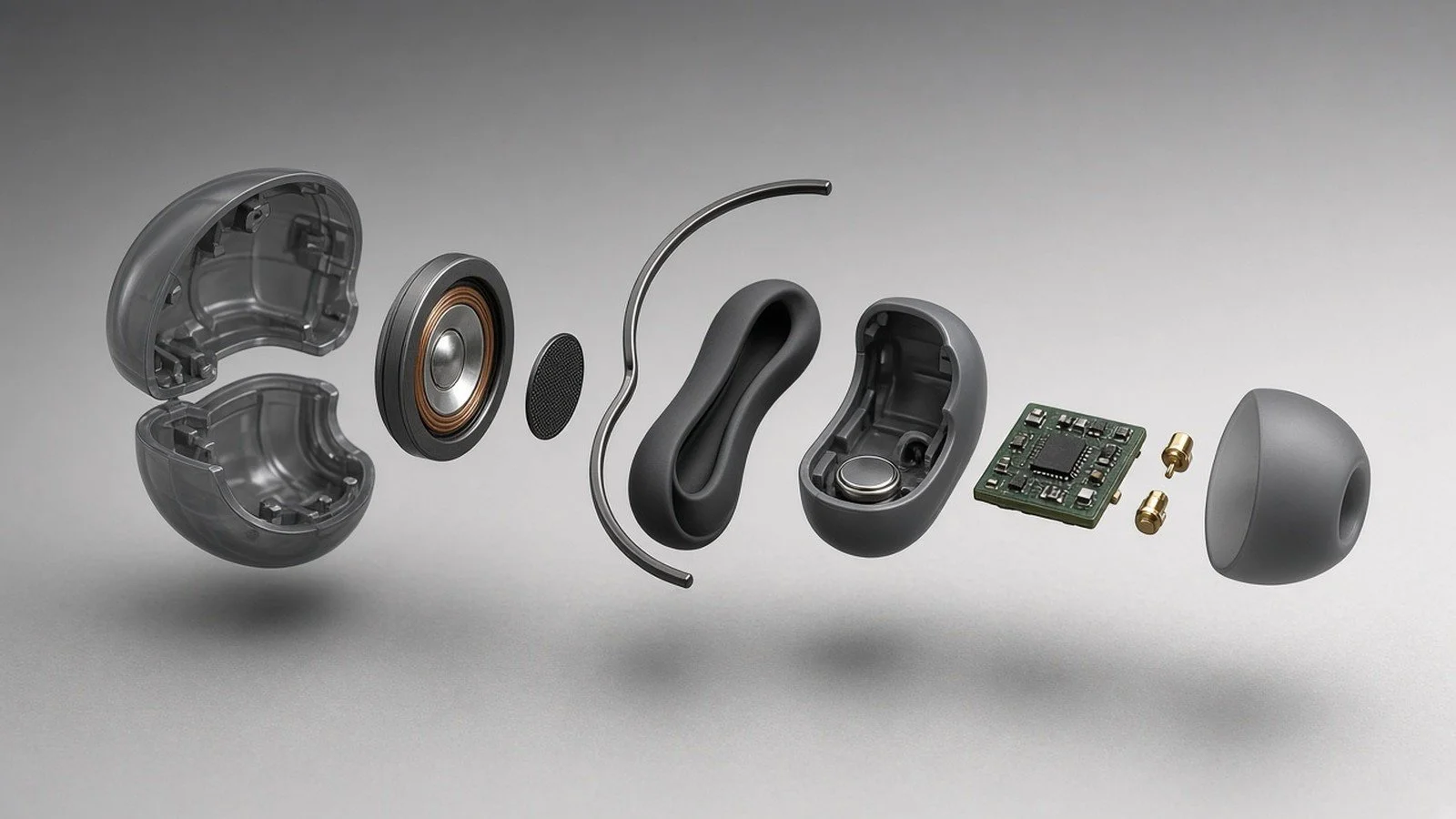
Concept render (illustration) of a generic clip-on earbud’s components, not a Cleer product.
What this means for product teams
The following is Jackson Hedden analysis, not reporting; we have no information about Cleer's internal design or test process beyond the linked sources. Any industrial design firm working on a clip-on wearable usually has to resolve these decisions.
Define the fit range before the form. Decide which ear sizes and shapes the product must fit, then design the bridge geometry and cushions for that range. Interchangeable cushions, like those Cleer describes for the China launch, are one way to widen the range without new tooling (the custom molds used to make parts at volume).
Treat clamping force as a specification. Measure grip force across the fit range and set limits, just as you would for battery life. Too little and the bud falls off during exercise; too much and users take it off after an hour.
Balance the mass. At under 8 grams per earbud, how weight splits between the front and rear pods affects stability as much as the clip does, so battery placement is an ergonomic decision.
Engineer the bridge for flex life. A flexing arm that carries conductors needs material, wire routing and strain relief tested over many flex cycles and sweat exposure.
Plan acoustics around an open ear. With no seal, bass and privacy depend on driver size, port aim and how leakage is controlled.
Design the antenna and controls on the body. The head absorbs radio energy, the same problem we described for an in-canal Bluetooth hearing aid. Touch controls have to be findable without looking, and the clip shares space behind the ear with eyeglass temples, where audio glasses such as the Sutyo Cue put their electronics.
What a design award tells you when choosing an industrial design firm
Awards such as Red Dot judge a finished product's design quality as presented to a jury. That is a meaningful signal of craft, but only part of what a founder needs. When a firm shows award-winning work, ask:
- What did the firm actually do? Industrial design only, or also engineering, prototyping and manufacturing handoff?
- Did it ship at volume, and on what timeline? Awards can go to concepts and early products; production is a different test.
- How was it validated? Ask for the fit studies, drop and life tests behind the look.
- What did it cost to make? A striking form that needs extra tooling or finishing can strain margins.
Award entry is by submission, so firms without trophies are not necessarily weaker.
Prototyping and testing a clip-on wearable
A practical prototype and test sequence for a product in this category:
- Fit studies: SLA-printed (stereolithography, a precise resin 3D printing process) bridges in several arc sizes and stiffnesses tried on real ears and silicone ear models.
- Force and fatigue rigs: fixtures that measure clamping force and flex the bridge through repeated cycles until wires or overmolds fail.
- Acoustic models: works-like prototypes measured on a head simulator to tune driver aim, bass and sound leakage.
- Appearance models: finish samples to check that an iridescent surface looks consistent part to part.
- Production-intent builds: parts from production tooling for EVT and DVT, engineering validation test and design validation test, the build stages that confirm the design works and then meets its requirements, including sweat, drop and battery safety testing.
Design for manufacturing (DFM), shaping parts so they can be molded and assembled reliably and affordably, matters early: overmolded flexible arms, sealed charging contacts and decorative finishes are expensive to change after tooling.
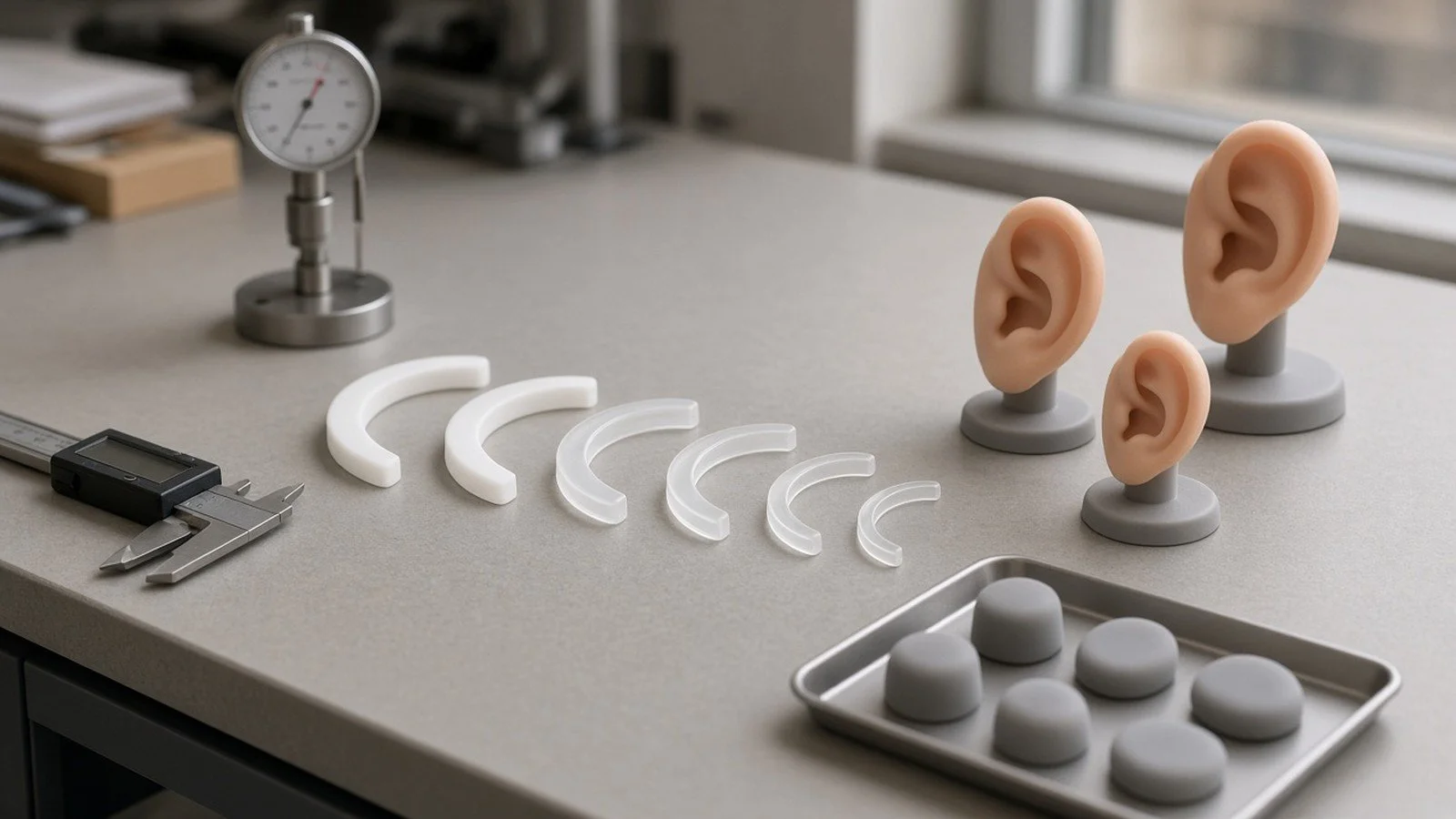
Concept render (illustration) of staged clip-on earbud fit prototypes and test tools, not a Cleer product.
Frequently asked questions
What is Cleer Bridge? Cleer Bridge is a pair of open-ear clip-on wireless earbuds Cleer Audio launched in the US on November 23, 2026 at $159.99. Cleer says it won a 2026 Red Dot "Best of the Best" award.
How do clip-on open-ear earbuds stay in place? A flexible bridge wraps the rim of the ear and clamps lightly, with a speaker pod in front and usually a battery pod behind. Cushions, bridge stiffness and weight balance decide security and comfort.
Should I choose an industrial design firm based on design awards? Awards show that a firm can produce work a jury rates highly, which is useful. Also ask what the firm did on the project, whether the product shipped at volume, and how it was tested and costed.
What are EVT and DVT? EVT (engineering validation test) is the build stage where engineers confirm the design works as intended. DVT (design validation test) uses production-intent parts to confirm the product meets its requirements, including safety and reliability testing, before mass production.
Developing a wearable or audio product?
If you are developing earbuds, a wearable or another product where fit, acoustics and appearance have to work together, see how we approach product design or contact us to talk through your project.
Jackson Hedden is a product design, development and manufacturing firm helping founders and product teams take consumer and industrial products from concept to production.
Sources
- Cleer Audio, "Cleer Bridge Open-Ear Clip-On Earbuds Launch With Red Dot 'Best of the Best' Design, Dolby Audio and Snapdragon Sound," EIN Presswire, November 23, 2026.
- Cleer Audio, "Bridge Clip-On Earbuds" product page, cleeraudio.com, accessed November 24, 2026.
- Cleer China, "声动大湾区|Cleer 独家冠名粤超 零碳产品全新亮相" (Cleer 2026 product launch, April 22, 2026), cleeraudio.cn, posted April 24, 2026.
- Red Dot, "The best products of 2026 at the Red Dot Design Museum," red-dot.org, accessed November 24, 2026.