On November 23, 2026, Austin-based Sutyo opened $99 pre-orders for Sutyo Cue, 17-gram "memory glasses" with four microphones and no camera, display or speaker that pair with a phone app to transcribe and organize conversations (Sutyo via PR Newswire).
Key takeaways
- Leaving parts out is the design. With no camera, display or speaker, Cue keeps the frame light and makes its privacy story visible in the hardware.
- Privacy is built on microphone geometry. Sutyo says four microphones form two directional beams, one toward the wearer and one toward the other person, so a "Private Mode" can keep only the wearer's voice without voiceprints.
- The phone does the heavy lifting. Audio is transcribed on the phone and then deleted, moving processing and storage off the face.
- Eyewear rules still apply. Frame shapes and prescription lenses matter as much as electronics for a product worn all day.
What Sutyo announced: Cue at a glance
According to Sutyo's announcement, Cue is designed to look and wear like regular glasses. Reported details:
- Weight: 17 g.
- What it leaves out: no camera, no display and no speaker.
- Microphones: four microphones forming two directional beams, one focused on the wearer and one on the people they are talking with. Voices are told apart by the direction sound comes from, and Sutyo says it does not build voiceprints.
- Listening modes: Private Mode records only the wearer's own voice; Conversation Mode also captures the people around them. Users can switch modes or pause Cue in the app.
- Data path: audio is sent over Bluetooth to the phone, processed and transcribed locally, then deleted. Sutyo says the audio is never uploaded and only de-identified text is uploaded.
- Battery and app: "all-day battery life," and the Sutyo AI app is required on iOS or Android.
- Price and availability: US pre-orders opened November 23, 2026 at $99, shipping begins by the end of December 2026, and pre-orders close January 3, 2027, after which the regular price is $149.
Sutyo's online store adds three frame outlines (square Cue 095, rounded Cue 240 and geometric Cue 322), a titanium alloy frame in silver or black, and separately priced lens packages, including single vision, progressive, photochromic and sun options.
"We built it to be a regular pair of glasses people wear every day and trust with their memories," said Kurt Huang, Sutyo's founder and CEO, in the release.
What the release does not state: battery life in hours, charging method, water or sweat resistance (IP rating), Bluetooth version, microphone type, frame dimensions or size range, or whether the 17 g figure includes lenses. All of the above is Sutyo's description; no independent reviews yet.
Why four microphones and no camera is a hardware decision
Most smart glasses add parts: cameras, speakers, displays and bigger batteries. Cue takes the opposite path, so the frame has fewer heat sources, fewer openings and fewer components competing for space in the temples, the arms that run from the hinge to behind the ear.
The microphones become the key system. Small wearables typically use MEMS microphones, chip-scale microphones a few millimeters across. Placing several of them at known positions allows beamforming: software combines the signals so the array "listens" in one direction and suppresses sound from others. One beam toward the wearer's mouth and one toward a conversation partner can separate two voices by direction, as Sutyo describes.
That approach turns acoustic design into a mechanical problem. Beamforming depends on microphone spacing and on repeatable sound paths to each microphone. Port holes, internal channels, gaskets and mesh must be consistent from unit to unit, or voice separation degrades.
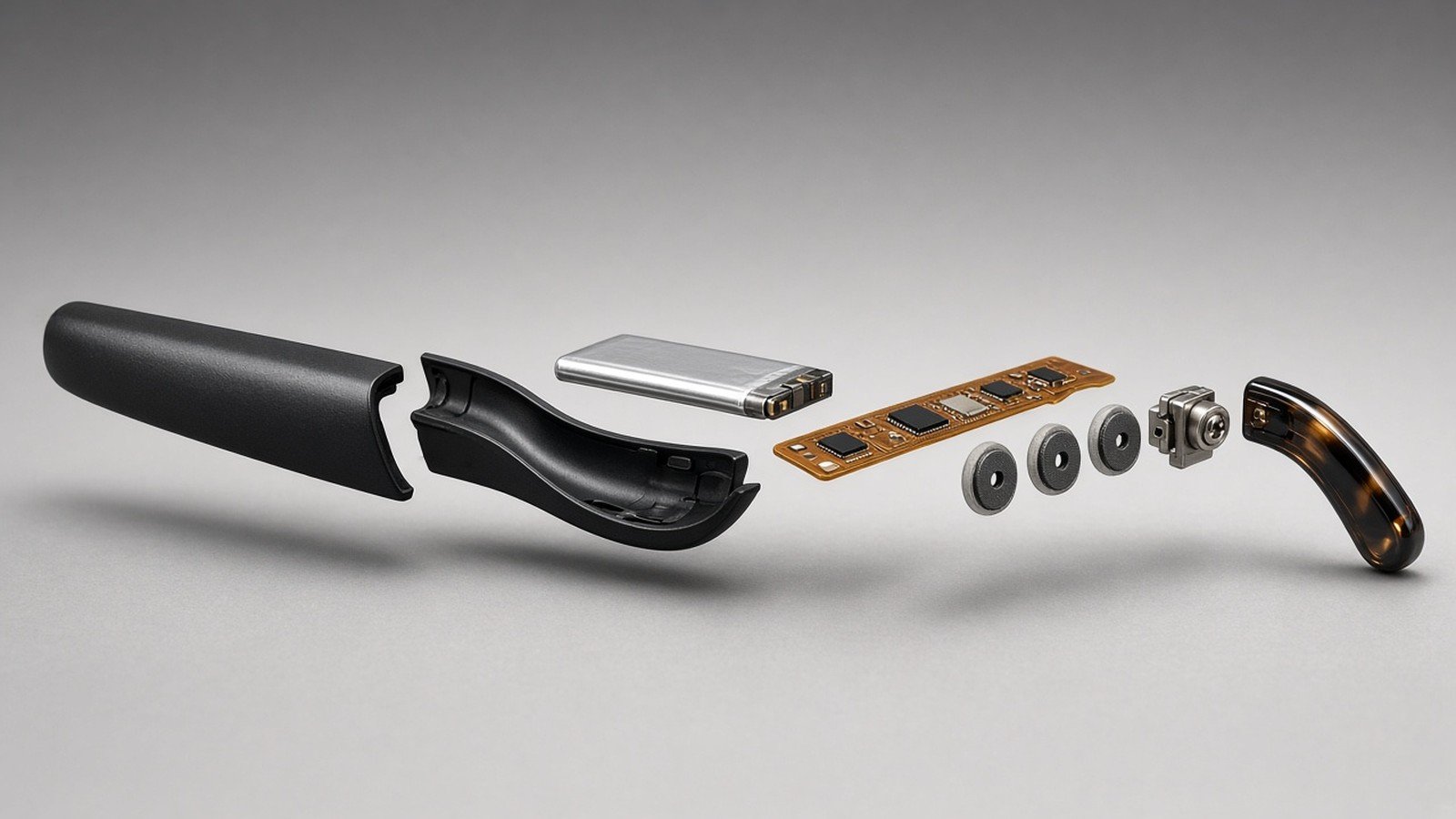
Concept render (illustration) of a generic audio-glasses temple arm assembly, not a Sutyo product.
What this means for product teams
The following is Jackson Hedden analysis, not reporting; we have no information about Sutyo's design beyond the linked sources. Audio-first glasses combine eyewear fit, miniature electronics and privacy expectations. Working with a product design firm on a product like this usually comes down to the following decisions.
Set a weight budget and defend every gram. At 17 g, a frame competes with ordinary glasses, not gadgets. Allocate grams to battery, board, microphones, hinges and frame before industrial design is locked, and track balance too: mass at the front presses on the nose.
Package the temples like a tiny product. Battery, flexible circuit and microphones usually live in the temples, and the hinge must pass wiring through thousands of open-close cycles. These are early architecture decisions, not details.
Treat microphone ports as sealing problems. Every port is a path for sweat, skin oil, rain and dust. Acoustic mesh and membranes protect the microphone but change its response, so sealing and audio have to be tuned together, against a defined sweat and water target.
Make privacy physical. Omitting a camera is a strong hardware signal. Microphone products still need a way for bystanders to know recording is happening, such as an indicator, a clear pause control and predictable behavior when the glasses come off. We discussed indicator design for camera glasses in our look at Google's Intelligent Eyewear. Recording laws vary, and some US states require consent from everyone in a conversation, so legal review belongs in the requirements phase.
Write the Bluetooth power budget early. Streaming audio to a phone all day costs energy for the radio, the microphones and the audio processing. Define what each function may draw per day, and what happens when the phone is out of range, before board layout. Good electronic product design treats radio, battery and enclosure as one system. For a related pocket-sized AI device, see our analysis of Meta's Muse Charm.
Design for prescriptions and head sizes. Glasses must fit faces, not averages. Multiple frame shapes and prescription lenses mean the electronics must work across lens thicknesses and temple lengths, and fitting becomes part of the customer experience.
Prototyping audio glasses: what to build and when
A practical prototype sequence for smart eyewear:
- Acoustic test rigs: microphones on a head fixture or test frame, used to compare port positions and spacing before the frame is final.
- Fit and comfort models: SLA-printed or machined frames in several sizes, worn by a range of people to check balance, nose pad pressure and temple length.
- Works-like integrated builds: battery, flex circuit, microphones and radio packed into a functional frame, used for firmware, power and Bluetooth testing.
- Production-intent builds: parts from production tooling (the molds, dies and fixtures used to make parts at volume), used for EVT and DVT, engineering validation test and design validation test, the build stages where a design is shown to work and then shown to meet its requirements.
Design for manufacturing (DFM), shaping parts so they can be made reliably and affordably, matters early because hinges and acoustic seals are hard to change once tooling is cut.
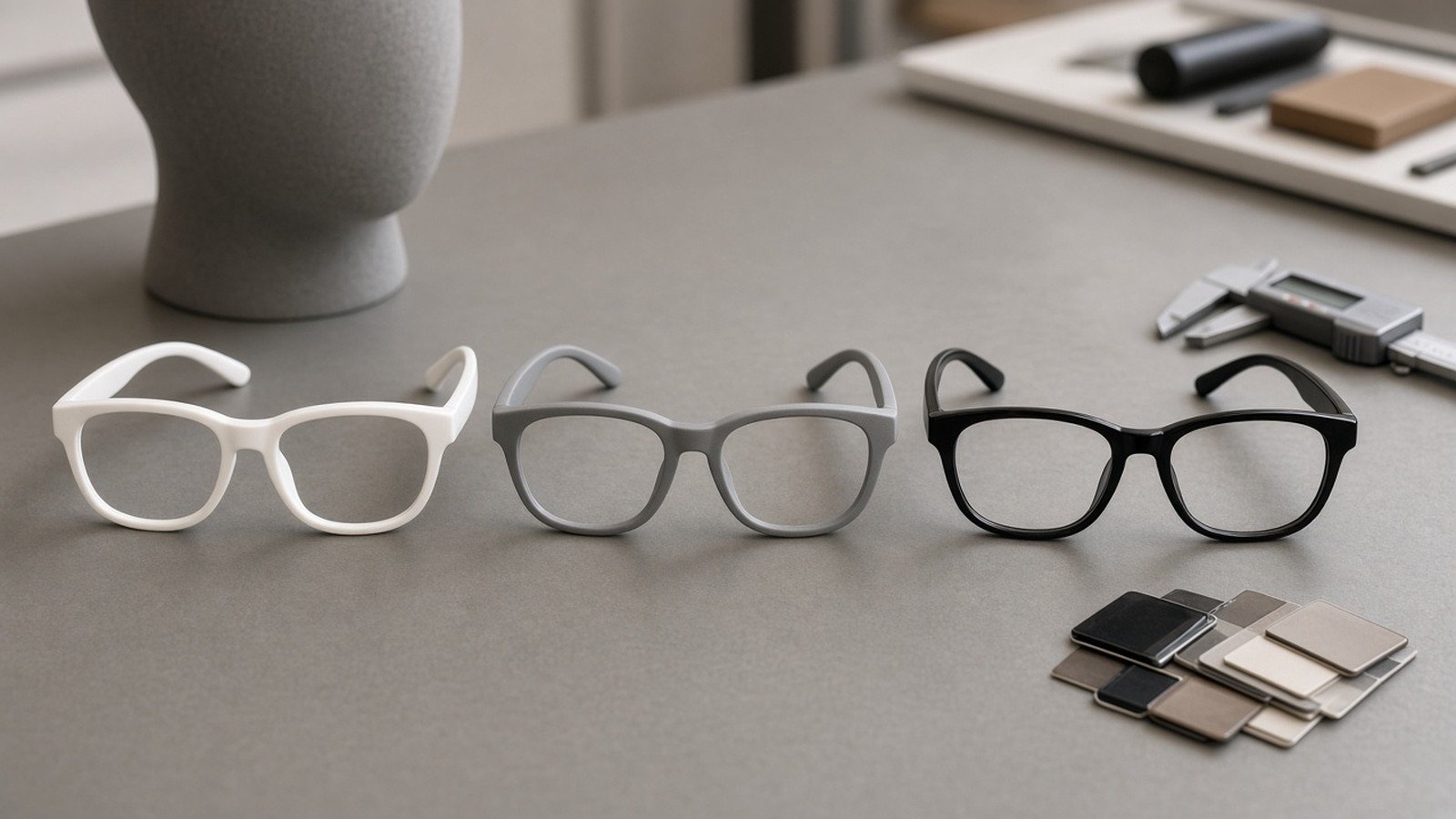
Concept render (illustration) of staged eyewear prototypes, not a Sutyo product.
Frequently asked questions
What are Sutyo Cue memory glasses? Sutyo Cue is a 17-gram pair of glasses with four microphones and no camera, display or speaker. It sends audio to the Sutyo AI app on the wearer's phone, where conversations are transcribed. Pre-orders opened November 23, 2026 at $99.
How does Sutyo Cue separate the wearer's voice from other people? Sutyo says the four microphones form two directional beams, one toward the wearer and one toward the people they are talking with. Voices are told apart by the direction of the sound rather than by identifying speakers, and Sutyo says it does not build voiceprints.
What should a product design firm consider when developing smart glasses? Start with weight, balance and fit across head sizes and prescriptions, then package the battery, circuit and microphones in the temples. Plan acoustic sealing, the Bluetooth power budget and privacy signals such as recording indicators early, before tooling.
What are EVT and DVT? EVT (engineering validation test) is the build stage where engineers confirm the design works as intended. DVT (design validation test) uses production-intent parts to confirm the product meets its requirements before mass production.
Developing a wearable or audio device?
If you are developing smart eyewear or another body-worn electronic product and want help balancing fit, acoustics, power and privacy in one manufacturable design, see our product design services or contact us to talk through your project.
Jackson Hedden is a product design, development and manufacturing firm helping founders and product teams take consumer and industrial products from concept to production.
Sources
- Sutyo, "Introducing Sutyo Cue: Memory Glasses That Remember What Matters, So You Can Be Present," PR Newswire, November 23, 2026.
- Sutyo, "Sutyo Cue 095" product page, sutyo.ai, accessed November 23, 2026.