On November 9, 2026, Yeasound, a hearing technology division of audio company Yealink, launched the Robin CIC60, a $399 over-the-counter hearing aid that fits completely inside the ear canal and still streams Bluetooth audio.
Key takeaways
- Each Robin CIC60 earpiece weighs 1.3 grams and measures about 18.8 by 11.8 by 5.7 mm, yet Yeasound says it fits an antenna, battery and processing for wireless streaming.
- Yeasound moved the everyday controls (volume up, volume down and program) onto physical buttons on the charging case instead of the earpiece.
- Published specs show a 12.5 mAh cell in each hearing aid and a 1,010 mAh battery in the case, so most of the system's stored energy lives outside the ear.
- FDA rules for OTC hearing aids set hard design inputs, including an insertion-depth limit, atraumatic eartip materials, output limits and a user-adjustable volume control.
- For hardware teams, the lesson is to budget volume, energy and interface across the whole system, not just the smallest part.
What the Robin CIC60 shows about electronic product design at hearing-aid scale
Hearing aids are among the hardest packaging problems in consumer health hardware: a battery, microphones, a speaker, a processor and a radio share a space smaller than a fingertip, inside a warm, moist ear canal. Below we separate what was reported from our analysis.
What was reported
The product. According to Yeasound's announcement, the Robin CIC60 is a completely-in-canal (CIC) hearing aid, meaning the whole device sits inside the ear canal rather than behind the ear. It measures 18.77 by 11.79 by 5.69 mm and weighs 1.3 grams. An instant-fit design replaces the custom earmold that CIC devices traditionally require, and the shell is made from PA+GF, a glass-fiber-reinforced polyamide (nylon). It is sold for $399 at yeasound.com.
The engineering claim. Yeasound general manager Huahu Wang said that "most hearing aids of this size lack sufficient internal volume for the antenna, battery, and processing power required for wireless streaming," and that the CIC60 carries simultaneous acoustic and Bluetooth audio channels in that form factor.
Controls on the case. The charging case doubles as a remote, with physical "+," "−" and "P" buttons for volume and listening programs, so users do not need a phone app or tiny buttons in the ear.
Independent coverage. HearingTracker, in a November 10 report, described the CIC60 as a preset OTC hearing aid: users choose among manufacturer-defined amplification profiles rather than running a self-fitting hearing test. It listed Bluetooth 5.3, Made for iPhone and Android ASHA streaming support, readiness for Auracast broadcast audio, an IPX8 water-resistance rating, open and closed ear tips, and replaceable wax filters. It noted the device had not yet been lab-tested by HearAdvisor and flagged the occlusion effect, the plugged-up sound of your own voice, as a watch-out for in-ear styles.
Battery and runtime. HearingTracker reported up to 13.5 hours in hearing mode and 7 hours with Bluetooth streaming, with a 15-minute quick charge giving 4 hours. Yeasound's product page lists a 12.5 mAh, 3.85 V lithium-ion cell in each hearing aid, two microphones per device for directional pickup, and a 1,010 mAh battery in the 66-gram case, rated for three full charges of both hearing aids.
The regulatory frame. The FDA created the OTC hearing aid category effective October 17, 2022, for adults with perceived mild to moderate hearing loss. The rule, 21 CFR 800.30, caps output at 111 dB SPL (117 dB SPL with input-controlled compression active) and requires that the deepest component stay at least 10 mm from the eardrum, that eartips be atraumatic, that lay users can control the device, and that it have a user-adjustable volume control.
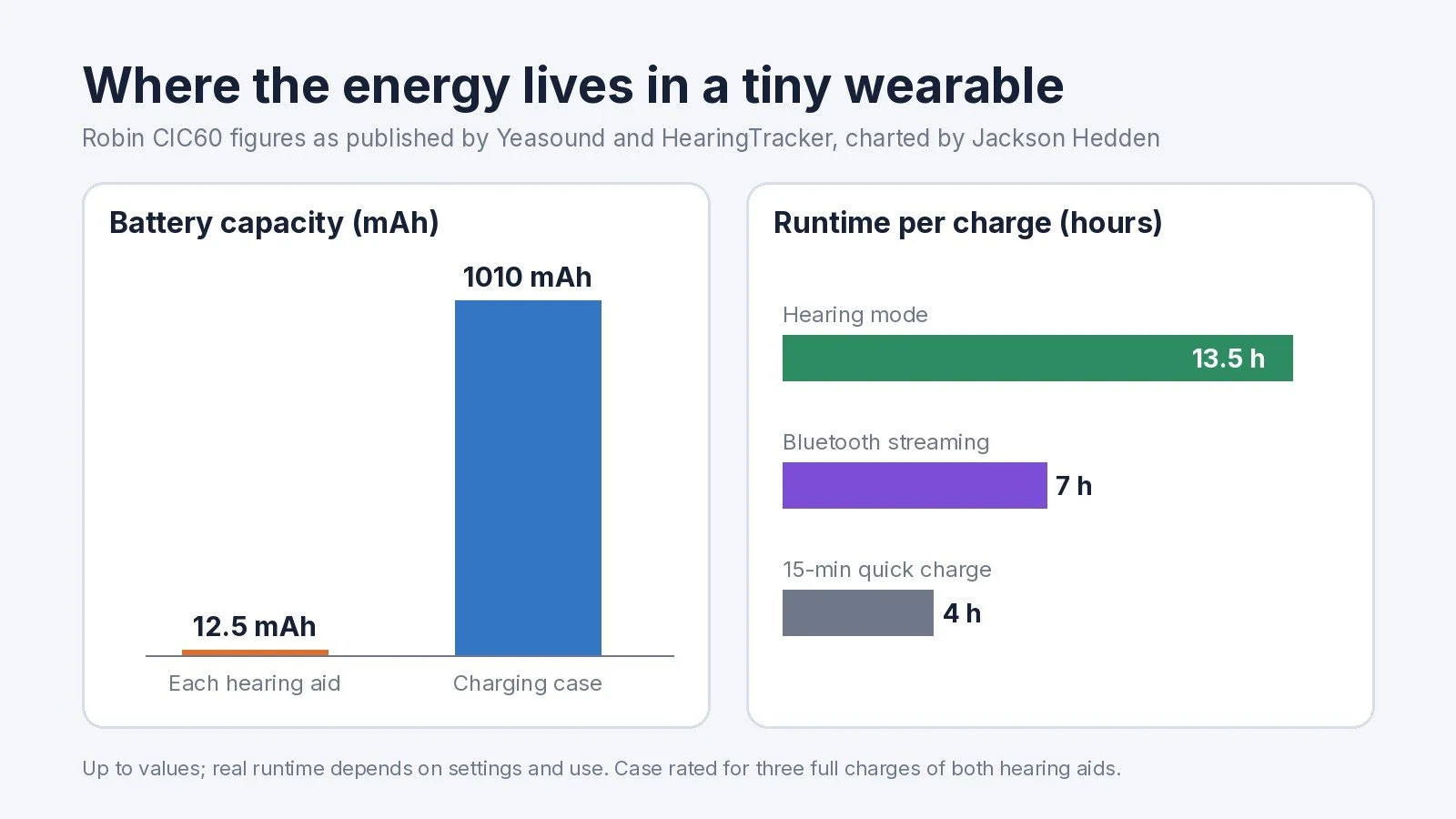
Robin CIC60 battery and runtime figures as published by Yeasound and HearingTracker (November 2026), charted by Jackson Hedden. Up-to values; real runtime varies.
Our analysis: the system is the product
The CIC60 makes visible a trade-off every small connected device faces: when the wearable part cannot get bigger, functions migrate to the accessory.
Energy moved out of the ear. A 12.5 mAh cell is tiny, and the published runtimes show what streaming costs: roughly half the hours of plain amplification. The 1,010 mAh case is effectively the product's real energy store, and the earpiece is a buffer that is refilled several times. Teams designing small wearables should treat the case or dock as part of the core architecture, with its own power, thermal and charging-contact requirements, not as packaging.
The interface moved too. Buttons on a device this small are hard to find and press, especially for users with reduced dexterity. Case buttons give a large, tactile interface while the earpiece stays sealed. The design cost is that the case becomes something users must carry, and the wireless link between case and earpiece becomes a reliability requirement.
Radio in a hard place. Fitting an antenna into a device that sits in the ear canal is difficult in general practice: the head absorbs 2.4 GHz energy, there is almost no room for a ground plane, and performance on a bench rarely matches performance on a person. Antenna placement usually has to be settled alongside the battery and speaker layout, early, and verified on real heads.
Regulation is a dimension, not a document. The 10 mm insertion limit, eartip material rules and output caps are not paperwork to finish before launch. They become shell geometry, material choices and firmware limits. In good electronic product design, these constraints are in the requirements list before the first CAD layout.
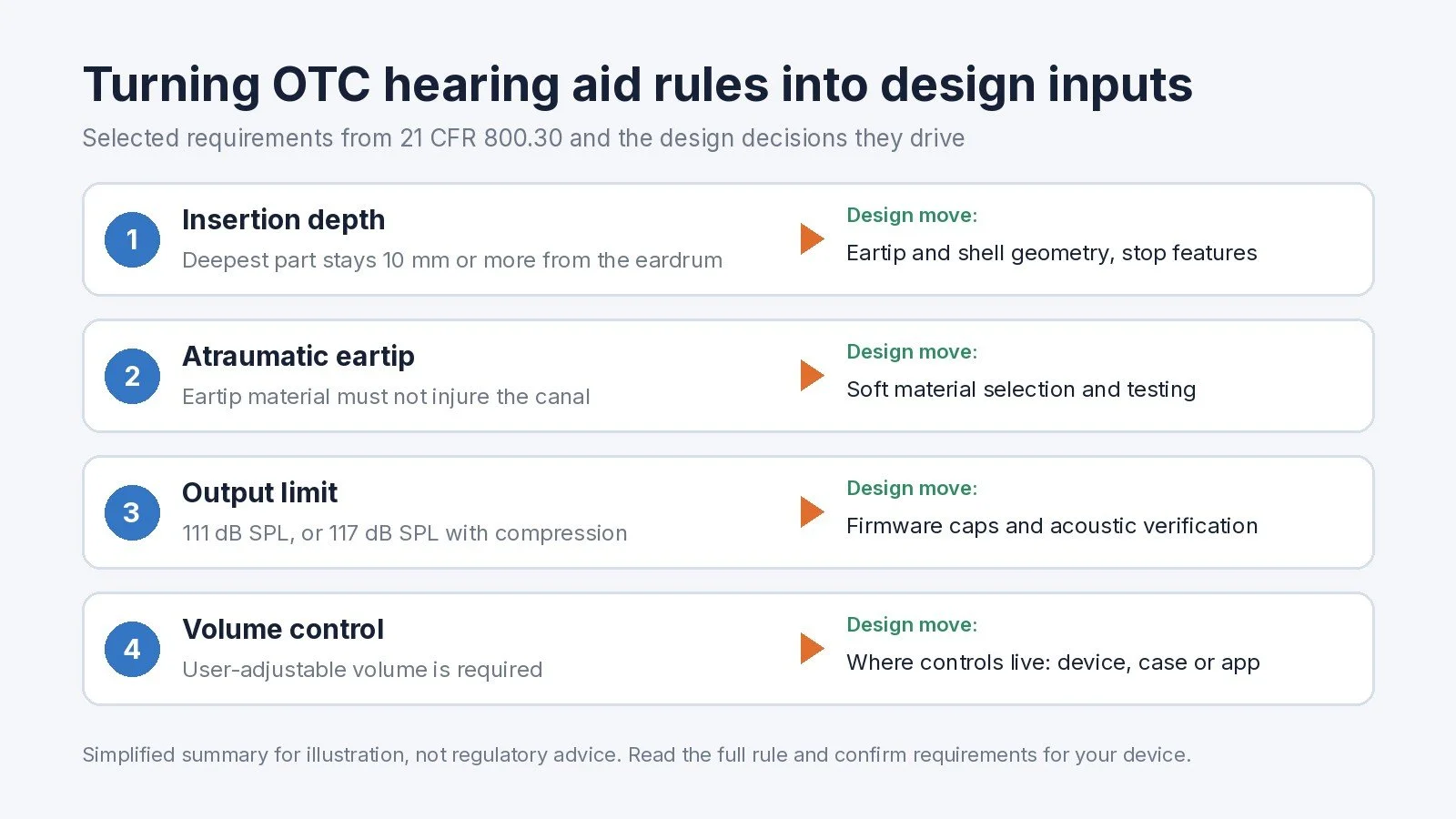
Simplified summary of selected 21 CFR 800.30 requirements and the design decisions they drive, by Jackson Hedden. Not regulatory advice.
What this means for product teams
These lessons apply to any small wearable, personal care device or health gadget. A practical sequence:
- Build a volume budget first. List every component with its dimensions, then add clearance for seals, adhesives, wiring and tolerance. If the total does not fit the target enclosure, change the architecture now rather than during tooling, the cutting of steel molds for production plastic parts.
- Decide what lives in the accessory. Batteries, buttons, displays and even processing can sometimes move to a case, dock or phone. Choose deliberately and give the accessory its own requirements.
- Prototype the radio on a body. Test antenna performance on people or tissue-equivalent phantoms in early prototypes, not just on the bench.
- Turn regulations into numbered requirements. For a regulated device, map each clause to a dimension, material, firmware limit or label. Our practical guide to medical equipment design covers how that fits into a development plan.
- Test fit across real anatomy. One-size or instant-fit parts have to work across a wide range of users. Plan fit and comfort studies alongside acoustic or sensor testing, as we discussed for smart rings and health-sensing wearables.
- Stage the builds. Use EVT (engineering validation test, first builds on production-intent design) to prove the electronics and fit, and DVT (design validation test, builds from production tooling) to confirm moisture, drop and runtime performance before launch.
Frequently asked questions
What is a completely-in-canal (CIC) hearing aid? A CIC hearing aid sits entirely inside the ear canal, so little or none of it is visible. That discretion leaves very little space for batteries, controls and antennas.
What makes OTC hearing aids different from prescription hearing aids? OTC hearing aids can be bought without a prescription or professional fitting by adults with perceived mild to moderate hearing loss. FDA rules limit their maximum output and set design and labeling requirements, including a user-adjustable volume control.
Why is Bluetooth hard to fit into very small devices? A radio needs an antenna, power and processing, and small devices have little room for any of them. Body tissue also absorbs radio energy, so antennas need early on-body testing.
When should a hardware team plan the charging case or accessory? At the architecture stage, alongside the main device. If the case holds most of the battery or the main controls, its design affects runtime, usability and cost as much as the device itself.
If you are developing a small connected device and need help with packaging, power and radio trade-offs, see our electronic product design services or contact our team to review your architecture before layout freeze.
Jackson Hedden is a product design, development and manufacturing firm helping founders and product teams take consumer and industrial products from concept to production.
Sources
- Yeasound via Newsfile, "Yeasound Introduces One of the World's First Bluetooth-Enabled Over-the-Counter Completely-in-Canal Hearing Aid," November 9, 2026: https://www.newsfilecorp.com/release/323101/Yeasound-Introduces-One-of-the-Worlds-First-BluetoothEnabled-OvertheCounter-CompletelyinCanal-Hearing-Aid
- HearingTracker, "Yeasound Launches $399 Robin CIC60 Bluetooth OTC Hearing Aids," November 10, 2026: https://www.hearingtracker.com/news/yeasound-launches-399-robin-cic60-bluetooth-otc-hearing-aids
- Yeasound, Robin CIC60 product page and specifications, accessed November 13, 2026: https://www.yeasound.com/products/yeasound-robin-cic60-otc-hearing-aids
- U.S. Food and Drug Administration, "OTC Hearing Aids: What You Should Know," accessed November 13, 2026: https://www.fda.gov/medical-devices/hearing-aids/otc-hearing-aids-what-you-should-know
- Electronic Code of Federal Regulations, 21 CFR 800.30, "Over-the-counter hearing aid controls," accessed November 13, 2026: https://www.ecfr.gov/current/title-21/chapter-I/subchapter-H/part-800/subpart-B/section-800.30