On November 23, 2026, Tineco launched the CARPET ONE Steam, an $899 upright carpet cleaner that combines 170°F steam, 185AW suction, sensor-adjusted water flow, heated-air drying and a steam self-cleaning cycle (Tineco via PR Newswire).
Key takeaways
- Heat is moving into wet floor care. Steam at 170°F, heated drying air and a 158°F self-drying cycle turn a carpet cleaner into a thermal appliance as well as a fluid-handling one.
- The machine now cleans itself, so its insides become user-facing. A self-cleaning cycle only reaches surfaces in its flow path, and those paths have to be designed for it.
- Sensors change the promise. Automatic dirt and humidity detection shifts the product from a tool the user controls to a system the user trusts.
- Benchmarks against your own previous model are a design tool. Tineco frames its claims as gains over the prior generation, the kind of measurable target product teams should set early.
What Tineco announced: CARPET ONE Steam at a glance
According to Tineco's announcement, dated November 23, 2026 in Seattle, the CARPET ONE Steam is designed to make deep carpet cleaning less physically demanding. Reported details:
- Steam: "HyperSteam Technology" delivers steam at 170°F (77°C) to loosen embedded dirt and stains.
- Suction: 185AW (air watts, a measure that combines airflow and suction), which Tineco says is a 42% increase over the previous generation.
- Modes and sensing: Quick Mode for everyday cleaning with extended runtime, and Deep Mode combining steam and suction. In Deep Mode, the iLoop Smart Sensor detects dirt levels and adjusts suction and water flow.
- Assisted movement: SmoothPower Assist reduces pushing and pulling effort by up to 80%, Tineco says.
- Drying: PowerDry heated airflow brings a 1 m² area to touch-dry in as little as five minutes under Tineco laboratory conditions, 50% faster than the previous model. A DrySense system monitors humidity and temperature to adjust drying.
- Self-cleaning: a one-touch cycle uses 170°F steam and fresh-water flushing to clean the brush roller, inlet, internal pipes, cover and tray, followed by a 158°F heated-air drying cycle.
- Accessories: a hose and tools for stairs, car interiors and pet beds, plus a silicone brush for wool.
- Price and availability: $899 at Tineco's website and Amazon. Tineco's US store listing showed a sale price of $689 on November 23 during its Black Friday promotion, which the release says runs through November 30.
What the release does not state: tank capacities, weight, power rating, cord length, noise level, warranty terms, safety certifications or the test method behind the suction and drying figures. All performance claims above are Tineco's; we have not tested the product and have seen no independent reviews yet.
Why steam changes the engineering of a carpet cleaner
A conventional carpet extractor (a machine that sprays water or solution into carpet and then vacuums it back out) is a fluid-handling product: a clean-water tank, a pump, a spray nozzle, a suction motor, a dirty-water tank and the seals between them. Adding steam and heated air adds a second discipline on top of that, thermal design.
Heat creates new constraints. A steam generator puts a heater next to water. Plastic tanks, hoses and nozzle housings have temperature limits, so material selection and heat isolation matter. Surfaces a user can touch, including the nozzle near bare feet, need defined temperature limits. And heaters in contact with tap water collect scale (mineral deposits from hard water) over time, which changes their performance.
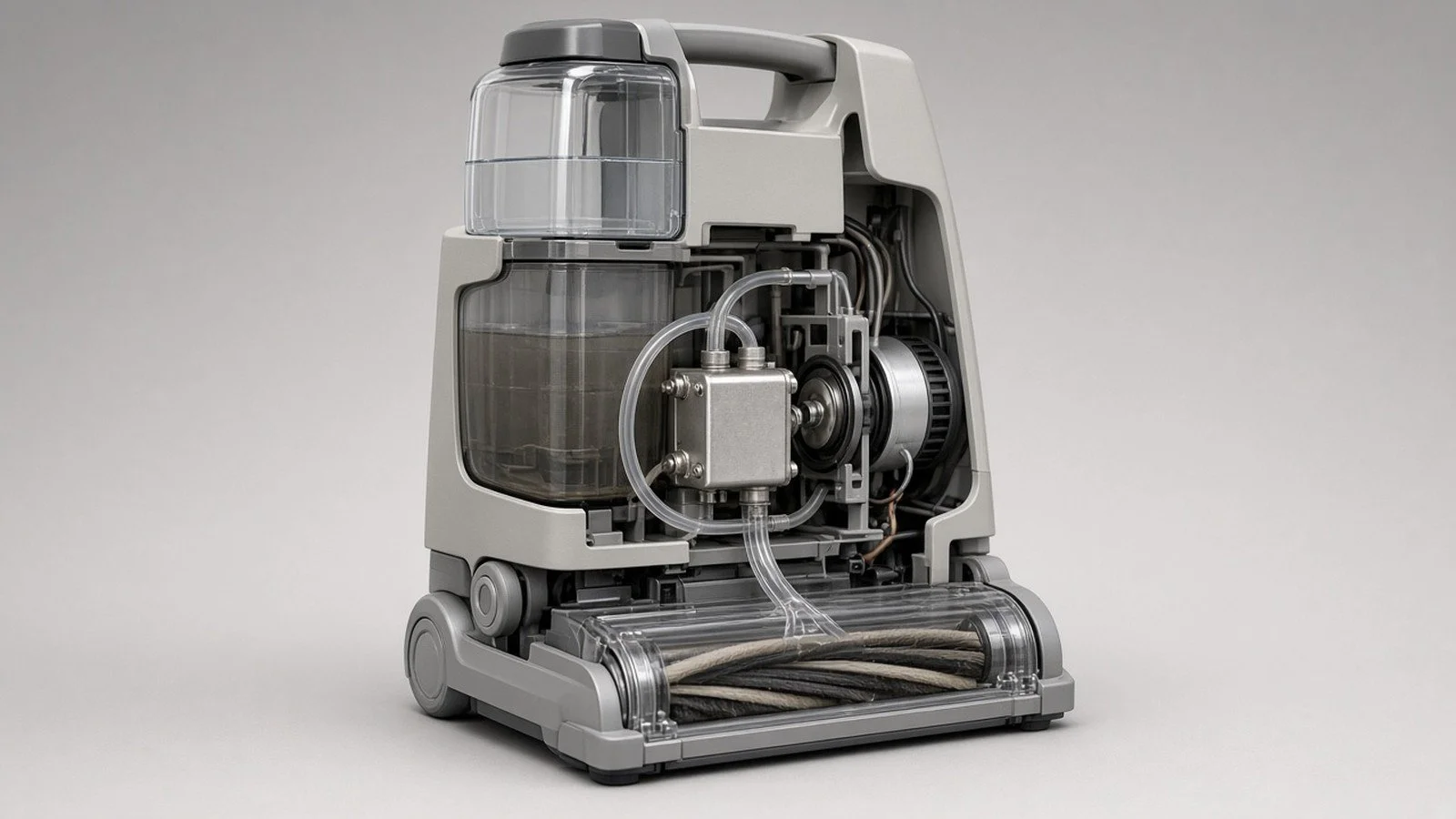
Concept render (illustration) of a generic heated carpet cleaner’s internal layout, not a Tineco product.
What this means for product teams
The following is Jackson Hedden analysis, not reporting; we have no information about Tineco's internal design or test process beyond the linked sources. Working with a consumer product design company on a product like this usually comes down to the following decisions.
Separate electricity, heat and water by design. Map where water can travel when the machine is tipped, dropped, overfilled or parked wet, and keep heaters, motor electronics and connectors out of those paths. Define what happens if the steam generator runs without water, a common abuse case.
Set touch-temperature and material limits early. Steam at 170°F and drying air at 158°F are useful for cleaning but hard on plastics and on skin. Choose tank, hose and nozzle materials for the actual temperatures plus margin, and decide which surfaces users can touch during and after a cycle.
Design the self-cleaning path, not just the cycle. A flush-and-steam cycle only reaches the surfaces it wets, which is the same lesson we drew from a touch-free nugget ice maker's self-cleaning system. Slope internal channels so they drain, avoid pockets where dirty water sits, and let users reach what the cycle cannot.
Treat sensors as part of the user promise. A sensor that adjusts water flow or drying time needs calibration across carpet types, soil levels and room humidity. Show users what the machine is doing so they trust it.
Make powered assist fail safe. Motorized drive that reduces pushing effort must stop predictably when the handle is released, on stairs and at edges. Every added mechanism needs its own reliability plan, as we discussed in our analysis of Xiaomi's robot vacuum with extendable arms.
Benchmark against your own last product. Tineco's claims are framed against its previous generation. For any second-generation appliance, define measurable targets for suction, drying time, noise and weight against the current model before concepts begin, and test both the same way.
Plan for service and scale. Brush rollers, filters and heaters wear or foul over time. Make them reachable, specify descaling guidance for hard water, and decide which parts are sold as replacements.
Prototyping and testing a heated floor-care appliance
A practical prototype and test sequence for a product in this category:
- Subsystem rigs: a steam generator, pump and nozzle on a bench fixture, used to measure temperature at the carpet surface and heater behavior with hard water, before packaging is fixed.
- Nozzle and airflow models: clear SLA-printed (stereolithography) or machined nozzles that let engineers watch water pickup and adjust channel shapes.
- Ergonomic models: foam or printed full-size models to check handle height, grip, weight balance and how the machine tilts and parks.
- Works-like integrated builds: functional prototypes run on standardized soiled carpet samples to check cleaning, drying time and the self-cleaning cycle, then inspected for residue in tanks, hoses and channels.
- Production-intent builds: parts from production tooling (the molds and fixtures used to make parts at volume) for EVT and DVT, engineering validation test and design validation test, the build stages that confirm the design works and then meets its requirements, including safety, life-cycle and drop testing.
Design for manufacturing (DFM), shaping parts so they can be molded and assembled reliably and affordably, matters early because tank seals, hose routing and heater mounts are expensive to change once tooling is cut.
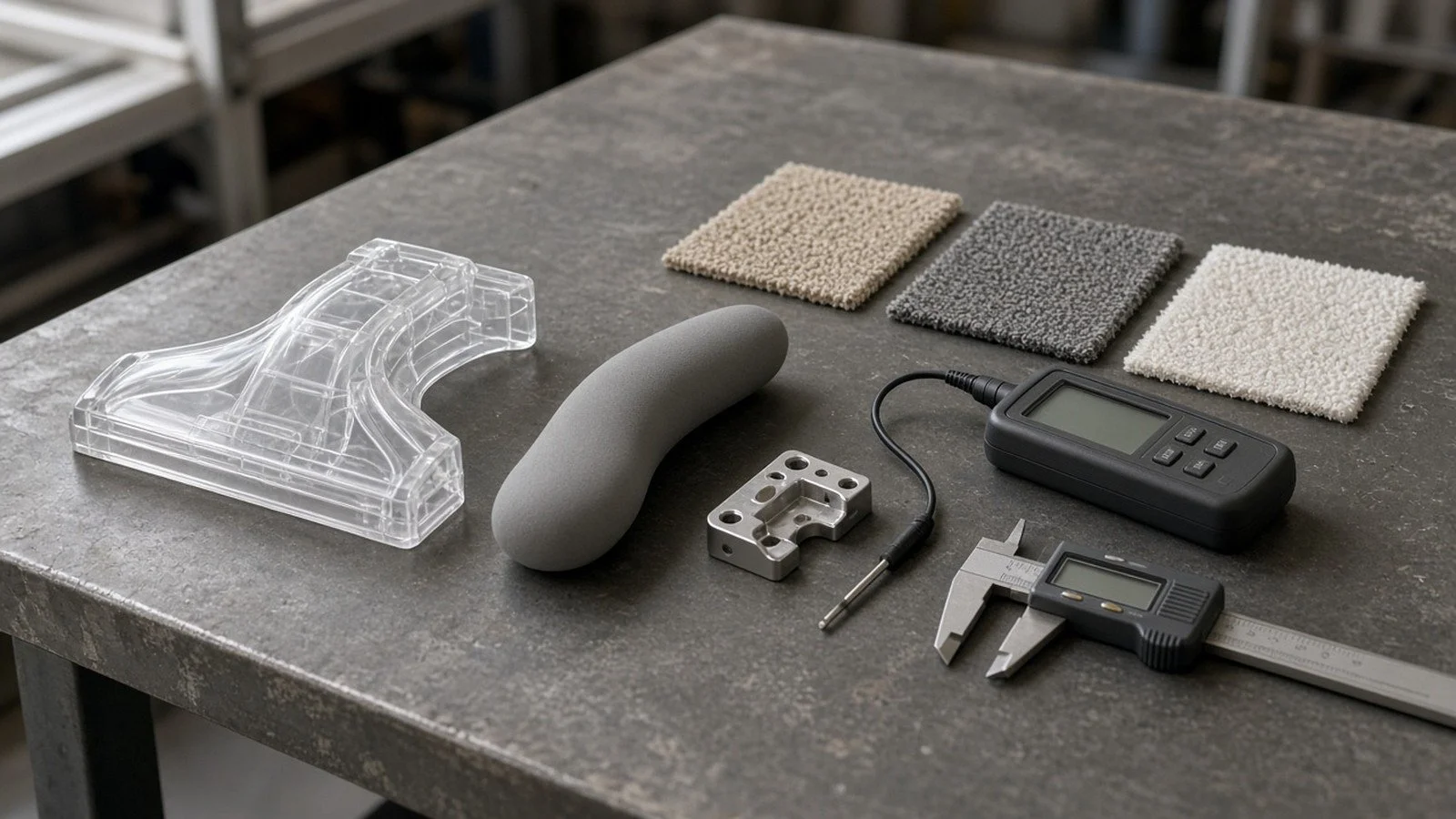
Concept render (illustration) of staged floor-care prototypes and test samples, not a Tineco product.
Frequently asked questions
What is the Tineco CARPET ONE Steam? It is an upright carpet cleaner Tineco launched on November 23, 2026 at $899. Tineco says it combines 170°F steam, 185AW suction, sensor-adjusted water flow, heated-air drying and a one-touch steam self-cleaning cycle.
Why add steam to a carpet cleaner? Tineco says steam helps loosen stubborn stains and embedded dirt. For designers, it adds a heater, higher material temperatures and scale management to a product that already handles water and electricity.
What should a consumer product design company consider when developing a carpet cleaner? Start with how water, heat and electricity are kept apart, then set touch-temperature and material limits. Plan drainable internal paths for self-cleaning, sensor calibration across real carpets, fail-safe powered assist, and service access for brush rollers, filters and heaters.
What are EVT and DVT? EVT (engineering validation test) is the build stage where engineers confirm the design works as intended. DVT (design validation test) uses production-intent parts to confirm the product meets its requirements, including safety and reliability testing, before mass production.
Developing a home appliance?
If you are developing a floor-care, kitchen or other home appliance that combines water, heat and motors, see how we approach consumer product design or contact us to talk through your project.
Jackson Hedden is a product design, development and manufacturing firm helping founders and product teams take consumer and industrial products from concept to production.
Sources
- Tineco, "Tineco Introduces CARPET ONE Steam, Bringing Intelligent Deep Cleaning and High-Temperature Steam to Carpet Care," PR Newswire, November 23, 2026.
- Tineco, "Tineco Carpet One Steam Carpet Cleaner" product listing, store.tineco.com, accessed November 23, 2026.