On November 3, 2026, the European Commission opened a public consultation and call for evidence on EU-wide ecodesign rules to make consumer electronics, small household appliances and some e-bikes and e-scooters easier to repair, with feedback open until February 9, 2027.
Key takeaways
- The EU is gathering evidence on five repair levers: spare parts, repair and maintenance information, software and firmware, disassembly and reassembly, and repairability scores at the point of sale.
- The consultation creates no obligations yet. Products, requirements and dates would be set in a later delegated act, which secondary sources say is targeted for adoption in the second quarter of 2027.
- The preliminary scope covers kitchen, personal care and other small electric appliances, plus certain audio and video equipment, wearables, peripherals, e-bikes and e-scooters.
- Repairability is mostly decided in early architecture: fasteners, battery access, module boundaries and firmware choices are hard to change after tooling.
What the Commission is consulting on
The consultation sits under the ESPR, the Ecodesign for Sustainable Products Regulation. This EU framework law, in force since July 18, 2024, lets the Commission set sustainability and circularity requirements for product groups. Those arrive through a delegated act: a binding rule the Commission adopts under powers the framework law grants, subject to scrutiny by the European Parliament and Council.
According to the Commission's announcement, the feedback will inform the impact assessment for a possible delegated act "currently planned for adoption in 2027." It asks about possible measures in five areas:
- Access to spare parts
- Availability of repair and maintenance information
- Software and firmware requirements
- Easier disassembly and reassembly
- Repairability scores or information at the point of sale
Based on a preliminary study and subject to confirmation, products expected to be covered by these horizontal (cross-category) rules include certain audio and video equipment, wearables and peripherals; certain e-bicycles, self-balancing devices and some e-scooters; and kitchen appliances, personal care devices and other small electric appliances. Products already covered by product-specific rules or voluntary agreements are expected to stay outside the measure.
2eu.brussels reports that the Commission's Have Your Say page targets the second quarter of 2027 for adoption, that adoption is not the application date, and that the ESPR generally requires at least 18 months between an act's entry into force and its application, subject to legal exceptions.
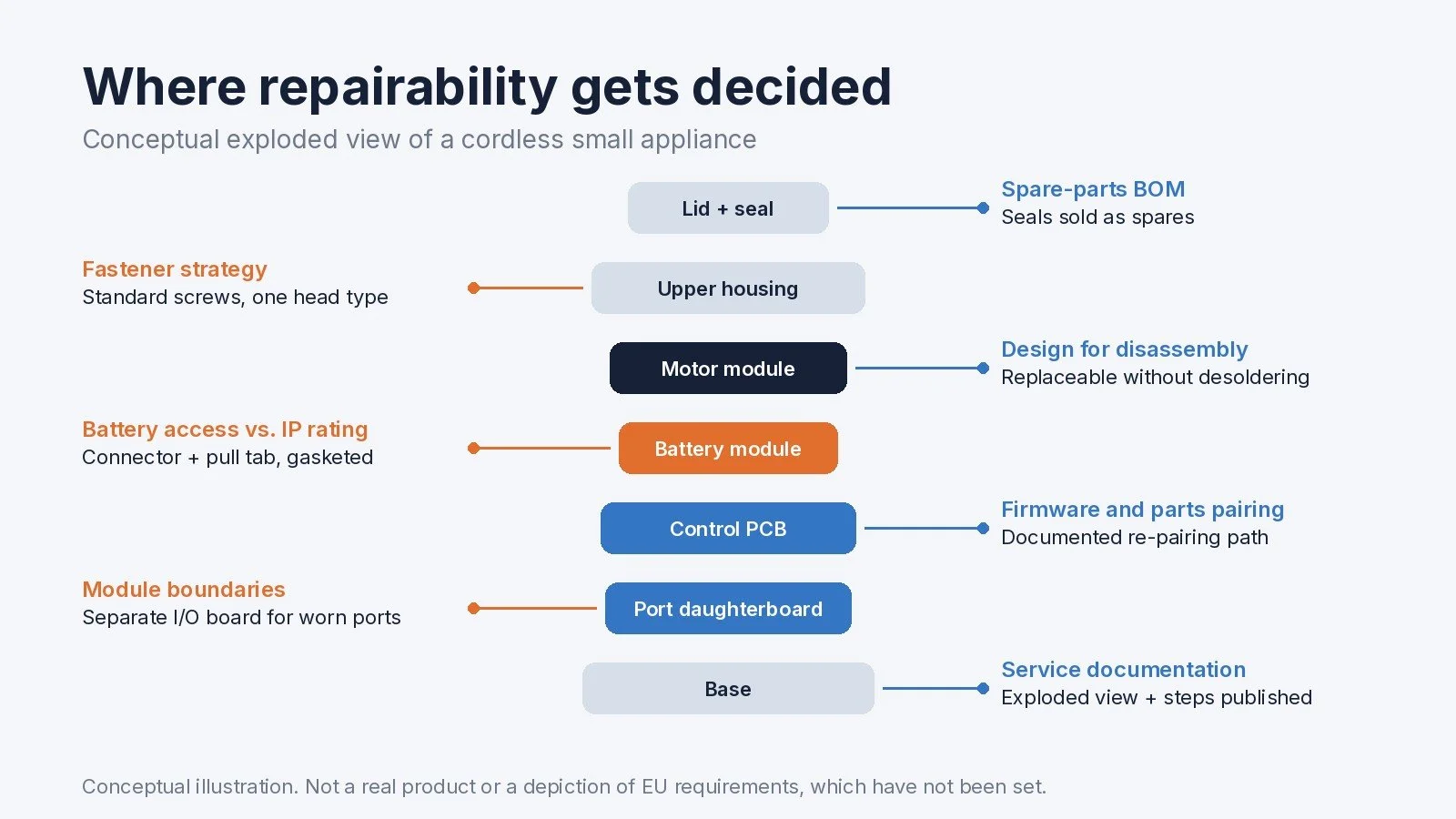
Conceptual exploded view showing where repairability decisions sit in a typical cordless appliance. Not a real product, and not a depiction of EU requirements, which have not been set.
Why repairability is a design problem, not a policy footnote
Manufacturers are already working through the tradeoffs. Panelists from Google, Intel, Lenovo, Panasonic and Logitech discussed designing for reuse at the October 26 E-Scrap Conference in New Orleans, as reported by Resource Recycling on November 9.
The sharpest tension was batteries. Scott Shackelford, Google's lead for environmental technical policy, said: "There's a massive conflict between safety standards and durability with repair. Design teams get two messages: Make it durable but removable by a layman. Most batteries are designed not to come out of a product for a reason." Panasonic's Andrea Murphy said it took a recycler's battery expert over eight minutes to safely remove the embedded battery from a wet/dry shaver, which needs one for shower safety.
Intel's Roberta Zouain said connecting input/output to the motherboard through a daughterboard (a small secondary circuit board) can improve repairability, though what suits a premium laptop may not suit a low-cost Chromebook.
A November 2 Resource Recycling piece on an iFixit and uBreakiFix teardown noted that iFixit's highest-scoring devices use screws with the same head type and easily removable backs. As uBreakiFix's Tripp Grant put it, "The words 'prying' and 'battery' should not go together."
The small appliance baseline is low. In its Leaders and Laggards III scorecard, published April 14, 2026, the U.S. PIRG Education Fund assessed 58 blenders, coffeemakers and vacuums. It found that 63.8% received an F, only three (5.2%) had service manuals or full repair information, 12 (20.7%) offered no spare parts of any kind, and over 67% sold no parts that require disassembly to replace. Those are categories the EU now lists as likely in scope.
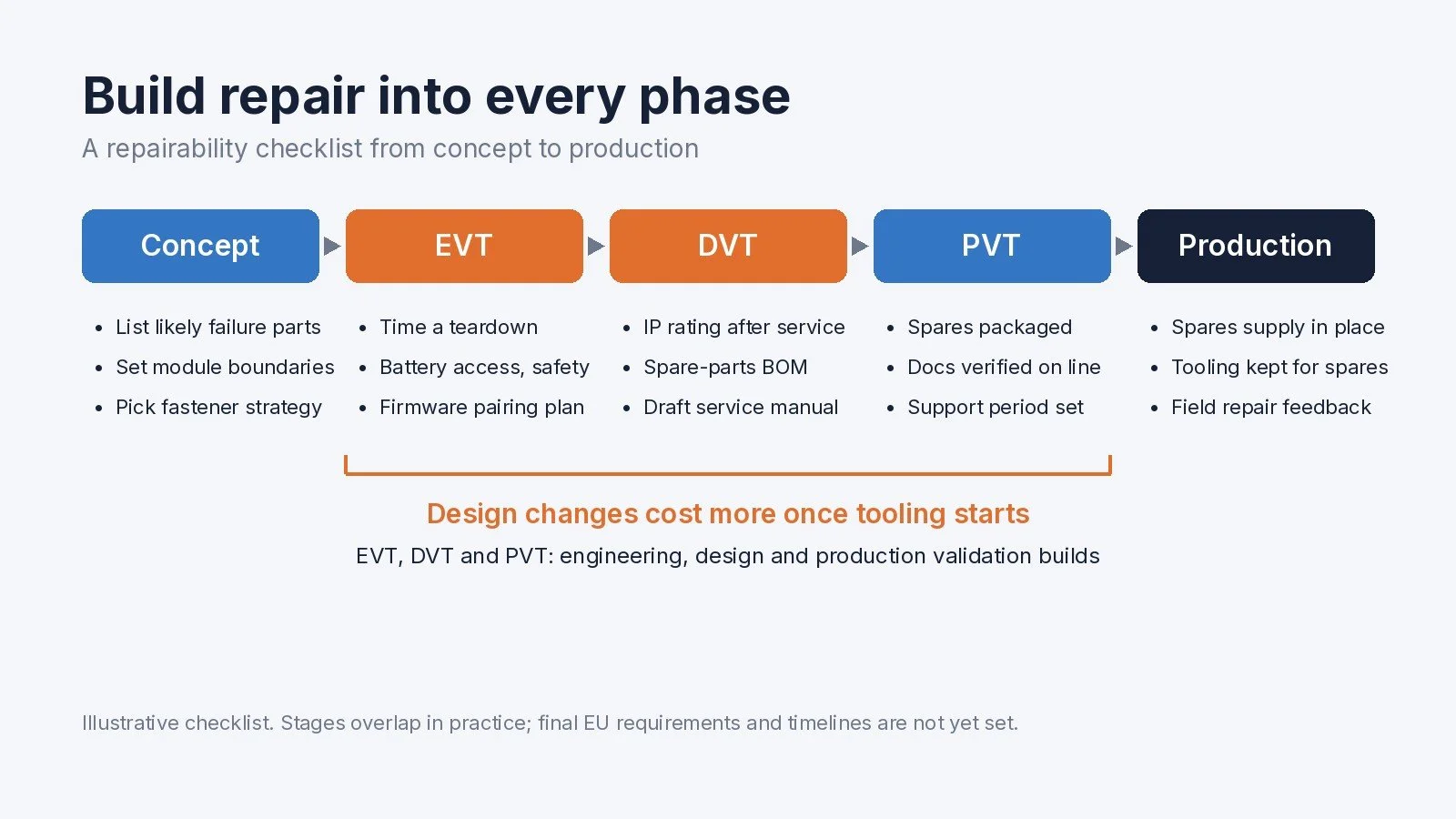
Illustrative repairability checklist from concept through production. Stages overlap in practice, and final EU requirements and timelines are not yet set.
What this means for product teams
What follows is our analysis, not a reading of future legal text; the final requirements are unknown. But the five consultation areas map directly onto engineering decisions, most of which lock in during concept and early prototyping.
Start in the architecture phase. Design for disassembly means planning how a product comes apart (access order, fasteners, connectors, module boundaries) so likely failures can be fixed without destroying the rest. List likely failure parts (batteries, motors, seals, switches, ports, blades) and give each a short, non-destructive removal path before industrial design is frozen.
Choose fasteners deliberately. Standard screws with one head type beat mixed or proprietary heads. Snap fits can be repairable if they are designed to release with a simple tool and survive several cycles. Reserve permanent adhesives, ultrasonic welds and heat stakes for joints that never need opening, or pair them with a replaceable sub-assembly.
Resolve battery access versus safety and sealing early. Water resistance, drop durability and battery safety are real constraints. Options include a sealed but replaceable battery module with its own gasket, connectors instead of solder tabs, pull tabs or stretch-release adhesive instead of prying, and documented discharge and handling steps. Validate the ingress protection (IP) rating, the standard measure of dust and water resistance, after repeated service cycles, not just on new units.
Plan the spare-parts BOM alongside the production BOM. Decide which modules will be sold as spares and how long you can support them. That affects tooling: a part supplied for years after launch keeps a mold or fixture in service, so make it standalone, not buried in a larger molding.
Avoid parts pairing that blocks repair. If firmware locks a replacement part to one unit's serial number, document a legitimate re-pairing or calibration path. Security and safety may justify some controls, but software and firmware barriers are explicitly part of the consultation.
Write service documentation as you design. Exploded views, part numbers, disassembly steps, torque values and safety notes are far cheaper to produce during CAD and DFM (design for manufacturing, making parts reliably buildable at target cost and volume) than to reconstruct after launch.
Test repair in every build. Hardware programs move through EVT, DVT and PVT: engineering validation (does the design work), design validation (does the production-intent design pass testing) and production validation (can the factory build it repeatably). Time a teardown at EVT, verify sealing and safety survive service at DVT, and confirm spares and documentation at PVT. Our guide to sustainable product design tradeoffs covers how repair fits alongside materials and end-of-life choices.
Our look at the Vitamix Ion portable blender asked whether a battery motor base is serviced or replaced as a unit, and our analysis of Beelink's swappable-motherboard NAS shows how module boundaries can make upgrades and repairs a feature.
Frequently asked questions
Do EU repairability rules apply to small appliances now? Not under this initiative. The November 2026 consultation gathers evidence and creates no new obligations. Any requirements would come in a later delegated act defining products, requirements and transition periods, and the ESPR generally allows at least 18 months before application.
Which products could be covered? Preliminary examples include certain audio and video equipment, wearables and peripherals, small household appliances such as kitchen and personal care devices, and certain e-bikes, e-scooters and self-balancing devices. The final scope depends on the Commission's impact assessment.
What is design for disassembly? It means planning how a product comes apart so failures can be repaired or parts recovered without damaging the rest. It covers fasteners, access order, connectors, module boundaries and documentation.
Can a product be both water-resistant and repairable? Often, with deliberate design. Replaceable sealed modules, serviceable gaskets and re-testing the IP rating after repair help, though safety-critical products may still justify embedded components with documented repair procedures.
Designing repairable consumer products
If you are developing a small appliance, wearable or consumer electronics product, our consumer product design team can help plan architecture, DFM and serviceability from concept through production. You can also contact Jackson Hedden to talk through your project.
Jackson Hedden is a product design, development and manufacturing firm helping founders and product teams take consumer and industrial products from concept to production.
Sources
- European Commission, DG Environment, "Commission launches public consultation on making products easier to repair," November 3, 2026: environment.ec.europa.eu
- 2eu.brussels, "Commission opens consultation on new repairability rules," November 3, 2026: 2eu.brussels
- Digital Product Passport, "Regulatory changes," entry of November 3, 2026: digiproductpass.com
- Paul Lane, "Manufacturers look to meet the call of designing for reuse," Resource Recycling, November 9, 2026: resource-recycling.com
- Paul Lane, "Designing repairability empowers device users," Resource Recycling, November 2, 2026: resource-recycling.com
- Julius Shieh and Nathan Proctor, "Leaders and Laggards III," U.S. PIRG Education Fund, April 14, 2026: pirg.org
Jackson Hedden is not affiliated with the European Commission, U.S. PIRG Education Fund, or any company named in this article. Regulatory details are as reported by the sources above and may change.