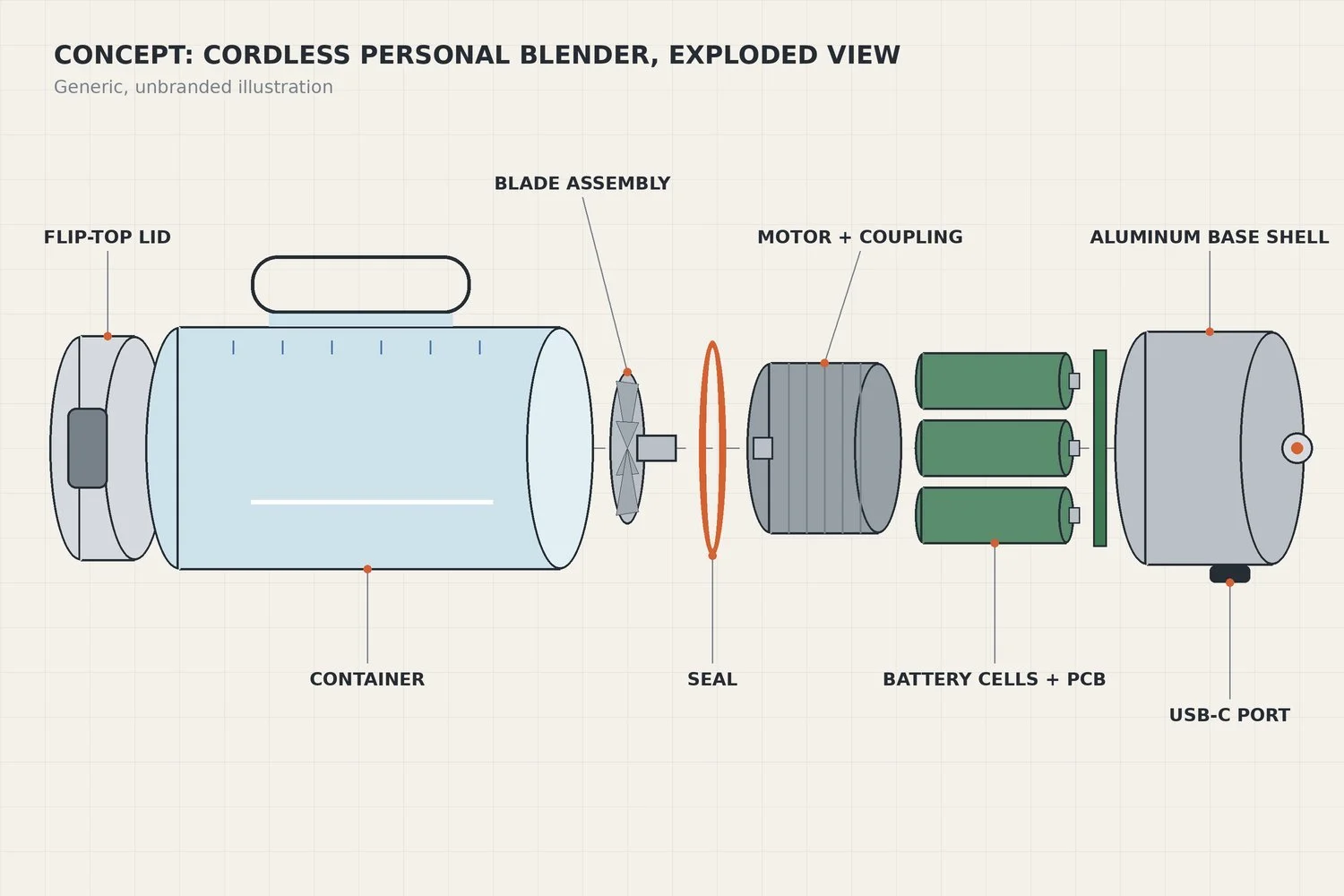
Conceptual illustration, not a Vitamix product image. A generic exploded view of the parts that drive most cordless blender trade-offs.
On November 9, 2026, Vitamix launched Ion, its first portable blender. Cordless personal blenders are not new, but a brand known for full-size, high-performance machines shipping one is worth studying. It shows the trade-offs every product team faces when a performance reputation has to fit into a battery, a small motor and a bottle you carry in a bag.
Below we separate what Vitamix has published from our analysis. We have not tested Ion, we have no relationship with Vitamix, and everything marked "our view" is interpretation.
What Vitamix announced
According to the Business Wire release, the Ion product page, the Vitamix launch article and the Quick Start Guide:
- Container: a 24-ounce handled travel container with a flip-top lid. The press release identifies the bottle as BPA-free Eastman Tritan.
- Build: an aluminum-enclosed motor base and stainless-steel blades. The motor base is detachable and nests inside the container for storage.
- Controls: one button. Press and hold to wake the unit into standby, then double-click to run the blend program. A status light shows blinking white (standby), solid white (blending), solid green (charged) and solid red (low battery).
- Blend behavior: the program regularly pauses during the cycle so ingredients can settle, and Vitamix says it is fine to shake gently while blending tough ingredients. Some recipes may need a second cycle.
- Power: USB-C charging, about 70 minutes for the first full charge, and "up to 15 blends per charge." The footnote says tests used new units blending 95 g sliced frozen banana, 240 g milk, 20 g peanut butter, 8 g protein powder and 45 g ice, and that results may vary.
- Specs: 12.6 V electrical rating, 3.5 x 3.5 x 12.25 inches, 2.2 lb, household use, manufacturer listed as Vitamix, Cleveland, Ohio.
- Cleaning: self-clean with water to the minimum fill line and a drop of dish soap, or hand wash the lid and container.
- Commercials: 2-year limited warranty; MSRP $149.95 USD ($199.95 CAD) on Vitamix.com in the U.S. and Canada from November 9, plus select U.S. retailers including Amazon. It joins the Vitamix Nano in the personal blending lineup.
What we could not find published: motor power, battery chemistry, battery capacity (Wh or mAh), blade speed, ingress rating, or cycle length. The 12.6 V figure is consistent with a three-cell lithium-ion pack at full charge, but that is our inference, not a Vitamix statement.
Our view: the energy budget is the product
In a corded blender, power is effectively unlimited. In a cordless one, every decision draws from a fixed energy budget, and the honest way to communicate it is the one Vitamix chose: define the claim by a specific recipe.
"15 blends" only means something next to the recipe that produced it. Frozen fruit and ice create load spikes; milk and powder do not. Teams building battery-powered motor appliances should fix a reference recipe early and design to it. It becomes the spec for motor sizing, pack capacity, thermal limits and pause logic.
The pause-and-settle behavior is likely an energy and thermal strategy as much as a texture technique. Pauses let ingredients fall back onto the blades instead of the motor spinning against an air pocket, which wastes charge and heats windings and cells. Inviting the user to shake makes the person part of the mixing system, which is smart for a small motor and worth testing with real users.
Detachable base, blades and safety interlocks
A removable motor base with exposed drive hardware raises questions any team should answer:
- How does the unit know it is fully assembled before the motor can run? In our view, the wake-then-double-click sequence works as a deliberate two-step start that should reduce accidental activation in a bag.
- What happens if the bottle is loosened mid-cycle, or the pack is too low to finish?
- How is the blade and seal stack retained so it cannot be misassembled?
Vitamix points users to the Owner's Manual for full safeguards. We have not reviewed it, so we make no claims about how Ion handles these cases. On any portable blender, these behaviors are firmware and mechanism working together, and they should be prototyped together.
Sealing and cleaning a motor base you carry around
A portable blender lives near sinks, gym bags and cupholders. Vitamix's self-clean instruction (water, a drop of soap, run a cycle) keeps hands away from the blade, which the guide warns against.
In our view, the engineering burden sits at the interfaces: the shaft seal, the bottle-to-base joint and the USB-C port. Each needs a defined water-exposure target and a test that matches real abuse, like a rinse under a tap or a tipped-over bottle.
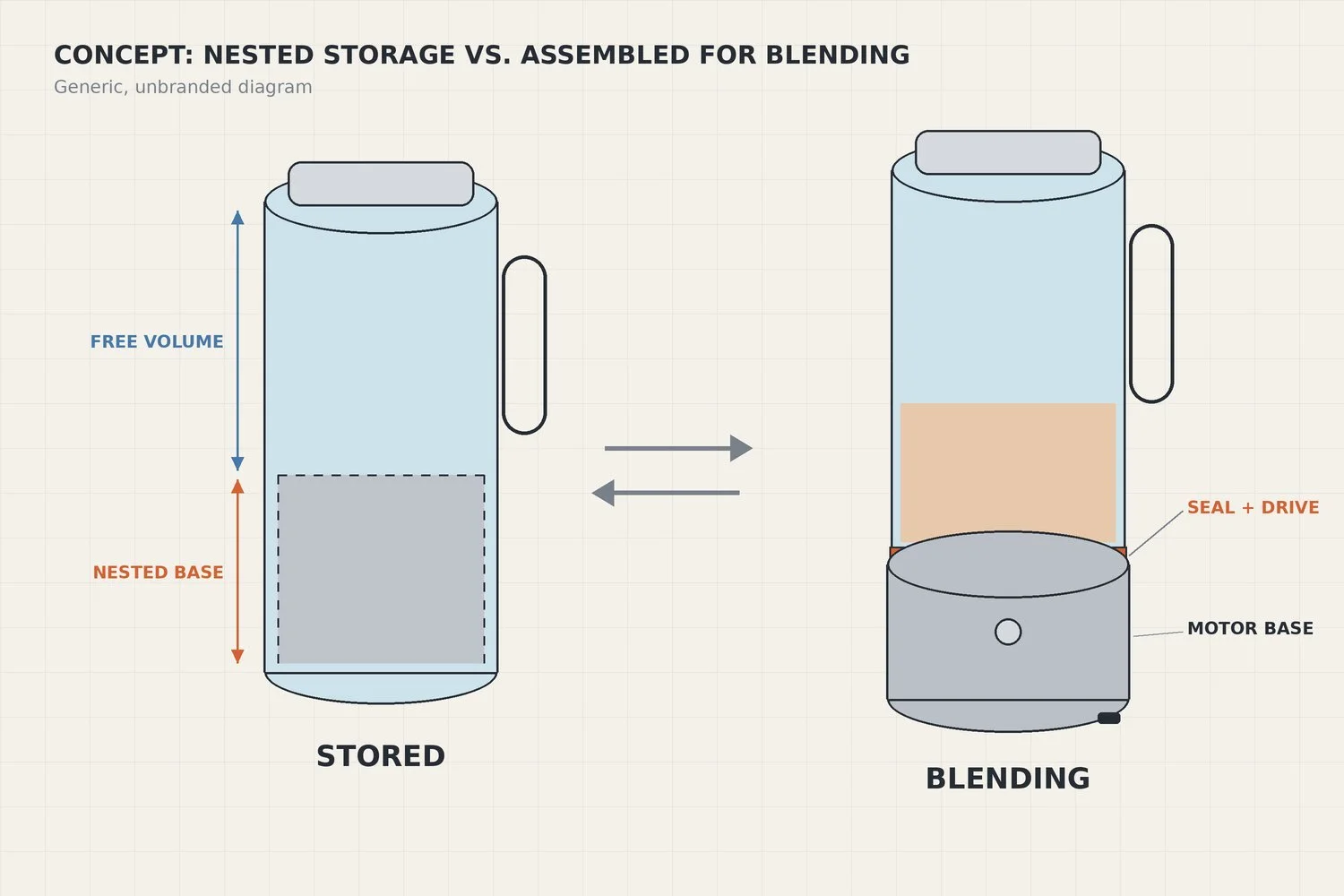
Conceptual illustration, not a Vitamix product image. Nesting the base inside the bottle trades drink volume, battery space and storage footprint against each other.
Nesting storage geometry vs. container volume
Nesting the motor base inside the container is elegant, and it imposes hard constraints. The base must clear the bottle's inner diameter, including threads or bayonet, and every millimeter given up limits the motor and cells you can fit. That is a three-way trade between drink volume, battery capacity and storage footprint. We would resolve it with volumetric models and printed shells before refining the industrial design, because it locks the architecture.
One button, a double-click and a status light
One-button UX is easy to promise and hard to get right. A double-click must feel deliberate but not fussy, and be learnable without the guide. A four-state light has to stay legible in sunlight and for users with color-vision differences. We would test gestures and light states with first-time users on works-like prototypes, timing how long it takes to blend unaided.
CMF: aluminum and Tritan as brand signals
An aluminum-enclosed base and stainless blades signal "premium" before the motor spins, helping justify a $149.95 price. They also bring trade-offs: aluminum adds cost and finishing steps and changes heat behavior around the motor and cells. Tritan is a common choice for clear, BPA-free drinkware, and any bottle still needs validation for drop impact, repeated washing and staining. Our CMF design and material selection guide covers how we frame these decisions.
Brand-extension risk and warranty
Our view: the biggest risk for a performance brand going portable is expectation transfer. Customers who know the full-size machines may expect the same results from a much smaller motor. Clear framing (Vitamix positions Ion for beverage blending) and a published test recipe help manage that gap.
The 2-year limited warranty matters for the same reason. Batteries age, seals wear and ports take abuse. Teams should model pack degradation across the warranty period, define what "defective" means for a battery that holds less charge, and decide whether the motor base is serviced or replaced as a unit.
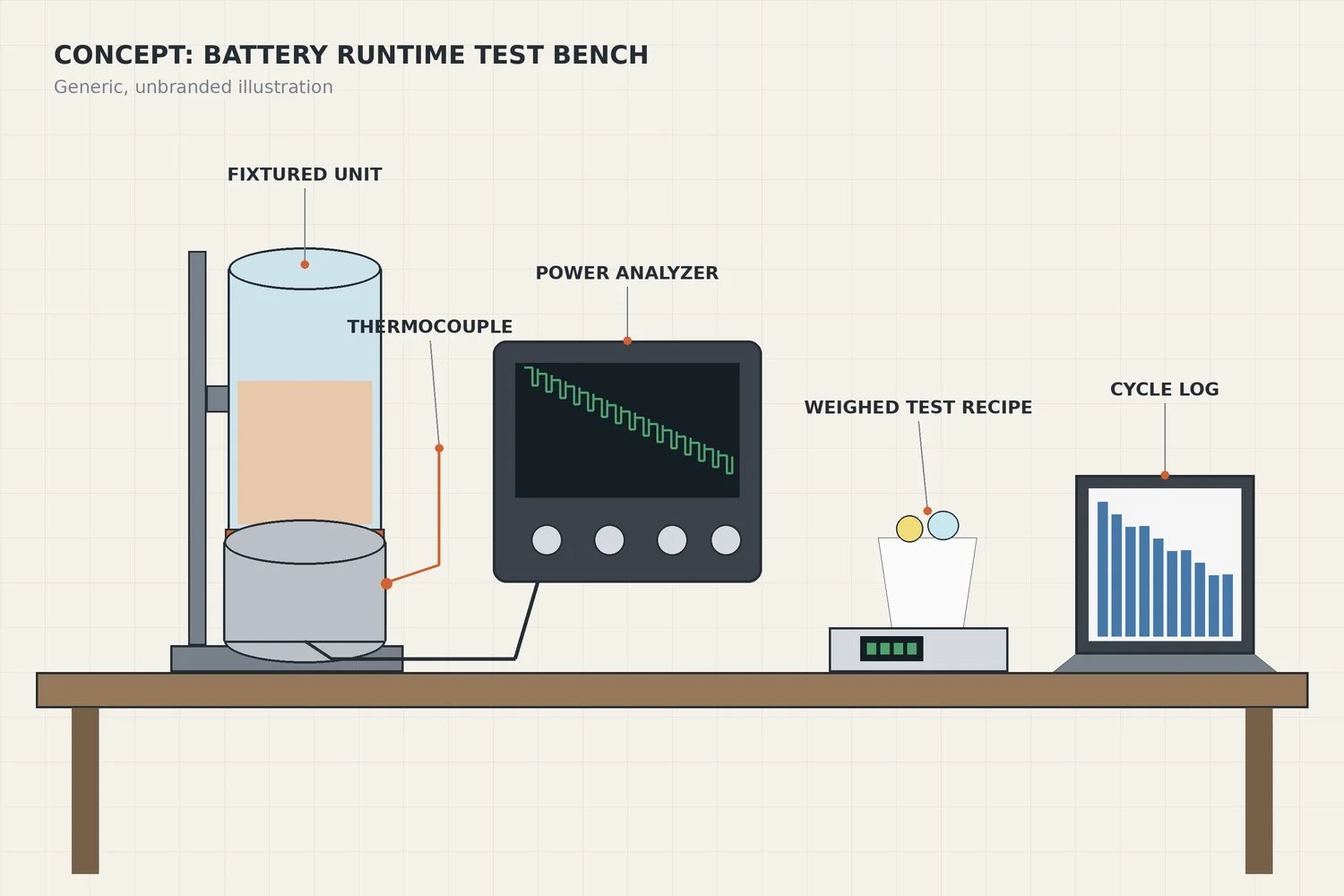
Conceptual illustration, not a Vitamix product image. A generic bench setup for logging voltage, current and temperature across repeated blend cycles.
What to prototype and test early
For a battery-powered motor appliance, these are the early builds we prioritize:
- Reference load and runtime rig: fixture the unit, weigh a standard recipe, and log voltage, current and temperature cycle by cycle. Our guide to prototype testing methods goes deeper.
- Packaging study: printed shells to lock motor, pack and nesting geometry.
- Interlock and firmware state machine: test every assembly and low-battery edge case on bench hardware.
- Water and drop abuse: rinse, tip, drop and repeat on the interfaces.
- First-use UX: untrained users, no manual, timed.
For staging these builds, see our take on consumer product prototyping.
Sources
- Business Wire, "Vitamix Introduces Vitamix Ion, Its First Portable Blender" (Nov. 9, 2026): https://www.businesswire.com/news/home/20261109837160/en/Vitamix-Introduces-Vitamix-Ion-Its-First-Portable-Blender
- Vitamix, Ion Portable Blender product page: https://www.vitamix.com/us/en_us/products/ion
- Vitamix, "Meet the Vitamix Ion Portable Blender": https://www.vitamix.com/us/en_us/articles/meet-the-vitamix-ion-portable-blender
- Vitamix, Ion Quick Start Guide (PDF): https://www.vitamix.com/content/dam/vitamix/files/153712_B_Ion_Quick_Start_Guide_09.26.pdf
Jackson Hedden is an independent product design, development and manufacturing firm with no affiliation with Vitamix. If your team is working through a cordless or motorized consumer product, we're glad to talk through it.