On November 12, 2026, Google, Samsung, Warby Parker and Gentle Monster opened pre-orders for Intelligent Eyewear, camera-and-audio smart glasses with Gemini built in that weigh about 41 grams and ship on December 10 starting at $395.
Key takeaways
- The glasses put a 12MP camera, four microphones, two open-ear speakers and a Snapdragon AR1 Gen 1 processor into frames weighing 39.6 to 43.9 grams, according to Samsung's published specifications.
- The launch is organized as one electronics platform engineered by Samsung, dressed in 30 frame variations from two eyewear brands.
- Battery life is rated at up to nine hours in the glasses and up to 72 hours with the charging case, so the case carries much of the system's energy.
- Privacy is handled in hardware as well as software: an outward LED signals recording, and camera capture is designed to stop if that LED is covered.
- For product teams, the lesson is that wearables succeed or fail on fit, weight and social acceptance as much as on electronics.
What Google's smart glasses launch teaches industrial design firms
Smart glasses have struggled for years with a basic problem: people do not want to wear something that looks like a gadget on their face. This launch is a useful case study for industrial design firms and the founders who hire them because it attacks that problem through partnership and platform thinking rather than a single hero product. Below we separate what was reported from our analysis.
What was reported
The product. According to 9to5Google's launch coverage, Intelligent Eyewear is designed to be worn all day rather than as occasional sunglasses. The frames weigh 40 to 44 grams "with the weight balanced evenly," and include a 12-megapixel ultra-wide camera, four microphones, two open-ear speakers, a touchpad for taps and swipes, and voice control. The glasses run on a 245 mAh battery, are rated IPX4 for splash resistance, and charge through contact pins on the underside of the nose bridge.
The partnership. Samsung's announcement says Samsung engineered the hardware, while Gentle Monster and Warby Parker contributed 30 designs: 16 variations across six Gentle Monster frame styles and 14 variations across three Warby Parker styles, with a range of widths and lens options. Prescription lenses are available for most frames. Warby Parker pricing starts at $395; Gentle Monster ranges from $449 to $489.
Weight and power. Samsung lists the glasses at 41 grams for one reference model, with a range of 39.6 to 43.9 grams for Gentle Monster frames and 40.4 to 42.6 grams for Warby Parker frames, excluding prescription lenses. The charging cases weigh 194.5 grams and 166.8 grams respectively. Samsung says a split-computing system offloads part of the processing to the paired phone, and credits "careful optimization of component placement, battery design, and thermal management" for the lightweight form factor.
Privacy hardware. When the camera captures photos or video, an outward LED lights up. Samsung says capture is designed to be disabled if that LED is covered or not working, and 9to5Google reports that Google runs a hardware check of the light during charging. Each pair also has a physical on/off switch so it can be worn as ordinary glasses, and recording stops when the glasses come off.
Our analysis: why this is an industrial design problem first
The specifications are impressive, but the more important story is how the product is structured. Here is how we read it as product designers.
Weight is the master requirement
A 41-gram frame is carrying a camera, radios, speakers and a battery on the nose and ears, and many ordinary frames weigh noticeably less. Every component decision, from battery size to hinge design, has to defend its grams. Google's emphasis on balanced weight matters as much as the total: mass concentrated at the front of the frame presses on the nose, while mass in the temples sits more comfortably behind the ears.
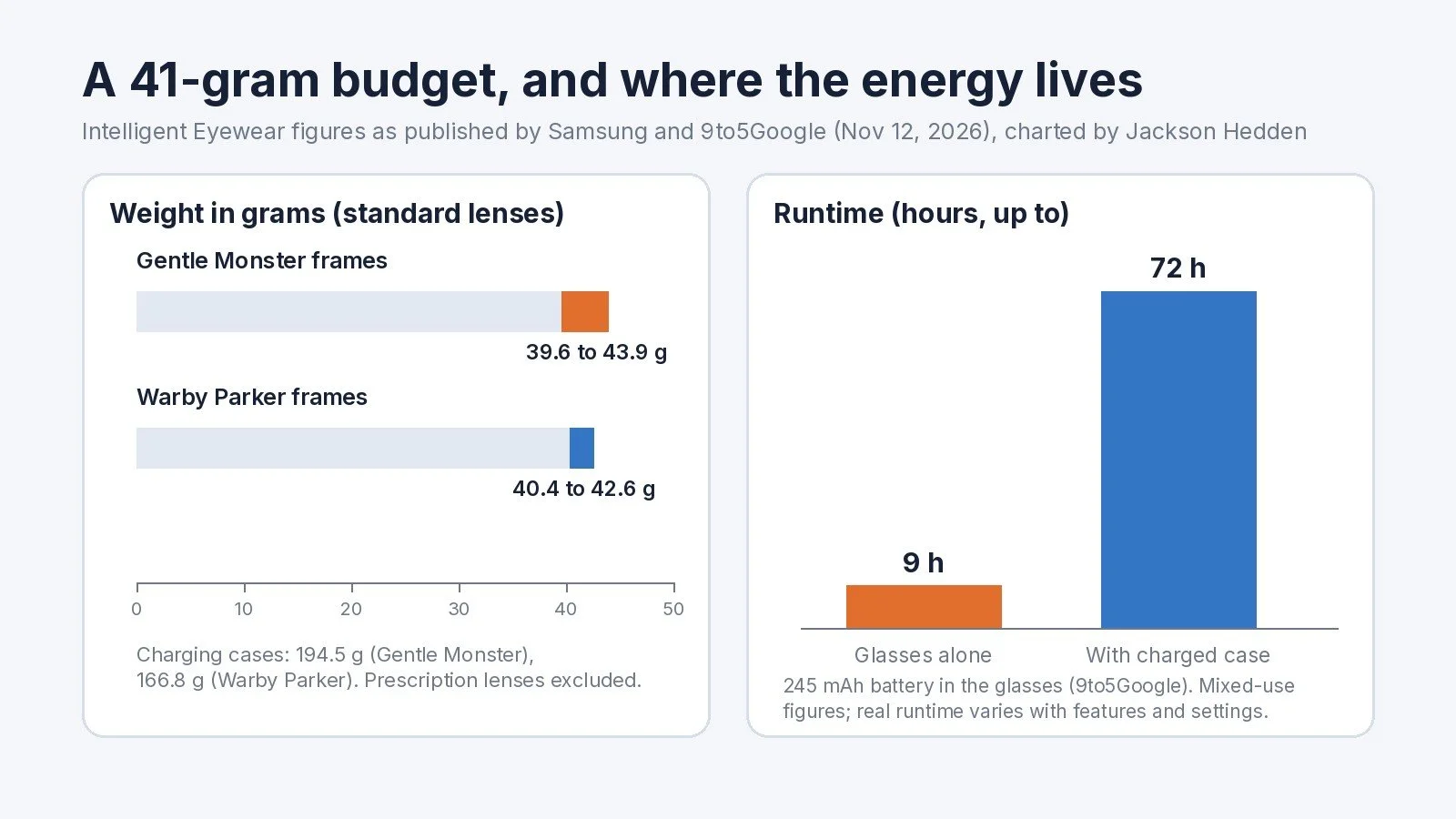
Intelligent Eyewear weight and battery figures as published by Samsung and 9to5Google (November 12, 2026), charted by Jackson Hedden. Up-to values; real runtime varies.
Samsung's published figures show a familiar wearable pattern. The glasses carry enough energy for a day of mixed use, and the pocketable case holds enough to recharge them several times. We saw the same split in Yeasound's in-canal hearing aid this week: when the worn device has almost no spare volume, the accessory becomes part of the product architecture, not an afterthought.
A platform with many skins
The second lesson is platform strategy. One electronics core (processor, camera, microphones, speakers, battery and software) is packaged into nine frame styles and 30 variations. That lets each eyewear brand keep its visual identity while the hard engineering is done once.
It is not free. Every frame shape changes where components fit, how weight balances, how antennas perform near the head and how heat escapes. Each variant needs its own fit, drop and flex testing, plus CMF (color, material and finish) approval. Teams planning a product family should budget for that per-variant validation from the start, rather than assuming a shared board means shared certification.
Social acceptance is a design input
Camera glasses raise a question most wearables do not: how do people nearby know they are being recorded? The answer here is partly physical. A light that cannot be covered without stopping capture, a hardware on/off switch and automatic stop on removal are industrial design and electrical design decisions, not just privacy-policy language. For any product with a camera or microphone used around other people, the indicator, its visibility and its failure behavior belong in the earliest requirements.
Wearables live or die on fit
This launch also reinforces lessons from earlier wearable stories we covered, such as Aina's screen-and-joystick AI ring and smart rings adding health sensing and retail fitting. Offering widths and prescription options, and offering guided demos at more than 360 Warby Parker stores, reflects the same truth: body-worn products need a fit strategy, not just a size.
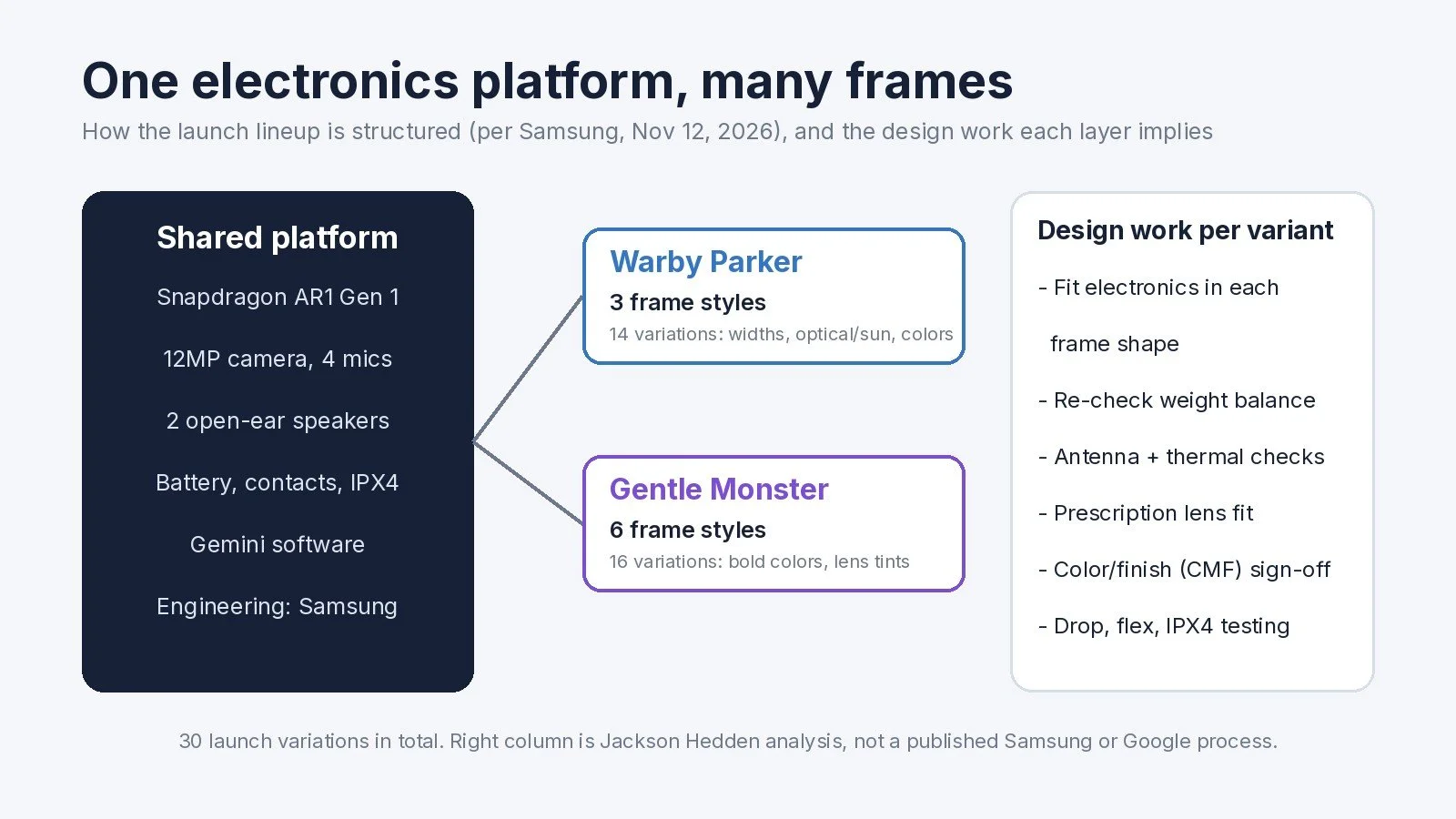
Launch lineup structure per Samsung (30 variations across nine frame styles). The per-variant design work list is Jackson Hedden analysis, not a published Samsung or Google process.
What this means for product teams
Whether you are building smart eyewear, earbuds, a wearable sensor or a connected accessory, these steps apply:
- Set a mass and balance target before you choose parts. Define a maximum weight and where the center of mass may sit, then make every component justify its place against that budget.
- Decide early what lives off the body. Cases, docks and phones can carry batteries, processing and controls. Give the accessory its own requirements, since its size and weight also shape the experience.
- Partner for the face of the product. If your product depends on taste, as eyewear does, consider working with an established design brand or an experienced industrial design firm that can turn engineering constraints into products people want to wear.
- Treat every variant as its own build. Plan fit, drop, thermal and radio testing for each shape in the family, not just the reference model.
- Design trust into hardware. Recording indicators, physical switches and fail-safe behavior should be specified, prototyped and tested like any other feature.
- Stage your builds. Use EVT (engineering validation test, early builds that prove the design works) to settle packaging and fit, and DVT (design validation test, builds from production tooling) to confirm durability, water resistance and battery life before launch.
Frequently asked questions
What are Google Intelligent Eyewear glasses? They are camera-and-audio smart glasses with Gemini built in, engineered by Samsung and sold in frames from Warby Parker and Gentle Monster. Pre-orders opened November 12, 2026, with availability from December 10 starting at $395.
How heavy are smart glasses compared with regular glasses? Samsung lists these glasses at 39.6 to 43.9 grams depending on frame, before prescription lenses. Many ordinary frames weigh noticeably less, which is why weight and balance drive so much of the design.
Why do smart glasses come with a charging case? The frames have room for only a small battery, rated here at up to nine hours. The case stores more energy, up to 72 hours of total use per Samsung, and doubles as protection when the glasses are not worn.
What should a startup look for in an industrial design firm for a wearable? Look for experience with tight packaging, comfort and fit testing, and taking products through engineering builds into production. Ask how the firm balances aesthetics against component, thermal and manufacturing constraints.
If you are developing a wearable or another product where looks, comfort and electronics have to coexist, see our product design services or contact our team to talk through your architecture and fit strategy before tooling.
Jackson Hedden is a product design, development and manufacturing firm helping founders and product teams take consumer and industrial products from concept to production.
Sources
- Google, "See our intelligent eyewear lineup and pre-order your pair," November 12, 2026: https://blog.google/innovation-and-ai/technology/xr-ar/google-intelligent-eyewear-collections-pre-order/
- Samsung Global Newsroom, "Samsung Announces December Release for Intelligent Eyewear, Bringing a Smarter Way To See the World," November 12, 2026: https://news.samsung.com/global/samsung-announces-december-release-for-intelligent-eyewear-bringing-a-smarter-way-to-see-the-world
- 9to5Google, "Google launches Intelligent Eyewear glasses: $395+, pre-order today, ships Dec. 10," November 12, 2026: https://9to5google.com/2026/11/12/google-intelligent-eyewear-glasses/