Between November 9 and 10, 2026, three smart ring stories landed in two days: Rogbid launched its VitalRing with on-demand ECG, Qringstore released the Titan 2 Pro with a display but no touch controls, and Oura announced that Oura Ring 5 is coming to 1,000 Ulta Beauty stores with in-store fitting, a week after Samsung brought FDA-cleared sleep apnea screening to its Galaxy Ring.
Key takeaways
- Smart rings are moving from step counting toward heart and sleep health features, which raises the bar for sensor design, validation and how claims are worded.
- Rogbid's ECG ring needs a finger from the opposite hand to close the electrical circuit, a reminder that some measurements are designed into the shape of the product, not just the chip.
- Qringstore removed touch controls from its new ring to avoid accidental touches and save power, a clear case of cutting a feature to make the product work better.
- Oura's retail launch leans on sizing kits and in-store displays, and Oura's own guidance says fit affects data accuracy. In rings, fit is part of the electronics.
- For electronic product design teams, the lesson is to treat sensors, enclosure, fit and regulatory claims as one system from the first prototype.
Smart ring news and what it means for electronic product design
None of these launches is a breakthrough on its own. Read together, they show where the category is heading and which design decisions now carry the most risk. Below we separate what was reported from our own analysis.
What was reported
Rogbid VitalRing (reported November 10, 2026). According to Gizmochina, the ring has a titanium alloy outer shell with an epoxy resin inner lining, measures 8 mm wide and weighs about five grams. It carries a 5ATM water resistance rating. The report says it pairs a Nordic main control chip with a separate analog front-end chip to process PPG, ECG and SpO2 readings. On-demand ECG uses dual-touch contacts that need a finger from the opposite hand to complete the circuit. Rogbid claims 8 to 10 days of battery life, with a 400 mAh magnetic charging case.
Qringstore Titan 2 Pro (reported November 10, 2026). Notebookcheck reports a ring weighing about 3.2 grams, 2.7 mm thick and 8 mm wide, with a built-in display for time, heart rate, SpO2, sleep and battery level. Unlike the previous Titan Pro, it has no touch controls; the company says that choice prevents accidental touches and reduces power consumption. It keeps gesture control, is rated IP68, and is claimed to run up to 7 days per charge, or 30 days with its charging case.
Oura Ring 5 at Ulta Beauty (announced November 9, 2026). Oura's announcement says the ring went on sale at Ulta.com on November 10 and arrives in 1,000 stores on November 22, "with in-store displays to help guests experience the product and find their fit." Stores carry sizes 7 to 10, with sizes 6, 11, 12 and 13 online only, and a sizing kit is sold alongside. Ulta's sizing kit listing notes that Oura Ring 5 sizes differ from standard ring sizes, that there are no half sizes, that a proper fit gives "the highest data accuracy," and that buyers should wear the sizer for 24 hours because fingers expand and contract. Glossy quoted an Oura executive noting that fingers can swell overnight.
Samsung Galaxy Ring sleep apnea screening (announced November 3, 2026). Samsung's newsroom says its updated Sleep Apnea feature, cleared by the US FDA in July 2026 and since approved by Korea's MFDS, now runs on Galaxy Ring. Samsung describes it as an over-the-counter, software-only mobile medical application for adults that needs two nights of valid data within 10 days, and says it should not replace diagnosis by a clinician. Samsung's support page adds that each night needs at least five hours of sleep and that the ring is not approved as a pulse oximeter.
Why rings are one of the hardest wearables to design
Electronic product design is the work of turning a feature list into circuit boards, sensors, firmware, power and an enclosure that all fit and work together. In a smart ring, every one of those pieces fights for the same few cubic millimeters. A watch has a flat back and a strap that holds the sensor against the wrist. A ring has a curved band only a couple of millimeters thick, worn on a finger that changes size through the day.
A few terms help here:
- PPG (photoplethysmography) shines light into the skin and measures what reflects back to estimate heart rate, blood oxygen (SpO2) and related signals. It depends heavily on steady skin contact.
- ECG (electrocardiogram) measures the heart's electrical activity. A single-lead consumer ECG needs two electrodes on opposite sides of the body, which is why Rogbid's ring asks the wearer to touch it with the other hand.
- AFE (analog front end) is the chip that amplifies and filters tiny sensor signals before the main processor reads them. Separating it from the main processor, as reported for VitalRing, is common where signal quality matters.
The four stories above map onto the four constraints that usually decide whether a ring program succeeds: sensing, power, fit and claims.
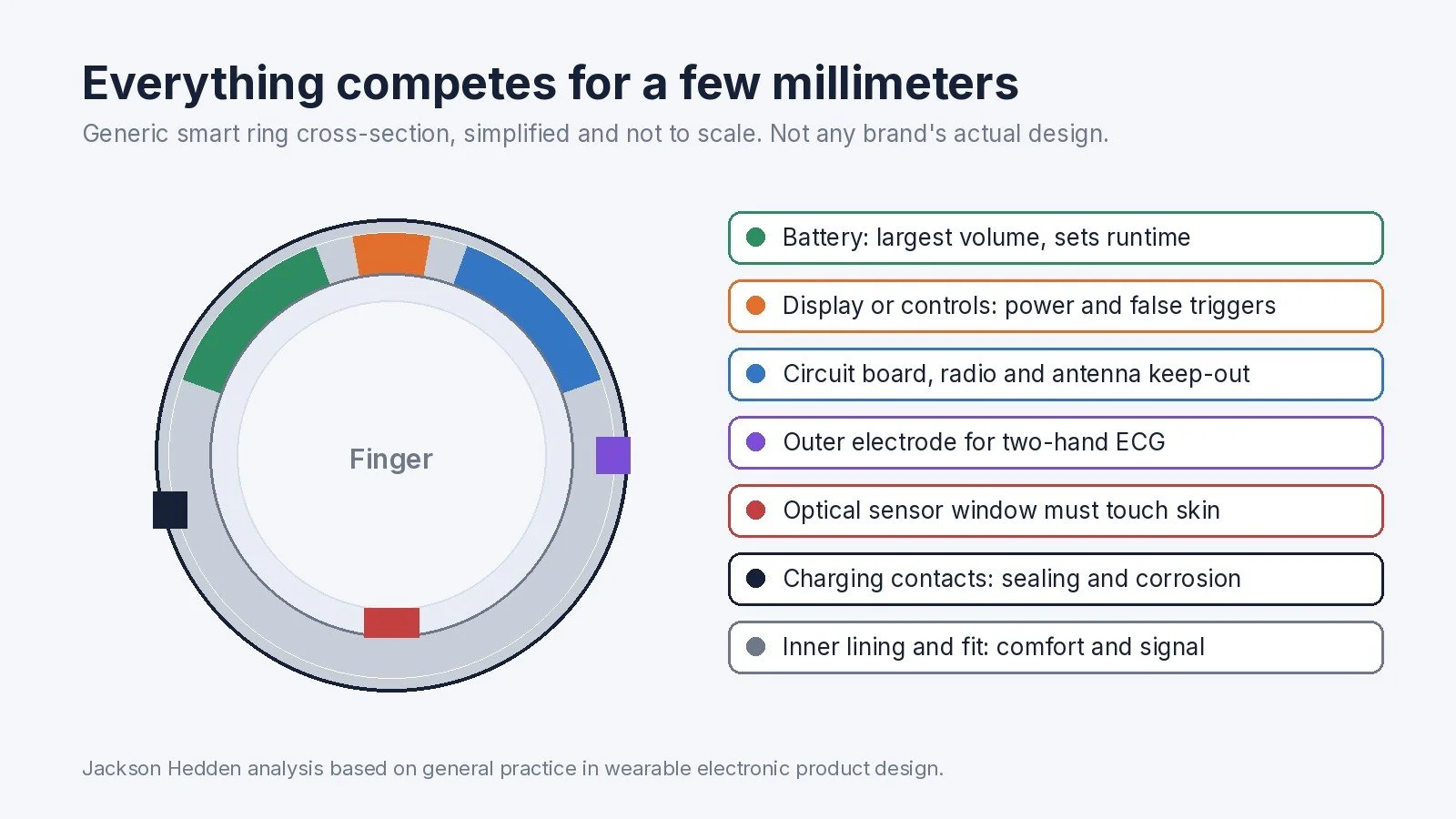
Generic, simplified smart ring used to illustrate packaging trade-offs. Jackson Hedden analysis; not any brand's actual design.
What this means for product teams
This section is Jackson Hedden analysis based on general professional practice, not on any of the companies named above.
Design the measurement into the shape
Rogbid's two-hand ECG gesture is a product decision as much as an electrical one. If a feature needs an electrode on the outside of the ring, that changes the shell material, the insulation between inner and outer surfaces, water sealing around the contact, and how the user is taught to take a reading. Teams should sketch the measurement posture before they sketch the ring. If a reading needs the user to hold still for 30 seconds, that flow has to be designed, tested with real people and explained in the app.
Cut inputs that cost more than they give
Qringstore's decision to drop touch controls is a useful pattern. Every input on a ring is an always-on source of false triggers and power draw. In early prototypes, log how often each control fires by accident during daily tasks like washing hands, gripping a steering wheel or typing. If an input fails that test, moving it to the phone or to a deliberate gesture is often the better product, even if the spec sheet gets shorter. Our earlier piece on Aina's AI ring looks at the opposite choice, putting a screen and joystick on the finger, and the trade-offs that come with it.
Treat fit as an engineering requirement
Oura's retail push makes fit visible: sizing kits, displays with sizing tools and a 24-hour wear test. For a ring, fit is not just comfort. A loose ring lets the sensor window lift off the skin, which degrades optical readings, while a tight one is uncomfortable overnight, when sleep data is collected. Practical steps:
- Define a fit range per size and test sensor performance at both the loose and tight ends, not just a perfect fit.
- Prototype sizing tools early. A plastic sizer that does not match the final inner profile will send customers the wrong size, which shows up as returns and bad data.
- Plan the size run with retail in mind. Oura's in-store range (7 to 10) versus online-only sizes shows how channel decisions shape inventory and tooling.
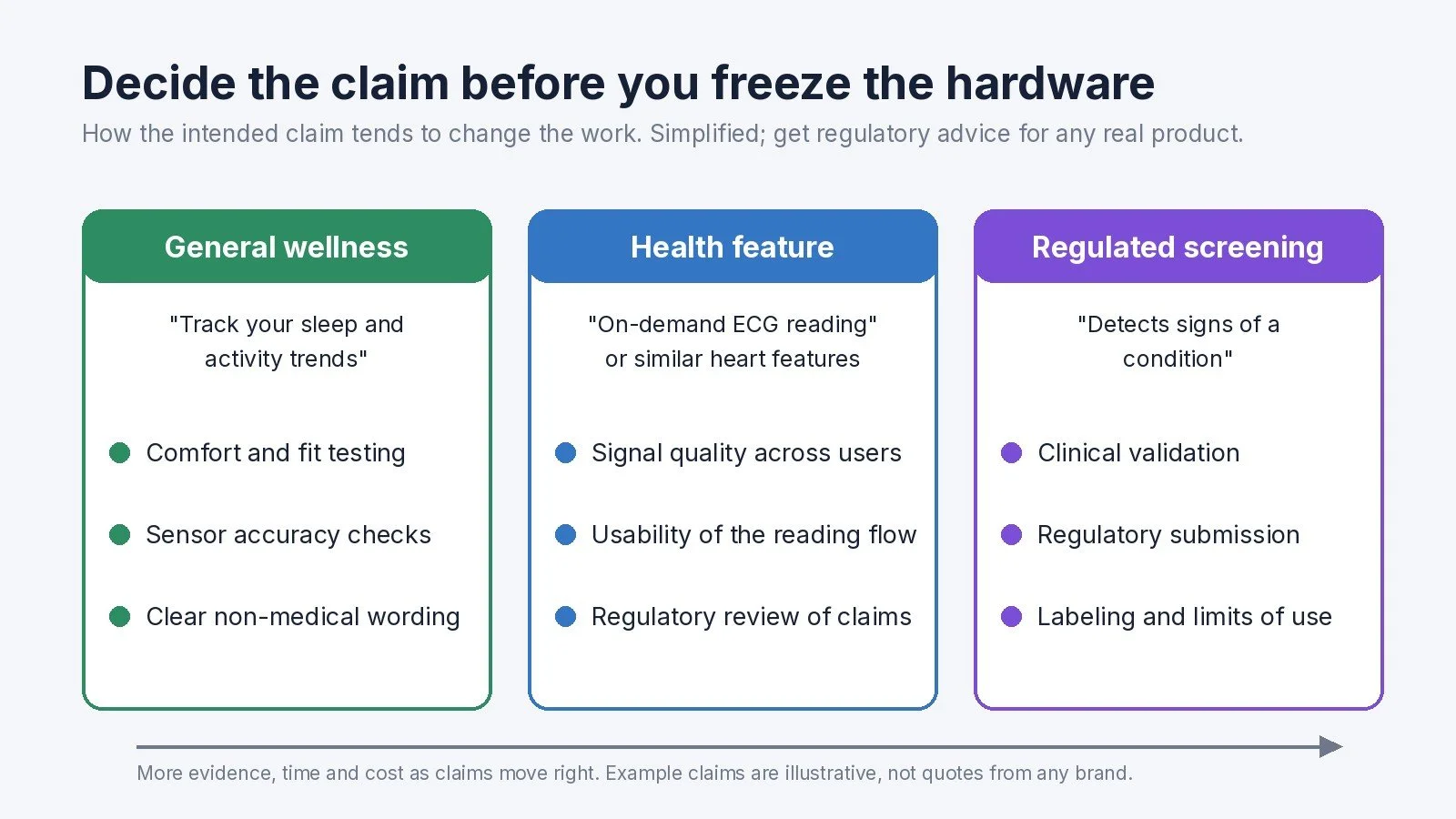
How the intended claim tends to change development work. Simplified illustration of general practice, not regulatory advice.
Decide early whether you are building a wellness product or a medical one
Samsung's announcement is careful: an over-the-counter, software-only medical application, adults only, not a substitute for diagnosis, and the ring is not approved as a pulse oximeter. That precision matters. In the US, the FDA's general wellness guidance describes low-risk products intended for general wellness, while claims about detecting or screening for a disease generally bring a device into FDA oversight. Where a ring sits depends on its intended use and claims, so marketing language, app copy and the validation plan need to be decided together, with regulatory advice, before the hardware is frozen. Our guide to medical equipment design covers how that choice changes the development process.
Stage the build so problems surface early
Hardware programs usually move through EVT (engineering validation test, proving the design works), DVT (design validation test, proving production-intent parts meet requirements) and PVT (production validation test, proving the factory can build it consistently). For rings, add specific gates: water ingress around any external contact, sensor accuracy across sizes and skin tones, charging-contact corrosion and battery behavior after repeated cycles. Finding a sizing or sealing issue at DVT is far cheaper than finding it in reviews.
For founders and product teams planning a wearable, strong electronic product design means making the sensor, power, fit and claim decisions together, early, and testing them on real hands rather than on a bench.
Frequently asked questions
Why do smart rings need special sizing kits? A ring's sensors only work well with steady skin contact, and ring sizes vary between brands and even between generations. Oura's guidance says Ring 5 sizes differ from standard ring sizes and recommends wearing a sizer for 24 hours, because fingers swell and shrink during the day.
How can a ring take an ECG? A single-lead ECG needs a circuit across the body, so the ring needs an electrode the other hand can touch as well as one against the finger. Rogbid's VitalRing, for example, asks the wearer to touch its contacts with a finger from the opposite hand.
Is a smart ring a medical device? It depends on intended use and claims. A ring marketed for general wellness is treated differently from one that screens for a disease; Samsung's sleep apnea feature, for example, received FDA clearance as a software-only medical application. Teams should get regulatory advice before they finalize claims and test plans.
What makes wearable electronics hard to design? Sensors, battery, antenna, charging and sealing all compete for very little space, and the product must stay comfortable and accurate on bodies that vary widely. Most of the risk sits in how those pieces interact, which is why integrated electronic, mechanical and industrial design matters from the first prototype.
If you are planning a smart ring or another wearable, see our electronic product design services or contact our team to talk through sensing, power and fit before you commit to tooling.
Jackson Hedden is a product design, development and manufacturing firm helping founders and product teams take consumer and industrial products from concept to production.
Sources
- Gizmochina, "Rogbid launches new VitalRing with ECG, SpO2 tracking and titanium alloy build," November 10, 2026: https://www.gizmochina.com/2026/11/10/rogbid-vitalring-ecg-smart-ring-launched-specs-price/
- Notebookcheck, "Qringstore releases new smart ring with built-in display and launch discount," November 10, 2026: https://www.notebookcheck.net/Qringstore-releases-new-smart-ring-with-built-in-display-and-launch-discount.1445665.0.html
- Oura, "Oura Ring 5 First Health Wearable Available at Ulta Beauty," November 9, 2026: https://ouraring.com/blog/oura-ring-ulta-beauty/
- Ulta Beauty, Oura Ring 5 Sizing Kit listing: https://www.ulta.com/p/oura-ring-5-sizing-kit-pimprod2063161
- Glossy, "Exclusive: Ulta Beauty bets on health tracking with Oura in 1,000 stores," November 9, 2026: https://www.glossy.co/beauty/wellness/ulta-beauty-oura-ring-health-tracking/
- Samsung Global Newsroom, "Upgraded Sleep Apnea Feature Now Available on Galaxy Ring Following Regulatory Approvals From US FDA and Korea MFDS," November 3, 2026: https://news.samsung.com/global/upgraded-sleep-apnea-feature-now-available-on-galaxy-ring-following-regulatory-approvals-from-us-fda-and-korea-mfds
- Samsung US support, "Use the sleep apnea monitoring feature with a Galaxy Watch or Ring": https://www.samsung.com/us/support/answer/ANS10013576/
- US FDA, "General Wellness: Policy for Low Risk Devices": https://www.fda.gov/regulatory-information/search-fda-guidance-documents/general-wellness-policy-low-risk-devices
Related: what K2's Anthem ski boots teach about grading sizes and building fit into rigid parts.