Key takeaways
- On November 5, 2026, TechCrunch reported that hardware startup Aina released an "AI ring" with a screen, joystick, microphone and speaker, aimed at talking to agents, taking notes and controlling nearby devices.
- Early-bird preorder pricing is $399, rising to $499 after the early-bird window, with shipping planned for January 2027.
- Packing a display and a physical control onto a finger-worn product is a different design problem than a smartwatch: battery volume, antenna keep-outs, heat into skin and usable control surfaces all shrink at once.
- For wearable product teams, the useful lesson is not the feature list. It is how to decide which inputs belong on the body, which belong on the phone, and what you must measure before you freeze the ring geometry.
What TechCrunch reported
According to TechCrunch's Ivan Mehta, writing on November 5, 2026, Aina released a smart ring built as a controller for AI and non-AI apps. The piece describes a device with:
- a screen for notifications and to show which apps are being controlled
- a joystick for navigation, plus gesture support
- a microphone for notes, prompts to agents, reminders and dictation (including via Wispr Flow or Aina's own engine)
- a speaker so the wearer can take calls from the ring
Aina previously built Mirage, a three-key Mac controller that remapped actions based on the frontmost app. The company is applying those lessons to the ring form. TechCrunch notes that other smart rings already target similar AI-input use cases (Pebble Index 01, Sandbar Stream, Oasis and Natura among them), which is why Aina is differentiating with more onboard controls and a speaker.
Founder Apoorv Shankar told TechCrunch the team designed for an age of proactive agents rather than app browsing: "Phones and laptop screens were designed for an age of browsing where you think about opening apps. For interacting with proactive agents, we need a better interface." The company raised $5.5 million in July. Preorders open at $399 early-bird pricing, with shipping planned for January 2027 and a later price of $499.
TechCrunch's hands-on notes matter too. Mehta wrote that after a few days of use the ring felt "like a smartwatch in a ring format, with more controls," and that software is still being fleshed out. Early wearable reviews often score the hardware promise higher than the finished interaction model.
Why a ring is not a shrunk smartwatch
Analysis: Teams that treat a ring as "a watch with less screen" usually fail the mechanical and electrical budgets first. A watch has a case volume for a battery, a crown or buttons with usable travel, and a strap that carries antennas and heat away from a small contact patch. A ring wraps continuous skin contact around a tiny cavity. Every feature Aina is emphasizing (display, joystick, mic, speaker) competes for the same millimeters.
That forces five simultaneous constraints:
- Battery chemistry and duty cycle. Display, mic and speaker loads are power-hungry relative to a passive health ring. Duty-cycling, a larger cross-section or frequent charging each change comfort and adoption.
- Antenna placement. Metal bands look premium, but they punish radios. Plastic windows, slot antennas and keep-outs are required if the ring must stay linked to a phone and a Mac.
- Heat into skin. A speaker coil and radio near a battery have almost no thermal mass. Finger surface temperature becomes a primary comfort metric.
- Control surface ergonomics. A joystick must work one-handed and without looking. Travel, detents, accidental activation and left/right variants need fixtures, not slide decks.
- CMF and skin safety. Finish, edge radii, plating and sweat chemistry decide whether people keep wearing it after week two.
Our guide to wearable product design principles covers the same trade space: comfort, glanceable UI, electronics packing and design for manufacturability from day one.
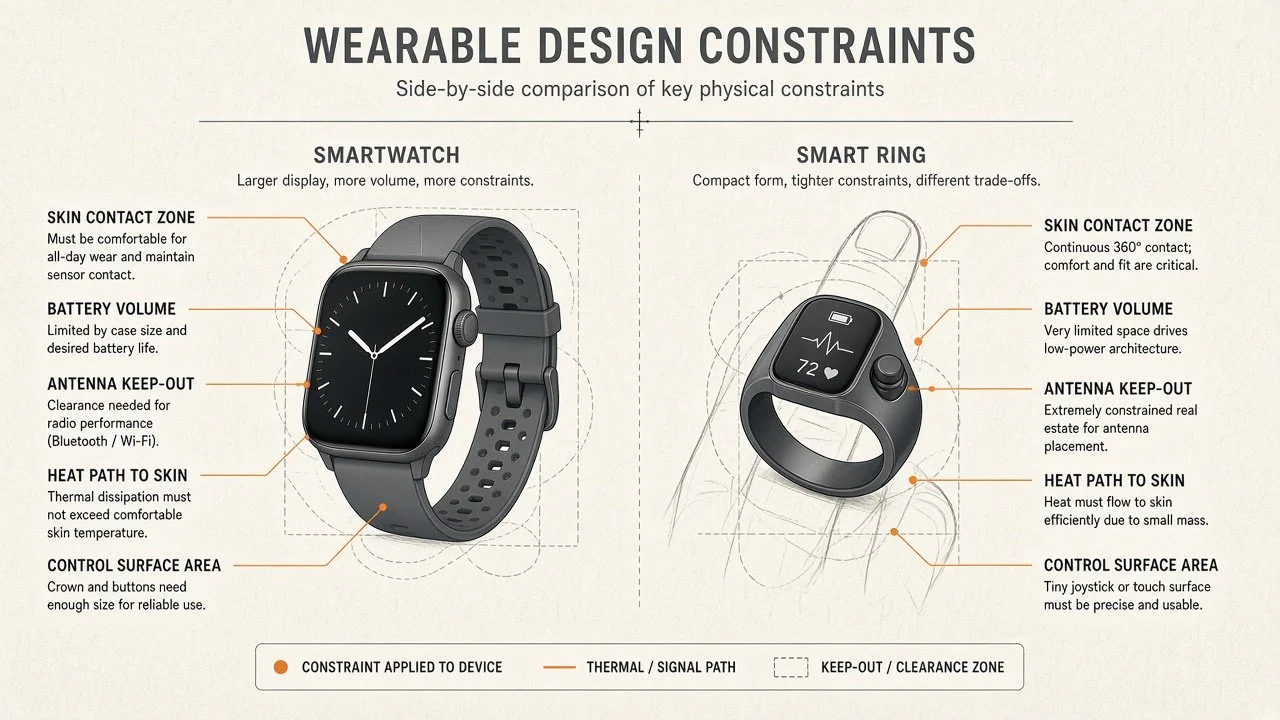
Conceptual comparison of wearable constraint budgets. Not a product photograph.
What belongs on the finger vs. on the phone
Analysis: Shankar's framing — interfaces for proactive agents rather than browsing — is the strategic design brief. It does not automatically mean every control should live on the ring. The high-value pattern for most connected wearables is:
- On the body: glanceable state, one or two primary actions, reliable capture (voice note, confirm, dismiss), and haptics that work without looking.
- On the phone or Mac: dense history, settings, agent configuration, long text editing and anything that needs a large keyboard.
Aina's Mirage lineage is instructive. Mapping actions to the frontmost app is a software problem first; the ring is only a physical token for that mapping. If the mapping is unclear, joystick travel will not save the experience. Prototype the intent model on a phone remote or temporary BLE clicker before freezing the ring's outer diameter. Outer band geometry, display window and joystick boss are expensive to change once hard tooling starts; interaction logic is not. Related reading: circuit board design for connected consumer products.
What to measure before you freeze the geometry
TechCrunch's early software caveat is exactly why wearable teams need a short, brutal test list before EVT freezes:
- Fit cohort. Multiple finger sizes, dominant and non-dominant hands, cold and warm swelling. A ring that only fits the demo hand is not a product.
- Accidental input rate. Joystick and gesture false triggers while typing, driving, carrying bags or sleeping.
- Voice capture outdoors. Mic performance with wind, café noise and a sleeve near the hand — not only in a quiet office.
- Thermal rise. Skin temperature after continuous call or dictation loads, with pass/fail limits your factory can check.
- Latency to agent action. Time from press or utterance to a visible result on the paired device. Users forgive a small screen; they do not forgive lag that makes the agent feel broken.
- Drop, abrasion and sweat. Rings live in pockets with keys. Coatings and mesh ports fail in ways watches do not.
We cover methods and acceptance criteria in prototype testing methods for better prototypes, and early DFM choices in DFM for consumer products. The same generation-two discipline from Suri Pro 2.0 — measure feel, then write it into the spec — applies even more tightly here. For packing serviceable electronics into a small enclosure, see also Beelink's swappable-motherboard NAS design notes.
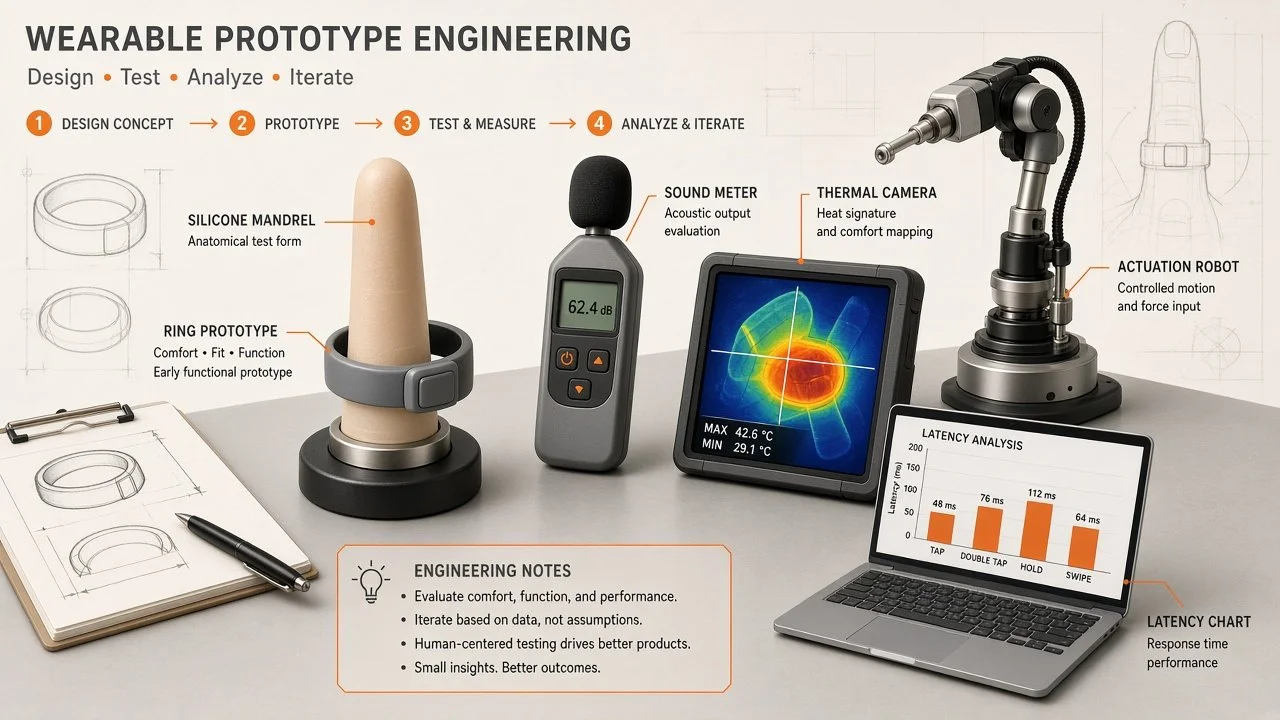
Conceptual illustration of comfort, acoustic and thermal checks for a finger-worn prototype. Not a photo of Aina’s lab.
FAQ
What did Aina announce?
According to TechCrunch (November 5, 2026), Aina released an AI-focused smart ring with a screen, joystick, microphone and speaker, positioned as a controller for agents and nearby devices.
How much does it cost and when does it ship?
TechCrunch reports early-bird preorder pricing of $399, a later price of $499, and planned shipping in January 2027.
Why is this relevant to industrial and consumer product design firms?
It is a live case of packing multiple human-interface modalities into a jewelry-scale enclosure. The engineering and UX trade-offs are the same ones client teams face on rings, pendants and other body-worn controllers.
Is Jackson Hedden affiliated with Aina?
No. Facts about Aina are as reported by TechCrunch. Analysis sections are Jackson Hedden's commentary.
For a look at how AI is starting to design electronics prototypes, see our analysis of AI-designed electronics prototypes.
Author
Jackson Hedden is CEO of Jackson Hedden Inc., an industrial design and product development studio focused on consumer and connected hardware. The studio helps teams move from concept through prototyping, DFM and manufacturing handoff.
Talk with our team
If you are scoping a wearable, smart accessory or other tightly packaged connected product, start with our wearable product design guide or contact Jackson Hedden to talk through architecture, prototyping and production risks.
Sources
Facts about Aina are as reported by TechCrunch. Sections marked "Analysis" are Jackson Hedden's own commentary. Jackson Hedden was not involved in this product and has no affiliation with Aina.