On November 17, 2026, TechPowerUp reported that Keychron had refunded European reservations for its upcoming Orca Echo split keyboard and will not ship this version to the EU or Northern Ireland, because its built-in battery is not designed to be removed by users.
Key takeaways
- Keychron says the Orca Echo's built-in battery is not user-removable, so it will not ship this version to the EU or Northern Ireland during its crowdfunding campaign.
- From February 18, 2027, EU rules require most products with portable batteries to let end users remove and replace the battery with commercially available tools, without heat, solvents or proprietary tools.
- The rule also requires replacement batteries to be sold as spare parts for at least five years after the last unit of a model is placed on the market.
- Battery access is an architecture decision. It sets the enclosure, fasteners, sealing and electronics layout, so it is cheap to plan early and expensive to retrofit after tooling.
- Teams selling in several regions should check battery rules per market before design freeze, not after reservations open.
What consumer product design firms see in the Orca Echo decision
The Orca Echo is a wireless split ergonomic mechanical keyboard. PC Central describes it as a 49-key design with a built-in trackball and roller. Keychron took $5 VIP deposits ahead of a Kickstarter campaign, and its reservation page lists the launch as November 18, 2026, at 8:00 AM EST.
According to TechPowerUp, Keychron emailed EU reservation holders about a day before the campaign launch. The email, first shared by a customer on Reddit and quoted by TechPowerUp, says: "Orca Echo has a built-in battery that is not designed to be removed by users. After reviewing the applicable EU battery requirements, which also apply in Northern Ireland, we're unable to offer shipping to EU countries or Northern Ireland for this version of Orca Echo during this campaign."
Keychron said it would post an update on its website if availability changes, and it is not yet clear whether a revised European version is planned. Nothing reported suggests the keyboard is unsafe. The issue is market access, not a defect.
The case shows a regulation reaching a product before launch. The rule does not apply until February 2027, but a product that will still ship after that date has to be designed for it now.
What the EU battery rule actually requires
The rule is Article 11 of the EU Battery Regulation (Regulation (EU) 2023/1542). It applies from February 18, 2027. In October 2026 the European Commission published guidelines on battery removability and replaceability in the Official Journal. The guidelines are not legally binding, but they show how the Commission reads the rule. In short:
- End users must be able to remove and replace portable batteries. The battery counts as readily removable when it can come out with commercially available tools. Specialised tools (unless supplied free with the product), proprietary tools, heat or solvents should not be needed.
- "Removable" means without damage. The guidelines say a battery must come out and be replaced without damaging the battery or the device, so the product keeps working with the same function, performance and safety.
- Spare batteries must stay available. Batteries must be sold as spare parts for at least five years after the last unit of a model is placed on the market, at a reasonable and non-discriminatory price. If fasteners cannot be reused, they should also be available as spare parts.
- Some products get partial exceptions. Appliances designed to work in wet environments, certain medical devices and some wearables can qualify for replacement by independent professionals instead of end users, if they meet specific conditions.
- Software should not block a replacement. The guidelines name parts pairing, where software ties a part to one specific device, as a practice that can stop a compatible battery from working.
A desktop keyboard does not obviously fit any of those exceptions, which is consistent with Keychron's decision.
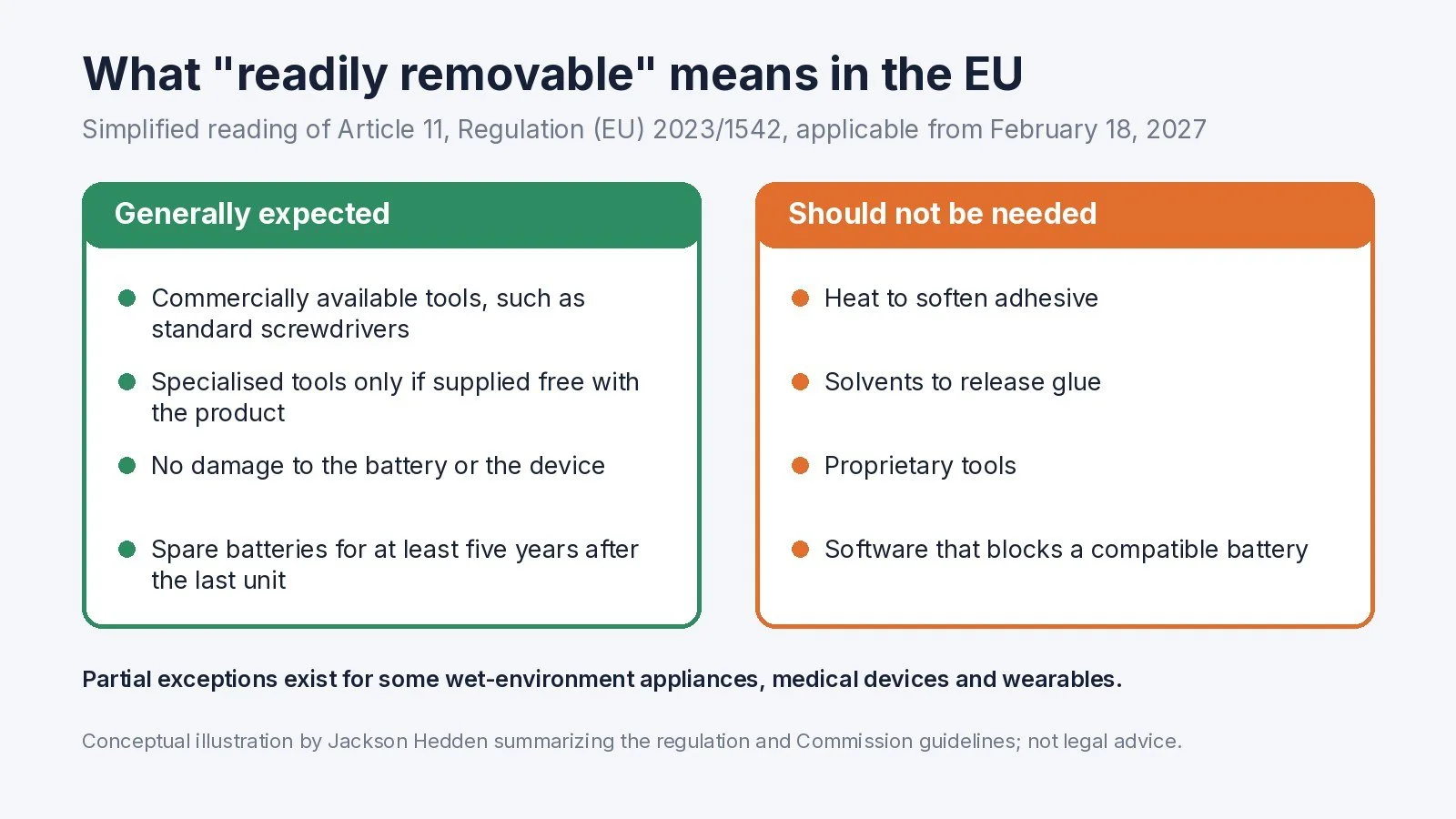
A simplified reading of Article 11 of the EU Battery Regulation and the Commission’s 2026 guidelines. Conceptual illustration by Jackson Hedden; not legal advice.
Why battery access is an architecture decision
A user-replaceable battery can look like a small change: add a door and a connector. In practice, battery access touches almost every part of a compact electronic product.
- Enclosure and tooling. A battery door or removable cover changes the plastic parts and the steel molds used to make them. Tooling is the set of custom molds and fixtures made for production. Changing it after it is cut costs time and money.
- Fasteners and adhesives. Many slim products glue the battery in place to save space and stop rattles. A replaceable battery usually needs screws, clips, a pull tab or a holder, and those take space.
- Electronics layout. A soldered battery lead becomes a connector that a user can unplug. The printed circuit board (PCB) may need a new connector position, strain relief and protection against reverse or loose connections.
- Safety and labeling. A user-handled battery needs clear instructions, a defined compatible battery specification and protection that works with batteries the manufacturer did not supply.
This is a core design for manufacturing (DFM) problem. DFM is the practice of shaping a product so it can be built reliably and affordably at volume. A late change to battery access can force new tools, new certification tests and a new bill of materials (BOM), the full list of parts in a product.
We have covered the wider repair picture before. Our article on what the EU repairability consultation means for product teams looks at proposed rules for small appliances and electronics, and our MacBook Pro teardown analysis shows how fasteners and module layout decide what can be serviced.
What this means for product teams
This section is Jackson Hedden's analysis, based on general product development practice rather than inside knowledge of Keychron's program.
Write market rules into the requirements. List every region you plan to sell in before industrial design is frozen. Battery, radio, safety and labeling rules differ by market. If the EU is on the list, user-replaceable batteries belong in the product requirements, not on a later to-do list.
Pick the battery strategy early. Decide between a standard cell, a custom pack with a connector or a sealed module that opens with common screws. Then design the enclosure around that choice. Experienced consumer product design firms treat this as an early architecture call, because it sets wall thickness, the parting line and where screws can go.
Consider one global design. A European version and a rest-of-world version can mean extra tooling, part numbers and split inventory. One replaceable-battery design can be simpler to build and support, if its cost and size still work.
Test the replacement, not just the product. Many hardware programs use validation stages called EVT (engineering validation test), DVT (design validation test) and PVT (production validation test). Add battery swaps to each stage: can a typical user do it with common tools, does the product still meet its drop and wear targets after several swaps and does it still work with a compatible third-party battery?
Plan spare parts and documentation. Five years of spare batteries after the last unit ships is a supply commitment. Agree on it with your battery supplier, and write clear replacement instructions as you design the product.
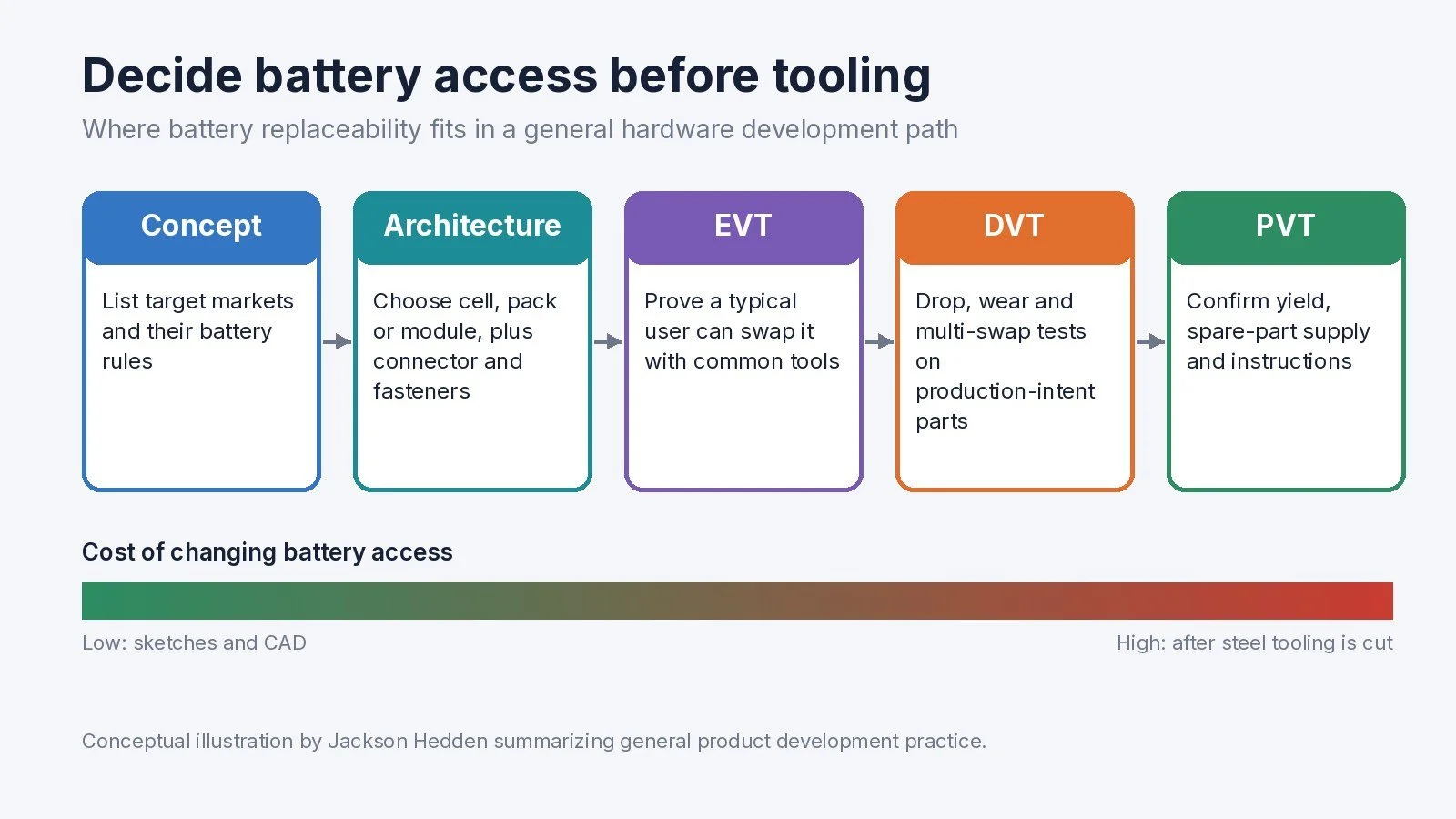
Where battery replaceability fits in a general hardware program. Conceptual illustration by Jackson Hedden summarizing general product development practice.
Frequently asked questions
Why did Keychron stop shipping the Orca Echo to the EU? Keychron told EU reservation holders that the keyboard's built-in battery is not designed to be removed by users, so this version does not suit the EU battery requirements. It refunded those reservations and said it would post an update if availability changes.
When does the EU replaceable battery rule take effect? Article 11 of the EU Battery Regulation applies from February 18, 2027. Products placed on the EU market from that date must comply, so designs still selling then need to be ready now.
Does the rule ban glued-in batteries? Not by name, but it rules out many glued designs. A battery counts as readily removable only if it comes out with commercially available tools and without heat, solvents or proprietary tools. Some products, such as certain wet-environment appliances and wearables, can qualify for replacement by independent professionals instead.
How early should a hardware team plan for battery replaceability? At the architecture stage, before industrial design is frozen and tooling is ordered. That is when battery access, fasteners and connector layout are cheapest to change.
Work with us
If you are planning a battery-powered product for more than one market, our consumer product design services cover industrial design, engineering and DFM from concept through production. Contact us to talk through your project.
Jackson Hedden is a product design, development and manufacturing firm helping founders and product teams take consumer and industrial products from concept to production.
Sources
- Cpt.Jank, "New Battery Law Shuts Down Keychron Orca Echo Shipments In EU," TechPowerUp, November 17, 2026: https://www.techpowerup.com/354961/new-battery-law-shuts-down-keychron-orca-echo-shipments-in-eu
- Anthony York, "Keychron Orca Echo Keyboard Suspended in EU and Northern Ireland Over Battery Rules," PC Central, November 18, 2026: https://pccentral.net/keychron-orca-echo-keyboard-suspended-eu-battery-rules/
- Keychron, "Orca echo VIP Reservation" (product page, accessed November 18, 2026): https://www.keychron.com/products/orca-echo-vip-reservation
- European Commission, "Commission guidelines to facilitate the harmonised application of provisions on the removability and replaceability of portable and LMT batteries in Regulation (EU) 2023/1542," Official Journal C/2026/5531, October 22, 2026: https://eur-lex.europa.eu/eli/C/2026/5531/oj/eng
- Regulation (EU) 2023/1542 of the European Parliament and of the Council concerning batteries and waste batteries: https://eur-lex.europa.eu/eli/reg/2023/1542/oj/eng