On November 17, 2026, Olight announced the Perun X and Perun Ultra headlamps, built around what it calls an industry-first single glass lens that replaces the usual stack of plastic optics, reflectors and an outer protective window.
Key takeaways
- Olight says one molded glass optic now does the work of separate plastic optics, reflectors and a protective outer lens in its new Perun headlamps, which go on sale November 19, 2026.
- Combining parts is a design decision, not just a cost decision. It can remove interfaces and assembly steps, but it concentrates risk, tooling cost and supplier dependence in one part.
- Olight's own release names the hard parts: precision glass molding, high-temperature anti-reflective coating and lining up several light paths on one axis.
- Glove-friendly controls, quick-release mounts and sealed, drop-rated housings show that outdoor products are judged by how they work in cold, wet and dark conditions, not on a showroom shelf.
- Teams should prove a consolidated part with real samples and environmental testing before committing to production tooling.
What a product design firm sees in Olight's single-lens headlamp
Most headlamps that offer both a flood beam and a long-throw spot beam use several separate optical parts. A typical design pairs a molded plastic lens or reflector for each LED with a clear outer window that protects everything from dirt and impact. Each part needs its own tool, its own supplier and its own place in the assembly.
According to Olight's November 17 release, the Perun X and Perun Ultra replace that combination with one glass optic. The company says the lens reaches up to 90% light-output efficiency and resists heat, aging and surface scratches better than standard polycarbonate lenses. It also says the lens collects less dust. The same optic serves three light sources: a flood beam, a spot beam and a red light.
Here are other details Olight reports:
- Up to 1,000 lumens of flood and up to 60 lumens of red light on both models. Spot throw is up to 300 meters on the Perun X and 350 meters on the Perun Ultra.
- A combined spot-plus-flood Turbo mode of up to 2,000 lumens (Perun X) and 2,400 lumens (Perun Ultra).
- A quick-release bracket that turns the headlamp into a right-angle handheld light, plus magnetic and clip-on mounting.
- A 35 mm breathable headband, a textured rotary dial for choosing the light source and a push button for power and brightness, all designed to work with gloves.
- IPX7 water resistance, 1.5-meter drop resistance, a proximity sensor that dims the light when something blocks it, and active thermal control.
- A 4,000 mAh 18650 battery, USB-C charging and prices of $89.99 (Perun X) and $119.99 (Perun Ultra).
T3's November 17 launch report adds that both lights claim longer beam distances than the earlier Perun 3 despite lower peak output, and lighter weights: 120 g for the Perun X and 130 g for the Ultra, versus 150 g before. These are manufacturer figures. We have not tested the lights.
Why part consolidation matters in product design
Part consolidation means combining the jobs of several components into one. Fewer parts can mean fewer joints that can leak, fewer tolerances that stack up, fewer assembly steps and a shorter bill of materials (the list of every part in a product). In an optic, it can also mean fewer surfaces where light is lost. Olight's efficiency claim points to this.
But consolidation moves work and risk, it does not remove them. That is why it is a core topic in design for manufacturing (DFM), the practice of shaping a product so it can be built reliably and affordably at volume. Olight's release lists three challenges, and each one is a useful warning for any team:
- Precision glass molding. Pressing glass into a precise optical shape needs specialized molds and process control. Few suppliers can do it, so sourcing options shrink.
- High-temperature anti-reflective coating. A coating that cuts reflections has to survive heat from high-output LEDs. Coating quality can decide whether the efficiency claim holds in production.
- Coaxial optical path coupling. Three light sources sharing one lens means their beams must line up on a common axis. That pushes tight tolerances onto the LED board, the housing and the way the lens is held.
When one part does three jobs, a defect in that part affects all three. Teams should plan for that with clear inspection criteria and a backup supplier conversation early on.
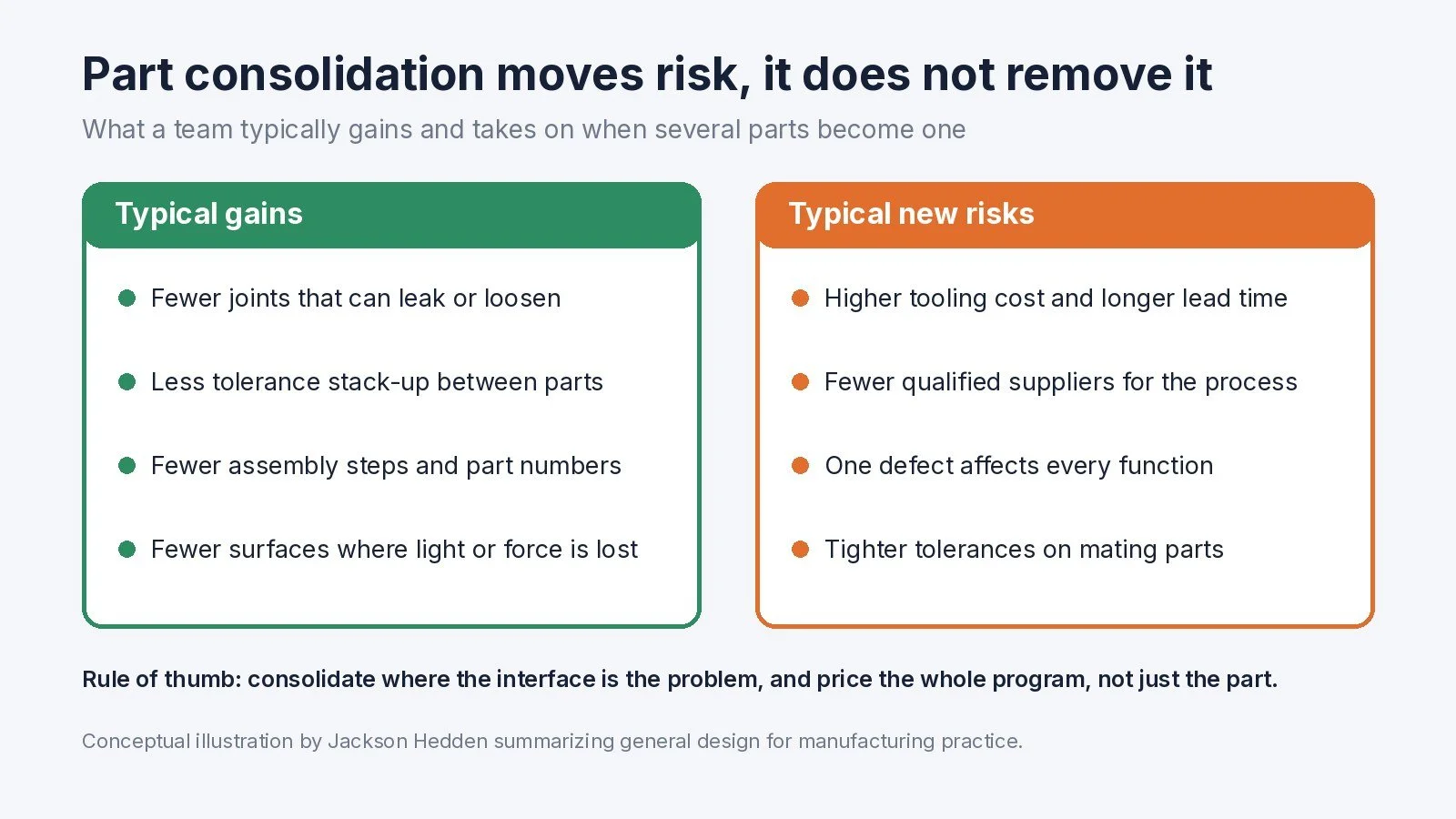
Part consolidation moves risk rather than removing it. Conceptual illustration by Jackson Hedden summarizing general design for manufacturing practice.
Designing for gloves, mounts and bad weather
The rest of the launch is a reminder that outdoor products are designed for the worst moment of use. Olight emphasizes a textured dial and a button that can be used with gloves, a wider strap to spread pressure and a quick-release mount.
Black Diamond made similar choices in its Fall 2026 headlamp refresh, reported by Snowsports News on November 7. The brand describes oversized, glove-friendly buttons on the redesigned Storm and Storm+, IP67 housings, USB-C charging as standard and recycled material in headbands and internal structures. Its new Megawatt adds a wireless remote switch and a GoPro-style quick-release mount. Two brands arriving at similar answers within weeks suggests these are now baseline expectations in the category.
We have looked at this pattern before. Our article on Nike's Tuned Air and its digital method of make covered how process choices shape what a design can be. Our piece on Arc'teryx's bonded harness construction showed how a construction method can change the product itself.
What this means for product teams
This section is Jackson Hedden's analysis, based on general product development practice rather than inside knowledge of Olight's program.
Consolidate where the interface is the problem. If most failures, leaks or assembly mistakes happen where two parts meet, combining them is often worth it. If the parts are simple and cheap, consolidation may only add tooling risk.
Price the whole program, not just the part. One complex part can cost more to tool and inspect than three simple ones. Compare tooling, yield (the share of parts that pass inspection), inspection time and assembly labor across the full build. A good product design firm should model this before tooling, not after.
Prototype the risky process, not just the shape. A 3D-printed or machined optic can test fit and beam pattern. It cannot show glass molding defects or coating durability. Get real samples from the intended process early, even in small numbers.
Test in the conditions people actually use. For outdoor gear, that means cold-soak tests with gloved hands, water immersion that matches the claimed IP rating, drop tests from the stated height and thermal checks at maximum output. The IP rating (Ingress Protection, a standard scale for dust and water resistance) is a promise you must be able to prove.
Plan validation gates. Many hardware programs use stages called EVT (engineering validation test), DVT (design validation test) and PVT (production validation test). Use EVT to confirm the consolidated part works, DVT to prove it survives testing in production-intent materials and PVT to confirm the line can make it consistently.
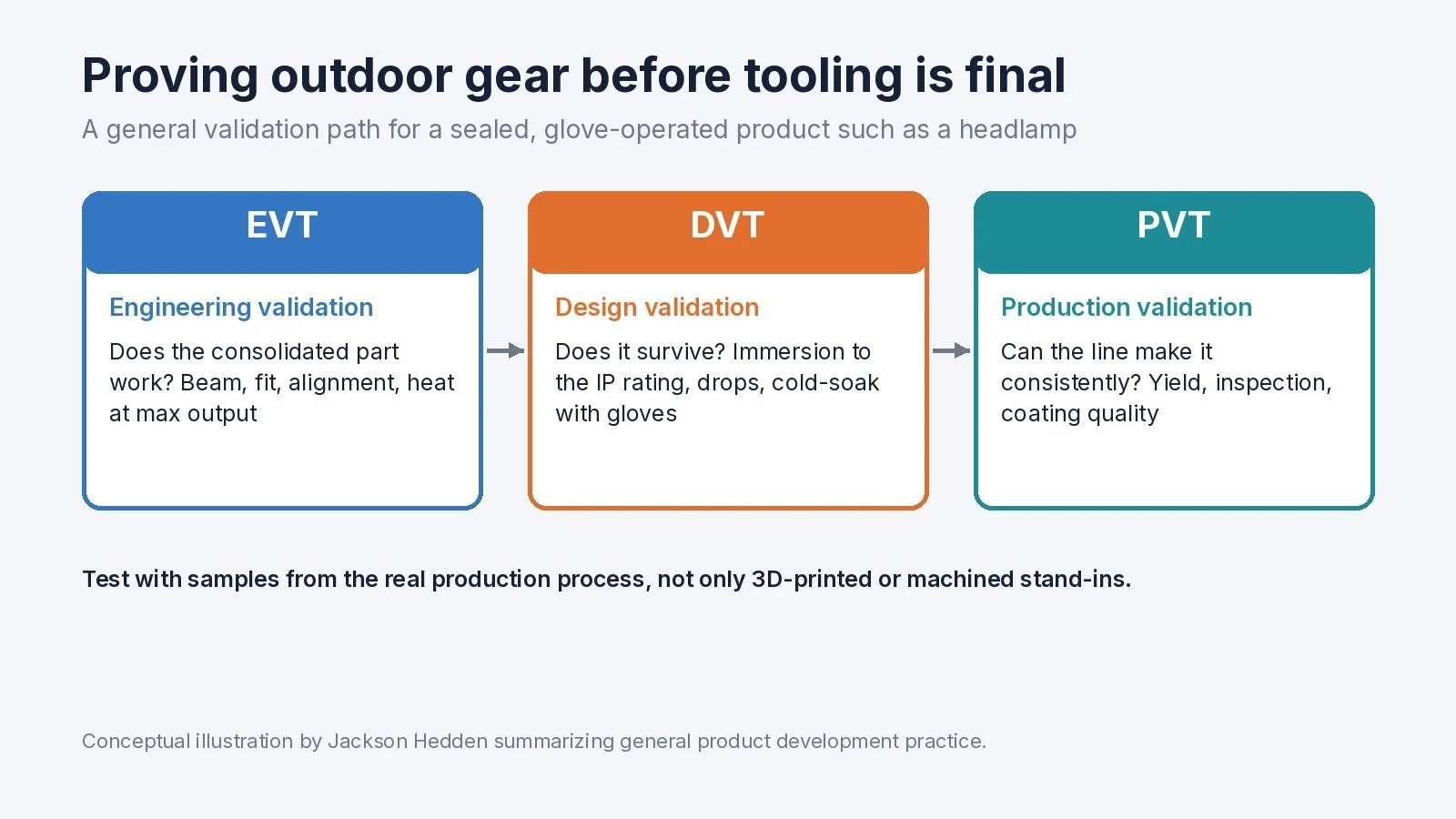
A general validation path for sealed outdoor gear. Conceptual illustration by Jackson Hedden summarizing general product development practice.
Frequently asked questions
What is part consolidation in product design? Part consolidation is combining several components into one part that does all their jobs. It can reduce assembly steps, joints and tolerance stack-up. It can also raise tooling cost and make one supplier more critical.
Is glass better than plastic for headlamp lenses? Glass generally resists heat, scratches and aging better than polycarbonate, which is the advantage Olight claims. Plastic is usually lighter, tougher on impact and easier to mold into complex shapes. The right choice depends on output, durability needs, weight and cost targets.
How do outdoor gear companies test products before launch? Common tests include water immersion matched to the IP rating, drop testing, cold and heat exposure, and usability checks with gloves. Teams usually run these on engineering samples and again on production-intent parts before tooling is final.
When should a startup bring in an industrial design firm for outdoor products? Ideally before the architecture is fixed, while decisions such as part consolidation, sealing and mounting are still cheap to change. Bringing in design and manufacturing input early reduces late tooling changes.
Work with us
If you are weighing a consolidated part, a sealed enclosure or glove-friendly controls for an outdoor or lifestyle product, our product design services cover industrial design, engineering and DFM from concept through production. Contact us to talk through your project.
Jackson Hedden is a product design, development and manufacturing firm helping founders and product teams take consumer and industrial products from concept to production.
Sources
- Olight Group Co., Ltd., "Olight Perun Series: Multi-Purpose Right-Angle Headlamp with Industry-First 3-in-1 Glass Lens," PR Newswire, November 17, 2026: https://www.prnewswire.com/news-releases/olight-perun-series-multi-purpose-right-angle-headlamp-with-industry-first-3-in-1-glass-lens-302937729.html
- Matt Kollat, "This compact 2,400-lumen headtorch can illuminate objects 350 metres away and transform into a magnetic work light in seconds," T3, November 17, 2026: https://www.t3.com/active/outdoor-tech/olight-perun-x-pureun-ultra-launch-1126
- Snowsports News, "Black Diamond Equipment Defies the Dark with the Biggest Lighting Refresh in Years," November 7, 2026: https://www.snowsportsnews.com/newsrepository/2026/november/black-diamond-equipment-defies-the-dark-with-the-biggest-lighting-refresh-in-years/