On November 19, 2026, the U.S. Consumer Product Safety Commission (CPSC) announced a recall of about 412 Kidsview infant bouncers after seven reports of the seats collapsing while in use, including two in which an infant's head struck the surface below.
Key takeaways
- CPSC recall 27-092 covers Kidsview infant bouncers made in August, September or October 2022 and sold on Amazon from August 2022 through November 2023 for $60 to $170.
- Kidsview received seven reports of collapse. In two, the infant's head hit the underlying surface, and one consumer sought medical attention for their infant.
- Infant bouncer seats are covered by a mandatory federal standard, 16 CFR part 1229, which adopts ASTM F2167 and includes structural integrity, collapse, stability and drop tests.
- The recall is defined by date codes on a sewn-in label, which shows how much permanent date-of-manufacture marking matters when something goes wrong.
- For product teams, a folding or lightweight frame needs structural margin, lot-by-lot testing and traceability, not just one prototype that passed.
What CPSC announced about the Kidsview bouncer
According to the CPSC notice, the recalled bouncers were sold in khaki with an accessory bar holding hanging animal toys. Affected units carry date codes beginning with 2022/08, 2022/09 or 2022/10 on a label sewn onto the back of the fabric seat. The firm is listed as Zhongshan Haimao Cross-border Information Technology Co., Ltd., doing business as Kidsview, of China, and the product was made in China.
CPSC tells consumers to stop using the bouncers immediately and contact Kidsview by email for an Amazon gift card. To confirm the recall, owners write "RECALLED" on the fabric seat in permanent marker, photograph it with the date-code label visible and email the photo to the company.
The notice does not say what caused the collapses. Unlike several other recalls CPSC posted the same day, its title does not cite a violation of a mandatory standard. We do not speculate about the cause below.
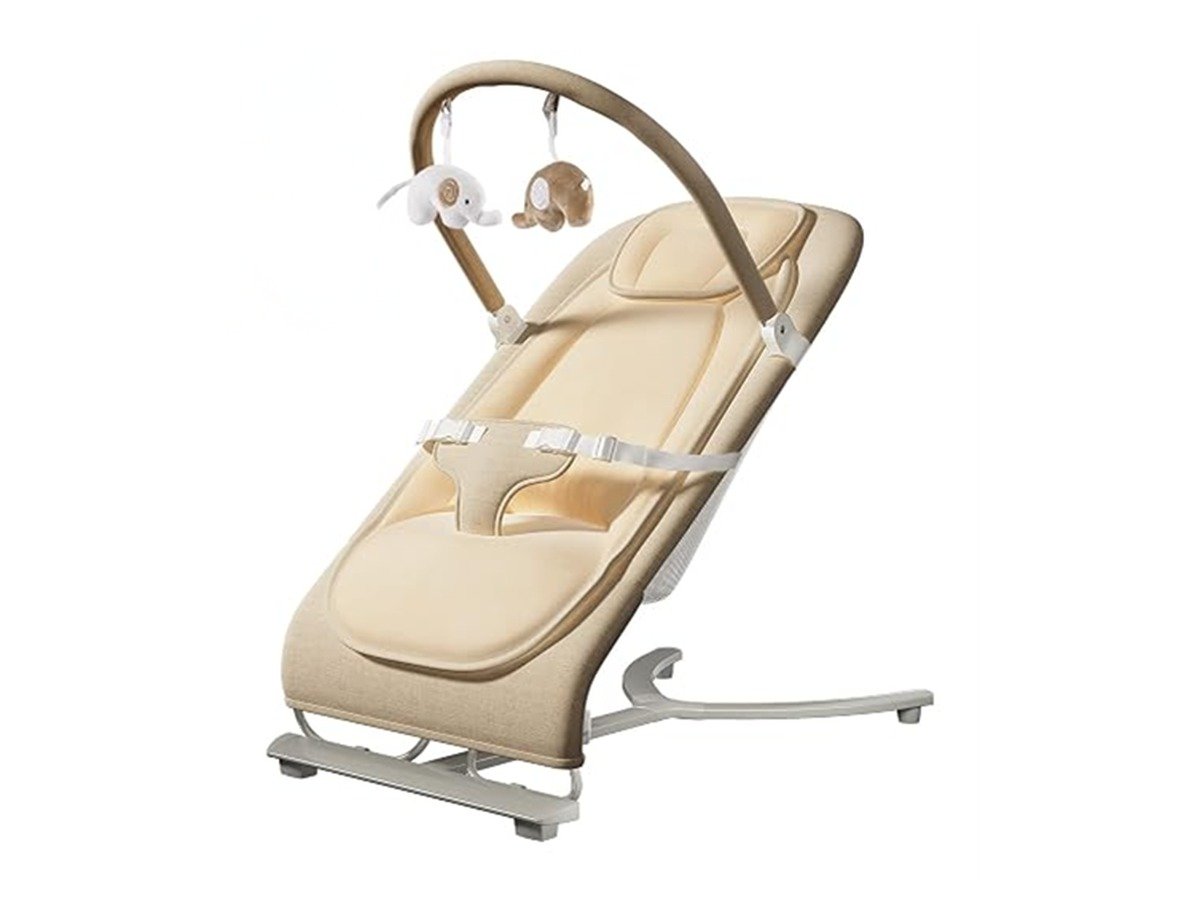
The recalled Kidsview infant bouncer, as shown in CPSC’s recall notice. Image: U.S. CPSC
What the federal infant bouncer standard covers
CPSC's business guidance for infant bouncer seats defines the product as a freestanding seat that supports an infant in a reclined position to allow bouncing, for babies who cannot yet sit up unassisted, roughly 0 to 6 months old. Under the Consumer Product Safety Improvement Act, bouncers are a "durable infant or toddler product," and 16 CFR part 1229 makes the ASTM F2167 standard mandatory.
The guidance lists performance requirements for the restraint system, stability, slip resistance, structural integrity, disassembly and collapse, a drop test, toy bar attachment integrity and battery compartments. General requirements cover latching or locking mechanisms, scissoring, shearing and pinch points, openings, small parts, sharp edges and label permanence. Which edition applies depends on the manufacture date: units made after December 19, 2022 must meet ASTM F2167-22, and units made after December 14, 2019 must meet F2167-19.
Three other rules shape the product. Each bouncer must carry permanent marking with the manufacturer or importer, a U.S. contact, the model and a date of manufacture of at least month and year, which may be coded. It must ship with a product registration card so the company can reach owners. And because it is a children's product, it must be certified on a Children's Product Certificate (CPC) based on testing by a CPSC-accepted third-party lab.
Jackson Hedden analysis: how a product design firm looks at a seat that can collapse
The analysis below is Jackson Hedden's view, based on general engineering practice. Kidsview and CPSC have not published a root cause, and we are not describing Kidsview's design or testing.
A bouncer is a structure, not just a seat. The infant's weight travels through the fabric sling into the frame tubes, the hinge and recline joints, and the base. Bouncing turns that into thousands of repeated load cycles, and caregivers add their own loads by pushing on the seat, lifting it by the frame or folding it every day. Weak points tend to sit where parts meet: rivets, pivots, tube ends, welds and plastic hinge housings.
Every adjustment is another failure mode. Recline positions, fold locks and removable toy bars make a product more useful and harder to make safe. Each lock needs to engage positively, be visibly locked or unlocked, and stay locked under bouncing and side loads. A lock that only looks closed is a design problem, not a user error.
One good sample does not prove every lot. Tube wall thickness, rivet setting, spring steel heat treatment and plastic resin can all drift between production runs, or change when a supplier substitutes a part. A recall limited to three months of production shows how narrowly a problem can be bounded, whatever its cause. As we noted in our look at Cipton's LED youth helmet recall, a certificate is only as good as the samples behind it.
Traceability sets the size of a recall. Because each seat carried a date code, this recall could be limited to specific months of manufacture. Without that label, every unit ever sold could have been in scope.
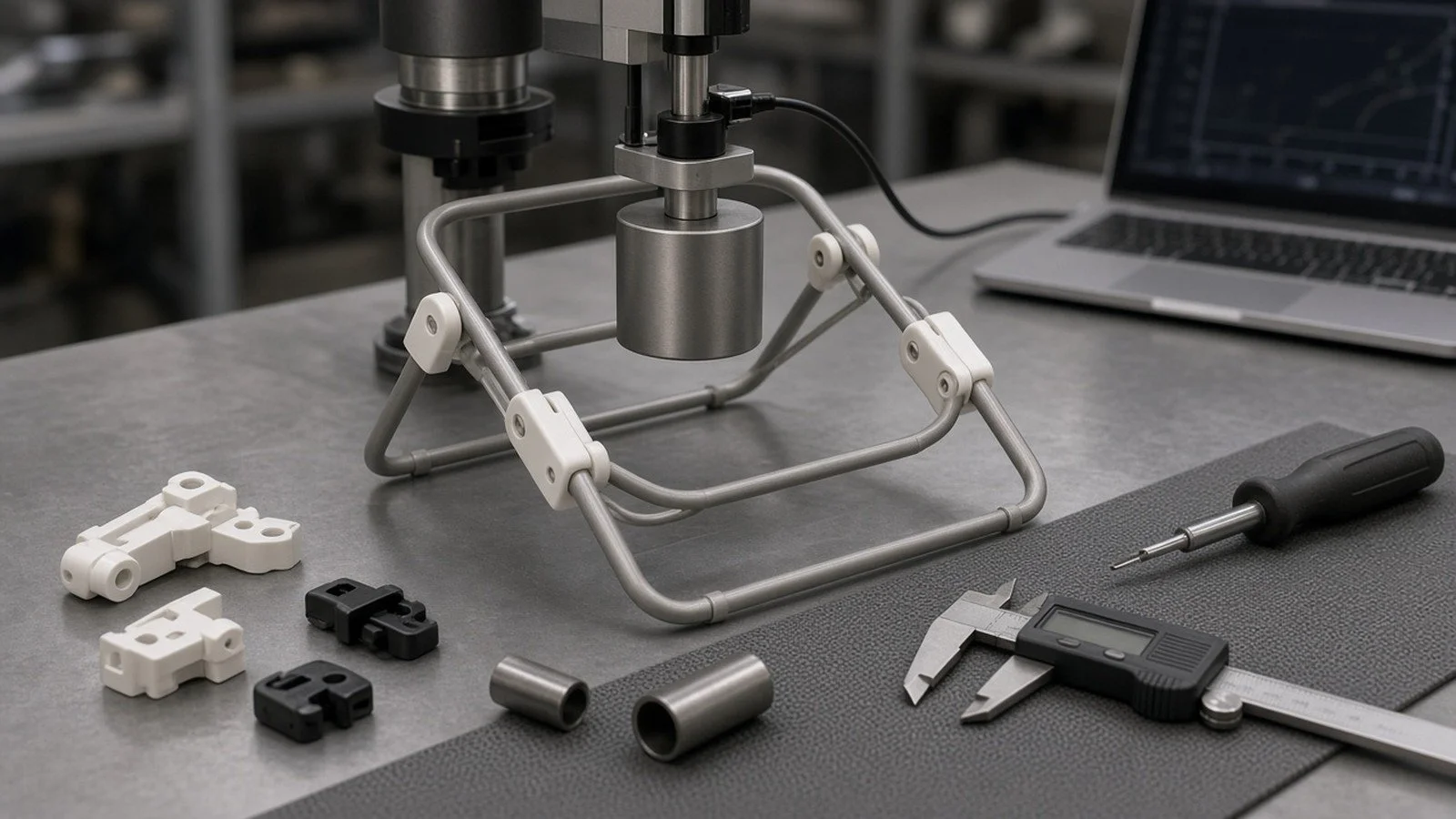
Concept render (illustration), not a Kidsview product.
What this means for product teams
Start with the standard and its test list. Before concept sketches, list every mandatory rule, the tests it calls for and which ones need a third-party lab. A good product design firm should be able to walk you through that list for your category and show how it will shape the design. Our guide to product compliance testing before production covers how to plan it.
Prototype for abuse, not appearance. Build functional prototypes from production-like materials early, and test beyond the required loads: static overload, repeated bounce cycles, hundreds of fold cycles and drops. Do it during EVT (engineering validation test, which proves the design works), then repeat it in DVT (design validation test, which uses production-intent parts and processes).
Design locks that cannot lie. Use positive engagement, audible or visible lock indicators, and geometry that will not hold a load unless the lock is fully seated.
Specify materials and processes before tooling. DFM, or design for manufacturing, means shaping parts so the factory can make them consistently. Tooling, the steel molds and fixtures used to make production parts, is costly to change, so lock tube gauges, fasteners and resins in the specification first. Require notice and retesting before any substitution, and test samples from production lots, not only the first approved build.
Plan traceability from the first label drawing. Put the date code, model number and registration card into the design brief, and decide how you will reach owners who bought through online marketplaces.
Frequently asked questions
Which Kidsview infant bouncers are recalled? The recall covers khaki Kidsview bouncers with an animal-toy accessory bar and date codes beginning 2022/08, 2022/09 or 2022/10 on the label on the back of the seat. They were sold on Amazon from August 2022 through November 2023.
Why were the Kidsview bouncers recalled? CPSC says the bouncers can collapse while in use, posing a risk of impact injury to infants. Kidsview received seven reports of collapse, including two in which the infant's head struck the surface below.
What safety standard applies to infant bouncer seats in the U.S.? Infant bouncer seats must meet 16 CFR part 1229, which incorporates ASTM F2167. Products also need permanent date-of-manufacture labeling, a registration card and a Children's Product Certificate based on third-party lab testing.
What should you ask a product design firm before developing a baby product? Ask which mandatory standards apply, how they will test structure, locks and stability before tooling, and how they handle production-lot testing and supplier changes. A firm that cannot answer those questions early is likely to find problems late.
Work with us
If you are developing an infant, juvenile or other safety-regulated product, see our industrial and product design services or contact us to talk through your standards, testing and production plan.
Jackson Hedden is a product design, development and manufacturing firm helping founders and product teams take consumer and industrial products from concept to production.