On November 18, 2026, Therabody announced it has acquired the intellectual property portfolio of Embr Labs, the MIT-founded maker of the Embr Wave, a wrist-worn device that cools and warms the skin to help manage hot flashes and improve sleep.
Key takeaways
- Therabody bought Embr Labs' patents, research and thermal technology, not a finished new product. The company says the deal "sets the stage for future products designed specifically for women," starting with menopause.
- The release says nearly a quarter million devices have sold across two generations of the Embr Wave, so Therabody inherits real field experience along with the patents.
- A wrist-worn heat pump is a hard design problem: it has to move heat, stay comfortable on skin, run for hours on a small battery and still look like jewelry.
- For product teams, acquired technology is a head start, not a finished product. Thermal, battery, fit and claims work still has to be planned and tested for the next generation.
What Therabody announced
According to Therabody's November 18 release on PR Newswire, the company acquired "the intellectual property portfolio of Embr Labs," including its "patented, clinically validated thermal technology and research." Therabody, known for the Theragun massage device, says the acquisition advances its work in women's health, "beginning with menopause."
The release says the Embr Wave targets the inside of the wrist, "an area dense with temperature-sensitive nerves," and cites a randomized crossover study in which two-thirds of women with menopausal hot flashes reported improved thermal comfort and ability to fall back asleep at night. It also points to a 2025 study in Psychophysiology by Embr Labs and University of Massachusetts Amherst researchers, in which an AI model identified 82% of menopausal hot flashes an average of 17 seconds before women felt them.
Embr Labs co-founder and CTO Matt Smith said in the release that Therabody will "carry our next-generation temperature technology forward." Therabody did not announce a new product, launch date or price, and Femtech Insider noted that the company did not share specific launches. Existing Embr Wave 2 customers should keep contacting Embr Labs for orders and support, the release says.
The current product gives a sense of the starting point. On the Embr Wave 2 product page, Embr Labs says the band uses a thermoelectric heat pump, lists 9+ hours of cooling or warming on a battery that charges in one to two hours, and gives dimensions of about 0.6 by 1.7 by 1.7 inches and a weight of 0.14 pounds. It fits wrists of roughly 5.3 to 9.25 inches, connects to an iOS and Android app over Bluetooth, is described as splashproof and sells for $299.
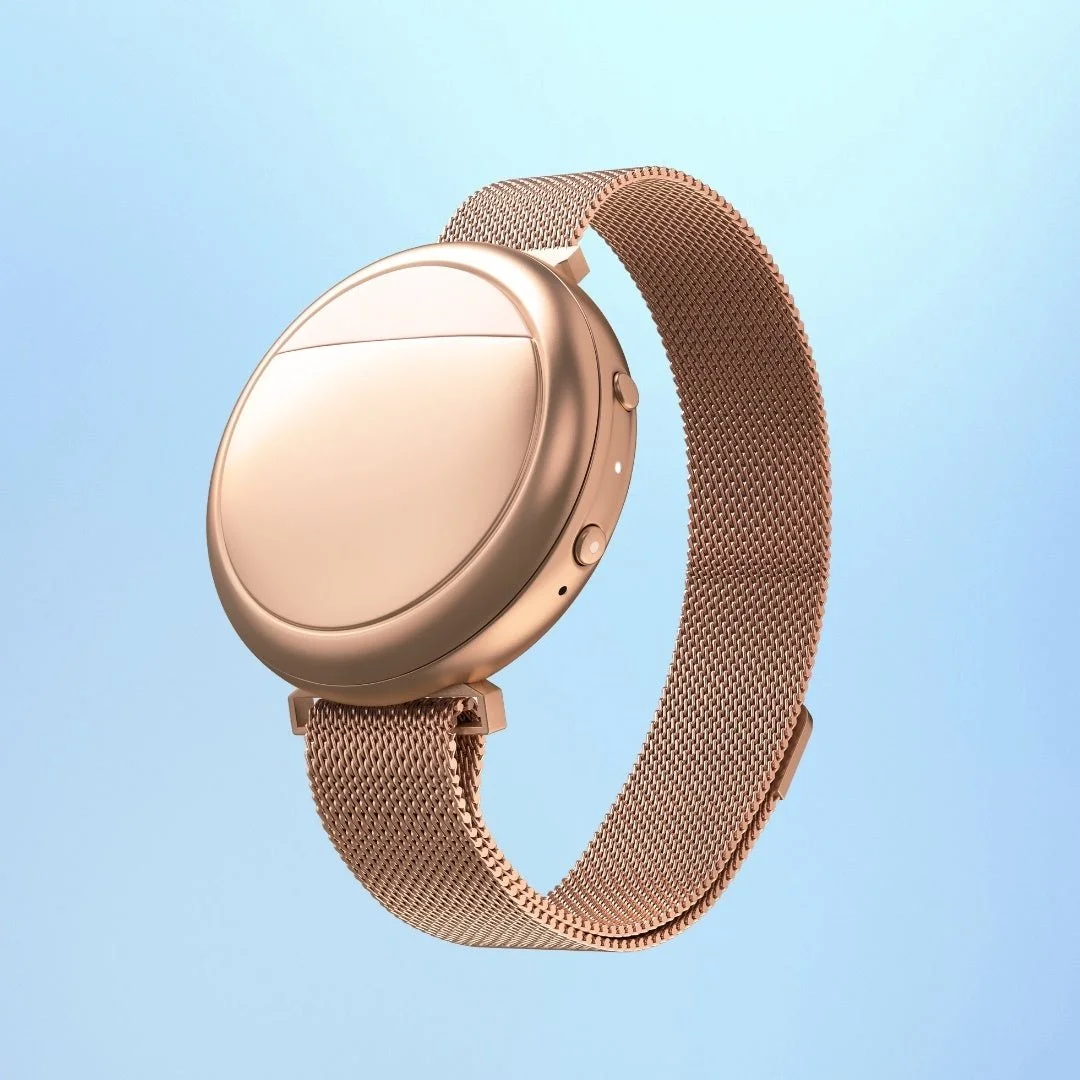
Embr Wave 2 in rose gold. Image: Embr Labs
Consumer product design inside a wrist-worn heat pump
The analysis below is Jackson Hedden's view, based on general product development practice. We have not tested Embr Wave or seen Therabody's plans, and we are not describing either company's internal design work.
A thermoelectric heat pump, often called a Peltier module, is a solid-state part that moves heat from one face to the other when current flows through it. Reverse the current and cooling becomes warming. With no fans or fluids, it allows a quiet, small device. It is also why good consumer product design for thermal wearables starts with physics rather than styling.
The heat has to go somewhere. When one face cools the skin, the other face gets warmer, and the module adds its own electrical losses on top. That heat must spread into the housing and the air. A larger, more conductive outer surface helps, but it also adds size and weight on a wrist. The housing material, finish and shape are thermal decisions as much as aesthetic ones.
Skin contact is a safety and comfort boundary. Teams need firmware limits on plate temperature, rate of change and session length, plus safe behavior if a sensor or the battery fails. IEC 60601-1, the safety standard for medical electrical equipment, sets surface temperature limits for parts that touch the body, a useful reference even for wellness products.
Battery life is set by the thermal load. Moving heat takes far more power than reading a sensor, which is why a thermal band quotes hours of active use while many sensing wearables quote days. The battery, the heat pump's efficiency and how often people actually use sessions all have to be modeled together.
From acquired patents to a next-generation product
A patent portfolio brings protected ideas, test data and field lessons, but not a production-ready next product. The architecture usually has to be rechecked against the new owner's goals, suppliers, channels and brand.
Fit is part of the function. A wrist device for women in menopause has to work across a wide range of wrist sizes and through the night, when people roll onto their arms. Anthropometrics, the measured ranges of body dimensions, should drive strap range, plate size and edge radius. A plate that lifts away from the skin delivers a weaker sensation, so fit testing is also performance testing.
Prediction raises the bar. If a future product tried to act on hot-flash prediction like the research Therabody cites, it would need sensing, firmware and validation work beyond on-demand cooling.
Claims shape the architecture. Words like "relief" and "clinically proven" need evidence and consistent use across app, packaging and marketing. Teams should decide early whether a product is positioned as general wellness or as a regulated medical device, because that changes testing, documentation and timelines.
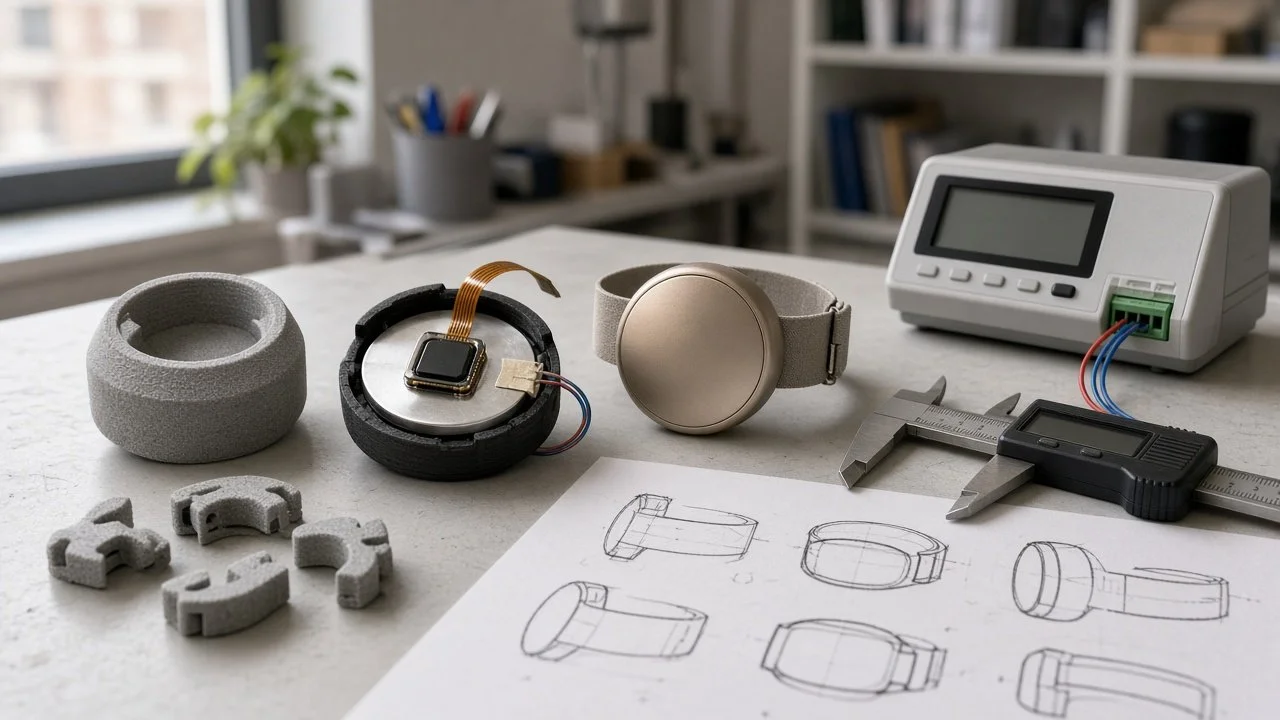
Concept render (illustration), not a Therabody or Embr Labs product.
What this means for product teams
Audit inherited technology before you design. List what the patents, prototypes, test reports and field returns actually prove, and what must be revalidated with new parts, suppliers or factories.
Write a thermal and power budget on day one. Map heat pump power, sensor and radio loads, and charging against battery size, plate temperature limits and the worst-case room temperature, such as a warm bedroom at night.
Prototype comfort early. Build fit models and working thermal rigs with 3D-printed or SLA (stereolithography) housings, and test them on people who match the intended users across the full size range, including overnight wear.
Plan EVT, DVT and PVT. EVT (engineering validation test) proves the design works. DVT (design validation test) checks production-intent parts against reliability, thermal, water and safety tests. PVT (production validation test) proves the factory can build it at rate.
Design for manufacturing (DFM) the thermal stack. The bond between heat pump, skin plate and housing has to be consistent in every unit, or performance will vary from band to band. Plan fixtures and end-of-line thermal checks before tooling, the steel molds and dies used to make parts at volume.
For more on body-worn products for women, see our look at Natural Cycles' NC° Band 2 and NC° Ring, and for a wearable where battery, sealing and skin contact compete inside one small body, our analysis of the MiniMed Fit tubeless insulin pump.
Frequently asked questions
What did Therabody acquire from Embr Labs? Therabody acquired Embr Labs' intellectual property portfolio, including its patented thermal technology and research behind the Embr Wave. The company announced the deal on November 18, 2026, and said it supports future products designed for women, beginning with menopause.
How does the Embr Wave work? Embr Labs says the Embr Wave uses a thermoelectric heat pump to move heat toward or away from the skin on the inside of the wrist. The company lists 9+ hours of cooling or warming per charge, with sessions controlled from the band or its app.
Is Therabody launching a new Embr product? Not as of this announcement. Therabody did not announce a new product, launch date or price, and Embr Wave 2 customers are directed to Embr Labs for orders and support.
Why are thermal wearables hard to design? They must move heat away from the skin, dissipate it through a small housing and run on a small battery, all while staying comfortable and safe. Fit, firmware limits, battery life and manufacturing consistency all affect how well they work.
Work with us
If you are developing a personal care or wellness product that sits on the body, see how our consumer product design team approaches comfort, thermal and manufacturing trade-offs, or contact us to talk through your project.
Jackson Hedden is a product design, development and manufacturing firm helping founders and product teams take consumer and industrial products from concept to production.
Sources
- Therabody via PR Newswire, Therabody Acquires Embr Labs' Thermal Technology, Marking the Next Chapter in Its Commitment to Women's Health, November 18, 2026
- Embr Labs, Embr Wave 2 product page and specifications, accessed November 20, 2026
- Femtech Insider, Therabody Acquires Embr Labs' Thermal Technology, Expands Women's Health Investment, November 18, 2026
Featured image: Embr Wave, Image: Therabody.